

Imagine the house lights dimming for a critical keynote and you reach into your gear bag, only to realize your spare batteries have shorted against a loose metal tool. It's a preventable disaster that happens to even the most seasoned technicians when they rely on loose storage or flimsy, generic packaging. You understand that maintaining a fleet of high-capacity cells requires more than just a consistent charging routine. It demands a rigorous organization strategy that prioritizes safety and efficiency.
We'll help you discover the best AA battery storage cases for 2026 to ensure your Pure Power Series and NiMH cells remain protected, organized, and ready for immediate deployment. By investing in a durable system for transporting your assets, you can prevent critical power failures and stop mixing up charged and dead cells during high-pressure live events. This guide examines rugged housing options that provide clear visual status indicators and the structural integrity needed for constant transit between professional venues. We'll explore how the right storage solution acts as a final line of defense for your expensive power assets.
Key Takeaways
- Learn how professional AA battery storage cases prevent accidental short circuits and terminal contact during transit, preserving the integrity of your high-capacity cells.
- Implement a "charged vs. discharged" visual management system to eliminate confusion during live events and ensure you always grab a fresh power source.
- Identify the specific advantages of slimline caddies for mobile gear bags versus ruggedized hard cases for extreme outdoor environments.
- Understand why secure latching mechanisms and individual cell isolation are non-negotiable features for protecting expensive Pure Power Series lithium-ion inventory.
- Streamline your asset management by matching case capacity to your device requirements while maintaining compliance with 2026 lithium-ion storage standards.
Why Professional AA Battery Storage Cases are Critical for Asset Management
Professional battery management begins with physical containment. For organizations managing large inventories of high-capacity cells, treating power sources as loose consumables is a recipe for technical failure. High-performance batteries, such as the Pure Power Series, require a dedicated environment to maintain their charge and structural integrity. Implementing a system of AA battery storage cases transforms a chaotic pile of cells into a streamlined, reliable asset fleet. This shift isn't just about organization; it's about mitigating risk and protecting a significant financial investment.
When batteries are stored loosely in gear bags or drawers, they face constant physical and electrical threats. A single short circuit caused by contact with other cells or metal tools can ruin a high-capacity NiMH battery instantly. In large-scale production environments, the cost of replacing damaged cells adds up quickly. Reliable storage ensures that every cell in your inventory remains in peak condition, extending the operational lifespan of your power assets and reducing the frequency of bulk replacements.
The Safety Risks of Loose Battery Storage
Safety is the most compelling reason to abandon loose storage. Understanding what a battery holder is and how it functions provides a baseline for evaluating professional-grade storage. When terminals are exposed, any conductive object, such as a paperclip or a metal zipper, can create a bridge between the positive and negative poles. This leads to rapid discharge and, in extreme cases, thermal runaway. Terminal protection is the primary safety feature of professional cases. By isolating each cell, these cases prevent the heat buildup and potential fire hazards associated with accidental discharge during transit between venues.
Professional Reliability vs. Consumer Convenience
Consumer-grade packaging is designed for the retail shelf, not the rigors of professional use. Original cardboard boxes tear and absorb moisture, which can lead to terminal corrosion. In contrast, professional AA battery storage cases are built from high-impact polymers that withstand the vibrations and drops common in live production. These systems do more than just hold the cells; they facilitate a healthy maintenance cycle. For more detailed advice, you can learn about Battery Storage best practices to maintain cell health. Secure storage prevents the "mystery drawer" effect, where technicians accidentally mix depleted cells with fresh ones, causing critical device failure during a performance or broadcast.
Types of Storage Solutions: From Slimline Caddies to Bulk Organizers
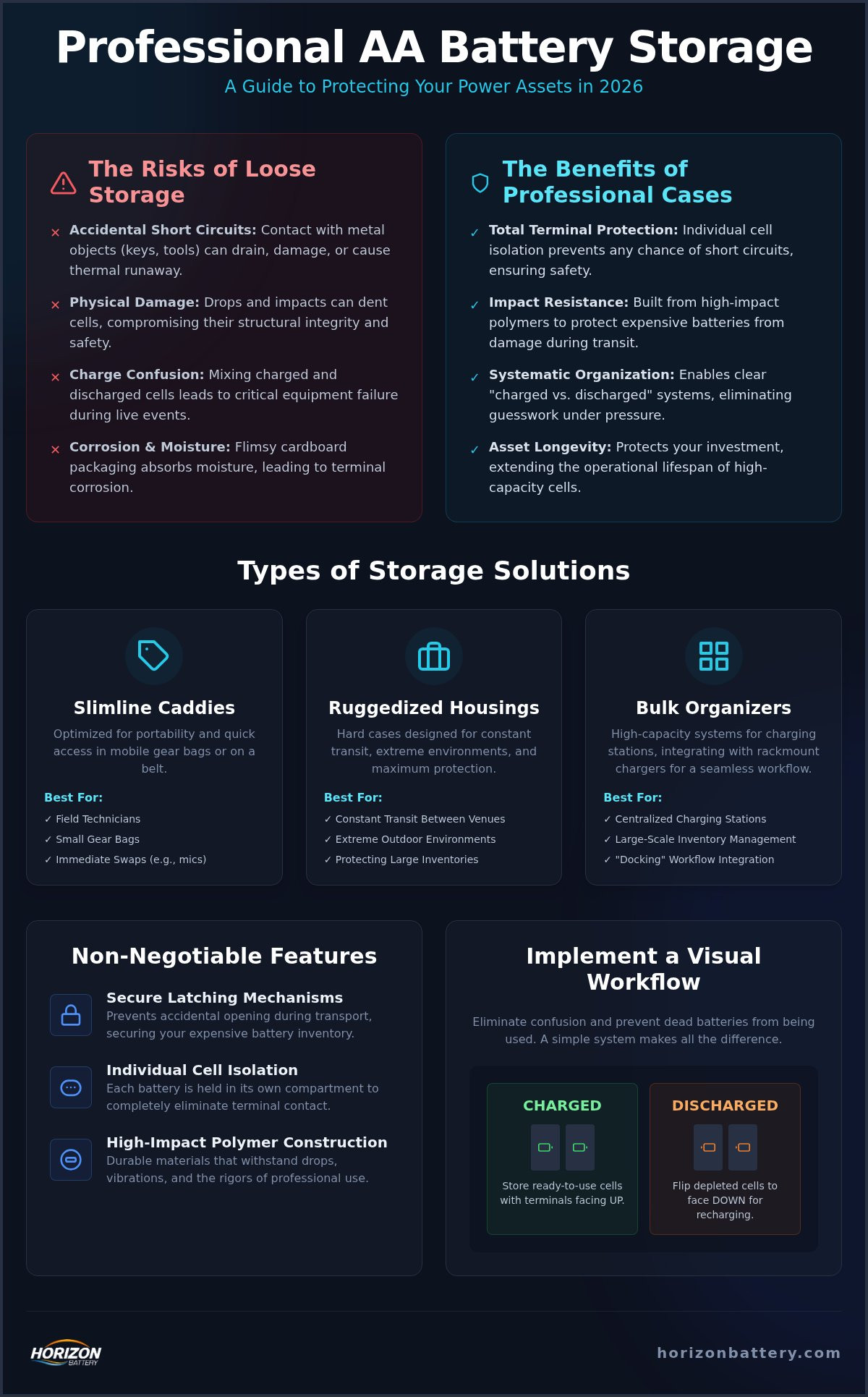
Professional energy management requires a tiered approach to hardware. You don't use the same container for a 200-cell inventory that you do for a single wireless microphone kit. 2026 standards for professional workflows categorize AA battery storage cases into three primary tiers: mobile caddies, ruggedized transport housings, and centralized bulk organizers. Each serves a specific role in maintaining the lifecycle of your high-capacity cells.
Slimline Caddies for Field Technicians
For technicians on the move, portability is the priority. Slimline caddies are optimized for belt-worn kits and small gear bags where every ounce matters. Unlike standard consumer polymers, these caddies utilize high-impact plastics that won't crack under the pressure of a packed flight case. They provide immediate access to Ansmann high capacity batteries, ensuring that a dead lavalier mic can be swapped out in seconds. The slim profile prevents the bulkiness often associated with older storage designs while still offering total terminal isolation.
Centralized Bulk Storage and Charging Integration
Efficiency breaks down when your charging station is a mess of loose cells. Professional AA battery storage cases designed for bulk use allow for a "docking" workflow where depleted cells are moved from mobile caddies into a centralized charging queue. This organized approach integrates directly with custom rackmount chargers, creating a seamless loop from the charger to the field and back again.
Using foam-lined inserts in these larger cases is essential for long-term asset protection. These inserts prevent cell rattling and physical damage during heavy transport. When you manage a large-scale battery rotation, having a dedicated space for every cell reduces the risk of misplacing expensive Pure Power Series assets. If you want to upgrade your current setup, you can explore our professional battery storage options to find a solution that scales with your production needs.
Ruggedized hard cases offer an additional layer of protection for outdoor shoots. These are often weatherproof, featuring O-ring seals that prevent moisture ingress in humid or rainy environments. For modular systems, you can scale your storage by snapping multiple units together. This allows your infrastructure to grow alongside your equipment list, ensuring your power supply is never the weak link in your production chain.
Key Features of High-Performance Battery Cases
Selecting AA battery storage cases requires looking beyond basic plastic containers. Professional environments demand specific engineering choices that ensure reliability under sustained stress. High-performance cases are defined by their ability to maintain structural integrity while providing immediate utility for the technician. These tools must protect the internal chemistry of your cells while surviving the daily rigors of a production environment. Investing in high-quality housing is the final step in a professional energy management strategy.
Mechanical Integrity and Latch Durability
Most consumer cases use "living hinges," which are thin strips of plastic that eventually fatigue and snap after repeated use. Professional-grade options utilize robust pin-and-socket hinges for superior longevity. These mechanical joints are designed to withstand thousands of opening cycles without degrading or losing their tension. Latch failure is the #1 reason technicians replace storage cases. A secure latching mechanism must remain closed even when a case is dropped onto a concrete floor or jostled inside a heavy gear bag. Technicians don't have time to chase loose batteries across a dark stage because a cheap plastic tab failed during transit.
Cell Fit and Vibration Dampening
Precision fit is a critical hallmark of industrial storage. If batteries are allowed to move inside their slots, they create constant friction. This rattle leads to micro-abrasions on battery wraps, which can eventually expose the metal casing and create significant safety risks. High-performance cases are engineered to accommodate slightly larger high-capacity slimline cells without allowing any excess movement. The use of non-conductive materials is essential to ensure that no part of the case can contribute to a short circuit or thermal event. It's a small design detail that prevents a major equipment failure during a live broadcast.
Material transparency is another vital feature for large-scale asset management. Clear or translucent lids on professional AA battery storage cases allow for quick visual inventory checks without the need to open every individual unit. This saves valuable time during pre-production walk-throughs and post-event audits. Additionally, these cases must provide resistance to temperature extremes and physical impacts. This protection is vital for maintaining the performance of Pure Power Series assets in industrial settings where gear is often exposed to harsh conditions.
Implementing a 'Charged vs. Discharged' Storage Workflow
Professional hardware is only effective when paired with a disciplined operational protocol. Simply owning AA battery storage cases isn't enough to prevent a failure during a live event. You need a system that communicates the status of every cell at a glance. This ensures that depleted batteries never find their way into a critical transmitter. A well-designed workflow reduces the mental load on your technicians, allowing them to focus on production rather than power levels.
Visual Indicators for Status Management
A common industry standard is the "Up/Down" orientation system. In this workflow, fresh batteries are stored with the positive terminal facing up. Depleted batteries are inserted upside down. This provides an immediate visual flag for the technician. It's a simple, fail-safe method that doesn't require digital testers or complex labeling during a fast-paced teardown. For long-term asset health, you can also use small adhesive labels on the cases to track "born-on" dates and estimated cycle counts. This data is vital for rechargeable battery inventory management. It allows you to identify and retire aging cells before their performance degrades.
Chemistry Segregation Strategies
Mixing different battery chemistries is a significant technical risk. You should never store 1.5V Li-ion and 1.2V NiMH cells in the same case. Devices calibrated for one chemistry may behave unpredictably if powered by a mixed set. To prevent this, many organizations use color-coded AA battery storage cases. For example, you might use clear cases for standard NiMH and blue cases for your high-performance Pure Power Series cells. This visual distinction prevents accidental cross-contamination of your inventory.
Training your staff on these protocols is the final step in securing your power chain. Consistency across the entire organization prevents errors during cross-venue equipment swaps. When every technician knows that a red case means "needs charging" or that "terminals down" means "discharged," the risk of human error drops significantly. This methodical approach ensures that your expensive high-capacity cells reach their full service life. To build a more resilient system for your team, you can purchase professional battery storage cases that support these specialized workflows and protect your technical assets.
Selecting Storage for Your Pure Power and Ansmann Inventory
The final step in a professional asset management strategy is selecting the specific hardware that matches your inventory and device requirements. If your primary equipment consists of wireless microphones, standardizing on 4-cell AA battery storage cases is often the most efficient choice. This alignment ensures that technicians always have the exact number of cells needed for a single device swap, reducing the clutter of half-empty cases. For larger operations, Horizon Battery often provides these cases as part of comprehensive charger and battery bundles to ensure that your storage infrastructure is ready on day one.
Ensuring your selection meets lithium ion battery storage standards is critical as your fleet transitions toward higher energy densities. Professional cases must be future-proofed to handle emerging cell technologies that may have slightly different thermal profiles. By selecting a system that prioritizes individual cell isolation and robust ventilation, you safeguard your investment against the evolving demands of the 2026 technical landscape. This methodical selection process prevents the need for frequent infrastructure overhauls as your equipment list grows.
Optimizing for High-Capacity Slimline Cells
High-capacity rechargeable cells, particularly those in the Ansmann and Pure Power Series, often feature slightly thicker protective wraps than standard alkaline batteries. Cheap, generic storage options frequently have tolerances that are too tight, causing the wraps to tear during insertion or removal. Professional AA battery storage cases are specifically engineered to accommodate these slimline dimensions without compromising the cell's exterior. For bulk facility storage, we recommend using modular tray systems that can be integrated into rack-mounted drawers near your charging hardware. This centralized approach keeps your entire inventory accessible and protected from environmental hazards while maintaining a clean, professional workspace.
The ROI of Quality Storage
The financial justification for high-quality storage is found in the extended service life of your assets. When you calculate the replacement costs of a dozen damaged professional cells, the price of a rugged case becomes a negligible insurance premium. Storage is a vital component of long-term battery sustainability; it prevents physical degradation that would otherwise lead to premature recycling. To streamline your procurement and protect your technical fleet, you can Explore our Charger and Battery Bundles for complete storage solutions that are purpose-built for industrial and AV environments. Investing in professional housing today ensures that your power supply remains the most reliable part of your technical infrastructure.
Securing Your Power Infrastructure for 2026
Transitioning from loose storage to a structured system is a fundamental requirement for professional asset management. By implementing high-performance AA battery storage cases, you eliminate the risks of accidental discharge and physical damage that lead to premature cell failure. A disciplined "charged vs. discharged" workflow ensures that your team always has access to reliable power during critical live events. These small organizational shifts protect your investment in high-capacity technology and streamline your daily operations. It's a simple change that yields significant dividends in reliability and safety.
Horizon Battery has served the professional AV and industrial sectors since 1998. We specialize in high-capacity Pure Power and Ansmann cells, offering custom-engineered rackmount and bulk charging solutions tailored to large-scale needs. Our systems are designed to bridge the gap between high-energy assets and field-ready reliability. You can Shop Professional Battery Storage and Chargers at Horizon Battery to find the perfect fit for your inventory. Building a resilient power chain today ensures your equipment performs flawlessly tomorrow.
Frequently Asked Questions
Can I store AA batteries in a plastic bag instead of a case?
Storing batteries in plastic bags is highly discouraged for professional applications. Loose cells can shift easily, allowing terminals to come into contact with one another or other conductive objects like keys and tools. This creates a significant risk of short circuits or thermal runaway. Using dedicated AA battery storage cases ensures each cell remains isolated. This prevents accidental discharge and protects the structural integrity of your high-capacity Pure Power Series inventory.
Do AA battery storage cases prevent batteries from leaking?
While storage cases cannot prevent the internal chemical failure that leads to a leak, they provide a critical secondary containment layer. A high-quality polymer case prevents corrosive electrolyte from spreading to your expensive gear or other batteries in your kit. This containment is especially important for professional AV technicians who transport equipment between venues. It limits potential damage to a single isolated compartment rather than an entire gear bag or flight case.
Is it safe to store lithium-ion and NiMH batteries in the same case?
It is physically safe to store different chemistries in the same case as long as the terminals are isolated. However, it is not a professional best practice for asset management. Mixing 1.5V lithium-ion and 1.2V NiMH cells often leads to operational errors during a live production. We recommend using color-coded AA battery storage cases to keep these chemistries segregated. This organization ensures your devices always receive the specific voltage levels required for optimal performance.
How should I store batteries to indicate they are fully charged?
The most reliable method for indicating charge status is through cell orientation. Professional technicians typically store fully charged batteries with the positive terminal facing upward. When a cell is depleted, it is returned to the case in the opposite direction. This visual "Up/Down" system allows for a rapid inventory check without the need for a digital tester. This protocol is a standard component of professional asset management for high-capacity battery fleets in 2026.
Will high-capacity AA batteries fit in standard storage cases?
Most high-capacity AA batteries will fit in standard cases, but professional-grade cells sometimes have tighter tolerances. Professional rechargeable batteries, such as the Ansmann series, may feature slightly thicker wraps that can snag on cheap, generic plastic. It is essential to select cases engineered for high-performance cells to avoid tearing the protective exterior. Horizon Battery provides storage solutions specifically tested for compatibility with the slightly larger dimensions of professional-grade rechargeable inventory.
Do I need a waterproof battery case for indoor professional use?
A waterproof case is not strictly required for indoor use, but it offers valuable protection against humidity and accidental spills. In environments like houses of worship or theaters, moisture can lead to terminal corrosion over time. Weatherproof cases with O-ring seals provide an airtight environment that preserves the shelf life of your cells. For many industrial users, the added durability of a ruggedized case is worth the investment for the physical protection it provides.
What is the best way to label my battery storage cases for inventory?
Effective labeling should focus on "born-on" dates and battery chemistry. Using industrial label makers to mark the purchase date on the exterior of the case helps you track the service life of your Pure Power Series assets. Many organizations also use a color-coding system to differentiate between departments or specific equipment kits. This methodical approach to labeling ensures that aging cells are retired before they cause a technical failure during a live event.
How often should I replace my battery storage cases?
You should replace your storage cases whenever the latching mechanism or hinges show signs of fatigue. In high-use professional environments, plastic components can become brittle or lose their tension over time. If a case no longer snaps shut securely, it cannot provide the terminal protection necessary for safe transport. Regularly inspecting your storage solutions during routine maintenance ensures that your expensive high-capacity cells remain fully protected while in transit between venues.