

If you treat your rechargeable batteries like disposable consumables, you're essentially throwing profit into the recycling bin every single quarter. In 2026, professional-grade cells are no longer just accessories; they're high-performance assets that require a hardware-driven strategy to deliver their full value. Most production teams have experienced the frustration of mixing old and new cells in critical gear or facing "dead" units during a live event. These failures aren't just technical glitches. They're the result of a fragmented system that drains your budget and your confidence.
Effective rechargeable battery inventory management transforms this chaos into a streamlined, predictable operation. By implementing standardized protocols and professional charging hubs, you can eliminate the high cost of replacing lost or damaged inventory. This guide will show you how to master the logistics of your fleet to maximize ROI. We'll explore how to track battery health with precision, the benefits of utilizing the Pure Power Series for lithium-ion needs, and why custom rackmount chargers are the central hub for any reliable organization. You'll learn to move from reactive replacement to a methodical system that ensures every cell is ready for duty and every investment is protected.
Key Takeaways
- Learn the 4-stage lifecycle framework to move from disorganized storage to a professional commissioning and deployment system.
- Discover why professional charging hardware is the most effective tool for rechargeable battery inventory management compared to manual tracking.
- Understand how standardizing your fleet with high-capacity cells like the Ansmann 2850 mAh eliminates technical failures and improves reliability.
- Identify how transitioning to custom rackmount chargers serves as the central hub for organizing your assets and maximizing ROI.
- Get a step-by-step 2026 management plan to audit your current inventory and purge the non-standard cells that cause event downtime.
What is Rechargeable Battery Inventory Management?
Professional rechargeable battery inventory management is the systematic tracking of battery health, charge cycles, and physical location within an organization. It's no longer sufficient to treat cells as loose accessories. In 2026, professional-grade energy assets require the same level of oversight as any other high-value piece of technical equipment. Moving beyond the "shoebox storage" method is essential for facility managers who oversee large fleets of wireless devices. Without a structured system, batteries are often retired prematurely or lost, leading to significant financial leakage. Establishing a single source of truth for your mobile power needs ensures that every department knows exactly which cells are ready for deployment and which are nearing the end of their service life.
The ROI of Professional Battery Management
The financial benefits of a managed system are clear when comparing high-capacity Ansmann NiMH cells to disposable alkaline alternatives. While the initial cost of professional rechargeables is higher, their cost-per-use drops significantly over hundreds of cycles. Centralized management reduces the need for emergency, last-minute battery purchases that often happen when a team discovers a drawer of "dead" rechargeables right before an event. Battery ROI is the ratio of total cycle life to initial procurement cost. By tracking cycles and maintaining health through standardized protocols, organizations can extend the lifespan of their fleet and lower long-term operational expenses.
Common Failures in Unmanaged Systems
Technical failures during critical events often stem from poor inventory habits rather than faulty hardware. Cell mixing is a primary culprit. When you pair batteries with different capacities or age profiles, the weaker cell drains faster and can cause gear to shut down unexpectedly. While many still worry about the "memory effect" myth, modern 2026 NiMH cells are more susceptible to voltage depression caused by improper storage or overcharging. This can be mitigated by using a sophisticated Battery Management System (BMS) or a professional charging hub that monitors individual cell status. Low-quality cells or unmanaged inventory often suffer from voltage sag, which directly impacts the range and reliability of wireless microphones. Effective rechargeable battery inventory management prevents these issues by ensuring only verified, high-performance cells like the Pure Power Series reach the production floor.
The 4-Stage Battery Lifecycle Framework
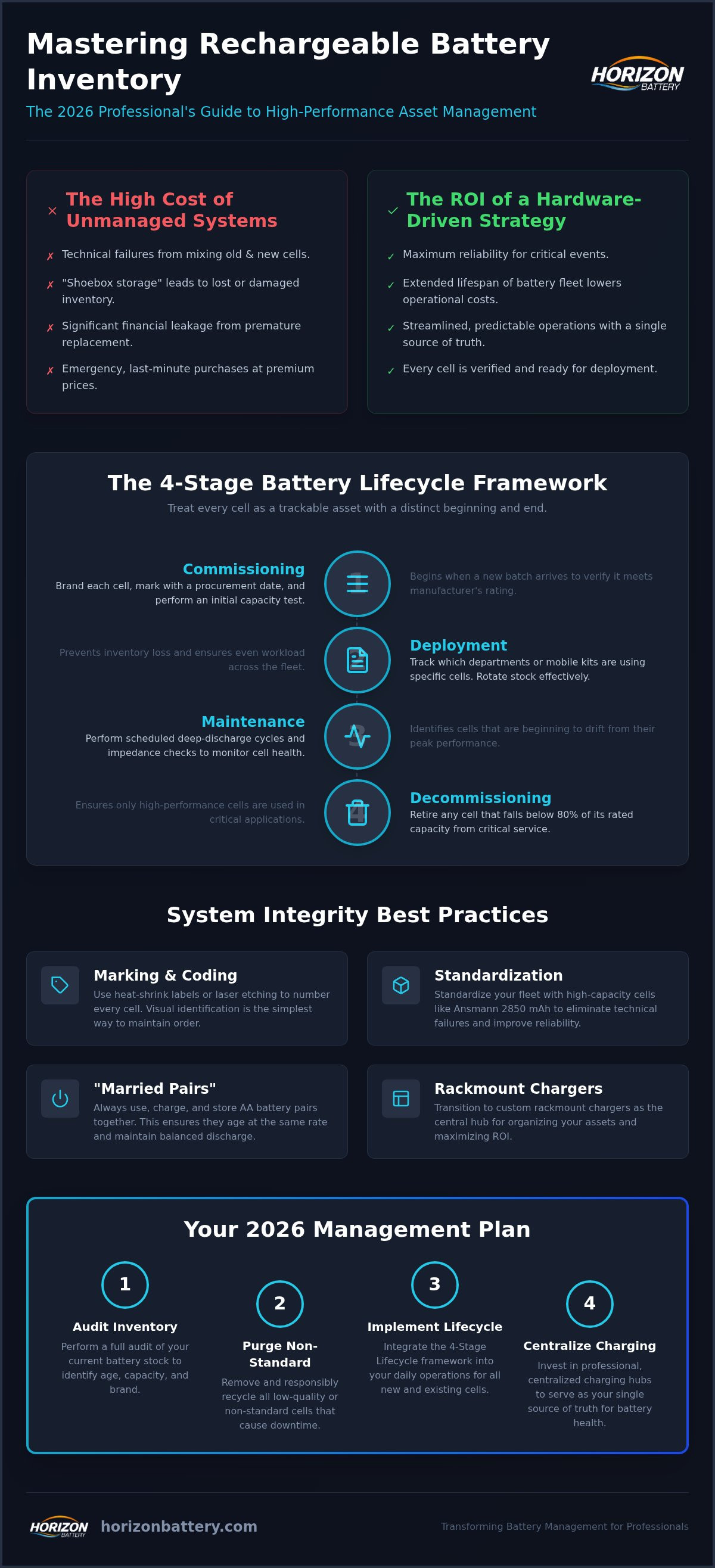
To achieve professional-grade reliability, you must treat every cell as a trackable asset with a distinct beginning and end. A structured lifecycle approach is the backbone of effective rechargeable battery inventory management. In 2026, organizations that manage hundreds of cells find that a four-stage framework prevents the "chaos of the unknown" where old and new cells are mixed. This methodical progression ensures that every battery in your rack is capable of meeting its performance specifications.
- Stage 1: Commissioning – This begins the moment a new batch arrives. You should brand each cell, mark it with a procurement date, and perform an initial capacity test to verify it meets the manufacturer's rating.
- Stage 2: Deployment – Tracking which departments or mobile kits are using specific cells prevents inventory from disappearing. It allows managers to rotate stock effectively so no single batch is overworked while others sit idle.
- Stage 3: Maintenance – Professional NiMH cells require scheduled deep-discharge cycles and impedance checks. This stage identifies cells that are beginning to drift from their peak performance.
- Stage 4: Decommissioning – Once a cell hits the "red zone," typically defined as falling below 80% of its rated capacity, it should be retired from critical service.
Marking and Coding Your Inventory
Visual identification is the simplest way to maintain order. Use heat-shrink labels or laser etching to number your cells. Numbering is vital. It's also essential to create "Married Pairs" for AA batteries. These are sets of cells that are always used, charged, and stored together. This practice ensures they age at the same rate and maintain balanced discharge levels. Utilizing color-coded Battery Storage cases helps the team instantly separate "Ready" inventory from cells that need processing.
Logistics of Charge Tracking
Identifying "rogue" cells, those that lose charge significantly faster than the rest of their batch, requires consistent data. While a simple logbook can work for small operations, larger facilities benefit from digital asset management systems. Tracking these metrics allows you to catch failures before they happen on stage. For a deeper look at setting up these physical systems, you can learn how to implement a professional battery storage and management system. By maintaining this level of granular detail, you protect your ROI and ensure your Pure Power Series cells deliver their full potential.
Hardware vs. Software: Choosing Your Management Tools
Software-heavy solutions like RFID tracking or complex database systems can be expensive and often prove to be overkill for production environments. In contrast, professional charging hardware serves as the most effective physical touchpoint for rechargeable battery inventory management. Integrated charging stations act as a natural gatekeeper for your assets. When a cell is in the charger, it's being accounted for; when it's out, it's deployed. This physical accountability is often more reliable than manual logbooks or digital spreadsheets that rely on constant human data entry. By making the charger the central hub of your workflow, you create a system where tracking happens automatically as part of the daily routine.
Modern smart chargers provide critical automated cell health reporting by measuring internal resistance and discharge capacity. These tools allow you to identify failing cells before they cause a gear failure on stage. In high-turnover environments like schools and theaters, hardware durability is just as important as the data it provides. You need industrial-grade systems that can withstand hundreds of insertion cycles without the contacts wearing down. Choosing hardware that combines charging with diagnostic capabilities ensures that your inventory tracking remains accurate without adding extra steps for your technical team.
The Advantage of Custom Rackmount Chargers
Moving your power management from loose tabletop chargers to Custom Rackmount Chargers centralizes your operation into a secure AV rack. This transition eliminates the common problem of lost power cables and the clutter of mismatched power strips. Rackmount systems are designed to optimize airflow and temperature management during large-scale charging sessions. When you charge dozens of high-capacity cells simultaneously, heat buildup can degrade battery chemistry and shorten their lifespan. Professional rackmount hardware ensures your inventory stays cool and protected, directly contributing to a higher ROI for your fleet.
Pure Power Series: Management for Lithium-Ion
The tracking requirements for 1.5V Li-ion cells differ from traditional NiMH batteries. Managing the Pure Power Series requires a system that accounts for their unique constant voltage output. Unlike NiMH cells, which show a gradual voltage drop, these lithium-ion cells maintain a steady 1.5V until they are nearly exhausted. This provides predictable runtimes for high-drain gear but necessitates a methodical rotation system to ensure cells aren't deployed in a low-capacity state. For more details on managing these specific assets, see The Professional Guide to Lithium Ion Battery Storage & Asset Management (2026). Using dedicated hardware designed for these chemistries is the only way to maintain a truly reliable inventory in 2026.
Standardization: The Secret to Scalable Inventory
The "Chaos of Variety" is a common pitfall in rechargeable battery inventory management. When a facility mixes different brands, chemistries, and capacities, it creates an unpredictable environment where gear performance varies wildly. Standardizing on a single high-capacity cell, such as the Ansmann 2850 mAh, eliminates these variables. It ensures that every device in your fleet has a consistent, known runtime. This approach also makes your system nearly "idiot-proof" for volunteers and seasonal staff. When there's only one type of battery and one type of charger, the risk of human error drops significantly. You can further simplify your operations by investing in Charger / Battery Bundles, which ensure that your hardware and cells are perfectly matched from day one.
Choosing a 'House' Battery Strategy
Deciding between NiMH and Lithium-Ion depends on your specific application. NiMH cells, like the high-capacity Ansmann series, are the preferred workhorses for US production houses because of their high cycle life and durability in high-drain devices. However, for critical wireless audio applications where low weight and constant 1.5V output are mandatory, the Pure Power Series is the superior choice. Establishing a "house battery" for each department prevents the accidental mixing of chemistries that can lead to charging failures or equipment damage. By narrowing your focus to these two professional standards, you streamline your procurement and reduce the mental load on your technical team.
Managing Battery Storage for Longevity
Proper storage is the final piece of the inventory puzzle. Temperature is the primary enemy of battery health. Storing your inventory in a climate-controlled environment prevents the accelerated chemical degradation that occurs in hot warehouses or equipment trucks. You must also manage charge levels based on chemistry. While NiMH cells should be stored at a full charge to maintain readiness, Li-ion cells are best kept at a 40% charge for long-term storage. Using specialized Battery Storage cases is essential to prevent short circuits and physical damage. These high-capacity cases keep cells organized and separated, ensuring that your assets are protected and ready for the next deployment. To begin standardizing your facility's power, explore our professional energy solutions today.
Implementing Your 2026 Management Plan
Transitioning from a disorganized collection of cells to a professional system requires a clean break from past habits. Start by auditing your current "drawer of doom," that notorious collection of mismatched, aging cells that inevitably leads to equipment failure. Purge any battery that doesn't meet your new standardization requirements. By removing non-standard cells, you eliminate the risk of them being accidentally deployed in critical gear. This audit clears the path for a hardware-driven infrastructure focused on custom rackmount chargers. These systems serve as the physical anchor for your new workflow, ensuring that every asset has a designated home and a clear status.
The 30-Day Inventory Turnaround
Success doesn't happen overnight. A structured three-week plan helps your team adapt to new standards without disrupting active productions. During the first week, focus on capacity testing and marking your existing stock to identify high-performing assets. The second week is dedicated to infrastructure, where you install centralized rackmount charging stations into your existing AV racks. By the third week, transition into staff orientation. This is when you teach the team how to use the new storage cases and tracking logs. This methodical rollout ensures that your rechargeable battery inventory management system is fully operational and understood by every user.
Training is the most vital part of this turnaround. Your team needs to understand the "Married Pair" protocol, where specific AA batteries stay together for their entire operational life to maintain balanced discharge rates. You must also implement "First-In, First-Out" (FIFO) protocols for your storage bins. This ensures that the oldest charged batteries are used first, preventing any single batch from sitting idle for too long while others are overtaxed. When your staff treats batteries as valuable assets rather than disposables, your ROI increases almost immediately.
Sourcing for Success
The quality of your management plan is only as good as the cells you put into it. Consumer retail stores often provide mixed batches with varying internal resistance, which makes tracking and prediction nearly impossible. Professional performance requires batch-consistent cells that behave identically under high-drain conditions. Partnering with a specialized distributor provides access to industrial-grade support and consistent batches of high-capacity cells. This level of reliability is essential for organizations that cannot afford power failure during a live event. To take the first step toward a failure-free facility, you can upgrade your facility with Horizon Battery’s custom rackmount solutions and secure your mobile power future.
Securing Your Technical Future with Professional Power
Mastering rechargeable battery inventory management is the most effective way to protect your production budget and ensure technical reliability. By moving away from disorganized storage and embracing a structured 4-stage lifecycle, you transform simple cells into high-performance assets. Standardizing your fleet on high-capacity cells and utilizing the industry-leading Pure Power Series provides the predictability required for critical wireless applications. These systems don't just save money; they provide the peace of mind that comes from knowing every battery in your rack is ready for duty.
Since 1998, Horizon Battery has served as a trusted partner for professional AV teams across North America. Our custom-engineered rackmount charging solutions and specialized battery bundles are designed for organizations that cannot afford power failure. It's time to purge the "drawer of doom" and invest in infrastructure that supports your team's success. Build your professional battery fleet with Horizon Battery and take control of your facility's mobile power needs today. You have the framework and the tools to eliminate battery-related downtime for good.
Frequently Asked Questions
What is the best way to track the number of cycles on a rechargeable battery?
The most accurate way to track charge cycles is through professional diagnostic chargers that measure discharge capacity and internal resistance. While manual logbooks can record every use, automated hardware provides a data-driven look at actual cell health. You should also mark the commissioning date on each cell with a laser etcher or heat-shrink label. This helps your team estimate total usage based on the procurement date even if specific cycle counts aren't logged for every individual battery.
How do I know when a rechargeable battery should be retired from inventory?
A battery should be retired from critical inventory when its capacity falls below 80% of its original rated mAh. High-drain devices like wireless microphones require consistent voltage, and a degraded cell may cause unexpected signal dropouts or voltage sag. If you notice a cell getting excessively hot during charging or taking significantly longer to reach a full state, it's a clear sign that the internal chemistry is failing and the unit needs decommissioning.
Should I use software or a physical log to manage my battery stock?
Choosing between software and physical logs depends on the size of your fleet. For organizations managing hundreds of cells, digital asset management software is superior because it allows for rapid searching and automated health alerts. However, for rechargeable battery inventory management in smaller facilities, a physical logbook kept at the charging station can be effective if the team is disciplined. The best approach often combines smart charging hardware that reports health data directly to a centralized database.
Is it worth standardizing on one brand of rechargeable batteries?
Standardizing on a single brand and capacity is essential for maintaining a predictable inventory. When you mix different manufacturers, you introduce variables in discharge curves and charge times that make it impossible to guarantee runtime. By using a single high-capacity standard like the Ansmann 2850 mAh, you ensure that every cell in your rack behaves the same way. This consistency simplifies training for staff and volunteers while streamlining your long-term procurement process for the entire organization.
How does temperature affect the storage of a large battery inventory?
Temperature is the primary driver of chemical degradation in large battery inventories. High heat increases the rate of self-discharge and can lead to permanent capacity loss over time. Conversely, extreme cold can temporarily reduce a battery's ability to deliver current. You should store your inventory in a climate-controlled environment, ideally between 60 and 70 degrees Fahrenheit. Proper storage in specialized high-capacity cases also helps maintain a stable environment and prevents accidental short circuits between cells.
Can I mix different brands of AA rechargeables in the same device?
You should never mix different brands or capacities of AA rechargeables in the same device. Even if they are the same chemistry, different brands have unique discharge rates and internal resistances. When mixed, the weaker battery will drain faster and may be driven into a reverse polarity state by the stronger cells. This results in poor equipment performance, potential cell leakage, and a significantly shorter lifespan for all the batteries involved in that specific pair or set.
What are the benefits of rackmount chargers for large organizations?
Custom rackmount chargers provide a centralized, secure hub for rechargeable battery inventory management in high-turnover environments. These systems eliminate the clutter of tabletop chargers and tangled power cables while providing superior airflow to keep cells cool during large-scale charging. For large organizations, rackmount solutions ensure that batteries stay within the technical booth or server room. This prevents assets from being scattered across the facility and makes it easier for managers to perform routine health audits.
How do I prevent batteries from being stolen or lost in a large facility?
Preventing loss in a large facility requires a combination of physical security and visual branding. Numbering every cell and using color-coded storage cases allows your team to see at a glance if a set is missing from the rack. Locked rackmount charging drawers also prevent unauthorized personnel from borrowing cells for personal use. Establishing a strict checkout protocol where specific kits are assigned to departments ensures that every battery is accounted for at the end of each event.