
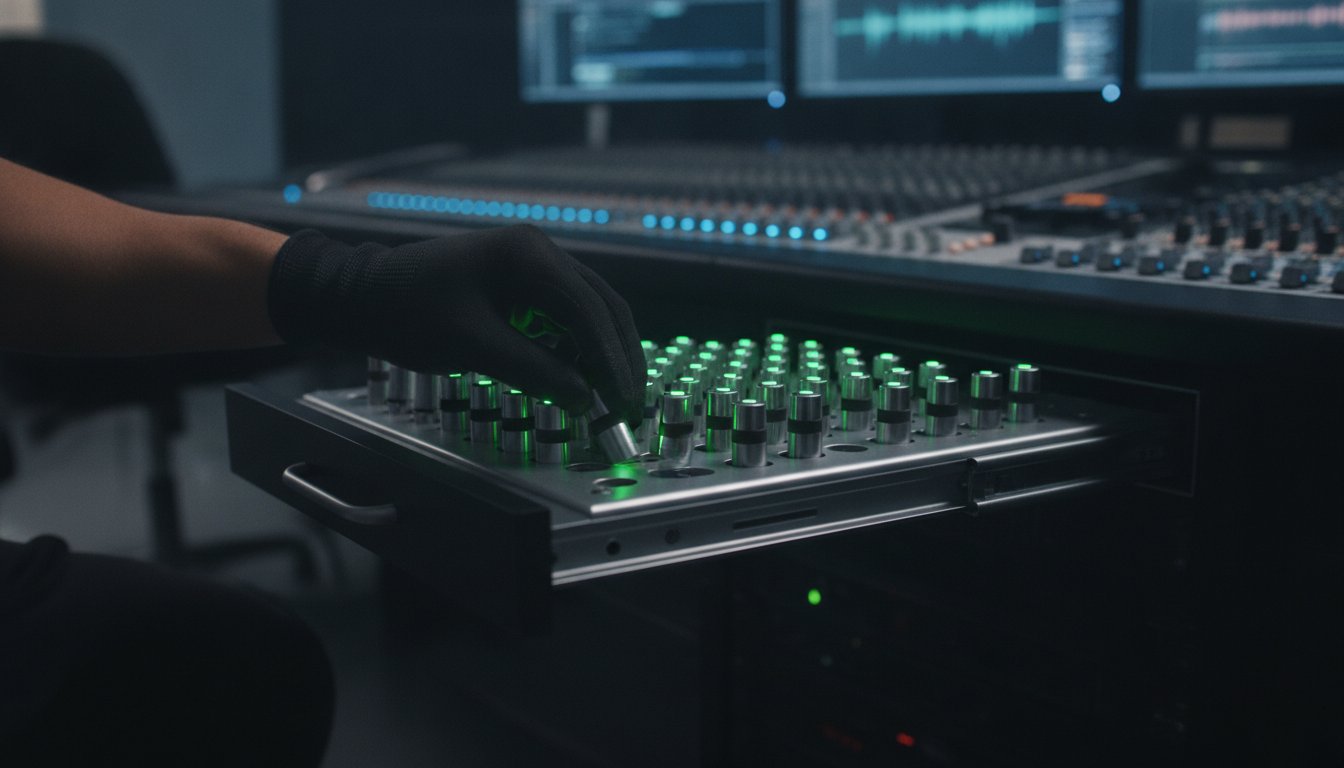
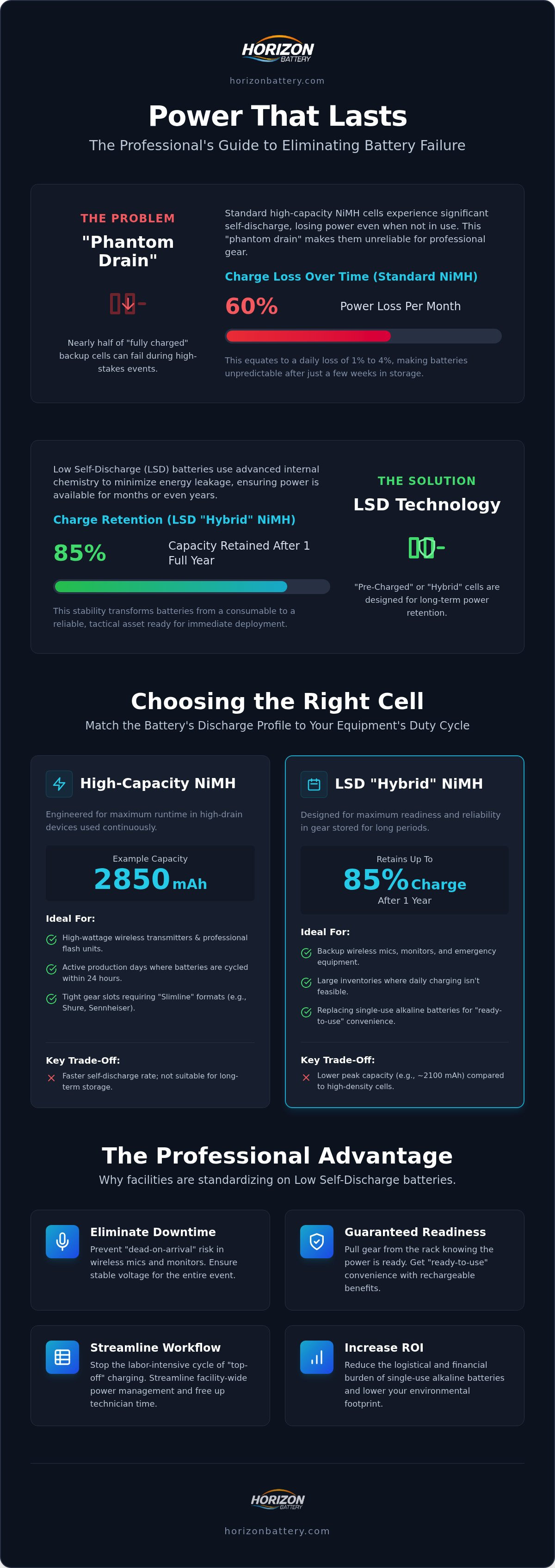
A lead technician at a major production house recently discovered that nearly half of their "fully charged" backup cells failed during a high-stakes live event. This wasn't a hardware malfunction; it was the result of phantom drain. Standard high-capacity NiMH cells can lose up to 60 percent of their power per month just sitting on a shelf. To maintain professional reliability, your inventory must transition to low self-discharge rechargeable batteries. These specialized cells, such as the Ansmann Hybrid series, are designed to retain up to 85 percent of their capacity even after a full year of storage.
You already know that equipment downtime is a non-starter for your facility. You need power that's ready the moment you pull it from the rack. This guide will help you bridge the gap between high-capacity mAh ratings and long-term shelf stability. We'll explore how the latest IEC 61951-2 standards impact your procurement and why the right charging hardware is essential for enterprise ROI. From the Ansmann 2850 mAh Slimline for tight gear slots to custom rackmount solutions, you'll learn how to ensure your professional gear never misses a cue.
Key Takeaways
- Understand why low self-discharge rechargeable batteries are the essential choice for gear that must remain ready for action after long periods of storage.
- Learn to navigate the trade-off between peak mAh capacity and charge retention to select the right cell for high-drain production environments.
- Eliminate technical downtime in wireless microphones and monitors by utilizing stable voltage technology designed for professional AV workflows.
- Audit your equipment's physical tolerances to ensure a perfect fit with high-capacity Slimline cells and specialized professional battery formats.
- Streamline facility-wide power management with custom rackmount charging hardware and standardized battery bundles.
Understanding Low Self-Discharge (LSD) Technology for Professionals
Low self-discharge rechargeable batteries, often marketed as "Pre-Charged" or "Hybrid" cells, represent a fundamental shift in how portable power is managed in technical environments. These batteries minimize internal chemical leakage, ensuring that the energy stored during a charge cycle remains available for use months later. By 2026, chemical refinements have made these cells the industry standard for any device that isn't in constant, daily rotation. While standard NiMH batteries might lose between 1 and 4 percent of their charge every single day, modern LSD variants retain approximately 85 percent of their total capacity after a full year in storage. This stability transforms a battery from a high-maintenance consumable into a reliable, tactical asset.
The Chemistry of Power Retention
The secret to this longevity lies in the internal architecture of the cell. Manufacturers have integrated improved separators and advanced cathode materials that create a more robust physical barrier against energy loss. Self-discharge is the loss of energy through internal chemical reactions when no load is applied. By refining these chemical pathways, Low self-discharge NiMH technology ensures that ions stay put until they are needed. It's also vital to consider the storage environment. While LSD cells are resilient, high ambient temperatures in equipment trailers or non-climate-controlled warehouses can accelerate discharge rates, though they still far outperform standard cells in these conditions.
Why Professionals are Abandoning Standard NiMH
Production environments cannot afford the "dead-on-arrival" risk associated with traditional rechargeables. If a wireless microphone or handheld monitor sits in a drawer for two weeks, a standard battery might be too depleted to finish a single set. This leads to a constant, labor-intensive cycle of "top-off" charging that drains valuable technician time. Adopting low self-discharge rechargeable batteries eliminates this maintenance hurdle, allowing teams to focus on the event rather than the inventory.
Large venues also see a significant return on investment by replacing thousands of single-use alkaline cells. You get the immediate "ready-to-use" convenience of an alkaline battery with the long-term cost efficiency and reduced environmental footprint of a high-performance rechargeable system. This shift reduces the logistical burden of large-scale battery procurement while ensuring that every device in your fleet is ready for immediate deployment.
The Capacity Trade-Off: Ansmann 2850 mAh vs. Hybrid Cells
Selecting the right power source requires understanding the inverse relationship between maximum energy density and shelf-life retention. In the professional sector, we categorize cells into two primary groups: ultra-high capacity and low self-discharge (LSD) hybrids. While a higher milliamp-hour (mAh) rating suggests a longer runtime during active use, those dense chemical structures often struggle to hold that energy when the device is powered down. Choosing between these two isn't about finding the "best" battery; it's about matching the discharge profile to your specific equipment's duty cycle.
High-Drain Performance: When to Choose 2850 mAh
The Ansmann 2850 mAh series is the powerhouse of the NiMH world. These cells are engineered for high-wattage wireless transmitters and professional flash units that demand rapid energy delivery. However, this high capacity comes with a trade-off. High-capacity cells generally exhibit a faster self-discharge rate compared to their hybrid counterparts. They're designed for active production days where batteries are charged, used, and depleted within a 24-hour window.
Physical dimensions also play a critical role. Many professional microphone packs from manufacturers like Shure or Sennheiser have extremely tight battery compartments. The Ansmann 2850 mAh Slimline variant is specifically designed to meet these tight tolerances, providing maximum capacity without the wedging issues common with standard consumer rechargeables. To keep these dense cells healthy, it's vital to use high-quality microprocessor-controlled chargers that prevent overheating during the final stages of the charge cycle.
Maximum Readiness: When to Choose Hybrid LSD
For gear that spends more time in a storage case than in your hand, low self-discharge rechargeable batteries are the superior choice. The Ansmann Hybrid series typically offers a lower peak capacity, around 2100 mAh, but excels in stability. These cells are rated to lose only about 5 percent of their power per month. In contrast, standard high-capacity cells can lose up to 60 percent of their charge in the same timeframe if left idle.
This stability makes Hybrid LSD cells the gold standard for standby kits, emergency backup gear, and remote controls. They offer a "ready-to-use" guarantee, retaining up to 85 percent of their capacity after a full year on the shelf. Beyond shelf life, hybrid cells often provide a superior cycle life, frequently lasting for more total recharges over their functional lifespan. Standardizing your inventory with Ansmann Charger / Battery Bundles allows you to manage both high-drain and standby cells through a unified charging infrastructure, ensuring every cell in your fleet is maintained for peak ROI.
Professional Applications: Where LSD Batteries Excel
Professional equipment often sits in a storage locker for days or weeks between events. In these scenarios, "phantom drain" is a silent killer of production reliability. Unlike household remotes or toys, professional wireless microphones and intercom systems require a high level of immediate current to maintain signal integrity. Using low self-discharge rechargeable batteries ensures that when a technician grabs a pack for a sound check, the power is actually there. This reliability is why theater departments and broadcast teams have moved away from standard NiMH cells, which often require a full charge cycle immediately before every use.
In-Ear Monitors (IEMs) present another specific challenge. These devices are sensitive to voltage fluctuations that can occur as a battery depletes. As a cell nears the end of its runtime, the voltage drop can introduce noise or signal artifacts into the performer's ears. LSD cells provide a more linear discharge curve compared to standard rechargeables, maintaining audio clarity for the duration of the show. For volunteer-run technical teams in houses of worship, this translates to fewer mid-service failures and a simplified workflow. Volunteers don't need to guess if a battery is "fresh" enough; if it was charged and stored, it's ready for the pulpit.
Audio and Video Production Workflows
Standardizing on LSD technology allows production managers to integrate battery management into their pre-show checklists with confidence. Instead of a frantic morning spent charging hundreds of cells, teams can maintain a "ready-stock" of pre-charged inventory. By maintaining a consistent discharge curve, LSD cells prevent voltage sag in sensitive professional audio circuits, ensuring consistent gain and signal-to-noise ratios throughout a performance. Educational institutions, such as large universities with multiple lecture halls, report that standardizing on Ansmann Hybrid power significantly reduces the labor costs associated with battery maintenance, as technicians spend less time managing frantic charging rotations.
Enterprise Facility Management
Scaling power solutions across a large campus or multi-room venue requires a methodical approach to inventory. Standard NiMH cells often become "dead stock" if they aren't used within a few days of charging, leading to confusion and wasted resources. Implementing low self-discharge rechargeable batteries across an enterprise ensures that backup gear in every room is functional at a moment's notice. While NiMH is the standard for many applications, some high-drain digital devices may benefit from the constant voltage of the Pure Power Series. Centralizing your inventory with LSD cells reduces the hidden costs of alkaline disposal and ensures that your facility management team isn't constantly chasing "low battery" warnings on infrequently used equipment.
Selection Guide: Choosing the Right Low Self-Discharge Solution
Transitioning an entire facility to a rechargeable fleet requires more than just swapping out alkaline cells for the highest mAh rating on the shelf. Professional procurement involves a four-step audit to ensure technical compatibility and long-term financial return. First, you must audit your device drain rates. High-wattage wireless transmitters demand high-capacity cells, while standby equipment like remote controls or emergency kits should always utilize low self-discharge rechargeable batteries to prevent failure during storage.
Physical fit is the second critical factor. Many professional AV devices have narrow battery tubes where standard consumer cells can become stuck. Measuring battery compartment tolerances is essential; for these tight environments, the Ansmann 2850 mAh Slimline is a necessary specification. Third, evaluate your infrastructure. A scattered collection of desktop chargers creates a maintenance nightmare for large venues. Finally, calculate your cycle-life requirements. While high-capacity cells offer more runtime per charge, hybrid LSD cells often provide a higher total number of recharge cycles, which directly impacts your long-term ROI.
Matching mAh to Device Requirements
It's a common mistake to assume that a higher mAh rating is always superior. Over-speccing capacity can lead to a shorter overall battery lifespan because ultra-high-capacity cells use thinner internal separators that are more susceptible to wear. For many professional applications, the 2100 to 2500 mAh range is the "sweet spot" for low self-discharge rechargeable batteries. This range balances sufficient runtime with the chemical stability needed for a high cycle life. You should also verify voltage requirements. While most gear handles the 1.2V profile of NiMH, some specific digital circuits may require the constant 1.5V output found in the Pure Power Series.
Optimizing Your Charging Strategy
Your batteries are only as good as the hardware that maintains them. Smart chargers are non-negotiable for professional workflows because they monitor individual cell temperatures and voltage curves to prevent heat damage. In a large-scale environment, consumer desktop units are inefficient and prone to loss. Custom Rackmount Chargers are the only viable solution for centralized facility management. These units organize your power in the AV rack, allowing technicians to quickly swap cells without hunting through drawers. Standardizing your hardware through professional Charger / Battery Bundles ensures that your Ansmann cells are treated with the precision charging algorithms they require to reach their full 1,000-cycle potential.
The Horizon Advantage: Professional Bundles and Rackmount Solutions
Horizon Battery has served the professional production industry since 1998. We act as a knowledgeable guide for facilities looking to move away from the environmental and financial waste of alkaline cells. Standardizing your inventory with Ansmann Charger / Battery Bundles is the most effective way to ensure consistency across your equipment fleet. These bundles pair high-performance low self-discharge rechargeable batteries with chargers specifically calibrated for their chemical profile. This synergy maximizes the lifespan of your cells and guarantees they are ready for immediate deployment. By choosing a unified system, you eliminate the confusion of mixing different brands and capacities in the same device.
Industrial-Grade Infrastructure
Centralizing power management is critical for large venues and broadcast centers. Our Custom Rackmount Chargers integrate directly into your existing AV rack, providing high-density charging without the clutter of scattered desktop units. These professional systems feature active cooling and precision monitoring to prevent heat damage during rapid charge cycles. By organizing power in a single, ventilated location, you significantly reduce fire risks associated with daisy-chained consumer power strips. Horizon Battery's heavy-duty battery storage solutions provide the rugged durability required by mobile production teams working in demanding field environments. This industrial-grade approach ensures that your charging infrastructure is as reliable as the microphones and monitors it powers.
While NiMH remains the workhorse for many, some specialized applications require the constant voltage of the Pure Power Series. If your digital wireless systems are sensitive to the slight voltage drop of traditional rechargeables, moving to professional-grade Lithium-ion provides the 1.5V stability your gear demands. This transition is often necessary for high-stakes broadcast environments where signal integrity is paramount.
Procurement for Large Organizations
Large organizations face unique logistical hurdles when managing thousands of cells across multiple rooms or campuses. We specialize in streamlining the transition from disposables to Ansmann enterprise power, providing a clear path to reduced technical downtime and optimized ROI. Our team offers dedicated support and volume discounts for major facilities across the United States and Canada. This ensures that your large-scale procurement of low self-discharge rechargeable batteries is backed by nearly three decades of industry expertise. Our role is to act as a reliable partner that values the longevity of your equipment and the performance of your gear. Explore our Professional Battery Bundles to find the right configuration for your facility's specific energy needs.
Standardizing Your Professional Power Fleet
Standardizing your facility on low self-discharge rechargeable batteries is a strategic move that pays dividends in both reliability and long-term ROI. By matching the right Ansmann cell to your device's specific drain profile, you eliminate the technical downtime that plagues high-stakes events. Whether you're deploying high-capacity Slimline cells for wireless transmitters or Hybrid cells for standby readiness, the goal is a fleet that's always ready for action.
Since 1998, we've helped AV professionals move away from the waste of disposables. We specialize in high-capacity Ansmann Pure Power solutions and exclusive custom rackmount charging systems designed to centralize your facility management. It's time to stop chasing phantom drain and start trusting your power inventory. Our team is here to guide you through the selection process, ensuring your enterprise procurement is handled with industrial precision.
Shop Professional Ansmann Battery Bundles at Horizon Battery and ensure your gear never misses a cue.
Frequently Asked Questions
What exactly is a low self-discharge (LSD) battery?
A low self-discharge (LSD) battery is a Nickel-Metal Hydride (NiMH) cell engineered to minimize internal chemical leakage while not in use. These cells utilize advanced separators and cathode materials to hold their charge for extended periods. While standard rechargeables might lose their entire charge in a few weeks of idleness, low self-discharge rechargeable batteries can retain approximately 85 percent of their capacity after 12 months of storage.
Do LSD batteries have less capacity than regular rechargeable batteries?
Yes, there's typically a capacity trade-off between maximum energy density and shelf-life stability. High-capacity cells like the Ansmann 2850 mAh provide more runtime for immediate use but lose charge quickly in storage. In contrast, LSD Hybrid cells usually offer a lower peak capacity, such as 2100 mAh. Professionals choose LSD when equipment readiness is more important than achieving the absolute longest single-session runtime.
Can I use any charger with low self-discharge batteries?
You should only use high-quality microprocessor-controlled chargers to maintain these cells properly. While basic chargers might physically fit, they often lack the precision to detect the full-charge termination point accurately. Smart chargers monitor voltage curves and temperature to prevent overheating, which is essential for preserving the long-term health of your low self-discharge rechargeable batteries. Standardizing with professional charger bundles ensures your inventory reaches its maximum rated cycle life.
How long can a low self-discharge battery sit in a wireless mic before it dies?
An LSD battery can remain functional for several months in a wireless microphone if the device is fully powered down. These cells lose only about 5 percent of their power per month compared to the 60 percent loss seen in standard high-capacity cells. However, you must check if your microphone has a "soft" power switch that causes a parasitic drain. If the device draws no power when off, your standby readiness is significantly improved.
Are Ansmann batteries better than consumer brands for professional audio?
Ansmann batteries are superior for professional audio because they offer tighter physical tolerances and more stable discharge curves. Consumer batteries are often designed for low-drain toys or remotes and can vary in diameter, leading to fitment issues. Ansmann cells are engineered for the high-current demands of wireless transmitters and in-ear monitors. This industrial focus ensures consistent signal integrity and prevents the voltage sags that cause audio artifacts during a performance.
What happens if I store my LSD batteries in a hot equipment room?
High temperatures will accelerate the internal chemical reactions that cause energy loss. While LSD chemistry is more stable than standard NiMH, storing them in a hot equipment room or a non-climate-controlled trailer will increase the self-discharge rate. For the best results, keep your battery inventory in a cool, dry environment. Prolonged exposure to heat doesn't just drain the current; it can also permanently degrade the battery's total service life.
Is it worth the extra cost to buy Ansmann Slimline batteries?
The extra cost is a necessary investment if your equipment features narrow battery tubes. Many professional microphone packs from brands like Sennheiser or Shure are designed with very tight tolerances. Standard rechargeable cells are often slightly wider than alkalines and can become wedged inside the gear. Ansmann Slimline batteries are specifically manufactured to match alkaline dimensions exactly, preventing hardware damage and ensuring quick, frustration-free swaps during a live event.
How many times can I recharge an Ansmann Hybrid battery?
Ansmann Hybrid batteries are generally rated for up to 1,000 recharge cycles. This longevity makes them a highly cost-effective solution for facilities that manage large inventories of wireless gear. Because they don't require top-off charging as frequently as standard NiMH, you'll likely find they last longer in real-world professional applications. Their robust chemical structure allows them to survive the rigors of daily production use while maintaining excellent charge retention.