
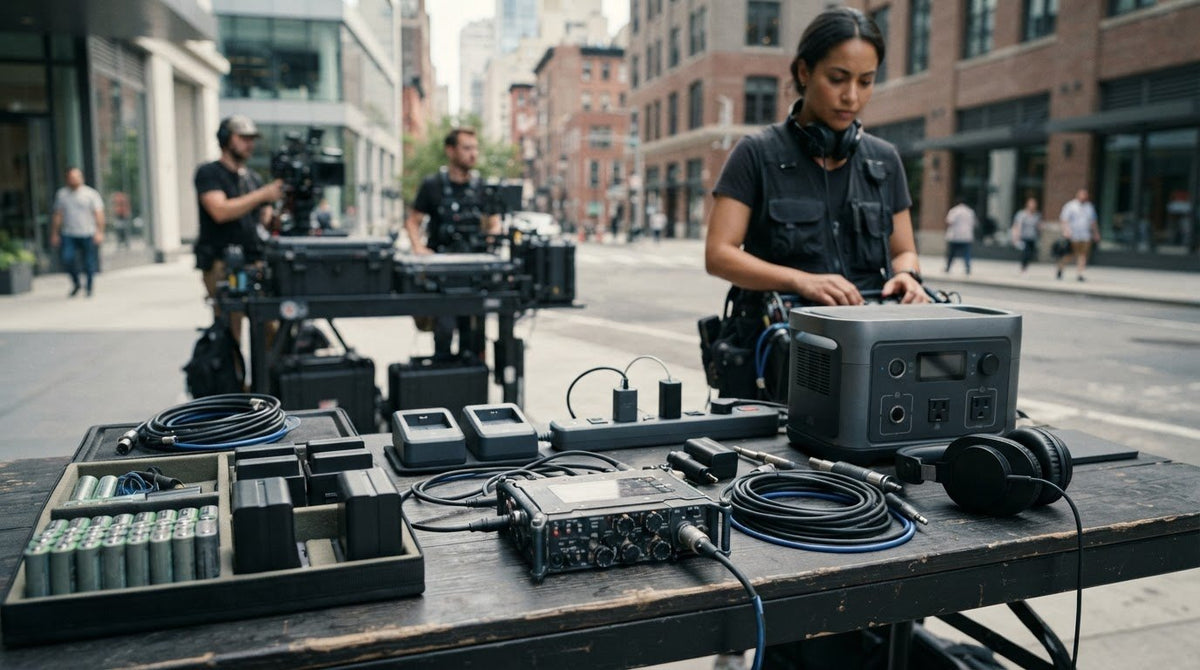
The most reliable power setup for a location shoot isn’t necessarily the one with the largest battery. It’s the one that matches every device, keeps charging and swaps organized, and provides a dependable backup before a take is at risk. That’s the principle behind choosing portable power solutions for location sound recordists.
If you’ve ever had to check whether a recorder takes AA cells, a proprietary battery, or external DC power, you know one format won’t cover every part of a sound kit. Runtime matters, but so do compatible chargers, clearly tracked spares, and a plan for keeping batteries ready throughout a production day.
This guide compares common battery formats and charging workflows, then shows how to build a practical field inventory around your gear and schedule. You’ll learn where high-capacity rechargeable AA batteries, charger bundles, and rackmount charging may fit, and where equipment-specific batteries or external power call for a different solution. Always verify each device’s requirements before choosing a battery.
Key Takeaways
- Start with each device’s manufacturer requirements to distinguish AA-powered gear from equipment that needs a proprietary battery or external power.
- Compare alkaline, rechargeable NiMH, and regulated lithium-ion AA options by device compatibility, charging needs, and fit with your field workflow.
- Use a gear-and-schedule inventory to estimate what you’ll need on set and identify where backup batteries or a different power format are necessary.
- Build a repeatable charging routine that separates charged, in-use, and depleted batteries, making handoffs and resets easier to manage.
- Portable power solutions for location sound recordists may include compatible AA rechargeable batteries, bundles, storage, or rackmount charging. Some equipment requires another format.
Portable Power Solutions for Location Sound Recordists: Start With the Gear
Recording doesn’t pause for a battery change. Field recorders, wireless transmitters, receivers, and accessories must stay powered through takes, location transitions, and crew handoffs. A sound kit may use several power formats, so choosing one battery type for everything can leave a critical device without a suitable supply.
A portable power solution is a device-matched plan for powering and recharging equipment. It includes compatible batteries, charged spares, organized storage, and a clear changeover routine. This system-level approach matters in the on-set environment described for the Production sound mixer, where recording equipment needs to support work across changing scenes and locations. To plan portable power solutions for location sound recordists, start with an inventory of the actual gear, not a general rule about what sound equipment “usually” takes.
Which sound equipment uses AA batteries?
Some wireless transmitters, receivers, and accessories use AA cells, while other equipment relies on proprietary packs, rechargeable internal batteries, or external DC power. Even devices in the same category can differ. Check each battery compartment and the manufacturer’s manual, then confirm the approved battery format, voltage, dimensions, and any external-power requirements before purchasing.
| Device group | Possible power format | What to verify |
|---|---|---|
| Field recorder | AA cells, proprietary pack, internal battery, or external DC | Model-specific format, voltage, and power input; research required |
| Wireless transmitter | AA cells or a model-specific rechargeable battery | Approved cell type and voltage; research required |
| Wireless receiver | AA cells, proprietary pack, or external power | Battery compartment and manufacturer specifications; research required |
| Accessories | Varies by device | Manual, labels, and approved power source; research required |
The formats in the table are possibilities, not compatibility claims for specific models. Don’t assume rechargeable AA cells are suitable just because they fit a compartment. Confirm the manufacturer’s requirements for each device before selecting batteries or a charger.
What makes a field power setup dependable?
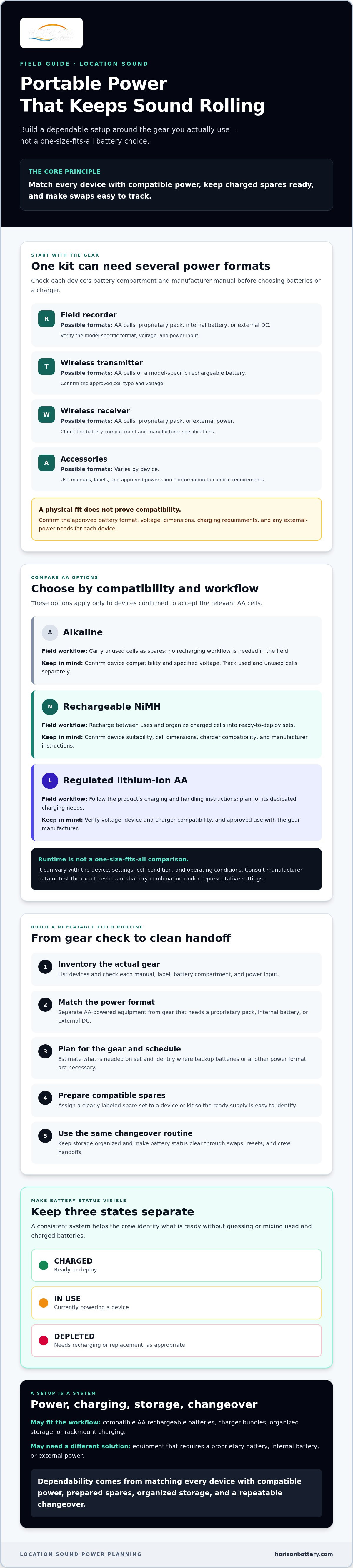
Dependability comes from matching each device with compatible cells, preparing charged spares, keeping storage organized, and following the same changeover process every time. Assign a clearly labeled spare set to a device or kit. During a fast swap, that simple convention helps crew members identify what’s ready without guessing or mixing charged and depleted batteries.
A dependable field power setup is a repeatable workflow that keeps compatible power, charged spares, and clear changeovers aligned with every device. Once you’ve mapped the equipment requirements, choose batteries, chargers, and storage that support the production schedule.
Compare Battery Options for Location Sound Work
Once you’ve confirmed which devices accept AA cells, compare battery options by compatibility and workflow, not by chemistry name alone. Voltage, dimensions, and charging requirements vary by product, and the equipment manufacturer’s specifications determine what’s suitable. Use the table as a starting point, then verify the exact cells and charger for each device.
| AA option | Field workflow | Check before use |
|---|---|---|
| Alkaline | Carry unused cells as spares; no recharging workflow is needed in the field. | Confirm the device accepts the cell type and specified voltage. Track used and unused cells separately. |
| Rechargeable NiMH | Recharge between uses and organize charged cells into ready-to-deploy sets. | Confirm device suitability, cell dimensions, charger compatibility, and manufacturer instructions. |
| Regulated lithium-ion AA | Follow the product’s specific charging and handling instructions; plan for its dedicated charging needs. | Verify voltage, device compatibility, charger compatibility, and approved use with the gear manufacturer. |
Actual runtime can vary with the device, settings, cell condition, and operating conditions. Avoid assuming one chemistry lasts longer in every sound application. For a more reliable estimate, consult manufacturer data or test the exact device and battery combination under representative settings before a production day.
Rechargeable NiMH versus disposable alkaline
Alkaline cells offer a straightforward spare strategy: carry unused cells and replace them as needed. Rechargeable NiMH cells require advance charging and a way to keep charged, in-use, and depleted sets distinct. That preparation can support a repeatable rotation, but it depends on having compatible chargers and enough charged cells ready for the schedule. Choose based on device requirements and how your crew can manage changeovers.
When should recordists consider lithium-ion AA cells?
Regulated lithium-ion AA products aren’t automatically interchangeable with alkaline or NiMH cells. Their voltage and charging requirements may differ, so check the battery and device documentation before use. The Pure Power Series lithium-ion AA guide and high-capacity battery guide provide additional product-category context. For a broader comparison, see the professional battery technology comparison.
For compatible AA-powered equipment, compare the battery and charger options available from Horizon Battery’s rechargeable AA range with the device’s documented requirements. A match on format alone isn’t enough. Confirm the full specifications before selecting a field setup.
Match Power Solutions to Gear, Shoot Length, and Crew Size
The right setup depends on more than the number of batteries in a kit. Start with the gear, then consider how long it must operate between charging opportunities and who will handle power changes. This gives you a practical way to choose portable power solutions for location sound recordists without assuming every device can share the same battery format.
How do I build a device-by-device power plan?
Record each device’s make and model, then use its manual or manufacturer documentation to fill in the power requirements. Group AA-powered equipment separately from gear that needs a proprietary pack, internal rechargeable battery, or external power. Choose cells, chargers, and storage only after confirming the format, approved voltage, and charging method.
| Device | Model | Required format | Approved voltage | Charging method |
|---|---|---|---|---|
| Recorder | ________ | ________ | ________ | ________ |
| Transmitter or receiver | ________ | ________ | ________ | ________ |
| Accessory | ________ | ________ | ________ | ________ |
Leave a field blank until you’ve confirmed it. Don’t infer compatibility from a device category or from batteries that physically fit. AA rechargeable batteries and charger bundles are relevant only for equipment whose manufacturer approves the format and charging approach. Gear requiring a proprietary pack or external DC needs a compatible power system designed for that equipment.
What changes for longer shoots and larger crews?
For a solo operator, keep the plan easy to maintain: identify which batteries are in use, which spares are charged, and which need charging. For a longer production, plan rotations around the actual schedule and the manufacturer’s charging instructions. Don’t assume a runtime or set a change interval without device-specific data or testing.
As the team grows, consistency matters. Use the same labels or compartments across kits, and assign a clear charging location so crew members know where to return batteries and find ready spares. During handoffs, identify the device, battery status, and next action rather than passing along an unmarked cell or pack.
Finally, define a contingency for a depleted, missing, or unusable battery. It might involve a labeled compatible spare or the manufacturer-approved alternate power input, if the device supports one. Keep the plan specific to each piece of equipment. For compatible AA gear, compare rechargeable AA batteries and storage options as part of the broader inventory plan.
Plan Charging, Spares, and Battery Storage for Production
A reliable battery routine reduces last-minute searching and makes handoffs easier to manage. Build the workflow around each battery type and its manufacturer’s instructions. A charger suitable for one format may not be appropriate for another. Keep charged, in-use, and depleted batteries clearly separated in labeled compartments or containers so their status is visible at a glance.
How should a location sound team manage rechargeable spares?
Use the same sequence before and after each production day. Record battery condition and service history as part of the routine, so the team can spot changes over time without relying on a fixed replacement interval.
- Inspect: Check batteries for visible damage and confirm they’re the correct type for the equipment.
- Charge: Use a compatible charger and follow the battery and charger instructions.
- Label: Mark sets or compartments as charged, in use, or depleted.
- Deploy: Issue ready batteries with the appropriate device or kit.
- Return: Place used batteries in the depleted area, not back with charged spares.
- Recharge: Return depleted rechargeable cells to the charging workflow and update their status.
Assigning these steps to a person or crew role helps keep the process consistent. For more detailed inventory practices, consult the professional battery storage and management guide.
When is a rackmount charger worth evaluating?
Rackmount charging may suit a production setup or facility that needs an organized, repeatable place to charge batteries. It isn’t automatically the right choice for every crew. First confirm the charger supports the batteries in use, then check channel count, installation requirements, available rack space, and how the charging location fits the team’s workflow. Horizon Battery offers custom rackmount chargers, but verify configuration and equipment fit before selecting one.
Portable power solutions for location sound recordists should make battery status easier to manage, not add uncertainty. For a larger charging setup, review enterprise battery charging solutions as part of your planning. If rackmount charging or dedicated battery storage fits your workflow, explore battery charging and storage options and confirm product details against your equipment requirements.
Choose a Portable Power Setup That Fits Your Sound Workflow
A suitable setup starts with the power requirements of your actual equipment, then accounts for how the crew charges, stores, and changes batteries during production. Horizon Battery’s offerings may be useful for compatible AA-powered devices, but they won’t replace proprietary battery packs or external power systems required by other gear. Treat product fit as the first filter, then consider whether the charging and storage workflow suits your team.
Which Horizon Battery products may suit location sound teams?
High-capacity rechargeable AA batteries and charger/battery bundles are options to evaluate for equipment whose manufacturer supports the relevant AA format. The Pure Power Series is another product category to consider, subject to confirming specifications and compatibility. Battery storage can help organize an inventory, while custom rackmount chargers may suit a production or facility workflow where the charger configuration matches the batteries and available rack space.
| Product category | May fit when | Limitations to check |
|---|---|---|
| Rechargeable AA batteries | A device is approved for the specific AA battery type. | Verify voltage, dimensions, capacity, and device requirements. |
| Charger/battery bundles | You need a coordinated option for compatible rechargeable AA cells. | Confirm the charger and batteries suit the intended devices and workflow. |
| Battery storage | You need a dedicated way to organize battery inventory. | Choose a setup that supports clear separation and labeling. |
| Custom rackmount chargers | A production or facility needs an organized charging arrangement. | Verify battery compatibility, configuration, installation needs, and rack space. |
What should I verify before choosing a solution?
Gather device models and manufacturer documentation before comparing products. Confirm each unit’s supported battery format, voltage, dimensions, and charging requirements, then separate AA-powered equipment from devices requiring proprietary packs, internal batteries, or external power. Confirm product specifications and charger compatibility with Horizon Battery before placing an order.
- List the model of each recorder, transmitter, receiver, and accessory.
- Record the manufacturer-approved power format and voltage for each device.
- Note which batteries need charging, and identify the approved charger.
- Consider crew size, production schedule, storage, and charging location.
- Mark equipment that requires a proprietary pack or external power system.
This device-first process keeps portable power solutions for location sound recordists grounded in compatibility rather than assumptions. Once you’ve identified the equipment and workflow needs, explore Horizon Battery products and check each product’s current details against your requirements.
Build a Power Workflow You Can Trust on Set
Reliable portable power solutions for location sound recordists begin with a simple discipline: confirm each device’s power requirements, plan charging around the production schedule, and keep battery status clear during handoffs. Match the battery and charger to the manufacturer’s specifications, then prepare a practical rotation of charged, in-use, and depleted spares.
Horizon Battery has served customers since 1998, with a range that includes rechargeable AA batteries, charger bundles, battery storage, and custom rackmount chargers. These options may suit compatible equipment and workflows, but devices requiring proprietary packs or external power need their own approved systems. Check product specifications and compatibility before choosing.
Ready to plan the next step? Explore Horizon Battery’s rechargeable batteries, charging solutions, and storage options to compare products with your verified equipment needs. With a clear inventory and a repeatable charging routine, you can head into production prepared and focused on the recording.
Frequently Asked Questions
Which batteries do location sound recordists use in wireless microphones?
It depends on the transmitter or receiver model. Some wireless devices accept AA cells, while others use a proprietary rechargeable pack, an internal battery, or external power. Check the battery compartment and manufacturer’s manual for the approved format, voltage, and charging method. Don’t assume that two devices from the same product category use the same batteries, or that a cell is suitable simply because it fits.
Are rechargeable AA batteries suitable for professional audio equipment?
Yes, rechargeable AA batteries can suit professional audio equipment when the manufacturer approves that battery type and its electrical specifications. Confirm the device’s supported format and voltage, and use a charger intended for the selected cells. Rechargeable AA batteries may be useful for compatible transmitters, receivers, or accessories, but they won’t replace a proprietary pack or external power source required by another device.
Can I use lithium-ion AA batteries in a field recorder or wireless transmitter?
Only if the battery manufacturer and equipment documentation confirm compatibility. Regulated lithium-ion AA batteries can have different voltage and charging requirements from other AA chemistries. Check the device’s approved battery specifications, then verify that the charger is designed for that specific product. Don’t rely on the AA shape alone as proof of suitability, and follow the battery and equipment manufacturers’ instructions for use and charging.
How many spare batteries should a location sound recordist carry?
There isn’t a single spare count that fits every production. Base your plan on the number and type of devices, manufacturer runtime information or your own representative tests, shoot duration, charging opportunities, and the consequences of a depleted battery. Portable power solutions for location sound recordists should include clearly identified ready spares and a plan for unexpected depletion, without assuming every device uses the same format.
How should a sound team organize and charge rechargeable batteries on location?
Use clearly labeled containers or compartments for charged, in-use, and depleted batteries. Follow each battery’s charging instructions and use a compatible charger. Assign a consistent charging location and make the return process clear so depleted cells don’t get mixed with ready spares during a handoff. Tracking battery condition and service history can also help the team identify changes over time without relying on an arbitrary replacement schedule.
When does a rackmount battery charger make sense for a production team?
A rackmount charger may make sense when a production or facility needs an organized, repeatable charging station and the charger supports the batteries in its inventory. Before choosing one, confirm battery compatibility, channel count, configuration, installation requirements, and available rack space. It’s a workflow option, not a universal requirement. A smaller or mobile setup may be better served by a charger suited to its equipment and charging routine.
Do rechargeable AA batteries power every field recorder and wireless system?
No. Some equipment accepts AA batteries, but other devices require a proprietary battery pack, a rechargeable internal battery, or external DC power. Check each model’s manual for supported format, voltage, dimensions, and charging requirements before selecting batteries or a charger. Horizon Battery’s rechargeable AA batteries and charger bundles are options for compatible equipment, not a substitute for power systems specified for other devices.