
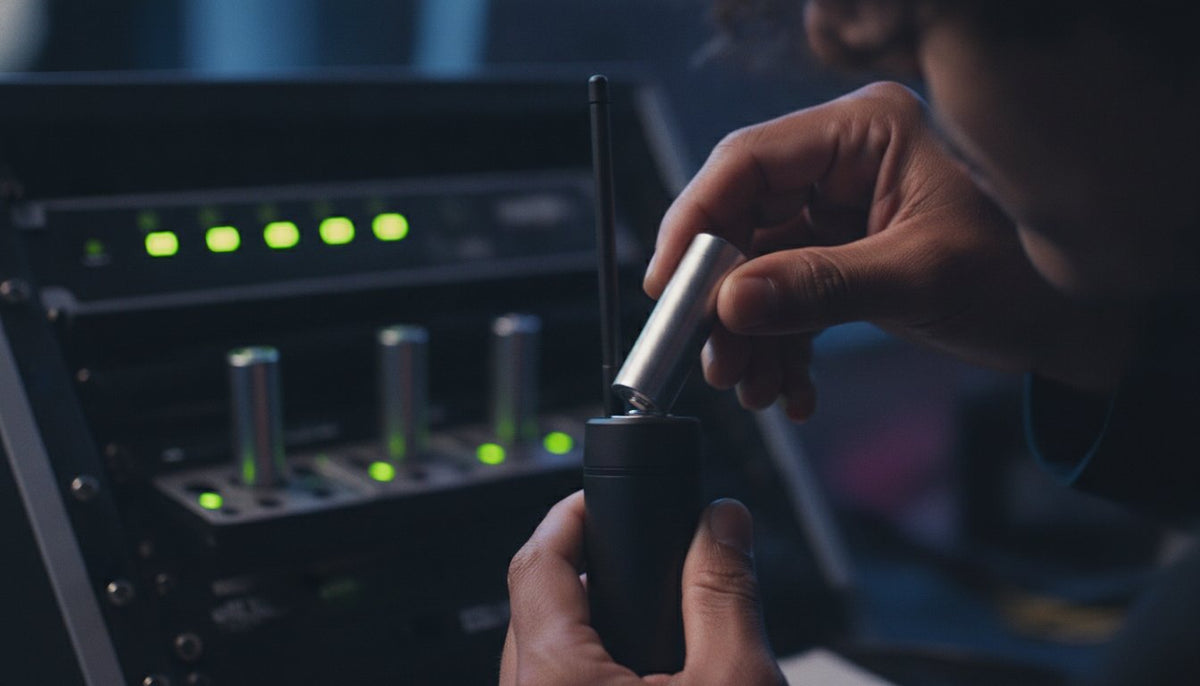
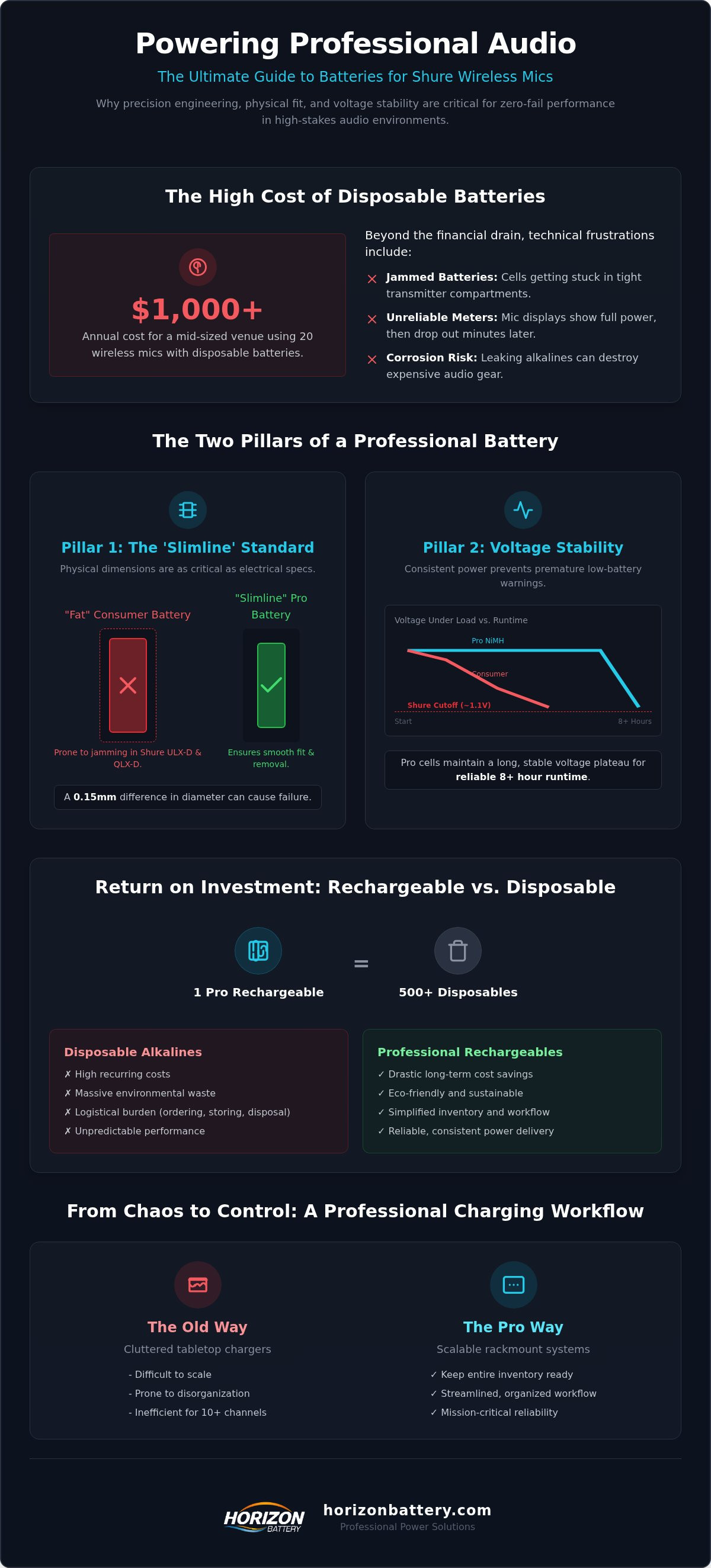
A mid-sized church using 20 wireless microphones can spend over $1,000 every year on disposable alkaline batteries. While the financial drain is significant, the technical frustration is often worse. You have likely experienced the stress of a battery getting stuck in a tight transmitter compartment or watched a mic display show full bars only to have the signal drop out minutes later. Reliability in professional audio requires more than just high capacity; it requires precision engineering.
Finding the best rechargeable batteries for Shure wireless mics is a matter of matching physical tolerances with consistent voltage output. You need cells that slide in and out of your gear easily and provide a predictable discharge curve you can trust during a live broadcast. This guide will explain why professional audio engineers prioritize specific slimline dimensions and 1.5V stability to ensure zero-fail performance.
We will examine the latest 2026 standards for high-capacity NiMH and Li-ion solutions. You will learn how to achieve a reliable 8+ hour runtime and build a scalable charging workflow that keeps your entire wireless inventory ready for the stage.
Key Takeaways
- Learn why "slimline" cell dimensions are essential for Shure ULX-D and QLX-D transmitters to prevent batteries from jamming in tight compartments.
- Understand the technical difference between standard NiMH cells and the Pure Power Series to eliminate premature low-battery warnings on your receivers.
- Identify the best rechargeable batteries for Shure wireless mics based on your specific needs for either daily high-capacity use or mission-critical 1.5V stability.
- Discover how to transition from cluttered tabletop chargers to professional rackmount systems that facilitate a scalable workflow for 10 or more wireless channels.
- Evaluate the operational benefits of curated battery bundles that provide a higher return on investment than traditional alkaline disposables.
Why Shure Wireless Systems Require Professional-Grade AA Power
High-stakes audio environments demand more than just a power source; they require a predictable energy discharge. Shure transmitters are precision instruments designed to monitor cell health in real time. When you select the best rechargeable batteries for Shure wireless mics, you aren't just buying capacity. You are investing in a cell that maintains a stable voltage plateau throughout the duration of a performance. Consumer-grade batteries often fail here, dropping their voltage output too early and triggering false "low battery" warnings on the receiver. This forces engineers to swap batteries prematurely, leading to wasted energy and unnecessary stress during a live event.
The standard for professional audio has shifted toward cells that can handle high-drain digital circuitry without sagging. Standard alkaline batteries are prone to leakage, which can corrode the internal contacts of a transmitter worth thousands of dollars. Professional-grade Nickel-Metal Hydride (NiMH) batteries offer a safer, more consistent alternative. These cells provide a steady flow of power that aligns with how Shure gear interprets remaining runtime, ensuring that your telemetry data remains accurate from soundcheck to the final curtain call.
Understanding the Voltage Cutoff in Wireless Transmitters
Shure wireless systems typically operate with a specific voltage cutoff, often around 1.1V. Once a battery drops below this threshold, the transmitter may shut down to protect the digital signal from artifacts or total dropout. There is a critical difference between nominal voltage and operating voltage. While a cell might be rated at 1.2V, its ability to stay above the 1.1V danger zone under a load is what determines its reliability. High-capacity professional cells are engineered to maintain their voltage plateau longer. This allows the mic to stay active for 8 to 12 hours, rather than dipping into the red after only 3 or 4 hours of use.
Alkaline vs. Rechargeable: The 2026 ROI Comparison
The financial argument for moving away from disposables is undeniable. A single high-quality rechargeable cell can replace 500 or more individual alkaline batteries over its lifespan. For large facilities like houses of worship or corporate event centers, this transition eliminates massive amounts of environmental waste. It also removes the logistical burden of ordering, storing, and disposing of thousands of alkalines every year. Beyond the savings, the performance of the best rechargeable batteries for Shure wireless mics provides a level of security that disposables cannot match. For more details on making this transition, see our guide on Switching to rechargeable batteries for business.
The 'Slimline' Standard: Solving the Tight Battery Compartment Issue
The "Fat Battery" problem is a persistent source of frustration for audio technicians using high-tier wireless systems. Many high-capacity NiMH cells are manufactured with a slightly larger diameter than standard alkalines to accommodate more active material. While these cells work in standard consumer electronics, they frequently jam in the precision-engineered sleds of Shure ULX-D and QLX-D transmitters. This physical mismatch isn't just an inconvenience; it often leads to damaged ejection springs or cracked battery compartments when users try to force a stuck cell out of the gear.
The best rechargeable batteries for Shure wireless mics must adhere to what the industry calls the "Slimline" standard. The primary culprit for fitment issues is often the battery jacket. Many consumer brands use thick, multi-layered plastic labels that add significant girth to the cell. In a professional wireless system, a difference of just 0.15mm can be the difference between a smooth swap and a mechanical failure. Consulting a professional wireless system battery guide confirms that physical dimensions are just as critical as electrical specifications in these mission-critical applications.
Why Ansmann 2850 mAh is the Industry Standard
Ansmann engineers their 2850 mAh cells with strict industrial tolerances to ensure they remain thin enough for professional AV gear. By using a specialized thin-film jacket and optimizing internal construction, they provide maximum capacity without increasing the outer diameter. This design prevents the friction-based jams that plague consumer "Pro" batteries. The Ansmann Slimline AA is the specific solution for Shure wireless transmitters, offering high-capacity power in a form factor that never compromises the hardware.
Compatible Shure Models for Slimline Cells
These slimline cells are essential for Shure QLX-D, ULX-D, and Axient Digital systems that utilize AA battery sleds. These systems are designed for rapid battery changes, and any resistance during insertion or ejection can slow down a stagehand or technician during a performance. Using Ansmann high capacity batteries ensures that the ejection mechanism works as intended every time. For production teams managing dozens of mics, pairing these cells with professional battery storage ensures that your inventory stays organized and your equipment remains in peak condition.
NiMH vs. Pure Power Lithium-Ion: Benchmarking for Pro Audio
Choosing the best rechargeable batteries for Shure wireless mics often comes down to a choice between two distinct chemistries: NiMH and regulated Lithium-Ion. The Ansmann 2850 mAh NiMH cell remains the industry workhorse for daily production. It provides a massive capacity that handles long rehearsals and multi-service Sundays with ease. However, for mission-critical broadcasts where every decibel of signal-to-noise ratio counts, the Pure Power Series Li-ion cells offer a different advantage. These cells utilize internal regulation to maintain a constant voltage, ensuring your transmitters operate at peak efficiency from the first minute to the last.
Most technicians are familiar with the "voltage sag" that occurs with standard rechargeable cells. As a battery drains, its voltage gradually drops. If this drop happens too quickly, the Shure telemetry system may report a "low battery" warning even if the cell still contains 40% of its energy. Regulated Li-ion chemistry eliminates this issue by holding a flat 1.5V curve. This results in more accurate telemetry and prevents the transmitter's RF output from weakening as the battery nears the end of its cycle.
Thermal management is another factor often overlooked. Professional cells like the Pure Power Series are designed to run cooler than consumer alternatives. In a handheld transmitter, excess heat can affect both the electronics and the comfort of the performer. High-quality cells dissipate heat more effectively, which is vital during high-power 10mW or 20mW transmissions. This stability ensures that the best rechargeable batteries for Shure wireless mics don't just last longer, but also protect the longevity of the mic itself.
The 1.5V Advantage of the Pure Power Series
Modern digital wireless systems are sensitive to voltage fluctuations. The Pure Power Series prevents the performance dips associated with traditional 1.2V NiMH cells by providing a regulated 1.5V output. This constant pressure is especially beneficial for long-range applications where maintaining maximum RF output is essential. Understanding professional lithium-ion voltage is key to choosing the right power source for high-stakes environments.
When to Stick with Ansmann NiMH
While Li-ion is a powerful tool, Ansmann NiMH cells remain a staple for many venues. If your facility already has a significant investment in NiMH-only charging infrastructure, sticking with high-capacity NiMH is a logical choice. These cells also excel in extreme temperatures, such as outdoor summer festivals, where Li-ion regulation circuits might be more sensitive. Additionally, the low self-discharge technology ensures that mics sitting in storage for a week will still have a full charge when they're pulled for the next event.
Implementing a Professional Charging and Storage Workflow
Managing a large inventory of the best rechargeable batteries for Shure wireless mics requires moving beyond consumer-grade tabletop chargers. In a professional environment, "wall wart" power supplies create cable clutter and multiple points of failure. High-density environments like theaters, churches, or broadcast studios need centralized systems that provide consistent charging currents to every cell simultaneously. Relying on a disorganized pile of small chargers often leads to half-charged cells reaching the stage, which is a risk no audio engineer should take. For those looking to upgrade their entire setup, HDTV Supply offers professional audio-visual equipment to ensure your facility's infrastructure is reliable and efficient.
Custom rackmount chargers eliminate the mess of power strips in your AV booth. These systems allow technicians to monitor the charge status of 16 or more cells at a single glance during rehearsals. By integrating power management directly into the equipment rack, you ensure that batteries are always where they need to be, fully charged and ready for the next session. For teams scaling their operations beyond a few channels, reviewing enterprise battery charging solutions is the first step toward a failure-free workflow. These systems provide the thermal management and circuit protection necessary for high-capacity cells.
Inventory Management for 50+ Cells
Effective management relies on a "First In, First Out" (FIFO) rotation strategy. Without a system, the same few batteries get used every day while others sit idle, leading to uneven wear and unpredictable runtimes. Labeling batches by date or serial number allows you to track usage cycles accurately and ensure even wear across your entire inventory. You should implement a battery storage management protocol that keeps charged and depleted cells physically separated. This prevents the nightmare scenario of a technician accidentally grabbing a dead battery minutes before a performance.
Regular testing is mandatory to maintain a professional standard. Modern chargers often include a capacity-test mode that identifies cells no longer meeting their mAh rating. If a cell consistently triggers a "low battery" warning earlier than the rest of its batch, it must be decommissioned and replaced. To upgrade your facility's power infrastructure, you can view our professional battery storage and rackmount charging bundles.
Horizon Battery Solutions for Shure Wireless Microphone Kits
Horizon Battery has spent years refining the hardware needed to support professional AV environments. We understand that finding the best rechargeable batteries for Shure wireless mics is only half the battle. The other half is ensuring those cells are paired with intelligent charging systems that maximize their longevity and reliability. Our curated bundles are designed to take the guesswork out of procurement. By combining high-capacity Ansmann 2850 mAh cells with professional-grade chargers, we provide a complete power ecosystem that production houses and houses of worship can depend on for every performance.
Standardizing on a single power platform through a specialized distributor offers significant operational benefits. Production houses often choose to standardize on the Pure Power Series or Ansmann cells because it simplifies inventory management and ensures consistent performance across dozens of wireless channels. This uniform approach reduces the training burden on stagehands and ensures that every microphone in the fleet behaves predictably. It also allows for a more streamlined procurement process when it is time to refresh your inventory.
Choosing the Right Charger / Battery Bundle
Selecting the correct bundle depends on your production schedule and the specific demands of your hardware. For facilities with back-to-back events, rapid charging systems are essential to ensure a quick turnaround between sessions. Conversely, venues with overnight downtime may prefer standard charging rates that prioritize long-term cell health. Our kits are customizable to accommodate different Shure form factors, whether you are powering handheld transmitters or belt-worn bodypacks. We also offer mobile energy solutions for touring professionals who need reliable power in a portable, ruggedized format.
Expert Support for US and Canadian Facilities
Horizon Battery serves as a primary source for national accounts across the United States and Canada. We provide bulk fulfillment services that ensure large-scale facilities have the inventory they need when they need it. Beyond simple distribution, our team acts as a knowledgeable guide for AV system designers. We provide direct access to technical specifications and performance data to help you architect a power system that meets your specific requirements. This level of specialized knowledge ensures that your investment in rechargeable technology delivers the maximum possible return. If you are ready to eliminate the waste and uncertainty of alkaline power, contact Horizon Battery to outfit your Shure wireless system today.
Secure Your Production with Professional Power
Transitioning to a professional rechargeable system is about more than just reducing waste. It's about achieving a level of reliability that consumer alkalines simply can't match. By prioritizing slimline cell dimensions and stable voltage output, you eliminate the mechanical jams and premature signal dropouts that plague standard setups. Whether you choose the massive capacity of NiMH or the constant 1.5V output of the Pure Power Series, selecting the best rechargeable batteries for Shure wireless mics ensures your focus remains on the performance, not the power meter.
Horizon Battery has been serving pro audio professionals since 1998. As an authorized Ansmann high-capacity distributor, we provide specialized solutions for Shure and Sennheiser systems that have been field-tested in the most demanding environments. Our rackmount charging systems and curated bundles offer a scalable alternative to disposable batteries. You can find everything you need to upgrade your facility's wireless infrastructure on our website.
Take the first step toward a zero-fail audio environment today. Shop Ansmann Slimline AA Bundles for Shure Wireless Mics and experience the confidence that comes with professional-grade energy solutions.
Frequently Asked Questions
Will Ansmann 2850 mAh batteries fit in my Shure ULX-D transmitters?
Yes, these cells are specifically engineered with slimline tolerances to prevent the fitment issues common with consumer rechargeables. Many high-capacity AA batteries are slightly wider than standard alkalines, causing them to jam in tight Shure battery sleds. Ansmann maintains a thinner diameter while still delivering 2850 mAh of capacity. This ensures your batteries slide in and out of the transmitter easily without damaging the internal ejection springs or the compartment housing.
Are Lithium-Ion AA batteries safe for professional wireless microphones?
Professional-grade regulated Lithium-Ion batteries like the Pure Power Series are perfectly safe and highly recommended for modern wireless systems. These cells include internal voltage regulation circuitry that provides a constant 1.5V output, which is different from the 3.7V found in unregulated lithium cells. This regulation prevents the voltage sag that can trigger premature low battery warnings. They also feature thermal management protections to ensure they remain cool during long high-power transmissions.
How many hours of runtime can I expect from Ansmann slimline AAs in a Shure mic?
You can typically expect between 8 and 12 hours of runtime when using these cells in a Shure digital transmitter. In real-world production environments, the Ansmann 2850 mAh provides a significantly longer plateau than standard alkaline batteries. Because they are among the best rechargeable batteries for Shure wireless mics, they maintain their voltage above the 1.1V cutoff point for much longer, giving you a wider safety margin during long events or services.
Do I need a special charger for Pure Power Series lithium-ion batteries?
Yes, you must use a charger specifically designed for 1.5V regulated Lithium-Ion AA cells. Standard NiMH chargers use a different charging algorithm that is incompatible with the internal circuitry of the Pure Power Series. Using the wrong charger can result in incomplete charges or damage to the cells. Horizon Battery provides specialized charger and battery bundles to ensure that your charging infrastructure is perfectly matched to your battery chemistry for maximum safety.
Why do my rechargeable batteries show 'low' on the Shure display even when fresh?
This occurs because most Shure displays are calibrated for the 1.5V starting point of alkaline batteries. Standard NiMH rechargeable cells have a nominal voltage of 1.2V. The mic interprets this lower starting voltage as a partially depleted battery, even if the cell is fully charged. To resolve this, you can either adjust the battery type settings in your transmitter menu or switch to the Pure Power Series, which provides a constant 1.5V output.
Can I mix different brands of rechargeable batteries in a wireless microphone kit?
No, you should never mix different brands, capacities, or ages of batteries within a single transmitter. Mixing cells can lead to uneven discharge rates, where one battery drains faster and potentially forces the other into a deep discharge state. For the best rechargeable batteries for Shure wireless mics, always use matched pairs from the same batch. This ensures consistent internal resistance and predictable runtimes across your entire inventory of wireless channels.
What is the lifespan of Ansmann professional rechargeable batteries?
Ansmann professional NiMH cells are typically rated for 500 to 1,000 charge cycles. For a facility using their wireless mics once or twice a week, a single set of batteries can provide several years of reliable service. This lifespan offers a massive return on investment compared to purchasing thousands of disposable alkalines. To maximize this lifespan, it's important to use high-quality chargers that include overcharge protection and thermal monitoring to prevent chemical degradation.
How should I store my rechargeable batteries between Sunday services or theater runs?
Batteries should be stored in dedicated battery storage cases to keep them organized and prevent the terminals from touching other metal objects. This prevents accidental short-circuiting and keeps your charged and depleted inventory clearly separated. Store your cells in a cool, dry environment at room temperature. If you don't plan to use your NiMH batteries for several weeks, it's best to store them with a partial charge to maintain their chemical health over time.