
Imagine the lead vocalist's wireless microphone cutting out during the most critical moment of a live broadcast, even though the transmitter's telemetry showed two bars of power just moments before. This nightmare scenario is often the result of voltage sag, a phenomenon where standard batteries lose the strength to power high-drain professional gear under load. Understanding professional lithium-ion voltage is no longer just a technical curiosity; it's a requirement for anyone managing high-stakes production environments in 2026.
You likely already know that relying on traditional alkalines or unmanaged rechargeables is a gamble that leads to unpredictable equipment shutdowns and skyrocketing operating costs. This article will show you how to achieve a stable 1.5V output throughout an entire discharge cycle, ensuring your battery telemetry remains accurate and your gear stays powered. We'll examine the technical reality of the 3.7V versus 1.5V debate, explain the impact of new 2026 shipping regulations on your fleet management, and demonstrate why regulated lithium-ion cells like the Pure Power Series provide a superior return on investment for professional facilities.
Key Takeaways
- Identify the root cause of premature equipment failure and learn how to stabilize power delivery for critical wireless gear.
- Understand the mechanics of internal regulation that keeps professional lithium-ion voltage at a constant 1.5V throughout the entire discharge cycle.
- Compare the flat discharge curve of the Pure Power Series against standard NiMH to ensure predictable battery telemetry during live events.
- Learn to implement a "Charge-Use-Rotate" system with rackmount charging solutions to maximize the lifespan of your high-capacity battery fleet.
- Discover how transitioning from alkaline to professional lithium-ion significantly reduces long-term operating costs for large-scale facilities.
The Voltage Sag Myth: Why Professional Gear Fails Early
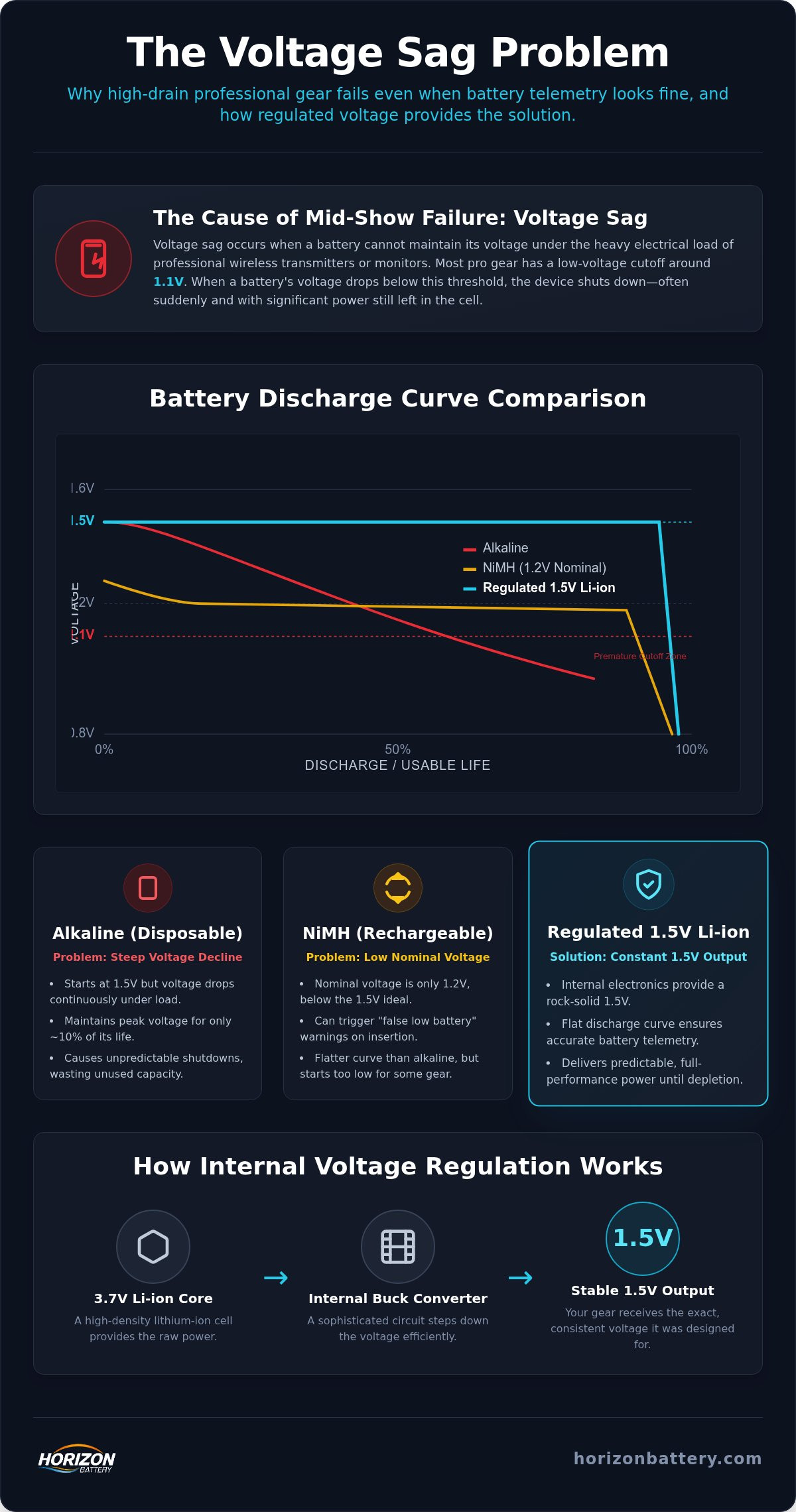
Professional audio engineers and AV technicians often encounter a frustrating phenomenon known as voltage sag. This occurs when a power source cannot maintain its nominal voltage under the electrical load of a high-performance device. In professional wireless transmitters, even a minor dip in potential can lead to catastrophic results. While a standard Lithium-ion battery cell typically operates at a nominal 3.6V or 3.7V, professional grade solutions must bridge the gap for devices designed for 1.5V inputs. Maintaining consistent professional lithium-ion voltage is the only way to ensure gear doesn't drop out mid-performance.
There is a common misconception that rechargeable cells are inherently "weaker" than disposable ones. This stems from decades of experience with older chemistries that struggled to hit the 1.5V mark. Modern engineering has solved this problem. Stable voltage doesn't just keep the lights on; it prevents RF interference and audio artifacts that occur when a transmitter's internal oscillators struggle with fluctuating power. When voltage stays locked at the required level, the device operates within its ideal electrical parameters, providing the clean signal professionals demand.
Understanding the Alkaline Decline
Traditional alkaline batteries follow a steep, sloping discharge curve. While they start at 1.5V, they don't stay there for long. In most high-drain applications, an alkaline cell only maintains its peak voltage for approximately the first 10% of its usable life. As the chemistry depletes, the voltage drops steadily. Most professional AV equipment is calibrated with a "low battery" warning threshold around 1.1V. Once the battery sags to this level, the device may shut down or exhibit erratic behavior, even if there is still significant chemical energy left in the cell. This inefficiency leads to wasted batteries and unpredictable uptimes.
The NiMH 1.2V Limitation
Nickel-Metal Hydride (NiMH) batteries present a different challenge for the modern technician. Physically, the chemistry of a NiMH cell is limited to a nominal 1.2V. While they offer a flatter discharge curve than alkaline, they start well below the target voltage of many sensitive professional devices. This lower starting point means the gear's telemetry often interprets the battery as partially depleted from the moment it's inserted.
Certain types of gear frequently reject 1.2V cells or trigger premature "low battery" alerts, including:
- Digital wireless microphone transmitters
- In-ear monitor (IEM) beltpacks
- High-end portable audio recorders
Without the ability to reach a true 1.5V, these cells often lead to "false positives" on battery telemetry. This leaves technicians guessing about remaining runtime during a live production. Switching to a regulated lithium-ion solution eliminates this guesswork by providing the 1.5V potential the gear was designed to use.
1.5V vs. 3.7V: Decoding Internal Voltage Regulation
Raw lithium-ion chemistry is fundamentally different from the zinc-carbon or alkaline cells of the past. At its core, a single lithium-ion cell produces a nominal potential of 3.6V to 3.7V. This discrepancy often leads to significant Confusion with Voltages among technicians who fear that inserting a lithium cell into a device designed for 1.5V will result in immediate hardware failure. However, professional lithium-ion voltage is achieved through sophisticated internal regulation that makes these batteries safe for sensitive electronics.
The primary difference between consumer-grade and professional-grade cells lies in the quality of this regulation. Professional units utilize high-performance circuit boards that maintain a rock-solid 1.5V output regardless of the raw cell's state of charge. This ensures your gear receives the exact power it expects without the risk of over-voltage. High-quality components also ensure that the electrical noise generated during the regulation process is kept to a minimum, which is critical for audio and RF applications.
How the Internal Buck Converter Works
The engineering centerpiece of a 1.5V lithium-ion AA is the internal buck converter. This component acts as a high-speed switch that steps down the native 3.7V to a precise 1.5V. Professional-grade cells prioritize heat management during this process, using efficient components that prevent the battery from warming up during high-drain use. A buck converter is a DC-to-DC power converter that steps down voltage while stepping up current to provide a regulated output. This process ensures the energy remains stable even as the internal lithium core depletes. For those managing large inventories, choosing a Pure Power Series solution provides the reliable regulation needed for mission-critical hardware.
The 'Cliff Effect' in Regulated Cells
One of the most distinct characteristics of regulated lithium-ion is the "cliff effect." Unlike alkaline batteries that slowly lose power, a regulated cell stays at a constant 1.5V until the internal lithium core reaches its minimum safe threshold. At that point, the regulator shuts off the output entirely to protect the chemistry. This creates a trade-off: you get 100% performance for the entire duration of the charge, but you lose the traditional "low battery" warning provided by a declining voltage curve.
Maintaining a consistent professional lithium-ion voltage is essential for managing these high-stakes environments where a sudden loss of audio can ruin a recording. To manage this in professional environments, technicians should move away from monitoring voltage bars and instead rely on timed rotations. Knowing your gear's specific runtime allows you to swap batteries before the cliff is reached, ensuring uninterrupted performance throughout the event.
Constant Voltage Performance: The Physics of Pure Power
Production environments in 2026 demand more than just raw capacity; they require electrical consistency. The Pure Power Series addresses this by utilizing advanced Lithium-ion battery technology to deliver a flat discharge curve. Unlike traditional cells that lose strength as they drain, these regulated batteries maintain a locked 1.5V output until the internal charge is fully depleted. This constant 1.5V output has become the "Gold Standard" for wireless microphones and mission-critical AV gear. It ensures that internal components operate within their intended specifications, which results in cleaner RF signals and more reliable audio capture. By preventing the slow decay of voltage, these cells also reduce the thermal stress on equipment, effectively extending the lifespan of both the battery and the gear it powers.
Maintaining professional lithium-ion voltage is also an environmental win for large facilities. When batteries provide a predictable, full-strength output, technicians don't feel the need to discard "half-full" batteries before a major segment. This predictability reduces total battery waste and lowers the long-term operating costs for theaters, houses of worship, and broadcast studios. The steady performance ensures that every milliampere-hour is used effectively, providing a level of reliability that standard rechargeables simply cannot match.
Pure Power Series vs. Ansmann Technology
While the Pure Power Series is ideal for gear requiring a strict 1.5V potential, some applications still benefit from the high-capacity NiMH chemistry found in Ansmann high capacity batteries. NiMH is often the preferred choice for legacy equipment or devices that don't have sensitive digital telemetry. Choosing between these two depends on your specific gear's tolerance for the 1.2V NiMH curve versus the need for constant 1.5V lithium power. For a deeper look at which chemistry fits your inventory, refer to the Ansmann vs Pure Power comparison. Generally, if your gear triggers "low battery" alerts prematurely, the regulated lithium-ion option is the superior solution.
High-Drain Efficiency
High-end audio transmitters often experience sudden current spikes during signal peaks or high-power RF transmissions. Professional lithium-ion voltage is designed to handle these spikes without the momentary dips that plague standard batteries. This resilience ensures that the real-world runtime matches the cell's rated capacity, even under heavy load. Furthermore, professional lithium-ion remains remarkably stable in extreme temperatures. Whether you're filming in a cold outdoor environment or a hot studio, the internal regulation keeps the output at 1.5V. This thermal stability is a key advantage for professionals who cannot afford to let environmental factors dictate their equipment's reliability.
Managing High-Voltage Li-ion Assets in Professional Environments
Outdoor enthusiasts who use high-drain electronics like GPS units in the field face similar challenges with signal and power; you can discover Vse za Lov in Prosti Čas for specialized advice on maintaining peak performance in remote areas.
Transitioning to a fleet of high-performance batteries requires a shift in how production teams manage their power inventory. Unlike standard alkaline cells that are used once and discarded, maintaining professional lithium-ion voltage involves a structured lifecycle. This starts with proper organization. Integrating Battery Storage into your workflow ensures that charged and depleted cells are never confused, which prevents the accidental use of an empty battery during a live event. Implementing a "Charge-Use-Rotate" system allows facilities to distribute wear evenly across their inventory, extending the total service life of every cell in the rack.
Identifying when to retire a cell is equally critical for maintaining reliability. While regulated lithium-ion provides a flat discharge curve, the internal chemistry will eventually degrade after hundreds of cycles. Professional environments should monitor for cells that take significantly longer to charge or those that exhibit unusual heat during use. Retiring these assets before they fail ensures that your equipment always receives the steady potential it requires for peak performance. A proactive replacement strategy is the only way to guarantee 100% uptime in high-stakes environments.
Charging Protocols for Lithium-Ion
You cannot use a standard NiMH charger for Pure Power Series cells. The internal buck converters and lithium chemistry require a specific charging profile that differs significantly from nickel-based cells. Using the wrong charger can lead to incomplete charges or damage to the internal regulation circuitry. For large microphone fleets, multi-channel charging systems are the most efficient choice. These systems provide independent monitoring for each cell, ensuring that every battery in the tray reaches its full potential. When selecting hardware, prioritize safety features such as overcharge protection, short-circuit prevention, and thermal monitoring to protect your high-value assets. This commitment to safety and high-drain performance is also a priority for specialized retailers like Andy's Vape Shop, who provide quality kits and e-liquids for discerning users.
Large organizations like schools and churches often see the fastest return on investment when switching from disposables. Calculating the ROI of professional lithium-ion involves looking beyond the initial purchase price to the thousands of alkaline batteries that are no longer being bought and trashed. To maximize this return, technicians should label and date every cell. This allows for consistent performance monitoring and ensures the oldest cells are cycled out first. Centralizing power management with custom rackmount chargers allows teams to see the status of their entire inventory at a glance. This organized approach maintains the professional lithium-ion voltage your gear depends on while reducing the chaos of loose batteries in a drawer. Explore our Charger and Battery Bundles to find the right infrastructure for your facility.
Standardizing Your Power: Horizon Battery’s Pure Power Solutions
Since 1998, Horizon Battery has served as a primary source for the professional audio and AV industries. We understand that technical specifications like professional lithium-ion voltage aren't just numbers on a datasheet; they're the difference between a successful production and a costly equipment failure. Standardizing your facility on the Pure Power Series eliminates the variables that lead to gear instability. By providing a regulated, consistent 1.5V output, these cells allow your team to focus on the performance rather than the power supply. Our role as a veteran distributor is to act as your knowledgeable guide, ensuring you have the right chemistry for every application in your inventory.
Transitioning to a professional rechargeable fleet is a strategic move that pays dividends in both reliability and operational savings. It's not just about replacing a single battery; it's about building a dependable infrastructure. We provide the specialized knowledge and hardware required to manage large-scale battery fleets with precision. From small theaters to massive corporate campuses, our solutions are designed to handle the rigorous demands of professional use while maintaining a formal, business-to-business standard of quality.
The Pure Power Series Advantage
The engineering behind the Pure Power line specifically targets the needs of modern production environments. High-interference settings, such as crowded RF stages or dense broadcast studios, require power that doesn't fluctuate or introduce electrical noise. Our regulated cells provide that essential stability. This reliability is why major audio houses trust Horizon Battery for mission-critical applications. It's not just about the high-capacity engineering; it's about the confidence that your wireless transmitters will perform exactly as expected from the first minute of the show to the last. Maintaining a steady professional lithium-ion voltage ensures your gear remains within its optimal operating parameters at all times.
Ready to Upgrade Your Power Infrastructure?
Moving a large facility away from alkaline disposables requires a methodical approach. It's best to start by auditing your current gear list to determine which devices require the constant 1.5V of the Pure Power Series and which can utilize our high-capacity NiMH options. We offer a wide-reaching scope of solutions, from individual starter kits to Custom Rackmount Chargers designed for enterprise-scale management. These centralized systems simplify the workflow for your technicians and ensure that every cell is ready for the next shift. Our methodical approach to charging and storage ensures your inventory remains organized and efficient.
Our team is ready to consult with you on your specific charging needs. Whether you're managing a dozen wireless mics or a multi-room broadcast facility, we can help find the right Charger / Battery Bundles to optimize your operations. We invite you to explore our full inventory of AA Rechargeable Batteries and professional charging solutions to take the first step toward a more reliable, cost-effective power strategy for 2026.
Securing Your Production Power for the Future
Mastering the mechanics of professional lithium-ion voltage is the first step toward eliminating unpredictable equipment failures in your facility. By moving away from the sloping discharge curves of alkaline and the low-voltage limitations of NiMH, you provide your hardware with the stable electrical foundation it was designed to use. This transition ensures that your telemetry remains accurate and your signal stays clean. Even during the most demanding high-drain sequences, your gear will perform exactly as expected.
Horizon Battery remains a trusted partner for major US media houses and churches. We provide industry-leading 1.5V regulation that stands up to mission-critical pressure. Whether you need individual kits or custom rackmount charging solutions for enterprise-scale management, our team has the expertise to help you standardize your power infrastructure. It's time to stop gambling with disposable cells and invest in a system that offers both performance and long-term value. We're here to help you power your next project with confidence.
Upgrade to Professional 1.5V Pure Power Series Today
Frequently Asked Questions
Is 1.5V lithium-ion better than 1.2V NiMH for wireless mics?
Yes, 1.5V lithium-ion is superior for wireless microphones because it maintains a stable potential throughout the entire use cycle. Standard NiMH cells begin at 1.2V and decline quickly, which often triggers premature low-battery alerts on professional transmitters. By using a regulated 1.5V output, you ensure that your gear operates at its peak efficiency without the risk of audio artifacts or signal dropouts caused by voltage sag.
Can I use a standard AA charger for Pure Power Series lithium batteries?
You cannot use a standard NiMH or alkaline charger for these cells. The Pure Power Series requires a dedicated charging profile designed to handle the internal lithium chemistry and regulation circuitry safely. Using incompatible hardware can lead to incomplete charges or permanent damage to the cell's internal buck converter. We recommend using our specialized Charger / Battery Bundles to ensure your fleet remains in optimal condition.
Will a 1.5V lithium-ion battery damage my older electronics?
No, these batteries won't damage your legacy gear. The internal electronics of a professional 1.5V lithium cell act as a safety barrier, stepping down the raw 3.7V potential to a precise 1.5V. This makes them a direct, safe replacement for any device designed for standard AA alkaline batteries. Your older electronics will receive the exact voltage they require without the risk of over-voltage or thermal damage during operation.
How do I know when my 1.5V lithium battery is almost dead?
Traditional voltage bars on your gear won't provide an accurate warning. Because the internal regulator keeps the output at a constant 1.5V, the meter will show "full" until the battery is completely exhausted. To manage this in professional settings, we recommend implementing a timed rotation system. Knowing your equipment's typical runtime allows you to swap cells before they hit the "cliff" and shut down unexpectedly during an event.
What happens if I accidentally use a NiMH charger on a lithium-ion cell?
Using a NiMH charger on a lithium-ion cell usually results in a failed charge cycle. NiMH chargers use different detection methods to stop the charging process, which aren't compatible with lithium-ion requirements. This mismatch can stress the internal components of the battery or the charger itself. It's critical to use the correct charging hardware to maintain consistent professional lithium-ion voltage and avoid compromising your equipment's safety or long-term reliability.
How many charge cycles can I expect from professional lithium-ion voltage cells?
You can expect hundreds of reliable cycles from high-quality cells designed for professional lithium-ion voltage standards. While the exact number depends on your specific discharge rates and environmental conditions, these batteries are built for longevity in demanding AV environments. Over time, the cost per use becomes significantly lower than purchasing thousands of alkaline disposables. Proper maintenance and using dedicated rackmount chargers will help maximize the total lifespan of your battery fleet.
Why does my gear show a full battery until the moment it dies?
Your gear's battery meter measures voltage to estimate remaining life. Since regulated lithium-ion cells hold a steady 1.5V until they are empty, the meter perceives the battery as being at 100% capacity for the entire duration. This "cliff effect" is a direct result of the internal regulation that ensures your gear gets full power until the very end. It's a necessary trade-off for the constant performance required in professional audio applications.
Are regulated 1.5V lithium batteries safe for high-heat environments?
Professional-grade cells are designed with internal safety circuits to handle the heat generated during normal operation. However, extreme external temperatures can impact the efficiency of the internal voltage regulator and the raw lithium core. For mission-critical events in hot environments, ensure your equipment has adequate ventilation. Using centralized rackmount charging systems also helps with thermal management by providing better airflow than crowded portable chargers during the replenishment cycle.