

What if the difference between a successful live broadcast and a total technical failure wasn't the quality of your microphone, but the discipline of your charging station? For many organizations, battery maintenance for professionals is often treated as an afterthought until a critical cell fails during a high-stakes performance. You likely already know the frustration of high replacement costs and the disorganized chaos of "dead cell" confusion. It's a common pain point that drains both your budget and your confidence in your equipment during live recordings.
Horizon Battery has served as a knowledgeable guide since 1998, and we believe that power reliability is a discipline of asset management rather than a simple charging habit. This article provides a comprehensive, professional-grade protocol designed to maximize the lifespan of your rechargeable inventory. We'll show you how to implement a repeatable system that ensures zero technical failures. You will learn how to integrate high-capacity solutions like the Pure Power Series into a structured cycle of testing and environmental control. From custom rackmount chargers to precise storage standards, this 2026 checklist offers the steady reliability your professional applications demand.
Key Takeaways
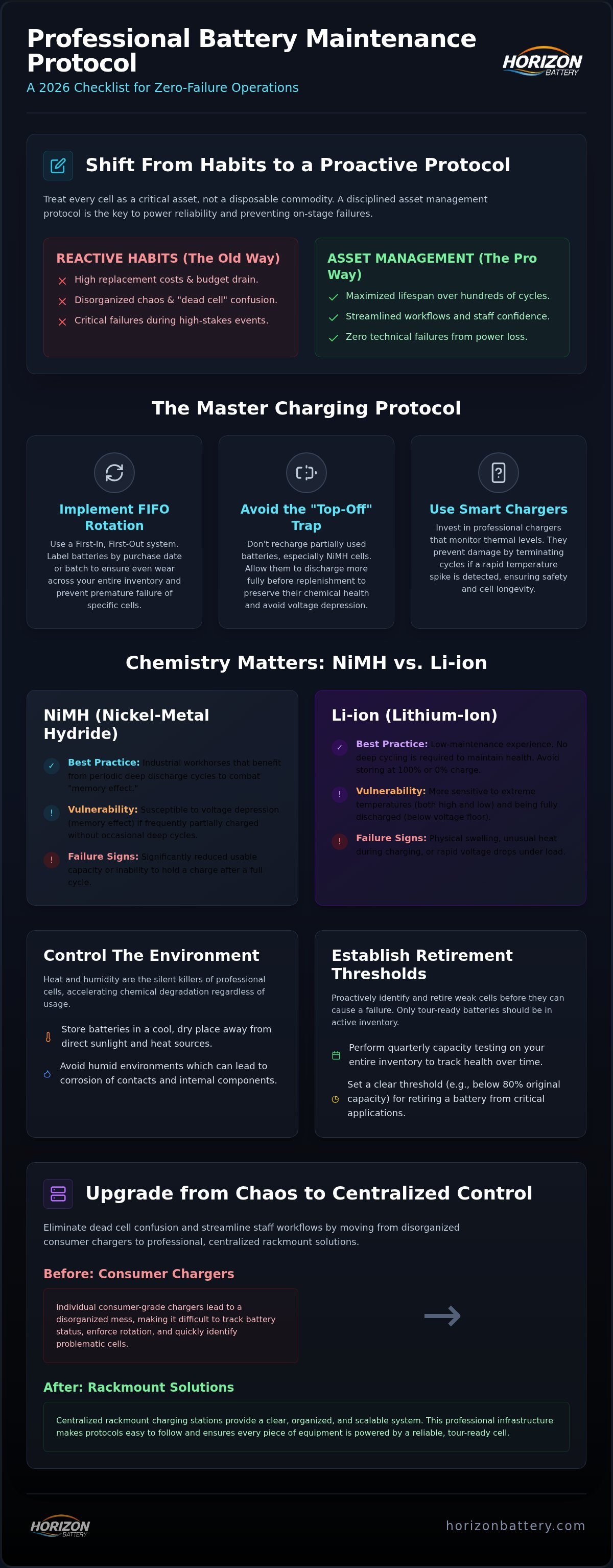
- Shift from reactive habits to a proactive asset management protocol to ensure power reliability for every mission-critical application.
- Implement a First-In, First-Out rotation and avoid partial charging traps to preserve the chemical integrity of your NiMH and Li-ion cells.
- Master the essential standards of battery maintenance for professionals by controlling environmental factors like heat and humidity that accelerate chemical degradation.
- Establish clear thresholds for retiring assets through quarterly capacity testing, which ensures only tour-ready batteries remain in your active inventory.
- Upgrade from disorganized consumer chargers to centralized rackmount solutions to eliminate dead cell confusion and streamline staff workflows.
Why Professional Battery Maintenance Differs from Consumer Habits
Professional equipment doesn't just sit in a drawer between uses. It's cycled daily under demanding conditions. The 2026 standards for high-capacity rechargeable cells emphasize stability under heavy load, which requires a departure from casual consumer habits. For a homeowner, using a battery until it dies is standard practice. In a high-stakes AV environment, that approach is a recipe for technical failure. Effective battery maintenance for professionals treats every cell as a critical asset rather than a disposable commodity. It requires a proactive protocol that tracks charge cycles and discharge rates with precision. This level of oversight often utilizes a sophisticated battery management system (BMS) to balance cells and prevent damaging over-discharge.
The Cost of Neglect in Professional Environments
Inventory management at scale is a financial discipline. Consider a large-scale facility managing an inventory of 500 high-capacity AA cells. A failure to maintain these assets leads to premature replacement and significant waste. However, the hidden costs are often more damaging than the hardware price. A single wireless microphone dropout during a live broadcast can compromise a production's reputation and lead to costly re-shoots. When switching to rechargeable batteries for business, the mindset must change from disposable to durable. Proper care ensures that your investment provides a reliable return over hundreds of cycles, maintaining the steady performance your clients expect.
Chemistry Matters: NiMH vs. Lithium-Ion Requirements
Understanding the specific needs of different chemistries is vital for long-term reliability. NiMH batteries are industrial workhorses, but they require specific attention to remain healthy. They benefit from periodic deep discharge cycles to combat the "memory effect" that can reduce usable capacity over time. Conversely, our Pure Power Series Li-ion cells provide a more streamlined, low-maintenance experience. These cells don't require deep cycling to maintain their health; however, they are more sensitive to extreme temperatures and voltage floors. Professionals must learn to identify chemistry-specific failure signs. Physical swelling, unusual heat during a charge, or rapid voltage drops are clear indicators that a cell is no longer tour-ready. Catching these issues before they reach the stage is the hallmark of a seasoned technician who values performance and safety.
The Master Charging Protocol: Managing Cycles for NiMH and Li-ion
Methodical rotation is essential for consistent performance across a large inventory. Implementing a First-In, First-Out (FIFO) system ensures that no single batch of cells bears the brunt of every production. By labeling batteries with purchase dates or batch numbers, you can track usage and ensure even wear across your entire stock. This even distribution of wear is a fundamental pillar of battery maintenance for professionals, preventing the premature failure of individual cells within a larger set.
Many technicians fall into the "top-off" trap, where cells are returned to the charger after only brief periods of use. NiMH cells are particularly susceptible to voltage depression when they are frequently partially charged. If you only use a battery for a short duration, don't immediately return it to the charger. Instead, let it cycle down to a lower state of charge before replenishment to maintain its chemical health. For those managing enterprise-level inventories, investing in professional-grade charger / battery bundles provides the necessary hardware to execute this protocol with precision.
Smart chargers act as the gatekeepers of your inventory. These units monitor thermal levels and can isolate a single defective cell before it damages the surrounding batch. Heat is the primary enemy of chemical stability; therefore, temperature monitoring during the charge cycle is non-negotiable. If a charger detects a rapid temperature spike, it should automatically terminate the cycle to prevent thermal stress and potential safety hazards.
Optimizing the Charge Cycle
While rapid replenishment is tempting during back-to-back events, ultra-fast charging often sacrifices long-term cycle life. Lower charge rates generate less internal heat and preserve the integrity of the internal separator. A robust strategy for battery maintenance for professionals must also account for the specific charging phases of each cell. The saturation stage is the final phase of a charge cycle where the current tapers down as the battery reaches its maximum voltage capacity, ensuring a full chemical reaction without overstressing the cell.
Li-ion Specific Care for Pure Power Series
Our Pure Power Series Li-ion cells offer a distinct advantage with their constant 1.5V output, but they require specific handling to maintain this stability. Unlike NiMH, lithium assets should never be stored fully charged or completely empty for extended periods. Following the established standards for lithium ion battery storage at a 40-60% charge level is critical for preventing chemical stagnation. Deep discharge remains the greatest threat to Li-ion health. If a cell drops below its critical voltage floor, the internal protection circuit may permanently disable it to ensure safety, making it unusable for future productions.
Climate and Environment: The Silent Killers of Professional Cells
Climate factors often act as invisible agents of degradation, silently undermining the reliability of your power assets. In the context of battery maintenance for professionals, environmental management is just as critical as the charging cycle itself. One of the most vital concepts to understand is the "10-Degree Rule." This principle states that for every 10°C (18°F) rise above the recommended operating temperature, the rate of chemical degradation within a cell approximately doubles. This exponential acceleration means that leaving gear in a hot vehicle or near a radiator doesn't just drain the charge; it permanently reduces the total lifespan of the battery.
Humidity is another silent threat that targets the physical integrity of the cell. High moisture levels lead to terminal corrosion, especially in high-capacity AA rechargeable batteries. This corrosion creates resistance at the contact point, which forces the device to draw more current and generates even more heat. For crews operating in unheated warehouses or trucks, "cold soak" becomes a major logistical hurdle. When batteries are chilled, their internal resistance increases significantly, leading to sluggish performance or premature "low battery" warnings even if the cell is full. Maintaining a stable environment prevents these fluctuations and ensures your equipment performs as expected when it matters most.
Ideal Storage Conditions for Enterprise Fleets
Maintaining a large inventory requires a centralized, climate-controlled environment. The "Gold Zone" for battery longevity is between 15°C and 25°C (59°F to 77°F). Storing assets within this range ensures that chemical reactions remain stable and self-discharge rates are kept to a minimum. For large-scale charging stations, ventilation is mandatory. Multiple chargers running simultaneously can quickly raise the ambient temperature of a small room beyond safe limits. To further protect individual cells, many organizations use AA battery storage cases to create a protective micro-climate. These cases prevent terminal shorting and act as a buffer against rapid humidity fluctuations during transport.
Field Maintenance for Production Crews
On-site conditions rarely mirror the controlled environment of a warehouse. Production crews working in outdoor venues must be vigilant against salt air and moisture, which can bridge contacts and cause micro-shorts. A critical part of battery maintenance for professionals is the acclimation period. If batteries have been stored in a cold truck, they must reach room temperature before being placed on a charger. Charging a "cold-soaked" cell can cause internal plating, which permanently damages the chemistry and reduces the cell's capacity. Finally, establish a regular cleaning protocol. Using a lint-free cloth and a small amount of isopropyl alcohol to wipe down battery contacts ensures maximum conductivity. This simple step prevents the build-up of oils or oxidation that can impede power delivery during a live recording or performance.
Asset Management and Testing: Preventing On-Stage Failures
Professional battery maintenance for professionals relies on data rather than guesswork. A battery might show a full charge on a standard consumer meter yet fail the moment it's subjected to the load of a wireless transmitter. Implementing a quarterly capacity test is the industry standard for maintaining a tour-ready fleet. This process involves a controlled discharge to verify that the cell still holds at least 80% of its original rated capacity. If a cell falls below this threshold, it triggers the "Retire and Re-purpose" protocol. While these cells are no longer suitable for mission-critical stage gear, they can still provide value in low-drain office peripherals or non-essential equipment.
Physical audits are just as important as electronic testing. Technicians should follow a visual inspection checklist before every deployment to catch physical indicators of failure. Look for chemical leaks or white powdery residue around the terminals, physical bulges in the casing, and deep scratches that might compromise the cell's integrity. Maintaining a logbook is also fundamental for tracking the life cycle of your assets. Whether you track cycles per individual cell or by batch bundles, this historical data allows you to predict failure points before they occur on stage.
Testing for Internal Resistance
Voltage alone is a deceptive metric for determining battery health. A damaged or aging cell can often reach its target voltage while its internal chemistry is significantly degraded. Professional technicians use specialized testers to identify "high-impedance" cells that can no longer deliver current effectively. High internal resistance causes a significant voltage drop the moment a device is powered on, which often leads to immediate equipment shutdowns in high-drain professional tools. Identifying these outliers ensures that only the most stable cells make it into your active production inventory.
Inventory Tracking Systems
Managing large battery pools requires a systematic organizational approach. Color-coding batches by purchase date or production quarter allows for rapid visual identification of older stock during a busy load-in. For enterprise-level facilities, integrating rechargeable battery inventory management software provides a digital logbook to track performance trends over time. For mission-critical wireless microphone applications, we recommend a "Stress Test" protocol where the battery is briefly monitored under full load to ensure voltage stability. Secure your next production by upgrading to Pure Power Series cells designed to withstand these rigorous professional testing standards.
Professional Infrastructure: Rackmount Solutions and Inventory Systems
The final component of a successful power strategy is the physical infrastructure used to house and charge your assets. Relying on a collection of consumer-grade 'wall-wart' adapters often leads to disorganized charging stations and neglected battery batches. Effective battery maintenance for professionals requires a centralized system that integrates directly into your existing technical environment. By transitioning to custom rackmount chargers, you eliminate the clutter of loose cables and create a dedicated hub for inventory oversight. This level of organization ensures that every cell is accounted for and properly cycled through your established FIFO rotation. It prevents the 'dead cell' confusion that often plagues facilities using scattered, non-standardized charging hardware.
Centralized charging racks do more than just save space. They're engineered to improve airflow and temperature regulation, which we've identified as critical factors for chemical longevity. Unlike a pile of individual chargers that trap heat against one another, rack-mounted units allow for consistent thermal dissipation across all cells. Standardizing on professional Battery Storage solutions further enhances this organization. It provides a clear visual indicator of which batteries are ready for the stage and which are in the queue for testing. This systematic approach reduces the risk of thermal stress and ensures your high-capacity assets remain stable over hundreds of cycles.
Benefits of Custom Rackmount Charging
Custom rackmount charging offers significant space efficiency in crowded AV racks or server rooms. A single 2U or 3U unit can replace dozens of individual plugs, simplifying your cable management and ensuring compliance with fire safety standards. For client-facing production environments, these solutions provide a clean, industrial aesthetic that reflects your organization's commitment to reliability. It's a visual cue to high-profile clients that your facility operates with a veteran level of precision. Eliminating the rat's nest of cables also makes it easier for staff to perform routine inspections and terminal cleaning.
Scaling Your Professional Power System
As your facility grows, your power system should remain modular. Building specific charger / battery bundles for different production teams allows for better accountability and easier load-outs. A scalable approach to battery maintenance for professionals involves future-proofing your racks with hardware compatible with Pure Power Series technology. This modularity allows you to add capacity without redesigning your entire power management workflow. You can deploy specialized kits for mobile crews while maintaining a centralized master inventory at the home base. To optimize your facility's power reliability, explore Horizon Battery's Custom Rackmount Solutions for your facility.
Securing Your Technical Infrastructure for 2026 and Beyond
Professional power management is more than just a charging habit; it's a discipline that ensures your equipment performs when the red light goes on. By implementing a systematic rotation and controlling environmental factors like temperature and humidity, you protect your inventory from the silent killers of chemical degradation. Adopting a rigorous protocol for battery maintenance for professionals transforms your power supplies from a recurring expense into a reliable, long-term asset. This methodical approach eliminates the uncertainty of "dead cell" confusion and protects your reputation during critical events.
Horizon Battery has been a trusted partner for major US venues since 1998. We specialize in solutions engineered for high-drain professional audio and provide custom-built rackmount hardware designed for enterprise-level reliability. Our Pure Power Series is specifically developed to meet the rigorous demands of modern production environments, ensuring your facility remains powered with precision and stability.
Upgrade your facility with professional-grade Pure Power Series batteries and chargers today. Taking control of your power management ensures that your team stays focused on the performance rather than the status of a battery cell. With the right infrastructure in place, you can move forward with the confidence that your power assets are tour-ready and reliable.
Frequently Asked Questions
How often should professionals perform a full capacity test on their batteries?
Professionals should execute a full capacity test at least once every quarter to maintain a reliable fleet. This frequency ensures that any degradation is caught before it leads to a failure during a live event. By discharging cells in a controlled environment, you can verify they still meet the 80% capacity threshold required for mission-critical applications. Regular testing is a cornerstone of effective battery maintenance for professionals who manage large-scale inventories.
Can I mix different brands of rechargeable batteries in the same professional device?
You should never mix different brands or even different batches of rechargeable batteries within a single device. Mixing cells leads to uneven discharge rates because internal resistance and chemical compositions vary between manufacturers. This imbalance can cause the stronger cell to drive the weaker one into a deep discharge state, which permanently damages the battery's chemistry. Always use matched sets from the same batch to ensure consistent voltage delivery.
What is the 'memory effect' and does it still apply to 2026 NiMH batteries?
The memory effect, technically known as voltage depression, still impacts modern NiMH batteries if they aren't managed correctly. It occurs when cells are repeatedly partially discharged and then recharged, causing them to remember the shorter cycle. While 2026 hybrid NiMH technology is more resilient, performing a periodic deep discharge helps maintain the full voltage floor. This practice ensures your high-capacity cells provide the maximum runtime required for professional gear.
How many cycles can I realistically expect from Pure Power Series Lithium-ion batteries?
You can realistically expect hundreds of reliable cycles from our Pure Power Series Lithium-ion batteries when following proper maintenance protocols. While the exact number depends on discharge depth and environmental conditions, these cells are engineered specifically for the high-drain requirements of professional audio. Their constant 1.5V output remains stable throughout their lifespan. Following the battery maintenance for professionals checklist will help you maximize the return on investment for these high-performance power solutions.
Is it safe to leave professional batteries in the charger over the weekend?
It's not recommended to leave professional batteries in a charger over the weekend, even with smart charging technology. While modern chargers feature overcharge protection, leaving cells in a powered cradle can still subject them to micro-cycles and unnecessary thermal stress. For the best long-term health, remove cells once the saturation stage is complete. If you need centralized management, our custom rackmount chargers provide the necessary oversight to simplify this workflow for your staff.
What are the signs that a professional rechargeable battery needs to be decommissioned?
A professional rechargeable battery should be decommissioned if it shows physical swelling, terminal corrosion, or excessive heat during a charge cycle. Electronic indicators include a failure to reach target voltage or a capacity drop below 80% of its original rating. High internal resistance is another critical sign; if a battery causes equipment to shut down prematurely despite showing a full charge, it's no longer suitable for professional production environments.
How does high-humidity storage affect battery terminal performance?
High-humidity storage environments cause terminal oxidation and corrosion, which significantly impede electrical conductivity. This build-up increases resistance at the contact point, forcing the battery to work harder and generate more internal heat. Over time, moisture can also bridge the terminals, leading to a slow self-discharge or even a micro-short. Using dedicated battery storage cases helps create a protective barrier against these environmental threats in humid or coastal venues.
Why is voltage stability more important for professional audio than for consumer electronics?
Voltage stability is critical for professional audio because wireless transmitters require a constant, clean power supply to maintain signal integrity. Consumer electronics can often tolerate slight voltage fluctuations, but a minor drop in a wireless microphone can cause audible artifacts or total signal dropouts. Our Pure Power Series is engineered to provide a steady 1.5V output, ensuring that your audio remains clear and uninterrupted throughout the most demanding live performances.