
How much revenue does your facility lose every time a wireless microphone or critical sensor fails mid-event due to a simple battery oversight? Most production managers agree that managing large inventories of rechargeable cells is a logistical headache, especially without dedicated 19-inch rackmount battery charging stations. You likely deal with cluttered workspaces filled with consumer-grade chargers and the constant anxiety of battery failure during live performances. It's difficult to track charge cycles across hundreds of units when your hardware is scattered across different rooms.
Integrating professional rack-integrated hardware into your existing infrastructure solves these issues by providing a centralized, high-density solution. This guide will show you how to achieve a clean, organized rack setup that guarantees a 100 percent charge for every event. We'll examine the technical benefits of custom-engineered chargers and high-capacity solutions like the Pure Power Series. You'll learn how to extend the lifespan of your inventory and achieve long-term cost savings through better battery management.
Key Takeaways
- Learn how centralized charging hubs eliminate workspace clutter and simplify inventory management for large-scale professional operations.
- Discover why professional 19-inch rackmount battery charging stations use independent circuit monitoring to protect your high-capacity cells from overcharging.
- Compare modular and fixed-channel systems to find the right balance of flexibility for your specific mix of handheld and bodypack transmitters.
- Identify key factors for scaling your power infrastructure, including how to account for inventory growth and critical turnaround times during live events.
- Understand the advantages of custom-engineered hardware when standard off-the-shelf chargers fail to meet high-density professional requirements.
What is a 19-Inch Rackmount Battery Charging Station?
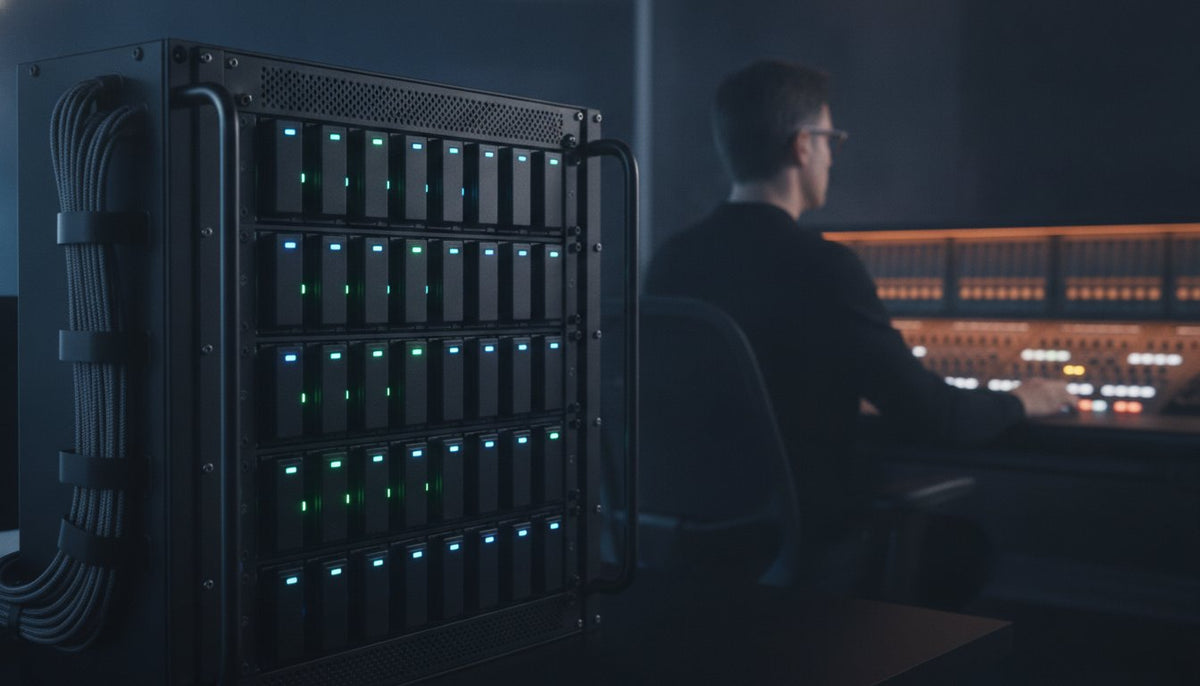
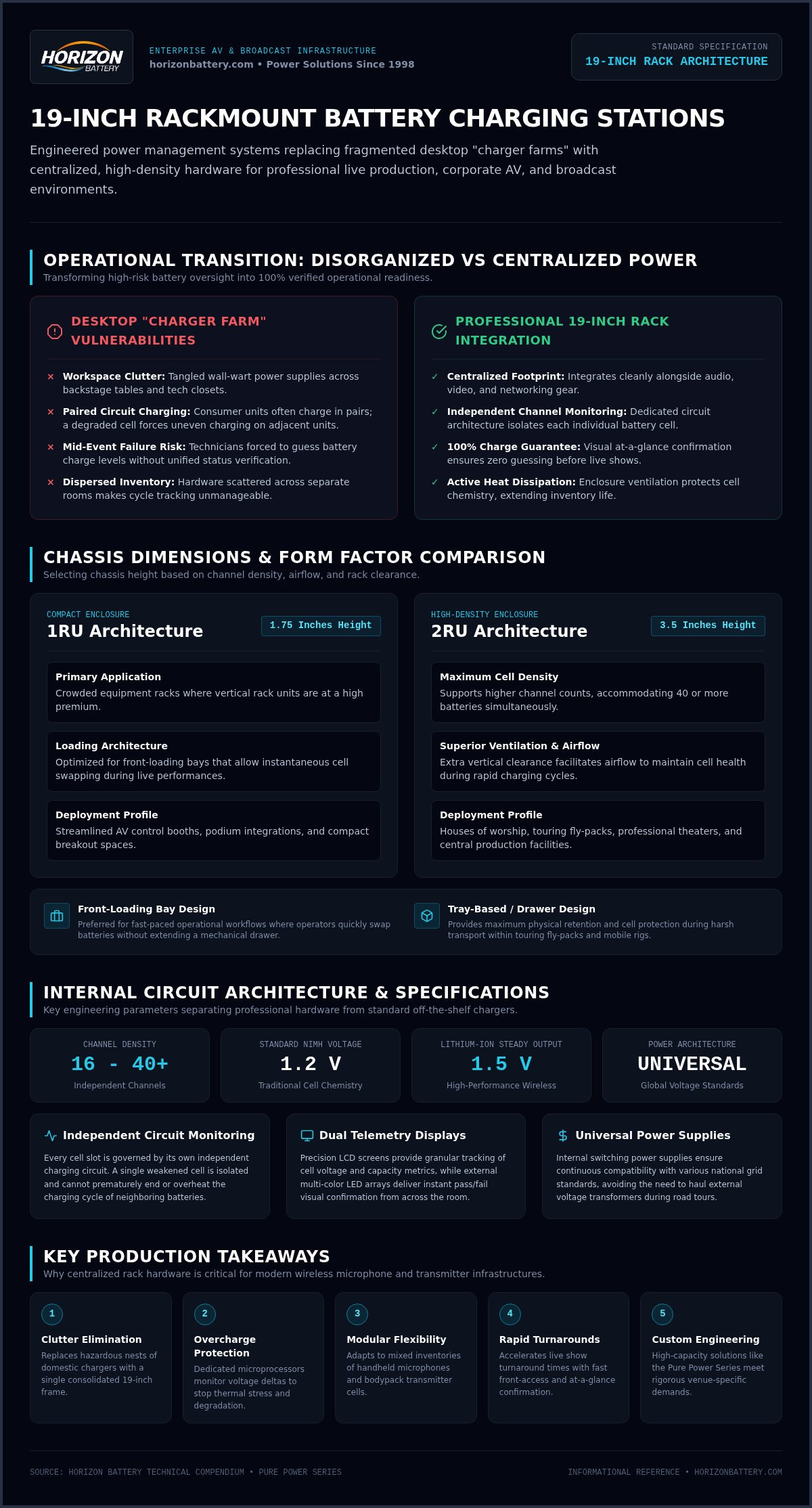
A 19-inch rackmount battery charging station is a centralized, high-density power hub engineered to sit within standard 19-inch rack enclosures. It replaces the disorganized "charger farms" of desktop units that often clutter backstage tables or technical closets. By consolidating power into a single unit, facilities can manage dozens of rechargeable cells in a footprint that matches their existing audio, video, and networking hardware. This specialized hardware is a staple in high-stakes environments like houses of worship, professional theaters, corporate AV departments, and large educational campuses where equipment downtime isn't an option.
By 2026, the industry standard has moved beyond simple power delivery. Modern 19-inch rackmount battery charging stations are now viewed as essential asset management tools. They don't just fill a battery; they ensure every cell is healthy, tracked, and ready for a full shift. This shift reflects a broader commitment to operational readiness. Technicians no longer guess which batteries are fresh. They rely on the visual confirmation provided by a rack-integrated system to ensure 100 percent reliability during a performance or presentation.
The Evolution of Professional Power Management
The transition from disposable alkaline batteries to high-capacity rechargeable workflows has redefined production budgets. Using disposable cells creates immense waste and unpredictable recurring costs. Professional rack integration reduces technical failure rates by ensuring batteries are always seated correctly and monitored by dedicated circuits. These units are core components of modern enterprise battery charging solutions, allowing technicians to verify the status of their entire inventory at a glance. Horizon Battery has provided these specialized solutions since 1998, helping facilities move from reactive battery replacement to proactive power management.
Standard Form Factors: 1RU vs. 2RU
Choosing between a 1RU (1.75 inches) and 2RU (3.5 inches) form factor depends on your channel density and space availability. 1RU units are ideal for crowded racks where vertical space is at a premium. They typically offer front-loading slots for quick access during a show. 2RU units provide higher channel counts, sometimes supporting 40 or more batteries simultaneously. The extra height in a 2RU chassis allows for superior ventilation and airflow, which is vital for maintaining cell health during rapid charging cycles.
Effective heat dissipation is critical for high-density charging. Whether using tray-based designs or individual front-loading bays, the goal remains the same: keep batteries cool to extend their total cycle life. Front-loading designs are generally preferred for fast-paced environments where technicians need to swap cells without pulling out a sliding drawer. Tray-based units, however, can offer more protection for the cells during transport in mobile fly-packs or touring rigs.
Technical Specifications for Professional-Grade Chargers
Professional 19-inch rackmount battery charging stations are defined by their internal architecture rather than just their physical footprint. Channel density is the first consideration for any large-scale facility. High-performance units typically provide between 16 and 40+ independent charging channels. This density allows a single rack unit to service an entire inventory of wireless transmitters or handheld devices simultaneously without requiring dozens of individual wall outlets or power strips.
Unlike consumer chargers that often charge cells in pairs, professional systems use independent circuits for every battery. This prevents a single degraded cell from dictating the charge cycle for its neighbors. Individual monitoring ensures each battery reaches its peak capacity without the risk of overcharging. It's a critical feature for maximizing the lifespan of your high-capacity cells and ensuring operational readiness. Technicians rely on clear status indicators to manage these inventories effectively. LCD displays offer precise voltage and capacity tracking, while LED systems provide instant visual confirmation through color-coded signals. Universal power supplies further enhance reliability by ensuring compatibility with national voltage standards in any touring environment.
Chemistry Compatibility: NiMH and Lithium-Ion
Modern workflows often mix battery types to balance cost and performance. Traditional NiMH cells operate at 1.2V, but many high-performance devices now require the steady 1.5V output of the Pure Power Series. Professional stations are designed to detect these chemistry differences automatically. They apply specific charging algorithms that optimize the cycle for each cell type. If you're looking to upgrade your entire power workflow, choosing matched charger and battery bundles ensures your hardware and cells work in perfect synergy.
Safety Mechanisms and Heat Management
Heat is the primary enemy of battery longevity. Professional-grade chargers incorporate Delta-V detection and thermal sensors to terminate the charge if a cell's temperature or voltage spikes unexpectedly. Adhering to AVIXA rack design standards for thermal management is essential when installing these high-density units. While passive cooling through ventilated chassis designs works for smaller units, 40-channel stations often feature active internal fans. These systems maintain a safe operating temperature, protecting your professional assets during rapid turnaround times or long-term storage modes.
Modular vs. Fixed-Channel Rackmount Systems
Deciding on the right architecture for 19-inch rackmount battery charging stations involves balancing immediate needs with long-term inventory growth. Fixed-channel systems remain the industry workhorse for facilities that rely heavily on standard AA or AAA cells. These units are typically built with a rugged industrial steel chassis to withstand the rigors of touring and high-frequency use. Unlike consumer-grade plastic chargers, professional stations prioritize durability and installation integrity. In commercial environments, following OSHA electrical installation safety standards ensures that high-density hardware is examined and installed to handle continuous thermal loads safely. It's a matter of operational security that keeps your equipment running without the risk of fire or electrical failure.
When to Choose Fixed-Channel Units
Fixed-channel chargers offer an exceptional return on investment for organizations with large fleets of wireless microphones. By standardizing on Ansmann high capacity batteries, production teams can simplify their workflow significantly. These systems are particularly effective for volunteer-led organizations, such as houses of worship or community theaters. They offer a straightforward user interface with fewer moving parts. Reducing the complexity of the hardware minimizes the risk of technical failure during critical events. When every slot is dedicated to a specific battery type, there's no confusion about compatibility or charging parameters. It's a "plug and play" solution that works every time.
The Case for Modular Flexibility
Modular systems provide a different kind of value by allowing technicians to mix and match charging modules within a single frame. This flexibility is essential for facilities that manage proprietary lithium-ion packs alongside standard cells. As your wireless inventory grows or shifts toward new transmitter models, you can swap individual modules rather than replacing the entire station. This approach future-proofs your investment against changes in battery form factors or manufacturer-specific charging requirements. While the initial cost-per-channel might be higher than fixed systems, the ability to scale provides significant long-term flexibility for enterprise-level operations. You don't have to worry about your charging infrastructure becoming obsolete when you upgrade your microphones.
Buyer's Guide: Evaluating the Best Station for Your Facility
Selecting the right 19-inch rackmount battery charging stations requires a strategic assessment of your current and future inventory. It's a mistake to buy only for today's needs. A reliable industry best practice is to plan for at least 20 percent growth in your inventory to avoid outgrowing your infrastructure within the first year. You must also evaluate your production schedule. Fast-charging units that deliver a full cycle in 1 to 2 hours are essential for back-to-back events. Standard overnight cycles are often gentler on battery chemistry and can extend the total service life of your cells.
Rack real estate is a premium resource in any professional facility. Balancing channel density with available RU space requires careful planning. If you have limited vertical space, high-density 1RU units are the most efficient choice. Integration matters too. A charger destined for a permanent install in a climate-controlled room has different requirements than one living in a mobile fly-pack. For touring rigs, look for units with ruggedized chassis and secure battery retention to prevent cells from dislodging during transport.
Calculating ROI and Operational Savings
The initial investment in 19-inch rackmount battery charging stations pays for itself by eliminating the recurring expense of disposable alkaline batteries. Beyond hardware costs, the labor savings are substantial. Technicians spend significantly less time managing disorganized chargers and testing individual cells. Precision charging also ensures you get the maximum number of cycles out of every battery, which lowers long-term replacement costs. It's a shift from seeing power as a consumable to seeing it as a managed asset.
Checklist for Enterprise Procurement
Prioritize partners that offer robust technical support and US-based warranties. Horizon Battery has served professional clients since 1998, providing the expertise needed for complex facility installs. You should look for bundle options that combine Custom Rackmount Chargers with bulk high-capacity battery orders to streamline your procurement process. Finally, verify that all hardware meets commercial building safety certifications. This ensures compliance with local fire and electrical codes while protecting your facility's insurance standing.
To find the ideal configuration for your specific rack layout, explore our range of Custom Rackmount Chargers today.
Implementing Horizon Battery's Custom Rackmount Solutions
Standard mass-market 19-inch rackmount battery charging stations frequently fail to meet the rigorous demands of professional audio and broadcast environments. While basic units provide a place to dock cells, they often lack the specialized channel counts or thermal stability required for high-density setups. Horizon Battery bridges this gap by offering custom-engineered hardware that integrates seamlessly into your facility's unique infrastructure. By focusing on the specific needs of the technician, these solutions move beyond simple charging to become a core part of an efficient asset management workflow. Pairing these chargers with a dedicated Battery Storage system ensures that your inventory is always organized, protected, and ready for deployment.
Custom Features for Professional Audio
Every facility has different rack constraints and transmitter counts. Horizon provides tailored channel counts, typically ranging from 16 to 40 channels, to match your specific wireless microphone rack configurations exactly. This customization prevents wasted rack space and ensures you have exactly the capacity you need. For critical performance environments, enhanced monitoring circuits provide real-time data on cell health, preventing unexpected failures during a show. These designs are also ruggedized for the road. Touring professionals and mobile production teams benefit from heavy-duty chassis construction that survives the vibrations and impacts of constant transport.
The Horizon Advantage: 25+ Years of Expertise
Operating since 1998, Horizon Battery has established itself as a leader in professional-grade mobile energy. This long history allows the brand to act as a knowledgeable guide for facilities looking to modernize their power systems. There's a distinct synergy between Horizon's rack hardware and high-capacity Pure Power Series cells. When you use hardware and batteries designed to work together, you achieve higher reliability and longer cell life. It's a level of precision that off-the-shelf consumer products simply can't match.
The direct-to-professional distribution model ensures that facilities receive maximum value without unnecessary retail markups. You aren't just buying a product; you're partnering with a veteran distributor that understands the technical nuances of professional AV power. If your organization is ready to move away from disorganized charging and toward a centralized, professional solution, initiating a consultation is the first step. Our team works with you to evaluate your current inventory and design a rack-integrated system that provides long-term cost savings and operational peace of mind.
Modernizing Your Facility's Power Infrastructure
Transitioning to professional 19-inch rackmount battery charging stations is a strategic investment in your facility's operational readiness. By consolidating power management into a centralized, rack-integrated system, you eliminate the mess of desktop chargers and the risk of mid-event power failures. This guide has detailed how technical specifications like individual cell monitoring and proper thermal management extend the life of your high-capacity inventory while ensuring every cell is ready for a full shift.
Since 1998, Horizon Battery has provided specialized hardware custom-engineered for AV and production racks. Our national distribution network ensures that professional facilities across the United States have access to high-density power solutions that scale with their needs. It's about more than just charging; it's about managing your assets with precision. Whether you require a fixed-channel workhorse or a modular system, the right infrastructure creates long-term cost savings and technical security. Explore Horizon's Custom Rackmount Charging Solutions to streamline your workflow. You'll find that a dedicated power hub is the most reliable partner for your next event.
Frequently Asked Questions
How many batteries can a standard 19-inch rackmount charger hold?
A professional 19-inch rackmount battery charging station typically supports between 16 and 40 individual channels. The exact capacity depends on the chassis design and whether the unit is 1RU or 2RU. High-density models are engineered to maximize space without compromising safety. This allows facilities to charge an entire fleet of wireless microphone batteries in a single rack enclosure, replacing dozens of disorganized desktop units.
Do rackmount battery chargers generate excessive heat in an enclosed rack?
Professional chargers generate some heat during rapid cycles, but they're designed with thermal management in mind. Most high-density units feature ventilated steel chassis for passive cooling, while 40-channel models often include active internal fans. Following industry standards for rack airflow ensures that temperatures remain within safe operating limits. This prevents heat buildup from damaging sensitive equipment or shortening the lifespan of your high-capacity rechargeable cells.
Can I charge both NiMH and Lithium-ion batteries in the same rackmount unit?
You can charge both chemistries if the station is specifically designed with multi-chemistry compatibility or modular bays. Modern units often use intelligent circuits to detect whether a cell is 1.2V NiMH or 1.5V Lithium-ion. However, it's vital to verify that your specific charger supports the chemistry of each battery. Using a matched system ensures that every cell receives the correct charging algorithm for its specific chemical makeup.
What is the difference between 1RU and 2RU charging stations?
The primary difference lies in the vertical height and the resulting channel density. A 1RU station occupies 1.75 inches of rack space and is ideal for facilities with limited room. A 2RU unit occupies 3.5 inches, offering more internal volume for higher channel counts and superior ventilation. While 1RU units are compact, 2RU designs often provide easier access for front-loading dozens of batteries simultaneously in high-volume production environments.
Are rackmount chargers compatible with 1.5V Lithium-ion AA batteries?
Yes, professional 19-inch rackmount battery charging stations are compatible with 1.5V Lithium-ion AA batteries when they feature the appropriate charging circuitry. Horizon Battery’s Pure Power Series is specifically designed for these high-performance applications. It's important to use a charger that recognizes the constant voltage requirements of Lithium-ion cells. This ensures your batteries reach full capacity safely and maintain their performance over hundreds of duty cycles in professional audio equipment.
How do rackmount chargers help with battery inventory management?
These stations centralize your power infrastructure, allowing technicians to track their entire inventory from a single location. Instead of searching for batteries across multiple rooms, you can see the charge status of every cell at a glance via LED or LCD indicators. This organization reduces the risk of deploying half-charged batteries during a performance. It also makes it easier to rotate stock and identify aging cells that need replacement.
Do I need a special power circuit for a high-density charging station?
Most high-density charging stations operate on a standard 15-amp or 20-amp circuit without requiring specialized electrical work. While they charge many cells at once, the total power draw is typically well within the limits of a standard commercial outlet. However, you should always calculate the total load of your rack to ensure you don't exceed the capacity of your power distribution unit. This is especially true when integrating multiple 40-channel chargers.
Why should a church or theater switch to rackmount charging systems?
Switching to a rackmount system eliminates the recurring cost and waste of disposable alkaline batteries. For churches and theaters, this translates to significant long-term budget savings and improved operational reliability. Centralizing your power needs reduces the clutter of consumer chargers and ensures that wireless microphones are always ready for use. It provides a professional solution that volunteer teams can manage easily without the technical confusion of disorganized charging setups.