
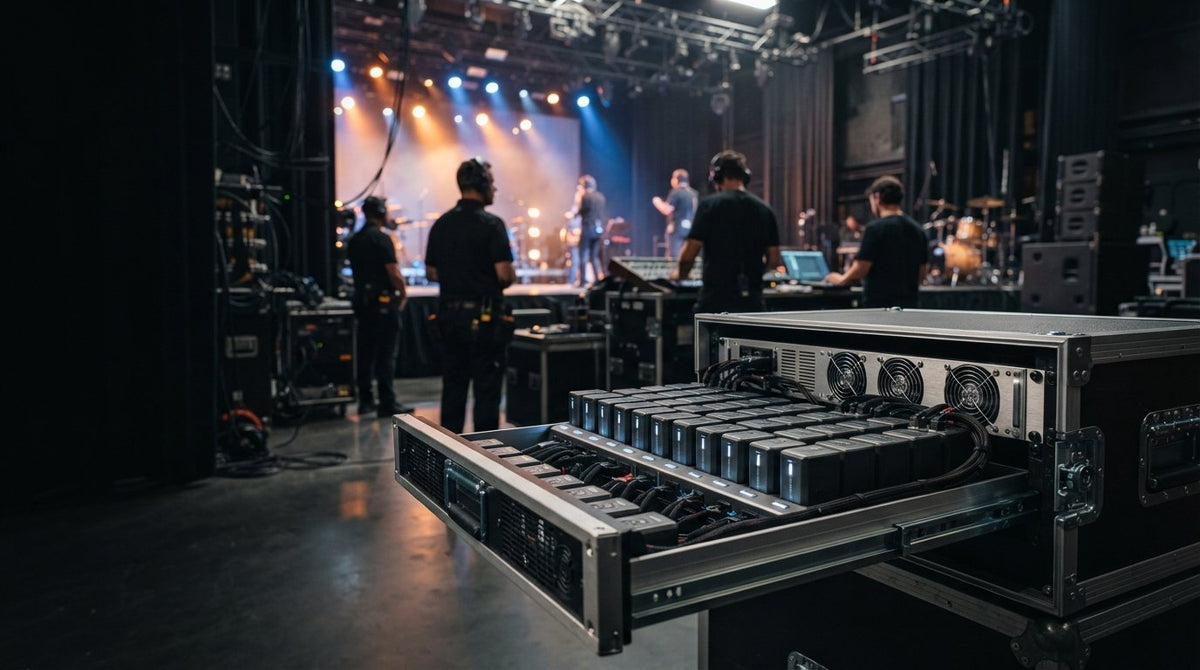
How much does a single battery failure cost when it happens during the climax of a live performance? For production managers, the answer isn't just the price of a cell; it's the loss of professional reputation and audience trust. Managing dozens of loose batteries and tangled wall warts in a dark rack room is a recipe for disaster. You likely already know that disorganized charging leads to overheating, shortened lifespans, and the constant risk of a dead mic on stage. Integrating professional stage production battery charging drawers into your workflow transforms this chaos into a streamlined, reliable system.
This 2026 buying guide provides the technical roadmap to engineering a high-density charging infrastructure that eliminates power failures. You'll learn how to select 19-inch rackmount solutions that prioritize thermal management and standardized rotation for your entire crew. We will cover everything from custom-engineered drawers to the integration of the Pure Power Series and Ansmann chargers, ensuring your production stays powered from soundcheck to the final curtain call.
Key Takeaways
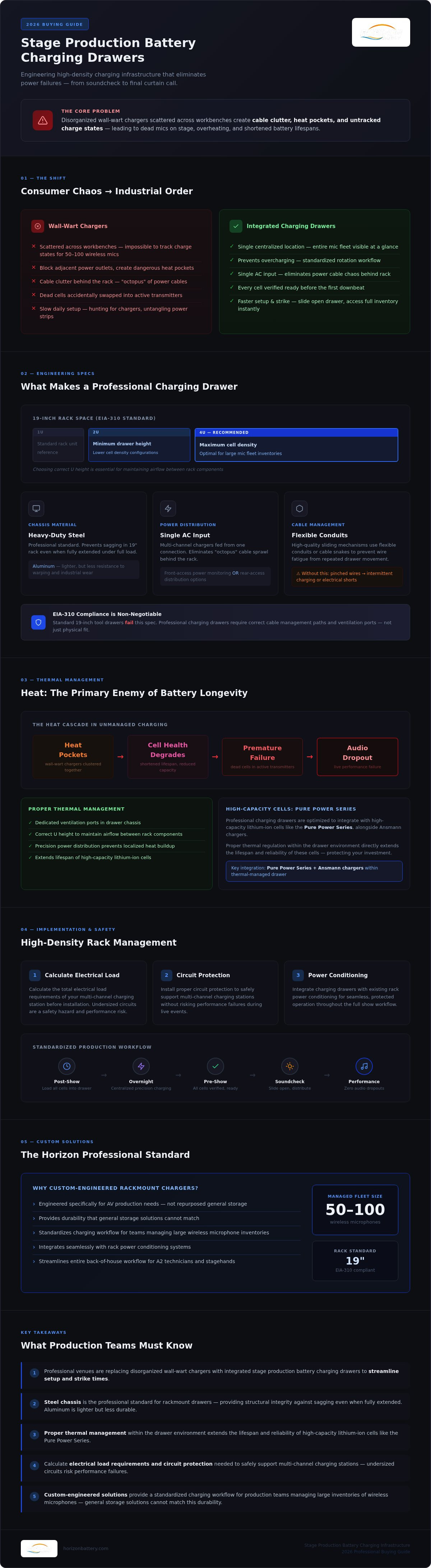
- Learn why professional venues are replacing disorganized wall-wart chargers with integrated stage production battery charging drawers to streamline setup and strike times.
- Understand the critical engineering specifications for rackmount drawers, including the choice between steel and aluminum for long-term durability in high-density environments.
- Discover how proper thermal management within a drawer environment extends the lifespan and reliability of high-capacity lithium-ion cells like the Pure Power Series.
- Calculate the electrical load requirements and circuit protection needed to safely support multi-channel charging stations without risking performance failures.
- Explore how custom-engineered solutions provide a standardized charging workflow for production teams managing large inventories of wireless microphones.
The Shift to Integrated Stage Production Battery Charging Drawers
The stage production industry has long outgrown the era of haphazard charging stations. In professional venues, the reliance on individual "wall-wart" chargers scattered across a workbench is a liability that many production managers can no longer afford. These consumer-grade setups introduce cable clutter, block adjacent power outlets, and create heat pockets that degrade cell health. Transitioning to integrated stage production battery charging drawers represents a move toward industrial reliability where power is centralized and protected. A professional charging drawer is a mission-critical AV asset that combines high-density storage with precision power distribution and thermal regulation to eliminate the risk of audio dropouts. To further optimize your technical setup, you can explore Live Event Production for tailored solutions in live and hybrid environments.
From Consumer Chaos to Industrial Order
Unmanaged charging creates a specific set of dangers in live environments. When batteries are charged in disparate locations, tracking the state of charge for a fleet of 50 or 100 wireless microphones becomes nearly impossible. This lack of organization often leads to "dead on arrival" cells being accidentally swapped into active transmitters. Centralized charging drawers solve this by providing a single, visible location for the entire mic fleet. This setup allows A2 technicians and stagehands to follow a standardized rotation workflow. By understanding the fundamentals of battery charging technology, teams can implement systems that prevent overcharging and ensure every cell is ready for the first downbeat. Beyond reliability, the shift is driven by efficiency. Standardizing the charging infrastructure significantly reduces the time required for daily setup and post-show strike. It's much faster than hunting for chargers and untangling power strips, as technicians simply slide open a drawer to access a fully powered inventory.
Standard 19-Inch Rack Integration
A common mistake in venue upgrades is repurposing standard 19-inch tool drawers for battery storage. While these might fit the rack physically, they fail to meet the EIA-310 specifications required for electrical equipment. Standard drawers don't have the necessary cable management paths and ventilation ports required for safe operation. Professional stage production battery charging drawers are designed specifically for the rack environment. They typically occupy 2U to 4U of rack space, depending on the required cell density. Choosing the right Rack Unit (U) height is essential for maintaining airflow between components. Modern designs also offer front-access power monitoring or rear-access distribution, allowing the charging station to integrate seamlessly with the existing rack power conditioning. Professional systems like Horizon's Custom Rackmount Chargers are engineered to address these specific AV needs, providing a level of durability that general storage solutions cannot match.
Engineering the Professional Charging Drawer: Key Specifications
Engineering stage production battery charging drawers requires a precise balance of mechanical durability and electrical safety. Unlike standard storage solutions, these units must support the significant weight of high-capacity cell inventories while managing the electrical load of multiple chargers. Heavy-duty steel is the standard choice for the chassis. It provides the structural integrity needed to prevent sagging in a 19-inch rack, even when the drawer is fully extended. While some manufacturers offer aluminum for its lighter weight, steel remains the professional preference for its resistance to warping and long-term industrial wear.
Power distribution is equally critical. Professional drawers integrate multi-channel chargers into a single AC input, which eliminates the "octopus" of power cables behind the rack. Inside the drawer, cable management systems must account for constant movement. High-quality sliding mechanisms use flexible conduits or cable snakes to prevent wire fatigue. Without these, repeated opening and closing can pinch power lines, leading to intermittent charging or dangerous electrical shorts. If you're looking for a reliable way to organize your power, a well-engineered Custom Rackmount Charger can streamline your entire back-of-house workflow.
Thermal Management and Heat Dissipation
Heat is the primary enemy of battery longevity. When dozens of AA batteries charge simultaneously in a confined space, the ambient temperature can rise quickly. Professional stage production battery charging drawers utilize perforated metal floors or sides to facilitate passive airflow. In high-density environments, active cooling through integrated fans is often necessary to pull heat away from the cells. Adhering to OSHA lithium battery safety guidelines is essential for preventing thermal runaway in professional settings. Proper thermal management doesn't just ensure safety; it protects the chemistry of your Pure Power Series cells, preventing the premature capacity loss that occurs when batteries are frequently exposed to high heat.
High-Density Charging Layouts
Maximizing cell count within a limited rack footprint is a core requirement for modern productions. Specialized drawer layouts can accommodate 16, 32, or even 48 charging channels in a single 2U or 3U space. The choice between custom foam inserts and fixed plastic cradles often depends on the specific needs of the crew. Foam provides superior protection during transport and keeps cells silent, while fixed cradles offer faster "grab-and-go" access during hectic stage changes. Ergonomics play a major role here. The layout must allow technicians to quickly identify which cells are fully charged and swap them out without fumbling, even in low-light environments behind the stage.
Beyond the Metal: Integrating High-Capacity Cells
High-quality steel and cable management are essential, but the true value of a charging station lies in how it treats the chemistry of your cells. Professional stage production battery charging drawers must be configured to support the specific charging curves required by high-density inventories. Using a generic charger for advanced cells can lead to incomplete charges or, worse, permanent capacity loss. Matching the drawer's internal hardware to the battery chemistry ensures that your wireless microphones and IEMs receive the precise voltage and current they need to perform throughout a four-hour show. When hardware and chemistry are aligned, the risk of mid-performance power failure drops significantly.
NiMH vs. Lithium-ion in Enclosed Drawers
Choosing between Nickel-Metal Hydride (NiMH) and Lithium-ion depends on your specific gear requirements. Traditional NiMH options, such as Ansmann high capacity batteries, offer reliability and cost-effectiveness for many standard applications. However, many modern digital wireless systems perform best with a constant 1.5V output. This is where the Pure Power Series excels, as it maintains a stable voltage until the cell is depleted. Within the enclosed environment of a drawer, lithium-ion cells typically charge faster but require stricter thermal monitoring. It's vital to ensure your drawer's safety protocols can handle different chemistries if you're running a hybrid fleet. Mixing chemistries without dedicated charging channels can lead to overheating or inaccurate charge readings.
Optimizing for High-Drain Wireless Audio
High-drain devices like beltpacks and handheld transmitters put immense stress on power cells. To counter this, high-capacity AA batteries for professional audio need consistent, managed charging environments to stay healthy. Smart charging algorithms within the drawer monitor the internal resistance of each cell, adjusting the current to prevent degradation. This level of precision is what allows the Pure Power Series to maintain its cycle life over hundreds of uses. For the technician, the ability to monitor charge status without opening the drawer is a significant advantage. Many professional stage production battery charging drawers feature external LED indicators or network-linked monitoring software. These tools provide real-time data on battery health and charge levels, allowing for quick decisions during high-pressure transitions. Reliable power isn't just about capacity; it's about the intelligence of the system managing that capacity.
Implementation and Safety: Managing High-Density Racks
Integrating stage production battery charging drawers into a professional equipment rack requires careful planning regarding electrical load. A single drawer charging 48 high-capacity AA batteries can draw significant current, especially when multiple drawers are installed in the same rack. Calculating the total wattage is essential to avoid tripping breakers during critical show times. Beyond basic load management, fire safety is a paramount concern. High-density charging generates heat, and without specific circuit protection, a minor fault can escalate. Implementing a rigorous rotation system is the best way to prevent cell memory and deep discharge. To learn more about organizing your inventory, see how to implement a professional battery storage and management system. This proactive management keeps your fleet healthy and your show running smoothly.
Circuit Protection and Power Conditioning
Surge protection is non-negotiable when you're managing thousands of dollars in rechargeable cells. A power spike can fry the delicate electronics in modern smart chargers. You also need to manage "inrush current." This is the sudden surge of power that occurs when a full drawer begins its charging cycle. High-quality power conditioners help stabilize this flow and protect the longevity of your charger electronics. They act as a buffer between the venue's mains and your sensitive gear. These units filter out electrical noise that can interfere with wireless audio signals. If you're ready to upgrade your rack safety, you can browse our custom rackmount solutions here.
Workflow: The 'Charged vs. Dead' System
A standardized workflow prevents technical downtime and ensures every A2 technician is on the same page. Visual labeling systems are the simplest way to manage stage production battery charging drawers. Many teams use a "left-to-right" or "top-to-bottom" protocol to distinguish between fresh and depleted cells. Establishing a "green light" standard means that no battery leaves the drawer unless the charger confirms a 100% state of charge. Proactive testing before every performance further reduces risks. Technicians should use a dedicated battery tester to verify voltage under load, rather than relying solely on the charger's LED. This disciplined approach ensures that the crew isn't guessing about battery health under the pressure of a live show. It builds a culture of reliability that performers can trust.
Custom Rackmount Chargers: The Horizon Professional Standard
Since 1998, Horizon Battery has specialized in high-capacity power solutions for the most demanding live environments. Our Custom Rackmount Chargers represent the culmination of decades of experience serving theaters, houses of worship, and touring production companies. These aren't repurposed tool drawers; they're precision-engineered systems designed to house high-density charging hardware within a standard 19-inch equipment rack. By integrating stage production battery charging drawers into your facility, you move away from the "disposable" mindset and toward a sustainable, high-performance power strategy. This transition allows you to adopt rechargeable batteries for business with complete confidence in your technical infrastructure.
Engineering a solution that scales with your production is a core part of our philosophy. Whether you're managing a small 16-channel microphone kit or a massive 128-channel wireless fleet, our hardware is tailored to your specific cell count and rack density requirements. This focused engineering ensures a significant long-term ROI for large facilities. You'll see immediate savings through reduced waste and the elimination of the "battery anxiety" that often plagues live sound teams. Our systems are built for the heavy duty cycles of professional production, ensuring that your investment pays for itself through thousands of flawless performances.
The Horizon Advantage for Production Houses
We provide more than just hardware; we offer a comprehensive partnership for AV professionals. Our expert consultation helps you determine the ideal rack density and power requirements for your specific venue. We offer fully integrated bundles that include the drawer hardware, industrial-grade Ansmann chargers, and our specialized Pure Power Series cells. This "one-stop" approach ensures that every component in your stage production battery charging drawers is compatible and optimized for longevity. With national distribution across the US and Canada, we provide the steady reliability and technical support that professional production houses require to stay operational year-round.
Next Steps: Outfitting Your Rack
Modernizing your power workflow starts with a thorough audit of your current battery usage. Consider how many cells your team cycles through during a typical four-hour show and how much time you have for recharging between performances. Selecting the right Rack Unit (U) configuration is essential for maintaining proper airflow and ergonomics within your rack. Most of our custom drawers are available in 2U to 4U heights to accommodate different charging densities. If you're ready to eliminate rack chaos and engineer a more reliable system, contact Horizon today for a custom charging drawer configuration that meets your specific production needs.
Engineering Your Production for Reliability
Transitioning from disorganized charging stations to professional stage production battery charging drawers is a fundamental step in modernizing your AV workflow. By centralizing your power infrastructure, you eliminate cable chaos and significantly reduce the risk of battery failure during live performances. Success in high-density environments depends on the precise integration of heavy-duty hardware, active thermal management, and advanced cell chemistries. These systems don't just organize your rack; they protect the lifespan of your inventory and ensure every microphone is ready when the curtain rises.
Horizon Battery has provided expert AV energy solutions since 1998. As an official distributor of the Pure Power Series and Ansmann chargers, we engineer solutions specifically for the rigors of professional production racks. Our custom-engineered drawers provide the steady reliability your facility needs to maintain a consistent, high-performance standard. If you're ready to optimize your power management, Explore Custom Rackmount Charging Solutions at Horizon Battery. Your crew deserves a system that works as hard as they do, providing peace of mind from soundcheck to the final applause.
Frequently Asked Questions
What is the best Rack Unit (U) height for a battery charging drawer?
The ideal Rack Unit (U) height typically ranges from 2U to 4U depending on your specific cell density requirements. A 2U configuration is standard for 16 to 32 charging channels. Larger 3U or 4U drawers provide more vertical clearance, which is essential for improved airflow and easier access to batteries in high-density setups. Selecting the right height ensures your equipment fits within standard 19-inch racks while maintaining professional thermal management standards.
Can I charge different battery brands in the same rack drawer?
You can charge different battery brands in the same drawer as long as the internal charging hardware supports independent channel monitoring. Professional stage production battery charging drawers often utilize multi-channel chargers like those from Ansmann. These units treat each cell individually, preventing issues related to mismatched capacities or internal resistance. It's still recommended to group similar chemistries together to simplify your team's workflow and ensure consistent performance across your wireless microphone fleet.
How do I prevent overheating in a high-density battery charging drawer?
Preventing overheating requires a combination of passive ventilation and active cooling. Professional drawers should feature perforated metal chassis to allow heat to escape naturally. In high-density environments where 48 or more cells charge simultaneously, integrated cooling fans are necessary to pull warm air away from the chargers. Maintaining an ambient temperature below 85 degrees Fahrenheit inside the rack helps protect the chemistry of cells like the Pure Power Series and prevents premature degradation.
Do I need a special circuit for a drawer charging 50+ batteries?
While a standard 15A or 20A circuit is usually sufficient for a single charging drawer, you must calculate the total wattage of all integrated chargers. The primary concern is the "inrush current" that occurs when dozens of batteries begin charging at once. Using a dedicated power conditioner or surge protector helps manage this initial load and protects charger electronics from voltage spikes. If you're running multiple high-density drawers in one rack, consider splitting the load across different circuits.
Are custom rackmount chargers compatible with both NiMH and Lithium-ion?
Compatibility depends on the specific charging hardware integrated into your Custom Rackmount Chargers. Many professional units are designed to handle both Nickel-Metal Hydride (NiMH) and Lithium-ion chemistries through intelligent sensing technology. It's critical to verify that your charger supports the specific voltage requirements of your batteries. For instance, the Pure Power Series requires a precise 1.5V charging curve that differs from traditional NiMH cells. Always check manufacturer specifications before mixing battery chemistries within a single drawer.
How do I manage cable fatigue with a sliding charging drawer?
Managing cable fatigue requires the use of flexible cable management arms or protective conduits inside the rack. These mechanisms guide the power cables as the drawer slides in and out, preventing the wires from pinching or stretching. High-quality stage production battery charging drawers use industrial-grade sliding tracks that include dedicated paths for power distribution. This setup ensures that repeated use doesn't lead to intermittent power issues or electrical shorts, maintaining a reliable connection for your production team.
What is the lifespan of batteries used in a professional production drawer?
The lifespan of your batteries depends heavily on cycle counts and thermal management. High-capacity professional cells typically provide between 500 and 1,000 charge cycles before significant capacity loss occurs. Batteries stored and charged in well-ventilated drawers tend to last longer because they aren't exposed to excessive heat. Implementing a strict rotation system helps ensure that all cells in your inventory are used evenly, preventing some batteries from being over-cycled while others sit idle in storage.
Can I integrate a battery tester directly into the charging drawer?
Many custom-engineered drawers allow for the integration of a dedicated battery tester or voltage meter. Placing a tester directly in the drawer streamlines the workflow for A2 technicians by allowing them to verify cell health immediately before a show. While some chargers have built-in LED status indicators, a separate tester provides a more accurate reading of voltage under load. This proactive testing is a hallmark of professional battery management and helps eliminate the risk of mid-show audio failure.