
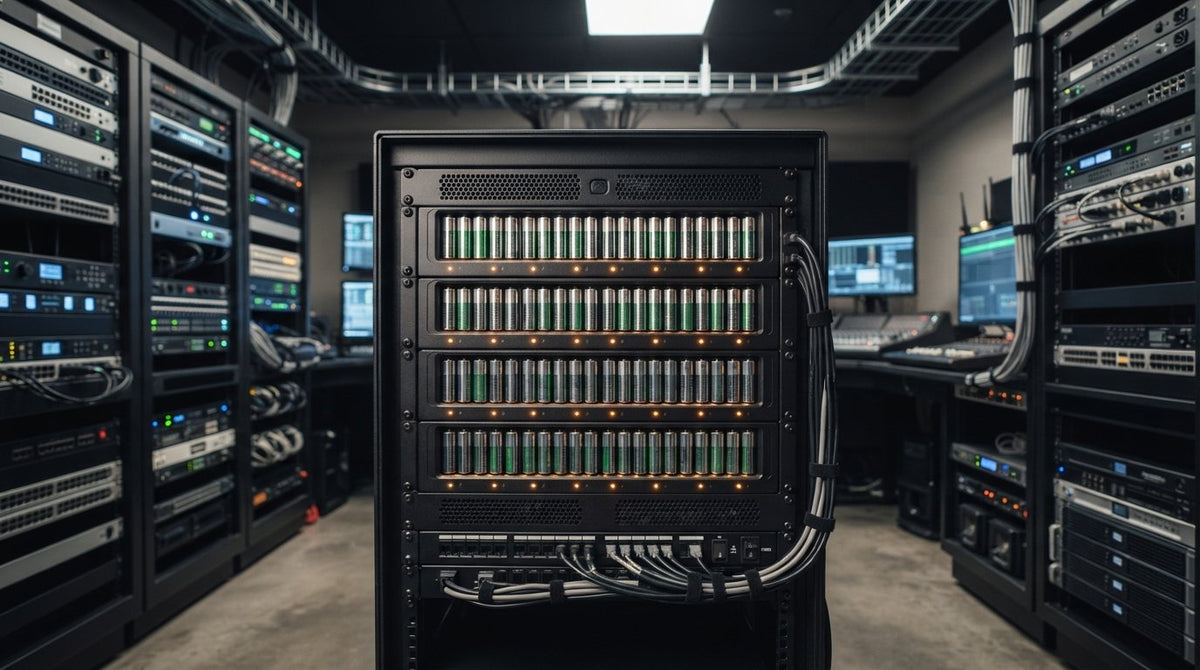
What if the most sophisticated wireless audio system in your rack is only as reliable as the tangled mess of consumer chargers hidden behind your equipment? For broadcast engineers, cable clutter in the machine room isn't just an eyesore; it's a failure point that often leads to overheating and unreliable charging. You've likely dealt with the stress of on-air audio dropouts caused by a battery that appeared charged but failed mid-segment. We understand that in a high-stakes environment, consistent power isn't a luxury. It's a fundamental requirement for operational continuity.
This 2026 guide will teach you how to eliminate studio downtime and organize your power infrastructure with professional high-density AA battery chargers for broadcast studios. Since 1998, we've helped major media houses across the US and Canada transition from disorganized setups to streamlined, rack-integrated charging stations. We will examine how the Pure Power Series and our custom rackmount chargers provide a consistent 8-hour runtime for all your wireless gear. By the end of this article, you'll know exactly how to choose a system that reduces battery replacement costs and keeps your signal clear through every broadcast.
Key Takeaways
- Learn how intelligent microprocessor control and -Delta V termination prevent overheating while maximizing the life of your high-capacity cells.
- Discover how high-density AA battery chargers for broadcast studios consolidate up to 40 slots into a single 19-inch rack unit to reclaim valuable workspace.
- Evaluate the differences between permanent rackmount fixtures and portable desktop units to determine which infrastructure best secures your equipment assets.
- Establish a professional battery rotation system using FIFO methods and batch-tracking to guarantee consistent 8-hour runtimes for every live production.
- Identify how transitioning from consumer-grade chargers to professional systems reduces long-term replacement costs and prevents unexpected on-air audio failures.
Why Broadcast Studios Require High-Density Charging Solutions
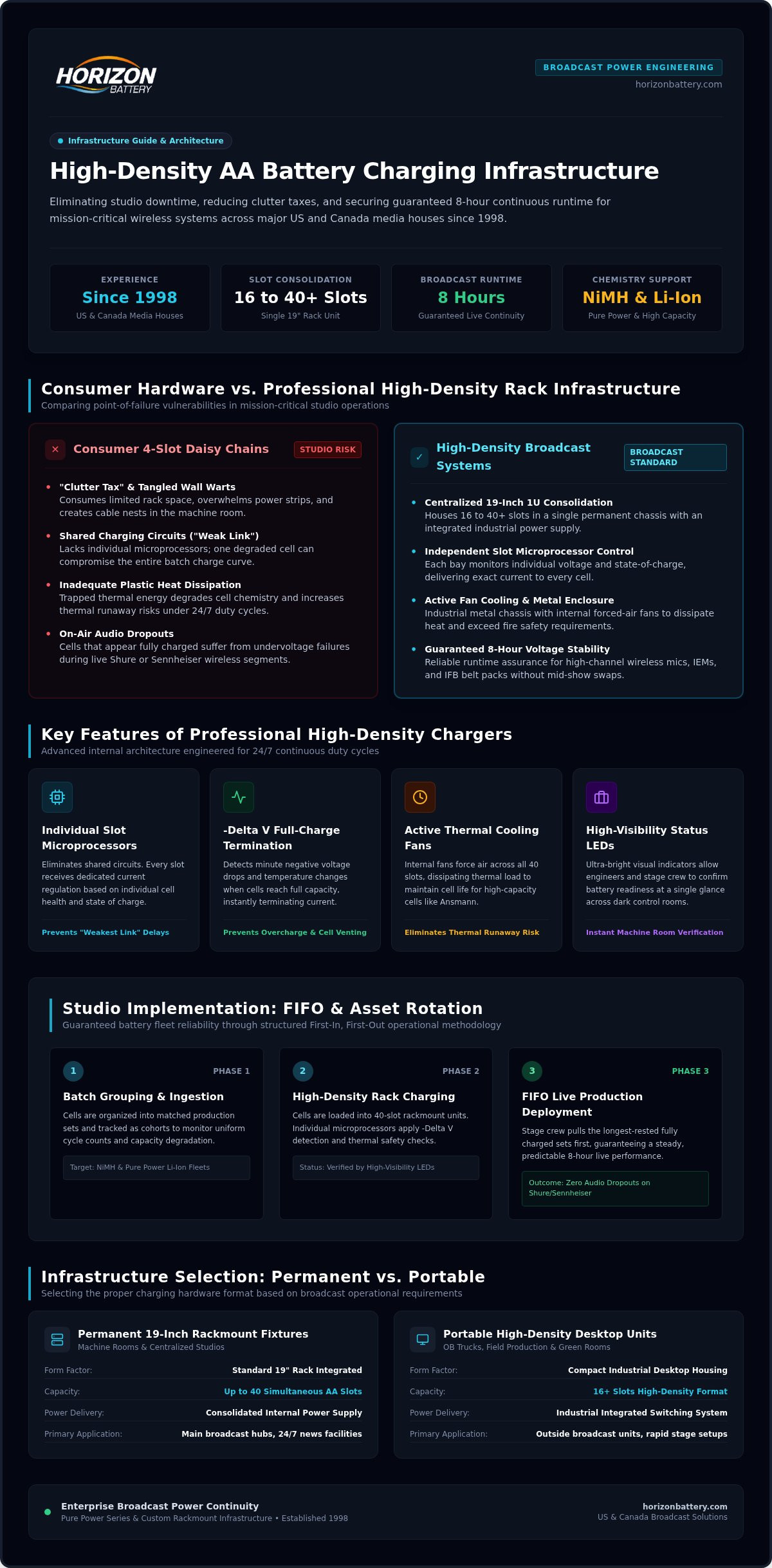
In a professional broadcast environment, power management is a significant logistical challenge. High-density charging refers to systems that house 16 to 40 or more charging slots within a single, centralized unit. Standard consumer chargers might claim professional status, but they often fail to meet the rigorous duty cycle requirements of a 24/7 studio. Using multiple four-slot chargers creates a "clutter tax" that consumes limited rack space and quickly overwhelms power strips. Integrating high-density AA battery chargers for broadcast studios solves this by consolidating power into a managed, industrial infrastructure. This shift reduces the time staff spend swapping cells between disparate units, allowing engineers to focus on production rather than hunting for available outlets.
The Problem with Consumer-Grade Hardware
Consumer-grade hardware is typically built with plastic housings that offer inadequate heat dissipation. When you charge dozens of batteries simultaneously, heat buildup can degrade cell chemistry and lead to premature failure. These units often lack individual microprocessor monitoring. This means one bad cell can affect the charging profile of its neighbors, creating "weak link" failures in your gear. Additionally, the external power supplies or "wall warts" associated with consumer gear create a bird's nest of cables in the equipment room. Professional battery charger technology integrates the power supply and provides individual slot management to ensure every cell reaches full capacity safely without overheating.
Broadcast-Specific Power Demands
Modern productions rely on high-channel count wireless microphone systems from manufacturers like Shure and Sennheiser. These systems, along with IFB and IEM belt packs, require absolute reliability for every segment. An undervoltage battery in a mission-critical audio pack can result in an immediate on-air dropout. For media houses, switching to rechargeable batteries for business is a strategic move for long-term ROI. It replaces the recurring expense of thousands of disposables with a predictable, managed asset. Specialized high-density AA battery chargers for broadcast studios ensure these assets are always ready for the next shift. They provide the voltage stability and consistent 8-hour runtimes required for professional audio gear.
Key Features of Professional High-Density Chargers
Professional high-density AA battery chargers for broadcast studios differ from consumer models through their internal architecture. Instead of sharing a single charging circuit across all slots, these units utilize independent microprocessors for every battery. This individual slot management ensures that each cell receives the exact current it needs based on its current state of charge. When you're managing dozens of cells for a large production, this granular control prevents the "weakest link" scenario where one failing battery slows down the charging of the entire batch.
Advanced termination methods are the hallmark of industrial hardware. These systems use -Delta V (negative delta voltage) detection alongside precise temperature sensing. As a NiMH battery reaches full capacity, its voltage drops slightly; the charger detects this minute change and stops the current immediately. This prevents the overcharging that leads to cell venting or reduced cycle life. For busy engineers, clear status indicators are essential. Professional units feature high-visibility LEDs that allow you to verify charge status from across a dark equipment room at a glance.
Thermal Management and Safety
Heat is the primary enemy of high-performance cells like Ansmann high capacity batteries. When 40 batteries charge at high currents, they generate significant thermal energy. Professional high-density AA battery chargers for broadcast studios often feature active cooling systems, such as internal fans, to move air across the cells. This is a critical safety feature. It prevents the "thermal runaway" common in cheap, packed plastic chargers. Industrial units are also built to higher fire safety standards, using metal enclosures that contain heat and protect the surrounding rack equipment.
Chemistry Versatility: NiMH and Lithium-Ion
Modern studios often manage mixed fleets. You might use NiMH for standard handhelds and the Pure Power Series Lithium-ion for voltage-critical digital transmitters. High-end chargers offer automatic chemistry detection. They identify the battery type and apply the correct charge profile without manual intervention. This versatility ensures that your gear maintains the voltage stability required for complex wireless environments. If you want to streamline your infrastructure, you can explore our professional charging options to find a system that supports your specific fleet.
Many professional units also include refresh and conditioning cycles. These cycles deep-discharge and then recharge NiMH cells to break down crystalline formations that cause the "memory effect." Regular conditioning can significantly extend the usable life of your battery assets, providing a much higher return on investment over several years of operation.
Rackmount vs. Desktop: Choosing the Right Infrastructure
Deciding between a rackmount or desktop configuration depends on your studio's operational workflow. Many facilities start with desktop units because they're easy to deploy. However, as wireless channel counts increase, the sheer volume of chargers can become unmanageable. Transitioning to integrated high-density AA battery chargers for broadcast studios allows you to reclaim horizontal workspace. By mounting your charging infrastructure directly into existing 19-inch AV racks, you create a permanent, secure station that won't get moved or "borrowed" by other departments.
Cable management is another critical factor. Desktop chargers often require multiple external power bricks that consume valuable space on power strips. Rackmount solutions internalize this distribution. They use a single AC input to power dozens of slots, resulting in a significantly cleaner equipment room. This organized approach doesn't just look better; it simplifies troubleshooting and reduces the risk of accidental power loss. It also makes scalability much easier, as you can stack additional units in the rack as your wireless inventory grows.
Benefits of Custom Rackmount Chargers
Custom Rackmount Chargers are engineered for the rigors of professional use. They feature rugged steel chassis that offer superior durability compared to consumer plastic housings. These units provide a professional aesthetic that matches your existing broadcast gear, maintaining a cohesive look in the machine room. Since they're fixed in place, they offer a level of accountability that portable units lack. You'll always know exactly where your batteries are, and you won't have to worry about chargers disappearing between shifts. Direct AC inputs eliminate the need for external power supplies, keeping the back of your rack tidy and accessible.
When to Use Desktop High-Density Units
Despite the benefits of rack integration, desktop high-density AA battery chargers for broadcast studios still have a place in professional workflows. They're ideal for "fly-packs" and remote field production where gear must be packed and moved quickly. If your team covers live events or conferences at external venues, a portable high-density unit provides the necessary capacity without the weight of a full rack. These units also serve well as secondary stations for office-based equipment or smaller edit suites that don't require a dedicated rack setup. They offer the same intelligent charging technology as their rackmount counterparts but in a form factor designed for mobility and situational flexibility, which is highly valued by crews using professional camera systems from United Broadcast & Media Solutions (UBMS).
High-density AA battery chargers for broadcast studios provide the physical infrastructure, but operational success requires a rigorous asset management protocol. Treating rechargeable cells as a managed fleet rather than disposable consumables is the key to broadcast reliability. A "First-In, First-Out" (FIFO) rotation system ensures that every battery in your inventory receives equal wear. This prevents a scenario where a small subset of cells is over-cycled while others sit idle. By cycling through your entire stock methodically, you maintain a uniform performance level across all wireless devices.
Effective tracking starts with a structured Battery Storage and management system. By labeling batteries in batches, you can track the age and performance of specific groups. Scheduled testing is also vital. Use the discharge and refresh functions on your high-density chargers to identify cells that can no longer hold a full 8-hour charge. Retiring these underperforming units before they fail on-air is essential for maintaining mission-critical audio. Staff training is the final piece of the puzzle. Ensure everyone knows the proper insertion techniques and understands the status indicators to prevent "half-charged" batteries from reaching the studio floor.
Standardizing Your Battery Fleet
Mixing different brands or capacities within a single wireless pack is a common cause of unpredictable power failures. When batteries have different internal resistances, they discharge at different rates. This can lead to one cell failing early and causing the device to shut down even if other cells still have energy. High-density charging works best when you use standardized hardware. For instance, high-capacity AA batteries for professional audio require specific charging profiles to maintain their longevity. Creating "ready-to-go" kits for production teams ensures that every microphone or IFB pack leaves the equipment room with a matched, fully charged set of cells.
Monitoring and Maintenance
Modern high-density AA battery chargers for broadcast studios feature detailed displays that provide real-time data on voltage and capacity. Use these metrics to diagnose cell health during every charge cycle. If a battery consistently shows a lower capacity than its peers, it's time to pull it from the rotation. Maintenance also extends to physical cleanliness. Over time, skin oils and dust can build up on contact points, increasing resistance and heat. Wipe down charger contacts and battery terminals with isopropyl alcohol periodically to ensure a solid connection. Maintaining a climate-controlled equipment room further protects your investment by preventing moisture buildup. To optimize your studio's power management, you can browse our full inventory of battery storage solutions.
Horizon Battery Solutions for Enterprise Broadcast
Since 1998, Horizon Battery has functioned as a specialized partner for media houses across the United States and Canada. We understand that broadcast reliability depends on more than just high-capacity cells. It requires a cohesive infrastructure. Our enterprise battery charging solutions are designed to meet the specific rigors of the broadcast environment. By focusing on high-density AA battery chargers for broadcast studios, we help engineers transition from disorganized, consumer-grade setups to professional, rack-integrated systems.
Our Custom Rackmount Chargers represent the gold standard for studio organization. These units are engineered specifically for the 19-inch rack standard, allowing for seamless integration with your existing AV equipment. We also offer bundled kits that provide everything needed for immediate studio outfitting, including both the chargers and the high-capacity batteries required for long production shifts. For facilities with unique requirements, we provide expert consultation to ensure your charging footprint matches your channel count and workflow demands.
The Pure Power Series Advantage
The Pure Power Series is specifically engineered for voltage-critical broadcast audio. Unlike standard rechargeable cells that may experience a voltage drop during use, these batteries maintain a 1.5V constant output. This stability is essential for sensitive digital wireless transmitters that require consistent power to maintain signal integrity. These cells also feature rapid recharge times. This keeps your production moving without lengthy delays between segments. Their high cycle life significantly reduces the total cost of ownership, making them a sustainable choice for high-volume enterprise users.
Ansmann High-Capacity Integration
We also integrate Ansmann high-capacity solutions into our enterprise offerings. These batteries are known for their slimline designs. This is a crucial feature for the tight battery compartments found in many professional belt packs and handheld transmitters. Ansmann cells utilize low self-discharge (LSD) technology, which makes them ideal for backup gear. Equipment can sit in storage for weeks and still perform at a moment's notice. With proven reliability in global broadcast environments, these cells complement our high-density chargers to provide a complete power management solution. We focus on national US and Canadian distribution, ensuring that professional media houses have access to the most reliable charging technology available.
Modernizing Your Studio Power Infrastructure
Transitioning from consumer-grade clutter to a managed power system is essential for any professional facility. It's a strategic move for reliability. By integrating high-density AA battery chargers for broadcast studios, you eliminate the failure points associated with overheating and disorganized charging. You've learned how intelligent microprocessor control protects your cell chemistry and why rackmount hardware provides the security that portable units lack. Implementing a disciplined FIFO rotation system ensures that every wireless pack in your inventory delivers a consistent 8-hour runtime for every live segment.
Horizon Battery remains a dedicated partner for the media industry. We've been trusted by major US media houses since 1998 to provide specialized industrial heat management and reliable power solutions. Our team offers national shipping across the US and Canada to keep your operations running smoothly. Don't let power inconsistencies compromise your signal integrity or increase your operational costs. View our Custom Rackmount Charging Solutions to find the right fit for your facility. We look forward to helping you streamline your studio workflow and secure your audio infrastructure for the years ahead.
Frequently Asked Questions
How many AA batteries can I safely charge in one rackmount unit?
Professional rackmount units typically support configurations of 16, 32, or 40 slots per single unit. Safety is maintained through independent microprocessor control for every individual slot. This design prevents the system from drawing more power than the internal supply can safely handle. Horizon Battery's custom rackmount chargers are engineered to manage these high-density loads while maintaining a standard 19-inch footprint without risking electrical overloads.
Will high-density chargers cause RF interference with my wireless microphones?
No, professional charging systems feature shielded internal power supplies specifically designed to minimize electromagnetic interference. Unlike inexpensive consumer units, high-density AA battery chargers for broadcast studios utilize high-quality components that meet industrial standards. This ensures that even when chargers are mounted in the same rack as your receivers, the charging process won't introduce noise or signal dropouts into your mission-critical audio feeds.
What is the difference between NiMH and Lithium-ion high-density chargers?
The primary difference lies in the charging algorithm and voltage termination requirements. NiMH chargers generally use -Delta V detection, while Lithium-ion chargers, such as those used for the Pure Power Series, follow constant current and constant voltage profiles. It's vital to use a charger compatible with your specific battery chemistry. Some professional units now offer automatic detection to safely manage mixed fleets without requiring manual intervention from your staff.
How do I prevent batteries from overheating when charging 40 cells at once?
Professional systems utilize active cooling and dedicated thermal sensors to manage heat effectively. Internal fans circulate air across the cells to prevent thermal buildup during the charge cycle. Additionally, the microprocessor monitors the temperature of individual slots. If a cell exceeds safe operating limits, the charger reduces the current or stops the cycle entirely. This active management is a core feature of high-density AA battery chargers for broadcast studios.
Do professional chargers help extend the overall life of my rechargeable batteries?
Yes, they extend battery life by preventing overcharging and providing specialized conditioning cycles. Overcharging is a primary cause of cell degradation in professional environments. By using precise termination methods, professional hardware ensures cells aren't unnecessarily stressed. Many units also feature a "refresh" mode. This process deep-discharges and then recharges NiMH batteries to break down internal resistance and restore lost capacity over several years of use.
Can I mount these chargers in a standard 19-inch equipment rack?
Yes, our custom rackmount chargers are specifically engineered to meet the 19-inch EIA standard. They typically occupy 1U or 2U of rack space depending on the specific slot density you require. This integration allows you to consolidate your power infrastructure alongside your wireless receivers and processors. It eliminates the need for external shelves or messy power supplies in your machine room, creating a much cleaner equipment environment.
What happens if one battery in a high-density charger is defective?
The charger will isolate the defective cell without affecting any of the other charging slots. Each slot operates on an independent circuit managed by its own dedicated microprocessor. If a battery fails to respond to the charge current or shows an internal short, the status LED will indicate a specific error code. This allows you to identify and retire the bad cell immediately while the remaining batteries continue to charge normally.
Are there specific power requirements for high-density charging stations?
Most high-density stations operate on standard 110V to 240V AC power inputs. However, you should check the total amperage draw if you're stacking multiple 40-slot units on a single power circuit. Professional chargers are highly efficient, but a fully loaded rack can draw significant current during the initial fast-charge phase. We recommend using a dedicated power conditioner or a high-quality PDU to ensure stable voltage for your charging hardware.