
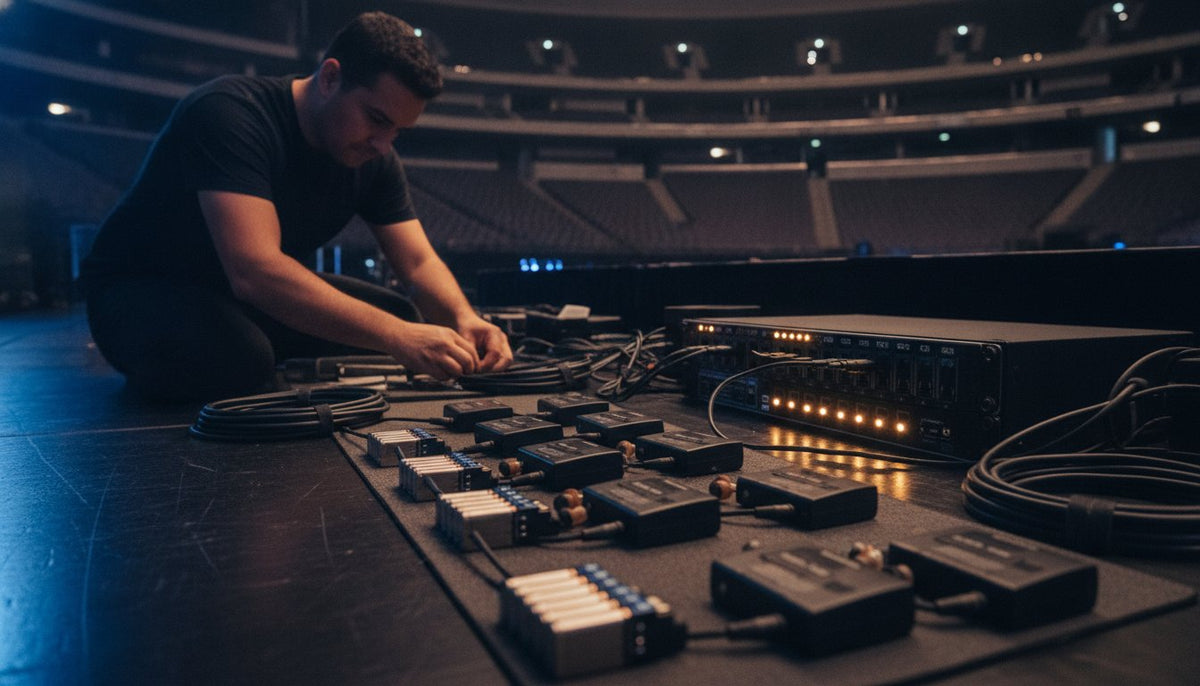
The lead vocalist hits the bridge, and suddenly, their mix goes silent. It isn't a wireless interference issue; it's a voltage sag from a standard alkaline battery that simply couldn't keep up with the demand. You've likely felt the frustration of managing a drawer full of half-used batteries or worrying if a "fresh" set will actually survive a four-hour set. Finding the right AA rechargeable batteries for in-ear monitor beltpacks is about more than just capacity. It's about maintaining a stable voltage output to ensure your RF signal stays locked from soundcheck to the final encore.
In this 2026 guide, you'll discover high-capacity rechargeable solutions that eliminate dropouts and significantly reduce your long-term operating costs. We'll break down the performance of the Pure Power Series and Ansmann 2850 mAh cells in real-world professional audio environments. You will learn how to achieve guaranteed 6-8 hour runtimes while building a professional charging rack that organizes your workflow. By switching to a high-cycle system, you can expect a reliable ROI through 500 or more charge cycles, moving your production away from disposable waste and toward steady reliability.
Key Takeaways
- Learn why 1.5V constant voltage output from the Pure Power Series prevents the premature low-battery warnings and RF instability common with standard cells.
- Identify the performance differences between Lithium-ion and high-capacity NiMH to select the best AA rechargeable batteries for in-ear monitor beltpacks based on your specific runtime needs.
- Discover the Ansmann Slimline solution for eliminating fitment issues in tight battery compartments without compromising on the industry-standard 2850 mAh capacity.
- Understand how custom rackmount charging systems transition your workflow from disorganized plastic chargers to a professional inventory management process.
- Evaluate the long-term ROI of professional battery systems that provide 500 or more charge cycles, significantly reducing annual operating expenses for churches and theaters.
Why Standard AA Batteries Fail in Professional IEM Beltpacks
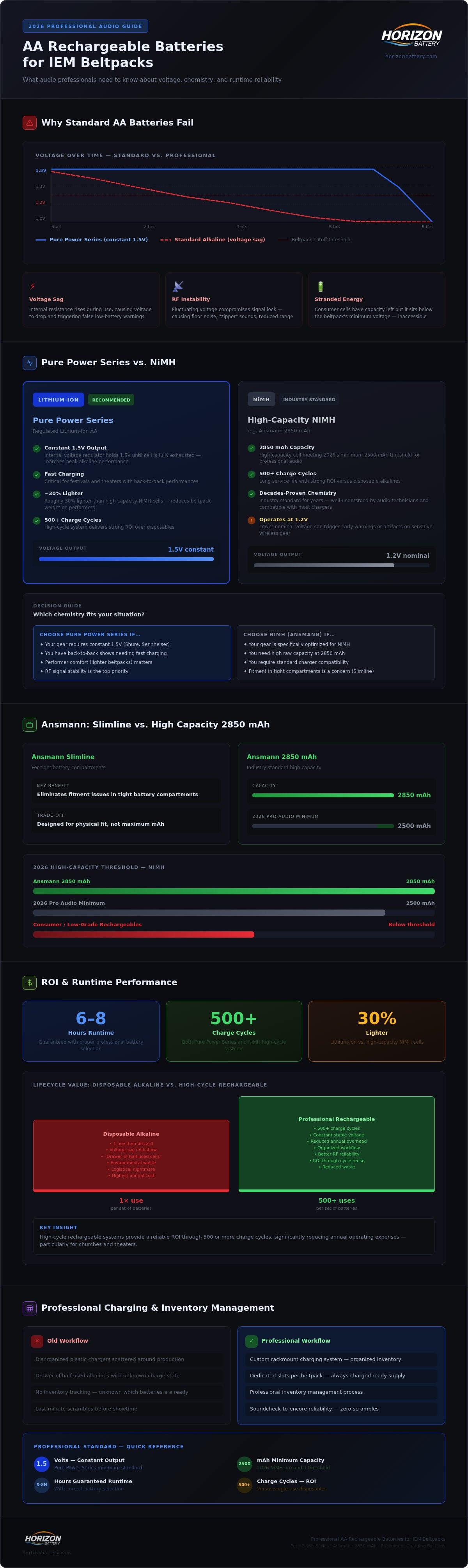
Most audio technicians have experienced the frustration of a beltpack showing a low-battery indicator just twenty minutes into a set. This rarely happens because the battery is actually dead. Instead, it's usually a result of voltage sag. Standard alkaline batteries and lower-grade rechargeables often cannot maintain the consistent pressure required by high-drain wireless gear. As the internal resistance of the battery increases during use, the voltage drops. Professional IEM receivers interpret this drop as a failing cell and trigger a warning or, in some cases, a hard shutdown to protect the internal electronics.
RF stability depends entirely on a steady power supply. When the voltage fluctuates, the transmitter's ability to maintain a rock-solid signal over distance is compromised. You might notice increased floor noise, occasional "zipper" sounds, or a reduction in the usable range of the wireless system. Professional AA rechargeable batteries for in-ear monitor beltpacks are designed specifically to combat these issues by providing a flatter discharge curve, ensuring the beltpack receives the same level of power at hour four as it did at minute five.
The legacy "new battery every show" policy is a significant drain on production budgets. Relying on disposables creates a massive amount of environmental waste and a logistical nightmare of managing thousands of half-used cells. In 2026, the industry has shifted toward high-cycle systems that offer a higher return on investment. By moving away from the "drawer of half-used alkalines," venues can achieve better performance reliability while slashing their annual overhead costs.
The Critical Threshold of Wireless Audio
Wireless hardware from industry leaders like Shure and Sennheiser operates within a very narrow voltage window. Once the power source drops below a specific cutoff threshold, the device becomes unreliable. Consumer-grade rechargeables often fail mid-performance because they lack the "usable energy" required for audio. They might have plenty of total capacity left, but because that energy sits at a lower voltage, the beltpack cannot access it. Reliable AA rechargeable batteries for in-ear monitor beltpacks prioritize maintaining that peak voltage through the entire discharge cycle.
High-Capacity AA Batteries for Professional Audio
In the 2026 technical landscape, a "high capacity" cell is defined as having at least 2500mAh for NiMH or featuring specialized constant-voltage circuitry for Lithium-ion. However, a high mAh rating alone doesn't guarantee success. You must consider how that power is delivered. When comparing Ansmann technology vs. Pure Power Series, the choice depends on whether your gear requires a traditional high-drain NiMH cell or the constant 1.5V output of a modern lithium solution. Selecting the right chemistry ensures your beltpacks stay active for the full duration of even the longest rehearsals or performances.
Pure Power Series vs. NiMH: Choosing the Right Chemistry
Selecting the right chemistry is the most critical decision when upgrading to AA rechargeable batteries for in-ear monitor beltpacks. Nickel Metal Hydride (NiMH) has been the industry standard for decades. However, regulated Lithium-ion technology like the Pure Power Series has redefined the requirements for professional RF stability. Both chemistries offer 500 or more charge cycles. This provides a massive improvement over disposable alkalines. The way they deliver that power is what separates a successful show from a technical failure.
The Pure Power Series Advantage
Standard rechargeables often sit at 1.2V. This lower voltage can sometimes lead to audio artifacts or early warning lights on sensitive gear. The Pure Power Series utilizes an internal voltage regulator to maintain a constant 1.5V output. It mimics the peak performance of a fresh alkaline battery until the cell is exhausted. This regulated power keeps the RF signal clarity at its maximum. These cells also support fast charging, which is vital for festivals or theaters with back-to-back performances. For a deeper look at this technology, read the Pure Power Series: The Professional Guide to Lithium-Ion AA Batteries.
Weight is another practical factor. Lithium-ion cells are roughly 30% lighter than high-capacity NiMH. For touring musicians wearing multiple beltpacks for several hours, this reduction improves physical comfort. It reduces strain on costumes and prevents beltpacks from sagging during high-energy performances.
When to Stick with High-Capacity NiMH
High-capacity NiMH remains a reliable workhorse for many productions. These cells perform exceptionally well in extreme temperature environments. They are the preferred choice for outdoor summer festivals or cold-weather stadium events where lithium performance can fluctuate. NiMH is also compatible with a wider range of legacy charging infrastructure. This allows venues to upgrade their inventory without necessarily replacing every charger in their rack.
From a cost-benefit perspective, NiMH is often the more economical choice for large-scale deployments. While they don't offer the constant 1.5V of lithium, high-quality NiMH cells like the Ansmann 2850 mAh provide the robust longevity needed for an 8-hour production day. These are excellent AA rechargeable batteries for in-ear monitor beltpacks in environments where temperature stability is the primary concern. If you are looking to simplify your transition, you might explore our charger and battery bundles to find a complete solution.
The Ansmann Standard: Slimline vs. High Capacity 2850 mAh
Ansmann 2850 mAh cells are widely regarded as the "Gold Standard" for high-drain professional audio applications. They provide the consistent current required by modern receivers without the performance drops seen in consumer brands. These cells are specifically designed as AA rechargeable batteries for in-ear monitor beltpacks, balancing raw power with long-term durability. They utilize a hybrid technology that combines high capacity with low self-discharge (LSD) characteristics. This ensures your cells stay charged while sitting in a technician's workbox, ready for immediate deployment during a high-stakes broadcast or live event. For more technical details on why these cells dominate the pro audio market, consult the Ansmann High Capacity Batteries: 2026 Professional Guide. This reliable chemistry provides the steady reliability that veteran distributors and high-profile clients have trusted since 1998.
Ansmann 2850 mAh Slimline: Dimensions Matter
The physical size of a battery is often overlooked until a cell becomes lodged inside a professional beltpack. Many generic high-capacity batteries achieve their mAh ratings by slightly increasing the cell diameter. While this works in a loose TV remote, it's a disaster for the precision-engineered compartments of Sennheiser G3 or G4 units. The Ansmann Slimline series addresses this "Stuck Battery" syndrome by maintaining strict ISO standards for AA dimensions. You won't have to use pliers to remove these cells after a show. Professional dimensions differ from consumer standards because mission-critical audio gear requires precision tolerances that cannot accommodate the physical swelling common in generic high-capacity cells.
Runtime Expectations for 2026 Pro Gear
In 2026, a pair of Ansmann 2850 mAh cells can reliably power a Sennheiser G4 beltpack for 8 to 10 hours of continuous use. This runtime exceeds the typical four-hour performance window, providing a comfortable safety margin for soundchecks, long rehearsals, and the main event. To maintain this level of performance, you should implement a methodical rotation system using labeled cases or battery organizers. Tracking the age and cycle count of your AA rechargeable batteries for in-ear monitor beltpacks ensures that every performer receives a set at peak health. This organization prevents the common mistake of mixing old and new cells. Low self-discharge technology also means your backup packs stay ready for weeks without needing a top-off charge.
Professional Charging and Inventory Management
Managing a professional inventory requires moving beyond the consumer-grade 4-slot plastic chargers found in retail stores. Those devices often lack the ventilation and circuit sophistication needed for heavy rotation. Standardizing your venue on a single battery ecosystem ensures that every technician knows exactly what to expect from their power source. By 2026, the industry has moved toward integrated systems that treat AA rechargeable batteries for in-ear monitor beltpacks as a mission-critical asset rather than a disposable commodity. Tracking the cycle life of these cells is essential for maintaining a high-performance audio environment. Efficiency saves shows.
Custom Rackmount Chargers: The Pro AV Standard
Custom rackmount chargers have become the standard for professional AV environments. These units eliminate the cable clutter that often plagues the monitor world rack; they provide a centralized hub for all power needs. Intelligent charging circuits within these racks monitor cell health in real-time, preventing overcharging and heat buildup. This steady reliability is why churches and theaters are switching to integrated rack solutions. They offer a clean, permanent installation that reduces the risk of lost or misplaced chargers. For a comprehensive look at these systems, see our Enterprise Battery Charging Solutions: The 2026 Professional Buying Guide.
5 Steps to a Fail-Proof Battery Workflow
A fail-proof battery workflow is the only way to guarantee performance reliability. Follow these five steps to manage your inventory effectively:
- Step 1: Labeling and dating. Mark every new cell with its "put into service" date to track its age.
- Step 2: Storage systems. Use a clear "charged vs. depleted" system, such as different colored bins, to avoid sending dead batteries onto the stage.
- Step 3: Capacity testing. Perform periodic tests using an analyzer to identify and retire weak links before they cause a dropout.
- Step 4: Production scheduling. Standardize charging times so cells are always ready before soundcheck and fully replenished overnight.
- Step 5: Proper storage. Store cells in dedicated battery storage containers to protect contacts from shorting and keep the workspace organized.
Implementing these protocols ensures that your AA rechargeable batteries for in-ear monitor beltpacks perform at their peak for every show. It pays off. If you're ready to upgrade your facility, browse our custom rackmount chargers to find a solution that fits your specific rack configuration.
Maximizing ROI: Why Horizon Battery is the Choice for 2026
Choosing a professional power solution requires a shift from viewing batteries as simple consumables to seeing them as a strategic investment. The long-term savings of switching to rechargeable batteries for business are substantial; you eliminate the recurring expense of purchasing and disposing of thousands of alkaline cells. Horizon Battery has served the professional audio industry since 1998. We act as a knowledgeable guide for churches, theaters, and touring productions that cannot afford technical failures. Our specialized focus on AA rechargeable batteries for in-ear monitor beltpacks ensures that every client receives a solution tailored to their specific fleet requirements.
We don't simply sell individual cells. We provide customized bundles that match the correct battery chemistry with professional-grade charging hardware. This holistic approach maximizes mobile energy performance and ensures long-term reliability. Whether you're managing a small house of worship or a large-scale theater production, standardizing your inventory with a veteran distributor provides a level of security that generic retailers cannot match. It's about building a partnership with an industry insider that understands the nuances of RF stability.
Reliability for High-Stakes Environments
Technical failures during live broadcasts are often traced back to power inconsistencies that generic cells can't handle. In professional environments, the peace of mind that comes from industry-standard Ansmann and Pure Power products is invaluable. Consider the actual cost of a "cheap" battery failure. When a lead vocalist's IEM goes silent during a performance, the damage to the production's reputation far outweighs any minor initial savings. Professional-grade AA rechargeable batteries for in-ear monitor beltpacks are designed to prevent these high-stakes errors by maintaining a flat discharge curve. By investing in stable voltage and high-cycle counts, you ensure that your production team remains focused on the performance rather than the power supply.
Next Steps for Your AV Team
The path to a more efficient production begins with a thorough audit of your current battery usage and waste. Take the time to look at your annual expenditure on alkalines and the frequency of mid-show swaps. This data often reveals a significant opportunity for immediate cost reduction and increased reliability. Once you understand your specific needs, consulting with Horizon Battery can help you design a custom rackmount solution that integrates perfectly into your existing gear. Implementing the 2026 professional battery standard today will stabilize your workflow and provide a clear ROI within the first year of operation. Moving to a professional system is a commitment to quality that your performers, your crew, and your budget will appreciate.
Securing Your Audio Performance Standards for 2026
Transitioning to a professional power ecosystem is more than a cost-saving measure; it's a commitment to performance integrity. By selecting the correct chemistry, whether it's the constant 1.5V output of the Pure Power Series or the high-drain capacity of Ansmann cells, you eliminate the unpredictable voltage sag that leads to mid-show dropouts. Implementing a structured inventory management system with custom rackmount engineering ensures your team is always show-ready. This methodical approach transforms batteries from a recurring frustration into a reliable asset that supports your technical workflow.
Horizon Battery has provided professional-grade solutions since 1998, helping venues move away from the logistical burden of disposable alkalines. The right AA rechargeable batteries for in-ear monitor beltpacks provide the stability and longevity required for modern, high-stakes productions. You can upgrade your IEM system with Professional AA Rechargeable Bundles to start seeing a significant return on investment today. With the right tools and a methodical workflow, you can focus entirely on the mix while we handle the power. Your audience and your performers deserve that level of consistency.
Frequently Asked Questions
Will 1.2V NiMH batteries work in my Shure or Sennheiser IEM beltpack?
Yes, 1.2V NiMH cells will power most Shure and Sennheiser units, but they often trigger low-battery indicators prematurely. This happens because these devices are calibrated for the 1.5V curve of alkaline batteries. High-quality AA rechargeable batteries for in-ear monitor beltpacks, such as Ansmann 2850 mAh, mitigate this by providing a robust discharge curve that keeps the voltage above the device's cutoff point for much longer durations than consumer cells.
What is the best mAh rating for AA batteries used in wireless audio?
For professional wireless audio, the optimal range is typically between 2500mAh and 2850mAh. While it's tempting to seek the highest number possible, excessively high mAh ratings in consumer cells often come at the expense of physical size or increased internal resistance. Professional-grade cells focus on usable capacity. This ensures the battery maintains enough voltage to keep the RF signal stable throughout a four-hour performance or an eight-hour production day.
How many hours of runtime can I expect from Ansmann 2850 mAh batteries?
You can reliably expect between 8 and 10 hours of continuous runtime when using Ansmann 2850 mAh cells in a standard pack like the Sennheiser G4. This estimate assumes the batteries are at peak health and have been charged using a professional-grade intelligent system. This safety margin is critical for audio teams. It covers everything from the initial morning soundcheck through the final encore without requiring a mid-show battery swap.
Why do some rechargeable batteries get stuck in IEM battery compartments?
Many consumer-grade high-capacity batteries are manufactured with a slightly larger diameter to fit more energy into the cell. While these fit in household electronics, they often become lodged in the tight, precision-engineered compartments of professional IEM receivers. Using a specialized solution like the Ansmann Slimline series ensures the batteries meet strict ISO standards. This prevents stuck battery syndrome and protects your expensive wireless hardware from physical damage during removal.
Can I use standard AA chargers for Pure Power Series Lithium-ion batteries?
No, you must use a charger specifically designed for the Pure Power Series or similar 1.5V Lithium-ion rechargeables. These cells contain internal voltage regulation circuitry that requires a different charging profile than standard NiMH batteries. Attempting to use a traditional NiMH charger can result in incomplete charges or damage to the battery's internal regulator. We recommend using our dedicated charger and battery bundles to ensure total compatibility and long-term safety.
How do I know when it's time to retire my rechargeable AA batteries?
It is time to retire your cells when they consistently fail to meet 80% of their original rated capacity during a discharge test. Most professional AA rechargeable batteries for in-ear monitor beltpacks are rated for 500 or more charge cycles. If you notice a sudden drop in runtime or if the batteries become excessively hot during the charging process, they should be removed from your active rotation immediately to prevent performance failures.
Are custom rackmount chargers worth the investment for a small church?
For small churches, custom rackmount chargers are a strategic investment that pays off through organized workflows and increased battery longevity. These systems eliminate the cable clutter of multiple small chargers and provide intelligent monitoring that prevents overcharging. By centralizing your power management, you ensure that volunteers always have fresh, tested cells ready for every service. This professional approach reduces the long-term cost of replacing batteries damaged by inferior charging hardware.
Do rechargeable batteries cause RF interference in wireless monitor systems?
High-quality rechargeable batteries do not cause RF interference. In fact, professional solutions like the Pure Power Series are engineered with shielding and voltage regulation to ensure a silent noise floor. Interference is more commonly caused by external RF congestion or failing hardware rather than the battery chemistry itself. Using professional-grade power ensures that your signal remains clear and your signal-to-noise ratio stays within the manufacturer's specified range for high-fidelity audio.