
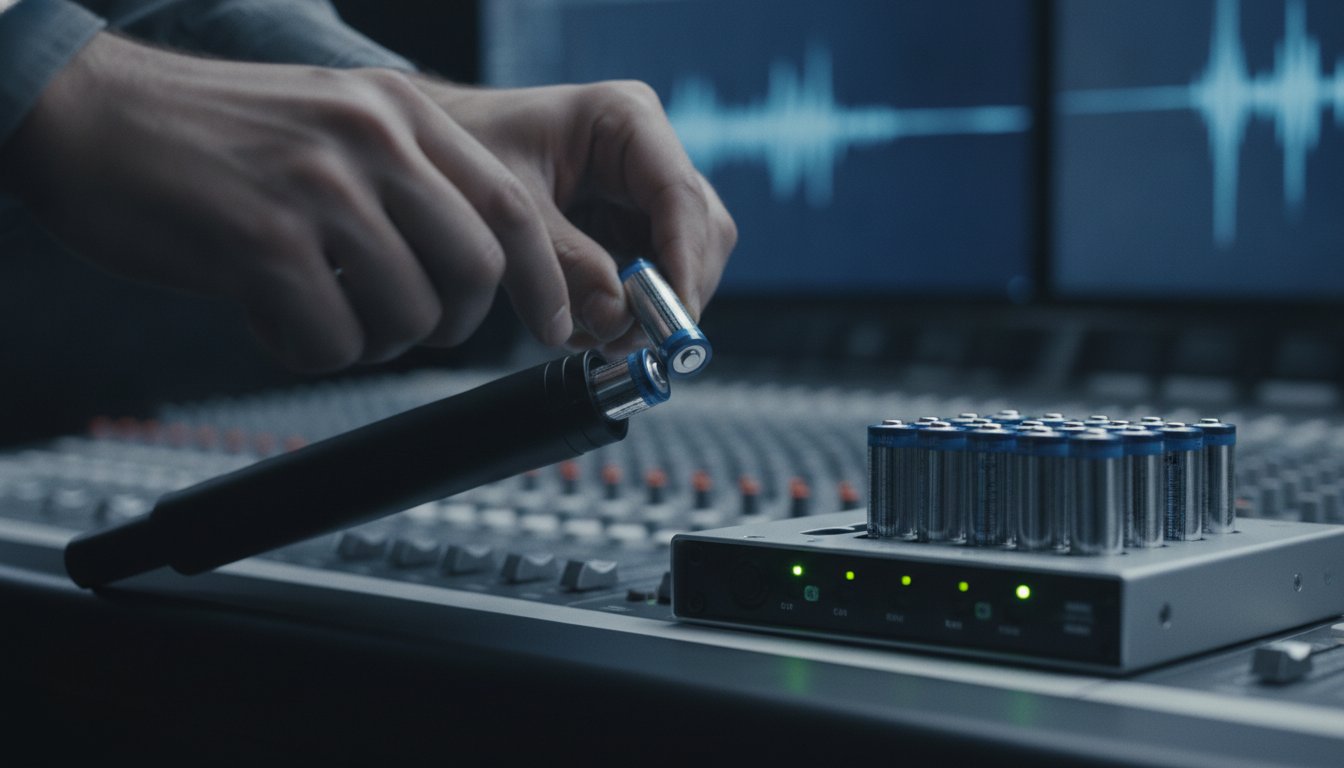
The standard NiMH rechargeable battery is often the weakest link in a professional wireless signal chain. While traditional rechargeables drop to 1.2V almost immediately, 1.5v lithium ion rechargeable batteries maintain a constant voltage until the moment they are depleted. This distinction is the difference between a flawless performance and a sudden, mid-show audio dropout.
You likely understand the frustration of seeing a "low battery" indicator on a wireless microphone just minutes after a fresh swap. It's a common pain point caused by the voltage sag inherent in older battery chemistries. Relying on expensive disposable alkalines isn't a sustainable solution for high-volume facilities, yet cheap consumer-grade rechargeables often introduce unwanted electronic interference.
This guide will help you master the technology behind constant-voltage power to eliminate battery anxiety in mission-critical environments. We'll examine the long-term ROI of the Pure Power Series and explain how to implement the right charging infrastructure for large-scale use. You'll learn how to transition your facility to a more reliable, cost-effective power standard.
Key Takeaways
- Gain a technical understanding of how internal buck converters maintain a constant voltage output to ensure mission-critical reliability for professional wireless gear.
- Compare the discharge curves of 1.5v lithium ion rechargeable batteries against NiMH and alkaline options to see why lithium is the superior choice for high-drain applications.
- Learn the essential operational protocols for charging and maintaining lithium-ion cells to protect your investment and ensure long-term performance.
- Explore enterprise-level implementation strategies using the Pure Power Series and custom rackmount chargers to eliminate desktop clutter and streamline facility management.
What are 1.5V Lithium-Ion Rechargeable Batteries?
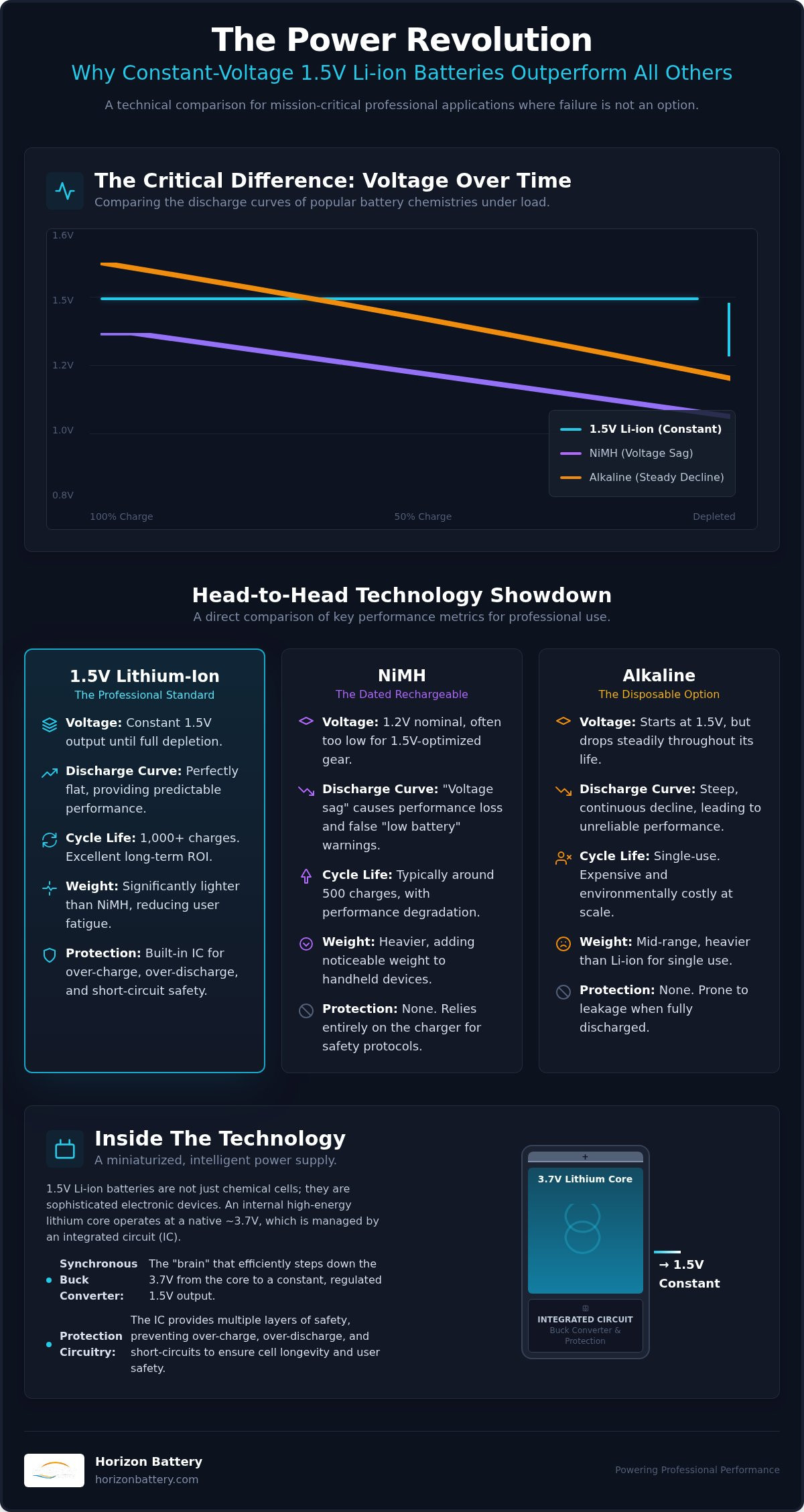
A 1.5v lithium ion rechargeable battery is a sophisticated power management system housed within a standard AA or AAA form factor. Unlike traditional rechargeable batteries that rely on Nickel-Metal Hydride (NiMH) chemistry, these cells utilize a high-energy lithium-cobalt or lithium-manganese core. Because lithium chemistry natively operates at approximately 3.7V, these batteries include an integrated circuit (IC) that steps the voltage down to a consistent 1.5V. This internal regulation ensures the battery behaves exactly like a high-performance alkaline cell while offering the longevity of lithium technology.
The shift toward 1.5v lithium ion rechargeable batteries marks a necessary evolution in professional power. For decades, technical directors and facility managers relied on NiMH cells, which are prone to significant voltage sag. As a NiMH battery depletes, its voltage drops from 1.2V toward 1.0V, often causing sensitive electronics to malfunction. By 2026, the industry has pivoted toward lithium-ion for mission-critical applications. This technology is now the standard for professional wireless audio, precision medical devices, and high-drain telemetry gear where consistent power is a requirement rather than a luxury.
The 1.5V Advantage Over Traditional Rechargeables
The primary benefit of this technology is its ability to maintain a "flat" discharge curve. Most professional equipment is engineered specifically for the 1.5V output of an alkaline battery. When you use a 1.2V NiMH cell, you are starting at a disadvantage. This lower voltage often results in the "dimming flashlight" effect or reduced operating range for wireless transmitters. 1.5V lithium-ion cells eliminate this issue by providing full power until the moment the cell is exhausted.
Weight is another critical factor in professional environments. Lithium-ion cells are significantly lighter than their NiMH counterparts. In handheld wireless microphones or head-worn battery packs, this weight reduction decreases user fatigue during long events. It's a practical improvement that enhances both the performer's comfort and the equipment's overall balance.
Chemistry and Construction Basics
The internal architecture of these cells is a marvel of miniaturization. Each battery contains a Lithium-polymer core and a sophisticated buck converter. This converter is the "brain" of the battery, managing the step-down from 3.7V to 1.5V with high efficiency. Professional-grade cells also incorporate several layers of protection managed by the IC, including:
- Over-charge protection to prevent cell damage during rapid charging cycles.
- Over-discharge protection which preserves the chemistry by shutting down before the voltage hits a critical low.
- Short-circuit protection to ensure safety in high-pressure industrial environments.
In 2026, professional lithium-ion cells are designed for durability. You can expect a cycle life of 1,000 or more charges when using proper infrastructure. This longevity, combined with the lack of "memory effect," makes them a reliable asset for large-scale facility management.
The Science of Constant Voltage: How 1.5V Li-ion Technology Works
Unlike NiMH batteries that rely on chemical reactions alone to provide power, 1.5v lithium ion rechargeable batteries function as miniaturized power supplies. The internal lithium core maintains a nominal 3.7V, which is too high for standard AA devices. To bridge this gap, an integrated circuit regulates the output to a steady 1.5V. This ensures that your equipment receives the exact voltage it was designed for, from the first minute of use until the cell is depleted.
This active regulation is what creates the "voltage flatline" effect. In traditional batteries, the voltage drops as the chemistry is consumed. With regulated lithium-ion, the output remains at a hard 1.5V. When the internal cell can no longer sustain the conversion, the battery shuts off instantly. This eliminates the period of "weak" performance often seen with alkaline or NiMH cells, providing a predictable and reliable power source for mission-critical gear.
Understanding the Internal Buck Converter
The core of this technology is the synchronous buck converter. This DC-DC regulator uses high-frequency switching to step down the voltage with minimal energy loss. The duty cycle of the internal regulator refers to the fraction of time the switching transistor is "on" versus "off" to maintain the target 1.5V output. Because of this conversion process, industry professionals prefer measuring capacity in milliwatt-hours (mWh) rather than milliamp-hours (mAh). This provides a more accurate representation of total energy, as mAh ratings can be misleading when voltage is being actively transformed.
Thermal management is a key consideration in this design. High-drain use can cause the internal regulator to generate heat. Professional-grade cells utilize efficient circuit layouts and heat-dissipating materials to keep operating temperatures within safe limits, ensuring the battery doesn't trigger a safety shutdown during a live event.
Addressing Electromagnetic Interference (EMI)
A common issue with entry-level rechargeable electronics is the introduction of audible noise into wireless signal chains. The high-frequency switching of a buck converter can create electromagnetic interference (EMI) if the cell isn't properly shielded. In professional environments, this manifests as a persistent buzz or hiss in wireless microphones. The Pure Power Series addresses this by using advanced filtering and shielding components to contain RFI. For facilities with dozens of simultaneous wireless channels, testing for RFI sensitivity is a standard protocol to ensure that internal battery electronics don't compromise the noise floor of the audio system.
1.5V Lithium-Ion vs. NiMH vs. Alkaline: A Professional Performance Comparison
Selecting the right power source requires understanding how different chemistries respond to load. While alkaline cells are ubiquitous, their voltage begins to drop as soon as the device is powered on. NiMH offers a more stable discharge but still operates at a lower nominal voltage. In contrast, 1.5v lithium ion rechargeable batteries provide a constant output that mimics the peak performance of a fresh alkaline cell throughout its entire cycle. This consistency isn't just a technical detail; it's a requirement for the sensitive electronics used in modern production environments.
The Discharge Curve Battle
Alkaline batteries are notorious for "voltage sag." Under the heavy load of a digital wireless transmitter, an alkaline battery's 1.5V rating can quickly plummet to 1.1V or lower. NiMH batteries maintain a steady 1.2V for much of their life, but many professional devices interpret this lower voltage as a "low battery" state. This often triggers premature warnings or reduced RF output power, leading to unnecessary battery swaps. 1.5v lithium ion rechargeable batteries avoid this "slope" entirely. They provide a flat 1.5V "cliff" where power remains at 100% until the internal cell is exhausted. This ensures maximum signal clarity and operating range for the entire duration of your event.
Performance in extreme conditions is where lithium truly excels. Traditional chemistries often struggle in cold-weather outdoor productions, as internal resistance increases and usable capacity drops. Lithium-ion remains resilient in lower temperatures, making it the preferred choice for winter events or stadium environments. From a financial perspective, the Total Cost of Ownership (TCO) favors lithium-ion for any facility using batteries daily. While the initial investment is higher than a bulk pack of disposables, the ability to reuse a single cell over 1,000 times eliminates the recurring expense and logistical burden of managing thousands of alkaline units.
Weight and Ergonomics
Physical weight affects more than just shipping costs. Lithium-ion batteries are approximately 30% lighter than high-capacity NiMH cells. This reduction is immediately noticeable in belt packs and handheld microphones during multi-hour performances. It's a simple change that significantly improves user comfort. For a more detailed breakdown of these differences, see our comparison on Pure Power Series vs NiMH: The Professional Guide to AA Rechargeable Batteries. Reducing the physical load on performers and technicians improves the overall production experience without sacrificing power capacity.
Operational Best Practices: Charging and Maintaining 1.5V Lithium-Ion Cells
Maintaining 1.5v lithium ion rechargeable batteries requires a departure from standard NiMH protocols. Traditional chargers for NiMH cells typically use a "Delta-V" termination method, which looks for a slight voltage drop to signify a full charge. Lithium cells, however, require a Constant Current/Constant Voltage (CC/CV) profile. Using a mismatched charger is ineffective and potentially damaging. It can lead to excessive heat or premature cell degradation. Professional environments must ensure that charging hardware is specifically matched to the internal circuitry of the lithium cell to protect the investment.
For those managing diverse inventories, understanding self-discharge rates is equally vital for long-term reliability. You can find more details on this in The Professional Guide to Low Self-Discharge Rechargeable Batteries in 2026. Proper maintenance ensures that your cells are ready for immediate use, even after weeks of storage.
The Importance of Dedicated 1.5V Li-ion Chargers
Charging speed is a major advantage for lithium systems. Most professional-grade 1.5v lithium ion rechargeable batteries can reach a full charge in under two hours. This rapid turnaround allows for smaller total inventories, as batteries can be cycled through chargers multiple times during a long production day. However, this speed must be managed by high-quality circuitry to prevent overcharging. High-quality chargers communicate with the battery's internal integrated circuit to ensure the voltage step-down process is handled safely during the replenishment cycle.
Facility-Wide Battery Management
Large facilities benefit from a structured rotation system. We recommend a simple "Charged vs. Uncharged" bin system to prevent confusion during high-pressure gear swaps. Clear labeling and dedicated battery storage cases protect the contacts and keep the workspace organized. While some facilities still utilize Ansmann Hybrid NiMH: The Professional Guide to High-Capacity LSD Power for specific legacy applications, the management principles remain the same. Tracking the age and cycle count of your cells is essential. Marking the "put into service" date on the battery shell helps you identify when a cell is approaching its end-of-life, which typically occurs after approximately 1,000 cycles.
To streamline your facility workflow and ensure compatibility, explore our professional Charger / Battery Bundles designed for enterprise reliability. These bundles provide the specific charging protocols required to maintain the longevity of your lithium-ion investment.
Standardizing Your Facility with Pure Power Series Lithium-Ion Solutions
Transitioning a professional facility to 1.5v lithium ion rechargeable batteries is a strategic move that requires the right hardware. While consumer-grade options exist, they often lack the durability and shielding necessary for high-stakes environments. Standardizing on a single enterprise-grade ecosystem ensures that every device, from wireless microphones to telemetry sensors, performs at its peak without the risk of interference or mechanical failure. This approach simplifies inventory management and provides a predictable baseline for equipment performance across your entire organization.
Pure Power Series: Professional-Grade Reliability
The Pure Power Series represents the enterprise standard for high-capacity power. These cells are specifically engineered to withstand the rigors of touring and live events. Unlike generic alternatives, they feature superior internal shielding to eliminate the electromagnetic noise that often plagues professional audio signal chains. This makes them the ideal choice for high-density wireless environments. For a deeper technical dive into these specific cells, review our article on Pure Power Series: The Professional Guide to Lithium-Ion AA Batteries. These batteries provide the steady reliability required when there is no room for equipment failure.
Implementing Custom Rackmount Charging Infrastructure
A common bottleneck in large-scale operations is the clutter of desktop units. Custom Rackmount Chargers solve this by consolidating power into an organized, professional format. These units allow technicians to monitor charge status across dozens of channels simultaneously within a production suite. This infrastructure is particularly valuable for churches, theaters, and corporate campuses where space is at a premium and workflow efficiency is critical. Moving charging operations into the rack ensures that batteries are always where they need to be, fully charged and ready for the next shift.
Since 1998, Horizon Battery has acted as a veteran guide for high-profile clients. Our focus remains on industrial reliability and finding the right solution for specific applications. We don't just provide hardware; we offer the expertise gathered from decades of serving the professional community. This experience ensures that your facility transition is handled with precision and long-term performance in mind.
To begin your transition, perform a comprehensive audit of your current battery usage. Identify high-drain devices that currently rely on alkaline disposables or underperforming NiMH cells. Calculating the potential ROI of switching to 1.5v lithium ion rechargeable batteries will clarify the long-term savings in both capital and labor. Once your requirements are defined, implementing a unified charging standard will eliminate "low battery" anxiety across your entire facility.
Securing Your Power Infrastructure for the Future
Adopting 1.5v lithium ion rechargeable batteries is a strategic step toward ensuring absolute signal integrity in professional environments. The constant voltage provided by these cells eliminates the performance dips common with older chemistries, allowing your equipment to function at its peak until the very end of the charge cycle. By understanding the science of internal regulation and implementing proper maintenance protocols, you can significantly reduce both operational downtime and long-term expenses.
Horizon Battery has served high-profile clients since 1998, acting as a knowledgeable guide in the world of industrial power. Our Pure Power Series is engineered to meet the rigors of live production, while our custom-engineered rackmount charging solutions provide the organized infrastructure that large-scale facilities require. Standardizing your inventory with these professional-grade tools removes the guesswork from battery management and ensures a higher standard of reliability.
Upgrade your facility with the Pure Power Series and Custom Rackmount Chargers to eliminate power-related failures and streamline your technical workflow. Investing in a reliable power standard today ensures your facility remains ready for every mission-critical event in 2026 and beyond. It is a practical solution for a high-demand industry.
Frequently Asked Questions
Can I use my existing NiMH charger for 1.5V lithium-ion batteries?
You cannot use a standard NiMH charger for these cells. 1.5v lithium ion rechargeable batteries require a specific Constant Current/Constant Voltage (CC/CV) charging profile. A NiMH charger uses a Delta-V termination method that won't recognize the lithium-ion charging cycle. This incompatibility can lead to incomplete charges or damage to the battery's internal integrated circuit. Always use a charger designed specifically for 1.5V lithium-ion systems.
Why does my device show 100% battery life right until the lithium-ion battery dies?
This occurs because the internal regulator maintains a steady 1.5V output until the cell is nearly empty. Most battery meters estimate remaining life by measuring voltage drop. Since the voltage doesn't drop gradually like it does in alkaline or NiMH cells, the device assumes the battery is full. When the internal protection circuit cuts power to prevent over-discharge, the device shuts down immediately without a traditional warning.
Do 1.5V lithium-ion batteries cause interference with wireless microphones?
Professional-grade 1.5v lithium ion rechargeable batteries, like the Pure Power Series, are designed with internal shielding to prevent electromagnetic interference. Lower-quality consumer cells often lack this shielding, which can introduce a persistent buzz or hiss into wireless microphone signals. If you're working in an RFI-sensitive environment, standardizing on professional cells with high-quality buck converters is necessary to maintain a clean noise floor and reliable signal.
What is the difference between mAh and mWh when comparing these batteries?
Milliwatt-hours (mWh) measure the total energy capacity, while milliamp-hours (mAh) only measure electric charge. For lithium-ion cells with internal voltage regulation, mWh is a much more accurate metric. This is because the internal circuit is stepping down the core voltage from 3.7V to 1.5V. Comparing mWh allows you to understand the actual runtime performance across different chemistries more effectively than mAh ratings alone.
How many times can I recharge a professional 1.5V lithium-ion battery?
You can typically expect 1,000 or more charge cycles from a professional-grade cell. This longevity is significantly higher than most high-capacity NiMH batteries, which often begin to degrade after 200 to 300 cycles. To reach this 1,000-cycle threshold, it's important to use a dedicated charger and avoid exposing the batteries to extreme temperatures. This high cycle life provides a substantial return on investment for high-volume facilities.
Are 1.5V lithium-ion batteries safe for use in high-heat environments?
These batteries include internal thermal management, but they shouldn't be used in environments exceeding 60 degrees Celsius. The integrated circuit provides safety shutdowns if temperatures become critical. However, consistent exposure to high heat will accelerate the degradation of the lithium-polymer core. For outdoor productions in direct summer sun, keeping the batteries in a shaded or temperature-controlled storage case between uses is a recommended practice.
Can I mix 1.5V lithium-ion batteries with NiMH or Alkaline in the same device?
You should never mix different battery chemistries in the same device. Combining 1.5V lithium-ion with NiMH or alkaline cells causes an uneven discharge rate because each battery type has a different internal resistance. This imbalance can lead to the weaker batteries being over-discharged or even leaking. For consistent performance and equipment safety, always use a matched set of batteries from the same manufacturer and production batch.
Do these batteries lose their charge if left on the shelf for several months?
These batteries have an exceptionally low self-discharge rate and will retain most of their charge for several months. Unlike older NiMH technology that could lose significant power while sitting idle, lithium-ion chemistry is very stable. You can expect them to retain approximately 80% to 90% of their charge after six months of storage. For the best results, store them in a cool, dry place at about 50% capacity if they won't be used for longer periods.