
Your battery indicator is lying to you. Most professional AV technicians have experienced the frustration of a wireless transmitter flashing a "low battery" warning only thirty minutes into a performance, even when using freshly charged NiMH cells. This isn't usually a lack of capacity. Instead, it's a result of the 1.2V voltage sag that triggers internal power sensors too early. When evaluating the Pure Power Series vs NiMH, it's clear that voltage stability is the true driver of professional reliability in 2026.
We understand that managing a large-scale facility requires equipment you can trust without constant monitoring. You've likely tried high-capacity rechargeables to cut down on the waste of alkaline disposables, only to find the runtimes inconsistent. This guide will show you how to eliminate those mid-show failures by choosing the right chemistry for your high-drain gear. We'll compare the 1.5V steady output of the Pure Power Series against traditional NiMH options. This analysis provides a clear path to reducing your long-term operating costs while ensuring your wireless microphones stay powered until the final curtain call.
Key Takeaways
- Learn why the 1.5V regulated output of Lithium-ion prevents premature "low battery" indicators in sensitive wireless transmitters.
- Compare the Pure Power Series vs NiMH to determine which chemistry offers the best return on investment for your specific high-drain or standard-drain applications.
- Discover how fast-charging Lithium-ion technology and high-capacity NiMH cells differ in runtime stability and charging cycles to optimize your workflow.
- Identify the physical dimension differences between high-capacity cells to avoid common fitment issues in professional audio equipment battery compartments.
- Explore how to transition to enterprise-level power management using custom rackmount chargers and centralized battery storage solutions.
The Voltage Gap: Why mAh Is Not the Only Metric That Matters
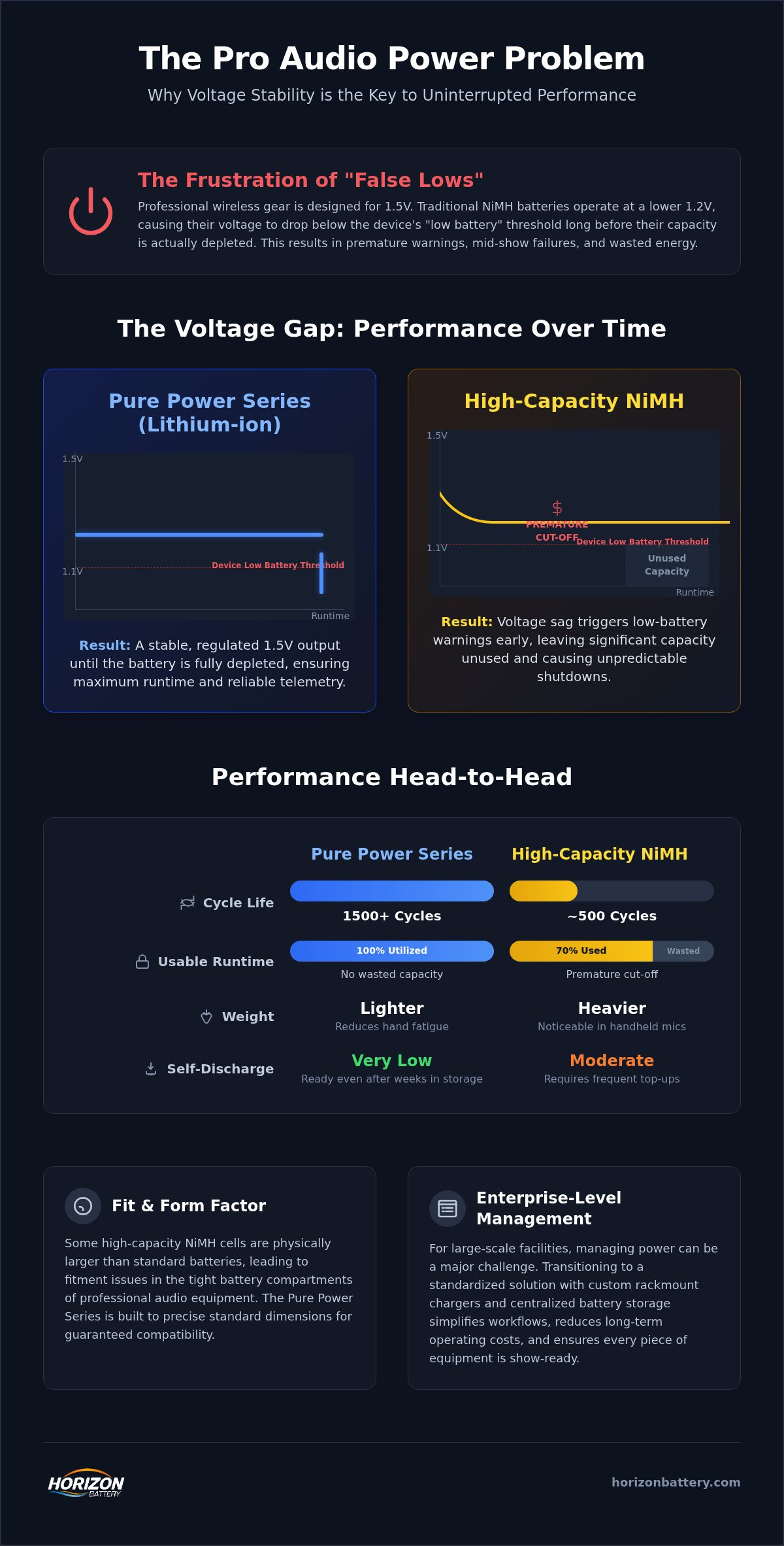
In the professional audio world, capacity is often misunderstood. Many technicians focus solely on milliamp-hours (mAh), believing a higher number automatically guarantees a longer show. However, the performance of high-drain wireless gear depends heavily on voltage stability. When comparing the Pure Power Series vs NiMH, the primary differentiator isn't just how much energy the cell holds, but how that energy is delivered to the device's circuitry. Professional transmitters are generally calibrated for the 1.5V standard of alkaline batteries. Because NiMH cells have a lower nominal voltage, they often trigger "false low" warnings that disrupt workflows and lead to unnecessary battery swaps.
The Problem with NiMH Voltage Curves
Traditional rechargeable battery chemistries like NiMH exhibit a linear voltage decline throughout their discharge cycle. A fully charged NiMH cell might start at 1.4V, but it quickly drops to its nominal 1.2V and continues sliding toward 0.9V as it nears empty. This "voltage sag" can compromise RF signal stability and increase the noise floor in sensitive transmitters. Even a high-capacity 2850 mAh NiMH cell can trigger a system shutdown if the voltage drops below the transmitter's minimum operating threshold. This often leaves a significant amount of unused capacity trapped in the battery because the device simply cannot stay powered at such low voltage levels. For 2026 production standards, this lack of predictability is a significant liability for live environments.
The Pure Power 1.5V Advantage
The Pure Power Series utilizes a sophisticated approach by combining high-density Lithium-ion chemistry with an integrated Battery Management System (BMS). This internal circuitry steps the native 3.7V Lithium charge down to a consistent 1.5V output. Constant Voltage Regulation is a key feature of the Pure Power Series that ensures the battery maintains a steady 1.5V output from the first minute of use until the cell is completely exhausted. This prevents the gradual performance degradation and premature "low battery" indicators common with other rechargeables. By maintaining a flat discharge curve, these batteries provide the reliable power levels that professional-grade wireless gear requires to function at peak specifications. AV teams in churches and theaters can finally trust their battery telemetry, knowing that a "full" indicator actually represents a stable, high-performance power source.
Chemistry Comparison: Pure Power Lithium-ion vs. High-Capacity NiMH
Understanding the core chemistry is the next step in evaluating the Pure Power Series vs NiMH. While NiMH has been the industry standard for decades, Lithium-ion technology brings a different set of advantages to the AA form factor. Pure Power Series batteries utilize a Lithium-ion core paired with an integrated Battery Management System (BMS). This internal circuitry acts as the brain of the battery, protecting the cell from overcharging and managing the power output. In contrast, high-capacity NiMH cells, such as the Ansmann 2850 mAh series, are robust chemical workhorses. They don't require internal electronics but rely on high-quality external chargers to prevent thermal damage.
When comparing the performance metrics of NiMH and Li-ion, cycle life is a major differentiator for your bottom line. You can expect roughly 500 cycles from a standard high-capacity NiMH cell. The Pure Power Series, however, is rated for up to 1500 cycles. This longevity significantly reduces the frequency of replacement purchases for large facilities. Self-discharge is another logistical hurdle to consider. Standard NiMH batteries can lose their charge while sitting in storage, which is why low self-discharge rechargeable batteries are essential for emergency or standby gear. Lithium-ion cells naturally hold their charge better over time, ensuring your equipment is ready to go even after weeks of sitting idle.
Weight and Ergonomics for Handheld Gear
Total weight matters more than you might think during a three-hour service or a theatrical performance. Lithium-ion cells are significantly lighter than their NiMH counterparts. For example, an Ansmann 2850 mAh NiMH cell has a noticeable heft that can contribute to hand fatigue in handheld microphones. Switching to a Pure Power cell reduces the overall weight of the transmitter. This provides a more comfortable experience for vocalists and speakers who are on stage for extended periods. It's a small change that makes a significant difference in user comfort.
Operating Temperatures and Environmental Resilience
Environmental conditions also dictate which chemistry you should choose. NiMH cells generally perform well in extreme cold, making them a solid choice for outdoor winter events where other batteries might struggle. However, the internal BMS in Pure Power cells provides a different kind of resilience by protecting the battery from overheating during rapid discharge cycles. For facilities that use a mix of high and low-drain devices, Ansmann hybrid NiMH remains a versatile and reliable option. If you're looking to simplify your inventory and transition your team, consider our professional battery bundles to ensure you have the right chemistry for every application.
Performance Head-to-Head: Stability, Runtime, and ROI
In a standard 30mW wireless transmitter, the difference between the Pure Power Series vs NiMH becomes immediately apparent during long production days. While a 2700 mAh NiMH cell provides respectable service, the 3500 mAh capacity of the Pure Power Series offers a significant runtime advantage. More importantly, the Pure Power Series maintains its peak voltage throughout the entire discharge. This means your transmitter won't experience signal dropouts or reduced range as the battery nears the end of its life. Charging speed also favors the Lithium-ion chemistry. While high-capacity NiMH cells often require long cycles to reach full capacity without overheating, Pure Power cells can be ready for use in a fraction of that time.
Transitioning away from alkaline disposables is a major win for the environment. A single facility can easily go through thousands of single-use batteries in a year. By switching to a high-cycle rechargeable system, you effectively remove that waste stream from the landfill. This isn't just about being "green"; it's about operational efficiency and reducing the logistical burden of ordering and storing bulk alkaline pallets. It's a reliable way to streamline your backstage operations.
Total Cost of Ownership (TCO) Analysis
Calculating the true value of your power solution requires looking beyond the initial purchase price. A high-capacity NiMH battery is typically rated for 500 charge cycles. In contrast, the Pure Power Series is rated for up to 1500 cycles. Over a two-year period of daily operation, the Lithium-ion solution lasts three times longer. This longevity reduces the frequency of replacement orders and the associated administrative costs. Large-scale facilities also see a reduction in labor costs. Technicians spend less time testing suspect batteries and performing mid-event swaps because the runtime is predictable and the cell health is managed by internal electronics.
Charging Infrastructure Requirements
It's critical to note that you cannot use a standard NiMH charger for Pure Power Lithium cells. Lithium-ion chemistry requires a specific charging algorithm to manage the internal core and the 1.5V output regulation. Using the wrong charger will fail to charge the cell and could potentially damage the internal Battery Management System. Professional charging bundles include dedicated chargers with auto-shutoff and overcharge protection. These safety features are becoming more robust as researchers develop safer, solid-state rechargeable batteries and improved management circuits. Investing in a matched battery and charger system ensures the longevity of your cells and the safety of your facility.
Fit and Form Factor: Solving the "Tight Slot" Dilemma
One of the most common complaints in the professional audio industry is the "stuck battery" phenomenon. While the AA form factor is technically standardized, high-capacity cells often push the physical limits of these dimensions. When evaluating the Pure Power Series vs NiMH, physical size becomes just as critical as electrical performance. In high-density NiMH cells, manufacturers often increase the volume of internal materials to achieve higher mAh ratings. This can result in a cell that is a fraction of a millimeter wider than a standard alkaline. That tiny difference is enough to cause a battery to jam in a precision-engineered transmitter slot. It's a risk you can't afford during a fast-paced production changeover.
The "Slimline" solution was developed specifically to address this mechanical hurdle. Professional gear from manufacturers like Shure and Sennheiser often features battery compartments with extremely tight tolerances. If your batteries require force to insert or a tool to remove, you're using the wrong cell for your gear. Identifying if your equipment requires a Slimline specific cell is simple: if a standard alkaline fits loosely but your rechargeable feels snug, you need a precision-fit cell.
Why Dimensions Vary in Rechargeable Cells
The trade-off between mAh capacity and physical size is a constant challenge for battery engineers. To reach capacities like 2850 mAh in a NiMH cell, the internal layers must be packed with incredible density. Over time, or during high-heat charging cycles, these cells can experience slight expansion. Professional AV teams should prioritize cells that strictly meet international IEC dimensions to ensure long-term compatibility. Troubleshooting battery compartments in wireless bodypacks often reveals that "stuck" batteries are simply high-capacity cells that have expanded beyond their original tolerances. Standardizing your inventory around gear-safe dimensions prevents mechanical wear on your expensive wireless transmitters.
Pure Power Series Physical Specifications
The Pure Power Series is engineered with a precision casing designed to guarantee a perfect fit in professional gear. Unlike some budget rechargeables, these cells maintain their shape even after hundreds of heavy-use cycles. The contact points are built for industrial durability. This ensures consistent connectivity without the friction associated with forced insertion. Every cell in this line is designed with gear-safe dimensions to prevent mechanical stress on the internal springs and contacts of your wireless gear. If you've struggled with tight battery slots in the past, it's time to upgrade your inventory. You can find our full range of AA rechargeable batteries designed specifically for professional AV dimensions.
Standardizing Your Power: Implementing Enterprise Solutions
Managing dozens of individual chargers on a folding table is a recipe for operational failure. In professional environments, efficiency depends on centralized power management. Horizon Battery has provided specialized mobile energy solutions since 1998, helping production teams transition from chaotic setups to streamlined systems. Implementing a "Charge-and-Swap" workflow allows technicians to rotate fresh cells into gear while depleted ones return to a central station. This methodical approach ensures that no transmitter ever hits the stage with a questionable charge. It also simplifies the hand-off between morning and evening crews in high-volume facilities.
When deciding on an enterprise-wide standard between the Pure Power Series vs NiMH, consider the logistical footprint of your entire operation. High-capacity NiMH remains a reliable workhorse for standard applications, but the Pure Power Series offers a lighter, higher-voltage solution for critical wireless paths. Standardizing your inventory reduces the risk of user error and simplifies your charging infrastructure. It's often more efficient to deploy Lithium-ion for primary vocals and NiMH for secondary gear like comms or test equipment. This tiered approach optimizes your budget while maintaining peak performance where it matters most.
Custom Rackmount Charging Systems
Professional AV racks have limited space, and loose chargers create unnecessary clutter and heat. Custom Rackmount Chargers solve this by consolidating 8, 16, or 32 charging slots into a single, durable unit. These systems allow for real-time monitoring of battery health at scale, which is nearly impossible with consumer-grade wall warts. You can integrate these units directly into your existing mobile production cases for touring or permanent installations. This setup ensures that your power source is as rack-ready and reliable as your wireless receivers. It turns battery management from a chore into a professional system.
Choosing the Right Bundle for Your Team
The right power solution must scale with your organization's needs. A small church setup might only require a basic bundle, while national touring acts need high-density rackmount capacity. We offer various configurations, including Pure Power Series bundles and high-capacity NiMH storage kits. Choosing a pre-configured bundle ensures that your chargers, batteries, and storage cases are perfectly matched for maximum cycle life. This eliminates compatibility guesswork and provides a clear path for future expansion. Explore our professional Charger and Battery Bundles to find the right fit for your team.
Optimizing Your Professional Power Standards
Deciding on the Pure Power Series vs NiMH is a strategic choice that impacts the reliability of every performance. For critical wireless microphone paths, the 1.5V regulated output of the Pure Power Series ensures consistent signal strength without the risk of voltage sag. Standard high-capacity NiMH remains a dependable choice for general gear where 1.2V is sufficient. By understanding these chemical and physical differences, your team can avoid the common pitfalls of "false low" indicators and batteries that get stuck in tight transmitter slots.
Horizon Battery has been a trusted resource for professional AV teams since 1998. We provide specialized 1.5V regulated output for wireless gear and custom engineered rackmount solutions for enterprise facilities. Standardizing your inventory reduces logistical waste and long-term operating costs while ensuring your equipment remains ready for use. It's an investment in steady, reliable performance that pays off with every successful show. We look forward to helping you find the right solution for your facility.
Upgrade your production with the Pure Power Series and Custom Rackmount Chargers to streamline your workflow and secure your power supply for 2026.
Frequently Asked Questions
Can I use my existing NiMH charger for Pure Power Series batteries?
No, you cannot use a standard NiMH charger for these cells. Pure Power Series batteries require a dedicated Lithium-ion charger designed to handle their specific voltage and internal management circuitry. A standard NiMH charger uses a different charging algorithm that won't correctly communicate with the battery's internal BMS. Using the wrong equipment can result in an incomplete charge or permanent damage to the cell.
Why does my wireless mic show a full battery for hours, then suddenly die with Lithium?
This occurs because Lithium-ion batteries provide a regulated, constant 1.5V output throughout their entire discharge cycle. Most battery meters in wireless microphones calculate remaining life based on declining voltage, which is common in NiMH and alkaline cells. Because the Lithium cell stays at 1.5V until it is nearly empty, the meter stays at "full" until the internal circuitry shuts off the power to protect the cell.
Are Pure Power Series batteries safe for use in professional audio gear?
Yes, these batteries are specifically engineered for use in professional wireless transmitters and receivers. The integrated Battery Management System regulates the native Lithium voltage down to a safe, steady 1.5V. This mimics the behavior of a high-quality alkaline battery while providing the benefits of a rechargeable. This regulation prevents the over-voltage risks often associated with raw Lithium cells, making them safe for sensitive AV equipment.
How many times can I recharge a Pure Power Series battery compared to NiMH?
You can expect a significantly longer lifespan from Lithium-ion technology. While high-capacity NiMH cells typically offer around 500 recharge cycles, the Pure Power Series is rated for up to 1500 cycles. When evaluating the Pure Power Series vs NiMH, this triple lifespan often provides a better return on investment for high-volume facilities. It reduces the frequency of replacement purchases and the associated administrative labor.
Do the Pure Power Series batteries have a "memory effect" like older rechargeables?
No, these batteries do not suffer from memory effect. You can recharge them at any point in their discharge cycle without negatively impacting their total capacity. This makes them ideal for professional environments where batteries are often "topped off" between sessions. Unlike older nickel-cadmium technologies, you don't need to fully deplete the cell before placing it back on the charger to maintain its health.
What is the best way to store these batteries when they are not in use for a long time?
Store your batteries in a cool, dry environment at approximately 40% to 60% of their total charge. Do not store them completely empty, as this can lead to a deep discharge state that may prevent the cell from recharging later. Using dedicated battery storage cases prevents the terminals from touching metal objects. This organization also helps your team distinguish between fresh and depleted stock during a busy production week.
Will high-capacity NiMH batteries like Ansmann 2850 mAh fit in all wireless transmitters?
Not necessarily, as some high-capacity NiMH cells are slightly larger than standard AA dimensions. Manufacturers often increase the internal material volume to achieve higher mAh ratings, which can lead to a tighter fit in precision-engineered battery slots. If your gear has an exceptionally narrow compartment, you should verify fitment before purchasing. Many professional users prefer the precision-fit casing of the Lithium-ion series to avoid these mechanical issues.
Is it worth the extra cost to switch from NiMH to the Pure Power Series?
It is generally worth the investment for mission-critical wireless audio gear. When comparing the Pure Power Series vs NiMH, the Lithium-ion option offers superior voltage stability and a much longer overall cycle life. While the initial purchase price is higher, the reduced failure rate and lower replacement frequency make it more cost-effective over time. For non-critical gear like remotes, NiMH remains a solid, budget-friendly alternative.