
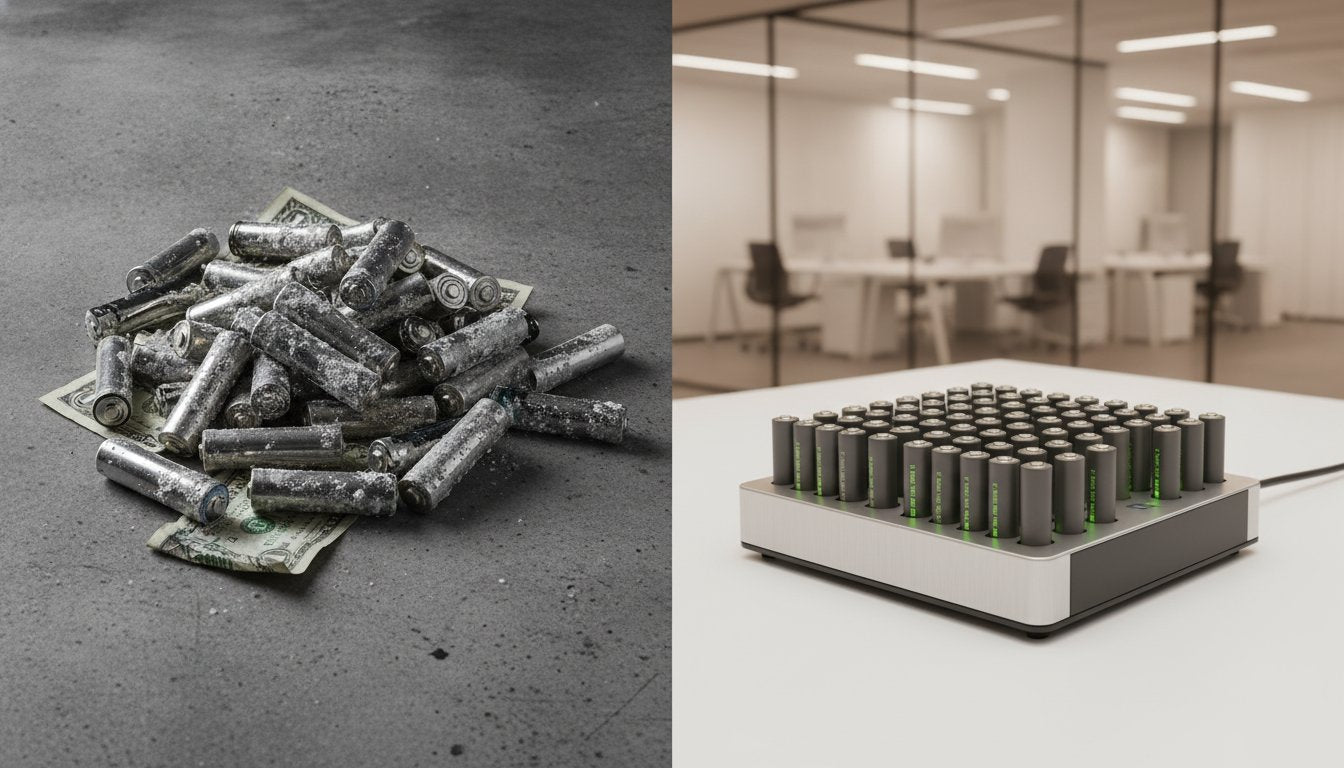
What if your organization's recurring expense for thousands of alkaline batteries wasn't a necessary cost of doing business, but a logistical failure that's actively damaging your hardware? Many facilities managers and production leads accept the "alkaline tax" as an inevitable part of the budget. You're likely dealing with the constant cycle of purchasing, storing, and disposing of disposable cells, all while facing mounting pressure from 2026 regulations, including expanded e-waste fees and increasing compliance requirements. Reducing corporate battery waste is no longer just a sustainability goal; it's a financial necessity to protect your operational overhead and your equipment from the corrosive leaks common in disposable cells.
We recognize the frustration of managing high-volume battery inventory and the skepticism regarding rechargeable reliability in critical electronics like wireless microphones. This strategy guide provides a professional-grade roadmap to transition your organization to a zero-waste power infrastructure. You'll learn how to implement high-capacity Ansmann NiMH cells and Pure Power Series lithium-ion solutions to achieve a quantifiable ROI. We'll show you how to move from a disposable mindset to a steady, rechargeable ecosystem that ensures your critical systems remain powered without the recurring waste.
Key Takeaways
- Discover how moving from linear consumption to a circular rechargeable ecosystem eliminates the environmental impact and landfill volume of toxic alkaline waste.
- Learn why high-capacity Ansmann NiMH and Pure Power Series Lithium-ion cells are the technical standard for reliable performance in professional organizational environments.
- Identify how Custom Rackmount Chargers solve the logistical bottleneck of decentralized charging by centralizing power management for large teams.
- Follow a five-step roadmap for reducing corporate battery waste that begins with a comprehensive facility-wide power audit and inventory standardization.
- Gain a clear path toward zero-waste operations by partnering with a veteran distributor to implement a durable, professional-grade power infrastructure.
The Shift Toward Sustainable Battery Ecosystems in 2026
True organizational sustainability is often misunderstood as a better way to recycle. In reality, reducing corporate battery waste requires a fundamental shift from linear consumption to a circular, preventative model. The legacy approach follows a "buy, use, toss" pattern that generates significant landfill volume and introduces toxic heavy metals like lead and cadmium into the environment. By 2026, this model has become untenable for professional organizations. New regulatory pressures, such as California's SB 1215 expanding e-waste fees and the EPA's finalized battery collection guidelines, have turned disposable usage into a compliance liability.
The transition to high-capacity NiMH and Pure Power Series Lithium-ion technology marks the tipping point for facility managers. Modern professional rechargeables don't just reduce environmental impact; they provide a dual benefit by aligning with Corporate Social Responsibility (CSR) goals while slashing recurring procurement costs by up to 90%. When your organization stops viewing batteries as a consumable expense and starts treating them as a long-term infrastructure asset, the financial and operational advantages become clear.
The Hidden Cost of Disposable Batteries
Cheap alkaline batteries carry a high price that doesn't appear on the initial purchase order. Over a three-year operational cycle, the cumulative cost of disposables is staggering. Consider the labor required for frequent battery changes in large-scale facilities. A technician spending just a few minutes daily swapping cells in wireless mics or sensors adds up to hundreds of hours in annual labor costs. There's also the catastrophic risk of equipment damage. Alkaline cells are prone to leaking potassium hydroxide, which can corrode the internal circuitry of expensive professional gear. One leaked cell can result in the total loss of a device worth thousands of dollars, a risk that Ansmann NiMH cells effectively eliminate.
Moving Up the Waste Hierarchy
The waste hierarchy places "Prevention" and "Reduction" at the very top, while "Recycling" sits near the bottom as a last resort. While many businesses focus on recycling programs, a "Prevention First" model is the only way to achieve a zero-waste-to-landfill facility certification. Professional rechargeable systems support this by stopping the waste stream at the source. Instead of managing the disposal of 5,000 alkaline batteries per year, a facility might manage an inventory of just 100 high-performance cells that are recharged hundreds of times. This approach simplifies logistics and ensures that your power management strategy is both environmentally responsible and operationally lean.
High-Capacity NiMH and Lithium-Ion: The Technical Core of Sustainability
Consumer-grade rechargeable batteries often fail to meet the rigorous demands of professional organizational environments. These cells typically lack the sustained capacity and current stability required for 8 to 12 hour continuous operation. When a battery fails during a critical presentation or performance, technical teams often revert to "safe" disposables, which immediately halts progress in reducing corporate battery waste. Maintaining a sustainable infrastructure requires a technical match between the battery chemistry and the specific power draw of the hardware. Reliability isn't just a technical requirement; it's the foundation of any successful waste reduction strategy.
Ansmann Engineering for Professional Run-Times
For mission-critical wireless equipment, Ansmann high capacity batteries offer the specialized engineering required for industrial use. The 2850 mAh rating is significant because it provides a safety margin that prevents mid-service technical failures. Unlike standard retail cells, these professional NiMH batteries are designed with slimline dimensions. This ensures they fit perfectly into the narrow battery sleds of professional wireless microphones and belt packs without the risk of getting stuck or damaging the terminals. It's this attention to physical and electrical tolerances that allows organizations to confidently transition away from disposables.
Voltage Stability and the Pure Power Series
Voltage stability is another critical factor that separates professional solutions from consumer hobbyist gear. Many industrial sensors and high-end audio devices are calibrated for the 1.5V output of alkaline cells. Standard 1.2V NiMH rechargeables often cause these devices to report a low battery status long before the cell is actually empty. The Pure Power Series solves this by utilizing advanced circuitry to maintain a constant 1.5V discharge throughout the entire run-time. This ensures that equipment performs exactly as the manufacturer intended without premature power drops.
This consistent output prevents premature device shutdowns, which is a major driver of operational inefficiency and waste. By selecting high-performance cells that support over 1,000 charge cycles, organizations can replace a massive volume of e-waste with a compact, managed inventory. This technical precision ensures that your sustainability efforts don't compromise the reliability your team expects. If your facility is currently struggling with inconsistent run-times, you can speak with an application specialist to identify the optimal power chemistry for your hardware while reducing corporate battery waste through long-term asset management.
Professional Charging Infrastructure as a Critical Sustainability Asset
While high-performance cells provide the energy, the charging hardware determines the longevity and logistical success of your power strategy. Many organizations fail in reducing corporate battery waste because they rely on consumer-grade plug-in chargers. These small, retail units are often the primary bottleneck in a professional environment. They lack the speed, thermal management, and organization required to manage hundreds of cells simultaneously. Without a professional infrastructure, batteries are often misplaced, improperly charged, or discarded prematurely because teams don't have a reliable way to verify their health.
Custom Rackmount Chargers bridge this gap by centralizing power management into a single, organized location. This hardware allows facilities to move away from a disorganized collection of wall-warts and power strips. By treating the charging station as a permanent piece of technical infrastructure, you ensure that every cell is ready for service when needed. This methodical approach is essential for maintaining the 1,000-cycle lifespan of professional NiMH and lithium-ion cells. It transforms battery management from a daily chore into a reliable, automated system that protects your investment.
Scalable Charging for Large Facilities
Large-scale facilities like schools, churches, and corporate campuses require high-density solutions to remain efficient. 16-bay and 32-bay charging systems allow staff to process large volumes of inventory in a single location without searching for available outlets. Integrating these units into existing IT or AV equipment racks saves valuable floor space and keeps power management within the technical environment. This professional integration also reduces fire risks associated with overloaded power strips and eliminates the "charging clutter" that often leads to lost assets. When every battery has a dedicated, monitored slot, inventory shrinkage drops significantly.
Intelligent Charging and Cell Maintenance
The environmental benefit of rechargeable systems is tied directly to how well the cells are maintained over time. Professional-grade chargers utilize delta-V detection and sophisticated overcharge protection to preserve the internal chemistry of each battery. These systems monitor the voltage curve and temperature to prevent the overheating that often kills consumer cells. For neglected NiMH inventory, intelligent "refresh" cycles can often revive cells that would otherwise be destined for a recycling bin. This automated maintenance allows a small staff to manage thousands of batteries with minimal intervention, ensuring that only truly exhausted cells are retired from service.
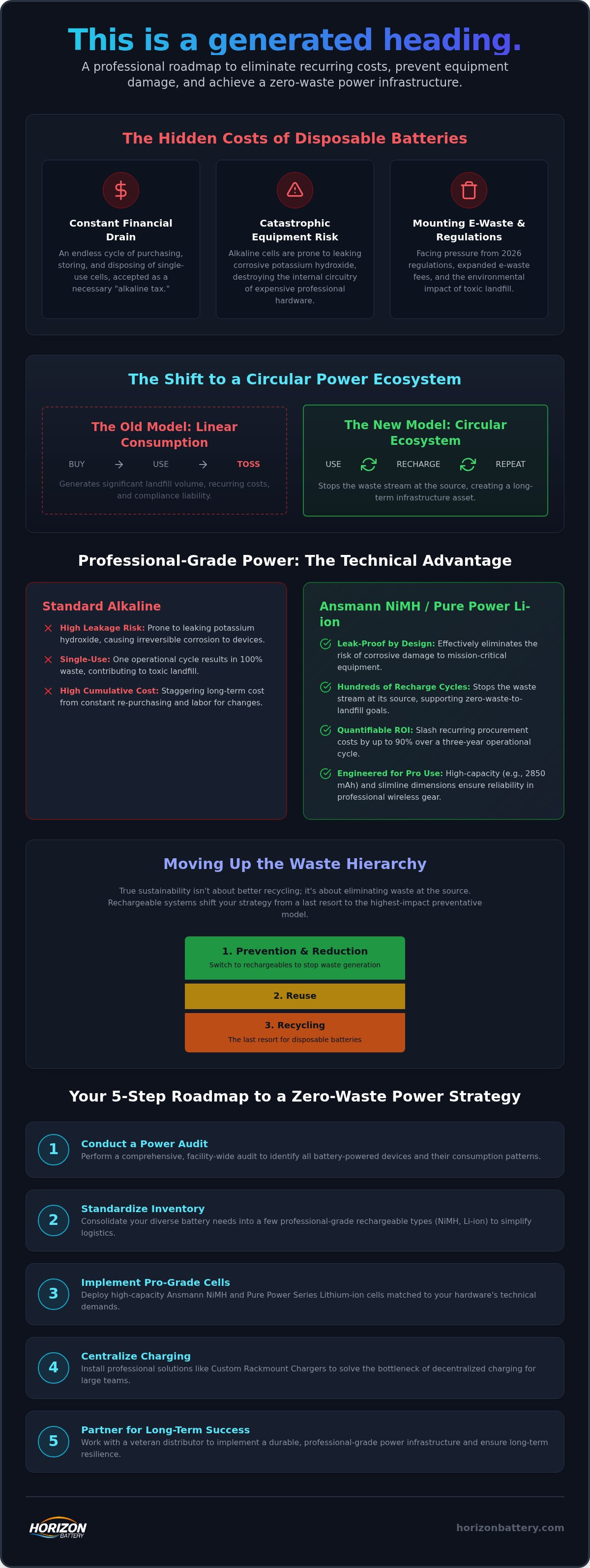
Implementing a Zero-Waste Power Strategy: A 5-Step Roadmap
Transitioning from a disposable-heavy environment to a sustainable rechargeable ecosystem requires more than just purchasing new cells; it demands a structured framework. Reducing corporate battery waste is most effective when approached as a facility-wide operational shift rather than a departmental experiment. By following a methodical 5-step roadmap, organizations can eliminate the recurring costs of alkaline cells while ensuring 100% technical reliability for their critical electronics. This process moves your facility from a linear consumption model to a managed, circular asset strategy.
Phase 1: The Inventory and Audit
The first step is conducting a comprehensive audit of every battery-powered device within the facility. You must categorize these devices by drain rate and operational importance. High-drain devices like wireless handheld microphones have different power requirements than low-drain items like wall clocks or simple remote controls. During this audit, it's vital to identify "vampire" devices. These are units that remain in a standby state and slowly deplete cells even when not in use, contributing to significant and unnecessary waste. Establishing this baseline allows you to estimate your current annual waste volume, providing the data needed for sustainability reporting and ROI projections.
Phase 2: Infrastructure and Storage
Once you understand your inventory, standardize your power needs on a single high-performance brand like Ansmann to simplify logistics and training. For an initial rollout, many organizations find success with specialized Charger / Battery Bundles that provide a complete starter kit for specific departments. Implementing professional Battery Storage solutions is equally critical to prevent the accidental disposal of expensive rechargeable assets. We recommend creating a centralized check-out/check-in system for high-use assets. This ensures that every technician is accountable for the cells they use and that depleted batteries are returned to the charging station rather than a trash bin.
After establishing the hardware foundation, deploy centralized charging hubs in key departmental areas for easy access. This eliminates the need for staff to hunt for available power. Training your team on specific handling requirements, such as proper storage temperatures and identifying degraded cells, will help you reach the full 1,000-cycle potential of your professional batteries. Finally, establish a clear end-of-life protocol. While the goal is to prevent waste, every battery eventually reaches its limit. A strict policy for the 100% recycling of retired rechargeables ensures your organization remains compliant with 2026 e-waste regulations while maintaining a truly zero-waste-to-landfill profile.
Partnering with Horizon Battery for Long-Term Organizational Resilience
Transitioning to a sustainable power model is a complex logistical undertaking that requires more than just high-performance hardware. It requires a veteran partner who understands the specific demands of large-scale facilities. Horizon Battery has provided professional mobile energy solutions since 1998, acting as a knowledgeable guide for organizations committed to reducing corporate battery waste. By bridging the gap between high-capacity performance and operational sustainability, we help national organizations build resilience into their technical infrastructure. We focus on providing a steady, reliable resource that handles both large-scale requirements and individual needs with equal precision.
Our partnership with Ansmann and the development of the Pure Power Series provide the technical backbone for this transition. We specialize in high-capacity solutions, such as the authorized distribution of Ansmann 2850 mAh cells, which are engineered for the rigorous run-times required by corporate, religious, and educational campuses. Beyond providing cells, we offer custom engineering services to solve the "missing link" in battery logistics: professional-grade charging hardware. Our specialized Custom Rackmount Chargers are tailored to your facility's specific gear. We don't believe in a one-size-fits-all approach. Instead, we provide rackmount solutions that integrate directly into your existing AV or IT equipment racks, ensuring that your power management is as professional as the equipment it supports.
Why Organizations Trust Horizon Since 1998
Since our inception, we've served high-profile clients in professional AV, theaters, and large corporate campuses. These environments don't allow for technical failure. The "Pure Power" guarantee ensures that our rechargeable solutions match or exceed the performance of disposable alkaline cells in every application. We provide expert consultation for facility-wide battery standardization projects, helping you navigate the transition with quiet confidence and established expertise. Our role as an industry insider allows us to guide you through the complexities of 2026 regulations while maintaining peak operational performance.
Initiating Your Sustainable Transition
Moving toward a circular power model begins with selecting the right Charger / Battery Bundles for your specific industry requirements. Whether you're managing a theater's wireless microphones or a university's sensor network, we help you identify the optimal starter configuration. For facilities with unique equipment needs, we provide custom rackmount configurations designed to maximize space and efficiency. Taking the first step in reducing corporate battery waste is a matter of professionalizing your inventory and infrastructure. You can consult with a Horizon specialist today to begin an audit of your facility's needs and design a roadmap for long-term organizational resilience.
Securing Your Facility’s Energy Future
Transitioning to a circular power model isn't just about environmental compliance; it's about building a more reliable and cost-effective operational foundation. By implementing high-capacity NiMH or Pure Power Series lithium-ion cells, your team can maintain technical precision without the recurring expense of disposables. Centralizing these assets through professional rackmount charging solutions eliminates the logistical hurdles that often stall sustainability efforts. Reducing corporate battery waste is a strategic move that protects your expensive hardware from leaks while significantly lowering your long-term procurement costs.
Horizon Battery has supported the professional AV and industrial sectors since 1998 with steady, reliable expertise. As an authorized distributor of high-capacity Ansmann technology, we offer the specialized cells and custom rackmount chargers your facility requires for a seamless transition. Our team is here to help you standardize your inventory and secure your energy logistics for the years ahead. Build Your Organization's Sustainable Battery Infrastructure with Horizon. You're ready to move beyond the disposable cycle and establish a professional power infrastructure that performs for the long haul.
Frequently Asked Questions
Are rechargeable batteries really more sustainable if they eventually require disposal?
Rechargeable batteries are significantly more sustainable because they replace hundreds of single-use cells over their functional lifespan. While they eventually require disposal, the total mass of hazardous waste generated is reduced by over 95%. By reducing corporate battery waste at the source, your organization minimizes the logistical burden of waste management. Modern industrial NiMH and lithium-ion cells are designed for high-density recycling; this ensures critical minerals are recovered rather than entering the landfill stream.
How many times can professional-grade NiMH batteries like Ansmann be recharged?
Professional-grade Ansmann NiMH batteries are engineered to provide up to 1,000 charge cycles under optimal conditions. This longevity is achieved through advanced chemical composition and internal thermal management. When paired with intelligent charging systems that prevent overcharging, these cells maintain high-capacity performance for several years of daily use. Standardizing on a high-cycle brand ensures your initial investment continues to pay dividends long after consumer-grade alternatives have reached their technical limit.
Will switching to rechargeables affect the range of our wireless microphones?
Switching to professional rechargeables won't negatively affect the range of your wireless microphones if you select the correct chemistry. While standard NiMH cells operate at 1.2V, modern professional transmitters are designed to handle this voltage without signal degradation. For legacy equipment specifically calibrated for 1.5V, the Pure Power Series provides a constant 1.5V discharge curve. This ensures your RF output remains stable and your range is preserved throughout the entire duration of a performance.
What is the typical ROI period for an organization switching to a professional battery ecosystem?
Most organizations realize a full return on investment within 12 to 18 months, depending on their current volume of alkaline consumption. This calculation includes the cost of high-capacity cells and professional charging infrastructure. Beyond direct procurement savings, facilities often see reduced labor costs because technicians spend less time managing inventory and replacing dead cells. Reducing corporate battery waste also eliminates the financial risk of equipment damage caused by leaking alkaline batteries, which is a significant hidden cost.
Can we use the Pure Power Series in devices that specifically require 1.5V?
The Pure Power Series is specifically designed for devices that require a constant 1.5V output to function correctly. Unlike traditional NiMH cells that drop to 1.2V, these lithium-ion batteries utilize an internal voltage regulator to mimic the discharge profile of an alkaline cell. This makes them ideal for high-drain sensors, digital cameras, and medical equipment that might otherwise report a low-battery warning or shut down prematurely when using standard rechargeable chemistries.
How do we manage hundreds of batteries without hiring extra staff for charging?
Managing a large inventory is simplified through the use of Custom Rackmount Chargers and standardized Battery Storage solutions. These systems automate the charging process with "set and forget" functionality; they require no dedicated staff. Intelligent chargers monitor the health of each cell and indicate when a battery is ready for service. By centralizing power management in technical hubs, staff can quickly swap depleted cells for fresh ones as part of their existing setup routines.
What happens to the batteries when they can no longer hold a charge?
When a professional cell can no longer hold a sufficient charge, it should be moved to a designated "retired" bin for recycling. Under the 2026 regulatory landscape, organizations must follow approved stewardship plans. Because you've reduced your total battery volume by 99% through rechargeables, managing the recycling of the remaining cells is a minor task. This can be easily integrated into your annual facility waste audit without requiring extensive third-party logistics.
Is it safe to store large quantities of professional lithium-ion batteries in a facility?
It's safe to store professional lithium-ion batteries when using specialized Battery Storage cases and high-quality charging hardware. Professional cells from the Pure Power Series include multiple layers of internal protection to prevent thermal runaway. Storing batteries in a cool, dry environment away from direct sunlight further enhances safety. By using rackmount chargers that include individual cell monitoring, your facility ensures any defective battery is identified and isolated before it can become a concern.