
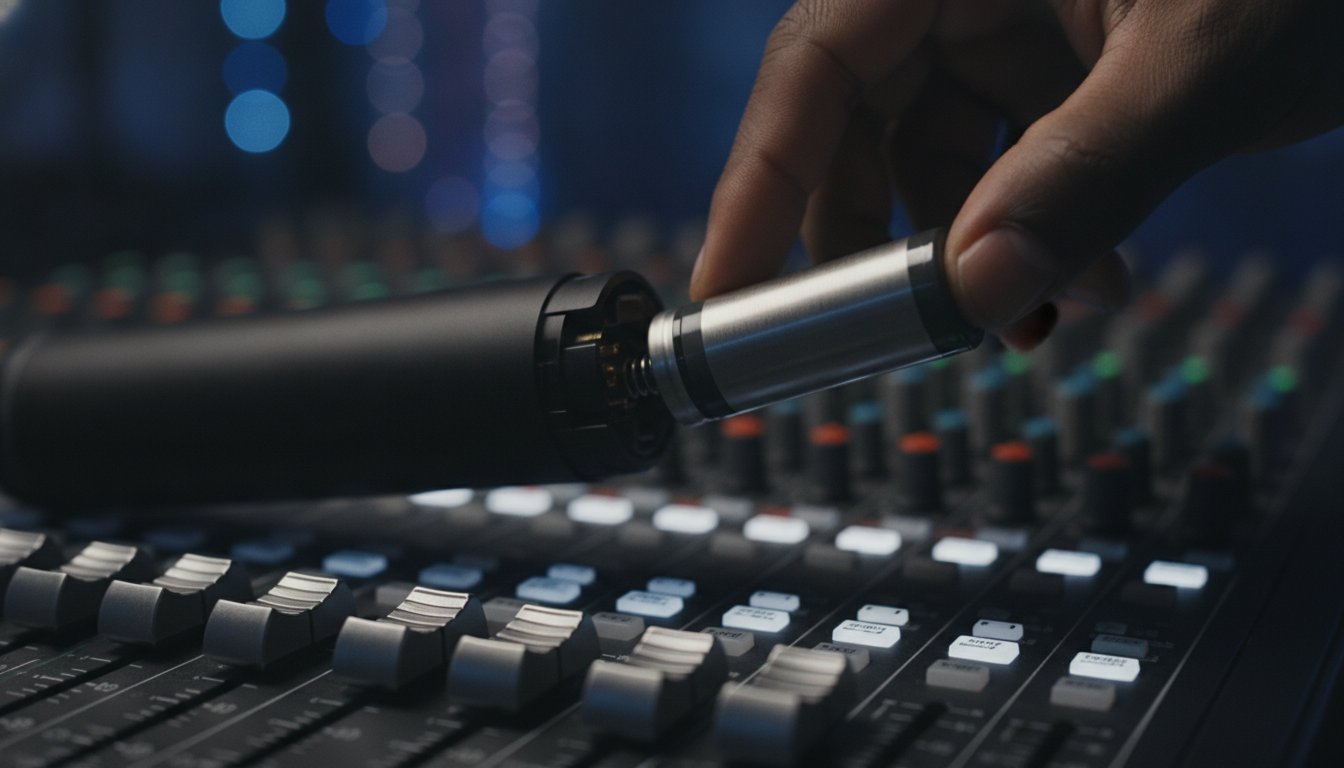
Why does a wireless microphone indicating a full charge suddenly die ten minutes into a live performance? It's a scenario that has haunted many production professionals who rely on consistent power for mission-critical events. You've likely experienced the frustration of unpredictable power drops or batteries that simply don't fit into precision-engineered gear slots. It's common to feel that you're wasting money on consumer-grade cells that lack the stamina for industrial use. We understand that reliability is your primary concern when managing high-stakes equipment.
This article breaks down the scientific reality behind rechargeable battery performance to help you eliminate technical failures and improve your operational ROI. You'll learn why mAh ratings aren't the only metric that matters and how to distinguish between marketing hype and actual runtime. We will debunk five common myths and provide a roadmap for standardizing a reliable charging infrastructure that keeps your professional gear running without interruption. By moving beyond outdated assumptions, you can ensure your equipment remains powered through every critical moment in 2026 and beyond.
Key Takeaways
- Learn why constant voltage delivery makes professional rechargeables more reliable than standard alkaline cells for wireless audio.
- Understand how internal resistance impacts rechargeable battery performance more than raw mAh ratings in high-drain gear.
- Discover the engineering differences between Grade A professional cells and consumer-grade batteries that cause fitment issues.
- Clear up the confusion surrounding the memory effect to implement modern maintenance routines that protect your battery lifespan.
- Identify how rackmount charging infrastructure improves asset management and prevents unexpected power failures during live events.
Myth #1: Disposable Batteries Outperform Rechargeables in Professional Gear
Many production teams cling to alkaline batteries because they perceive them as a safe default. This belief is based on legacy performance standards that no longer apply to modern digital gear. In reality, the current landscape shows that disposables are often the weakest link in a professional signal chain. The perceived security of a fresh alkaline cell is frequently an illusion that leads to unexpected failures mid-show. Reliable power requires more than just a new seal; it requires a chemistry that can handle the specific demands of high-drain electronics.
The Voltage Stability Argument
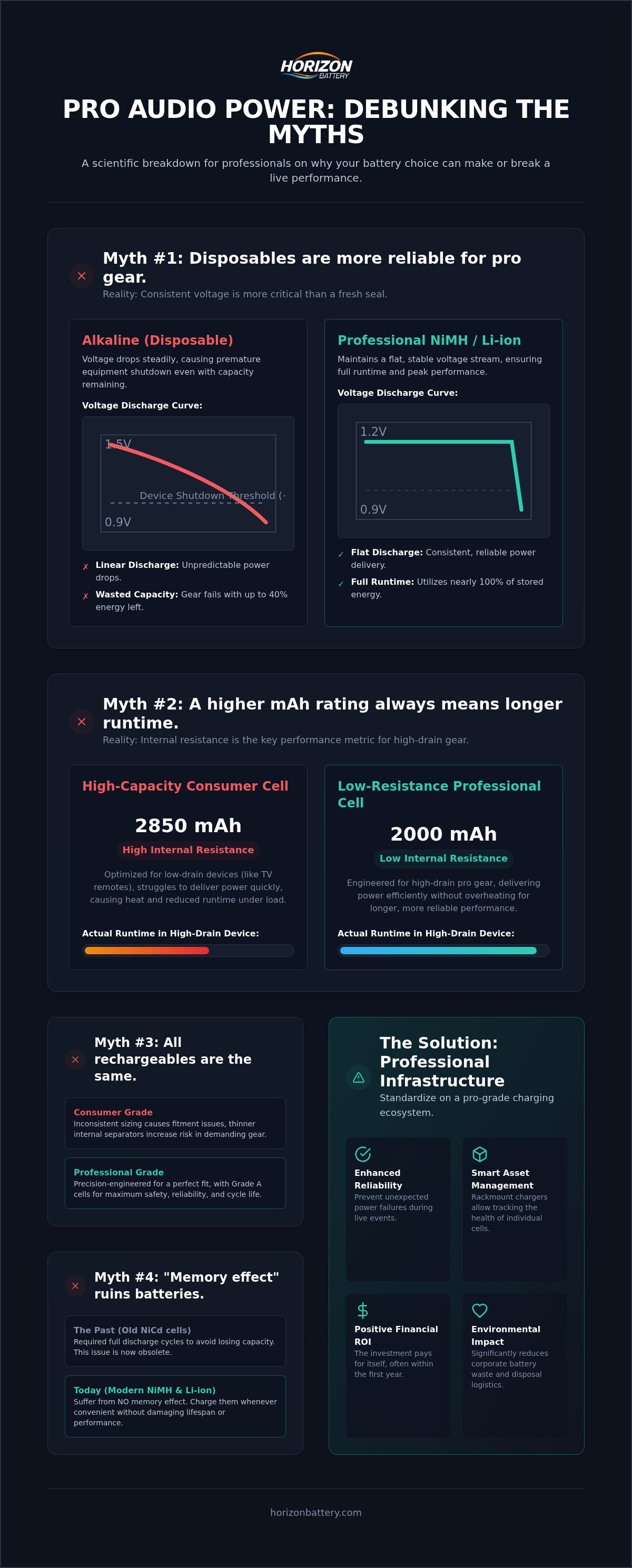
Digital wireless microphones and high-drain production tools require consistent voltage to maintain signal integrity. Alkaline batteries operate on a linear discharge curve, meaning their voltage drops steadily from the moment you power on the device. When an alkaline cell reaches approximately 1.1 volts, many transmitters will shut down or experience signal dropouts. This happens even if a battery tester suggests there's still 40% capacity remaining. The gear isn't out of energy; it's out of the pressure required to run the internal processors. It's a common point of failure that catches even seasoned technicians off guard.
In contrast, professional NiMH and Li-ion cells, such as the Pure Power Series, are engineered to maintain a flat discharge curve. They deliver a steady stream of power until the very end of their cycle. This consistency is essential for rechargeable battery performance in environments where signal failure isn't an option. By utilizing high-capacity cells from brands like Ansmann, technicians avoid the voltage sag that causes digital signal processors to glitch or reset during critical moments. You get the full runtime promised by the gear manufacturer rather than a premature shutdown.
Financial and Environmental ROI
The true cost of disposable batteries includes more than just the unit price. Large-scale facilities must manage the logistics of thousands of cells, including climate-controlled storage and the labor required for constant replacement. Standardizing on a professional charging infrastructure, like custom rackmount chargers, simplifies asset management. You can track the health of individual cells rather than guessing the status of a bulk bin of alkalines. This data-driven approach ensures that every cell in your kit is ready for the stage.
Most enterprise-level organizations find that the investment in high-quality rechargeable bundles pays for itself within the first year of operation. This transition is also a key component in reducing corporate battery waste. Moving away from a use-and-toss culture allows your team to focus on performance rather than disposal logistics. By adopting a sustainable power strategy, you ensure that your gear remains reliable while significantly lowering your long-term operational expenses. It's a pragmatic shift that balances fiscal responsibility with technical excellence.
Myth #2: Higher mAh Ratings Always Guarantee Longer Runtimes
Selecting batteries based solely on the milliamp-hour (mAh) rating is a common mistake that leads to equipment failure. While mAh indicates the total energy storage capacity, it doesn't account for how efficiently that energy is delivered under load. In professional environments, a 2000 mAh cell with low internal resistance often provides a longer actual runtime than a 2850 mAh consumer-grade cell. This discrepancy occurs because high-capacity consumer cells are frequently optimized for low-drain applications like remote controls rather than the intensive requirements of production gear. Relying on raw capacity numbers without context creates a "capacity trap" that compromises reliability.
Understanding High-Drain Discharge Rates
In 2026, professional electronics have become increasingly power-hungry. High-drain applications involve devices that pull significant current quickly, such as digital wireless transmitters or LED field lights. Consumer cells with ultra-high mAh ratings often achieve those numbers by using thinner internal separators. While this allows for more active material, it also increases the risk of overheating when the device demands power rapidly. Overheating doesn't just shorten the immediate runtime; it permanently degrades the cell's chemistry and reduces its total cycle life. Professional users should prioritize stability over raw capacity to ensure consistent rechargeable battery performance throughout a long production day.
The Role of Internal Resistance
Internal resistance is the friction that opposes the flow of current within a battery. It's the silent killer of performance. When a battery has high internal resistance, much of its stored energy is wasted as heat instead of powering your device. This is particularly noticeable in flash photography or motor drives that require sudden bursts of high current. As batteries age or undergo improper charging cycles, their internal resistance naturally increases. A cell might report a full charge on a basic tester, but its voltage will collapse the moment a load is applied. You can't see this resistance with a standard voltmeter; it only reveals itself when the gear starts to work.
To maintain a reliable fleet, you must implement testing procedures that measure performance at professional discharge rates. Testing a cell at a 100mA load might show it's healthy, but testing it at 1000mA (1A) often reveals the truth about its condition. Identifying these "tired" cells before they reach the field prevents mid-show failures and ensures your gear remains operational. For teams looking to upgrade their inventory with reliable options, exploring AA Rechargeable Batteries - High Capacity solutions is a logical next step. Temperature also plays a vital role in this equation. In cold environments, internal resistance spikes, effectively shrinking the usable capacity. Professional-grade cells are engineered to mitigate these fluctuations, providing a more predictable power source in varying field conditions.
Myth #3: All Rechargeable Batteries Are 'Basically the Same' (Consumer vs. Pro)
A common misconception suggests that because many batteries originate from the same manufacturing facilities, they are essentially interchangeable. This logic ignores the tiered nature of production runs and the specific engineering required for professional environments. When evaluating rechargeable battery performance, it is vital to understand that industrial distributors demand 'Grade A' cells. These batches undergo rigorous testing to ensure the tightest voltage variances and chemical stability. Consumer-grade batteries often exhibit wider performance gaps that can compromise expensive gear.
Factories produce cells in massive quantities, but not every cell meets the same standard. Professional-grade cells are selected based on their ability to maintain specific chemical formulations and structural integrity. Generic NiMH formulations often suffer from higher self-discharge rates, meaning they lose power while sitting in your gear bag. Professional cells are designed to hold their charge for longer periods, ensuring they are ready to perform when you need them most. This distinction in quality control is what separates a reliable power source from a potential point of failure.
Ansmann High Capacity Engineering
Physical dimensions are a critical factor often overlooked by consumer reviewers. Professional wireless transmitters from brands like Shure and Sennheiser feature precision-engineered battery compartments with zero tolerance for swelling. The Ansmann high capacity batteries use 'Slimline' technology to ensure a perfect fit. This specialized engineering prevents physical damage to your equipment while maintaining high-drain reliability. It ensures that cells slide in and out of tight slots without resistance, even after hundreds of charging cycles.
Pure Power Series: The Lithium-Ion Shift
The Pure Power Series represents a shift toward Lithium-Ion technology in the AA form factor. Unlike traditional NiMH cells that operate at 1.2V, these professional cells provide a constant 1.5V output. This ensures your gear performs at peak levels throughout the entire cycle. The reduced weight of Lithium chemistry is also a major advantage for handheld microphones and head-worn equipment, effectively reducing user fatigue during long events. This constant voltage is a primary driver of superior rechargeable battery performance in digital wireless systems.
Tolerance levels also differ significantly between consumer and professional tiers. Professional cells are built to withstand the rigors of daily use in touring environments, where they may be subjected to rapid charging and varying temperatures. By choosing cells engineered for industrial applications, you minimize the risk of leaked chemicals or physical deformation. This commitment to engineering excellence protects your investment in high-end audio and video equipment while providing the peace of mind that only comes from using industry-standard power solutions.
Myth #4: The 'Memory Effect' Still Ruining Modern Batteries
Many technicians still believe they must fully drain their cells before recharging. This habit stems from older Nickel-Cadmium (NiCd) technology where "memory effect" caused capacity loss if batteries weren't cycled completely. Modern NiMH and Lithium-ion chemistries don't suffer from this limitation. Following these outdated practices can actually decrease rechargeable battery performance by putting unnecessary stress on the cell. Today's focus has shifted from avoiding memory to managing heat and voltage floors.
NiMH vs. Li-ion Maintenance Realities
For NiMH cells, like those used in standard high-capacity kits, topping off after a short event is perfectly safe. You don't need to wait for the device to shut down. However, Lithium-ion cells found in the Pure Power Series require a different approach. Deep-discharging these cells until they are completely empty can damage the internal chemistry and prevent the battery from accepting a charge in the future. Maintaining a voltage floor is critical. Most professional gear will shut off before this point, but leaving a "dead" battery in a drawer for months can lead to permanent failure. Consistent rotation and smart charging are the best practices for daily use in high-rotation environments.
Storage Myths and Temperature Control
Heat is the primary factor that degrades cell health over time. While the old "refrigerator trick" was once popular for slowing down self-discharge in alkalines, it's unnecessary for modern professional cells. Storing batteries in a cool, dry place at room temperature is sufficient. If you are putting cells into long-term storage, aim for a 40% to 50% state-of-charge rather than leaving them fully charged or completely depleted. This balanced state minimizes chemical stress on the internal components and ensures the cells are ready for their next deployment.
Managing a large fleet of batteries requires more than just good habits; it requires the right hardware. Smart chargers now handle the heavy lifting by monitoring cell temperature and adjusting charge rates automatically. This prevents the overheating that often occurs with cheap, consumer-grade wall-warts. To ensure your team is equipped with the best tools for the job, consider investing in Charger / Battery Bundles designed for professional rotation. These systems provide the intelligence needed to maintain peak performance across your entire inventory.
Optimizing Performance with Professional Infrastructure
Professional power management requires more than just high-quality cells. It demands a structured environment that supports those cells throughout their entire lifecycle. Relying on consumer-grade wall chargers in a high-stakes production environment is a recipe for failure. These devices often lack the thermal management and circuit protection necessary for high-density charging. To achieve consistent rechargeable battery performance, you must shift your focus toward industrial-grade infrastructure. This approach ensures that every cell is charged safely and efficiently while providing the data needed to manage your fleet effectively.
Custom Rackmount Charging Solutions
Integrating power management directly into your signal chain is the most effective way to eliminate technical variables. Custom Rackmount Chargers allow production teams to centralize their power needs within the AV rack. This setup provides better airflow and cooling compared to a disorganized collection of cables and individual chargers. It also solves the problem of "lost battery" syndrome by providing a designated home for every cell. When chargers are part of the permanent rack infrastructure, they are less likely to be misplaced or damaged during transport. This level of organization is essential for maintaining order in professional venues and touring rigs.
Implementing Enterprise Asset Management
A successful power strategy relies on clear organization and redundancy. Utilizing dedicated Battery Storage solutions allows you to separate "Ready" inventory from cells that need charging or testing. This simple step prevents the catastrophic mistake of putting a half-charged battery into a transmitter before a show. Tracking the age and cycle count of your fleet is equally important. Specialized battery testers can identify when a cell's internal resistance has reached a critical level. This allows you to retire it before it fails on stage. This preventive maintenance is the foundation of reliability.
Standardizing on a single high-performance platform simplifies your logistics. It ensures that every charger in your inventory is compatible with every battery in your kit. Whether you use the Pure Power Series or Ansmann high-capacity cells, consistency is key. By the time 2026 arrives, the difference between successful productions and those plagued by technical glitches will be the quality of their power infrastructure. Investing in professional-grade hardware is not just about convenience. It is about protecting your ROI and ensuring that your gear performs exactly as expected every single time.
Securing Your Power Strategy for 2026
Reliability in professional production doesn't happen by accident. It's the result of moving beyond consumer-grade myths and embracing industrial standards. By prioritizing voltage stability over raw mAh ratings and understanding the engineering differences in Grade A cells, you protect your gear and your reputation. Maintaining peak rechargeable battery performance requires a shift from reactive replacements to proactive asset management. The infrastructure you choose today determines your reliability for every event that follows.
Horizon Battery has specialized in high-capacity AA rechargeable solutions since 1998. We provide the expertise needed to navigate the transition to modern chemistries. From our Pure Power Series 1.5V Lithium-ion technology to custom rackmount charging systems, we offer tools designed for the rigors of professional audio and wireless mic power. Don't let unpredictable power drops compromise your next performance. You can upgrade your facility with professional Ansmann high-capacity solutions to ensure consistent results every time the curtain rises. Secure your equipment's future with a partner who understands the high-stakes demands of your industry.
Frequently Asked Questions
How many times can I actually recharge a professional AA battery?
Professional NiMH cells like Ansmann typically offer several hundred full cycles under normal conditions, while Lithium-ion variants like the Pure Power Series provide even greater longevity. This cycle life depends heavily on the use of smart charging infrastructure that prevents overheating and overcharging. Regular testing with professional equipment ensures you get the maximum value from your investment before internal resistance rises too high for mission-critical use in wireless audio systems.
Why do my rechargeable batteries feel hot when charging?
Heat is a natural byproduct of the chemical reaction occurring during the charging process. While a warm sensation is normal, excessive heat indicates that the charging current is too high or the cell is nearing the end of its life. Using industrial-grade chargers with thermal monitoring helps manage this risk. High temperatures are the primary enemy of rechargeable battery performance, so ensuring proper ventilation during the charge cycle is essential.
Can I use a NiMH charger for Pure Power Lithium-ion batteries?
No, you must use a charger specifically designed for Lithium-ion chemistry. NiMH chargers use a different termination method which will not work with the internal circuitry of Pure Power cells. Attempting to mix chemistries can lead to incomplete charges or damage to the battery. Always utilize the chargers provided in professional battery bundles to ensure compatibility and safety across your entire fleet of high-end production equipment.
What is the best way to store rechargeable batteries when not in use?
Store your batteries in a cool, dry environment at room temperature. For long-term storage, Lithium-ion cells should be kept at approximately 40% to 50% state-of-charge to maintain chemical stability. Avoid leaving batteries in gear for extended periods, as small parasitic drains can lead to deep discharge. Using dedicated battery storage cases helps keep inventory organized and prevents accidental short circuits between terminals during transport or storage in your facility.
Do high-capacity batteries take longer to charge?
Higher capacity cells require more time to reach a full state-of-charge because they have more energy to replenish. For example, a 2850 mAh cell takes longer to fill than a 2000 mAh cell when using a standard current. Industrial smart chargers often mitigate this by safely increasing the charge rate while monitoring for heat. It's vital to balance charge speed with thermal management to protect the cell's internal structure from long-term degradation.
Why does my device show 'low battery' immediately with some rechargeables?
This often happens because standard NiMH batteries operate at a nominal 1.2V, whereas some devices are calibrated for the 1.5V of alkaline cells. While the capacity is present, the device interprets the lower voltage as a nearly depleted battery. Switching to the Pure Power Series solves this issue by providing a constant 1.5V output. This ensures that your gear's battery indicator remains accurate and prevents premature shutdowns during high-stakes professional applications.
How do I know when it is time to retire a rechargeable cell?
You should retire a cell when its internal resistance increases significantly or its runtime drops below your operational threshold. Professional battery testers can provide a clear health percentage by measuring the cell's performance under a simulated load. If a battery consistently triggers heat sensors or takes an unusually long time to charge, it's no longer reliable for the field. Consistent asset management prevents these tired cells from causing failures on stage.
Is it worth the extra cost to buy professional batteries over consumer brands?
Professional batteries are an investment in reliability and equipment safety. Consumer brands are often manufactured with wider tolerances that can lead to fitment issues or unpredictable rechargeable battery performance in high-drain gear. Industrial cells offer tighter voltage variances and more robust chemical formulations. When you consider the cost of a technical failure during a live event, the ROI on Grade A professional cells and specialized charging infrastructure becomes very clear.