

What if a battery shortage during an event starts with the charger, not the batteries? Professional rechargeable battery procurement for venues involves more than choosing cells with enough capacity. Device compatibility, battery format, charging capacity, and a clear process for returning charged batteries all affect whether equipment is ready when staff need it.
It’s easy to focus on runtime and overlook the charging workflow. Mismatched chargers, too few charging positions, unclear storage practices, or unassigned handoffs can create avoidable bottlenecks across a busy event schedule. Start with an inventory of the venue’s equipment and battery requirements, then match those needs to charging, storage, and daily operations.
This guide will help you build a practical specification, plan capacity around event demand, and decide whether a battery-and-charger bundle or separate equipment better suits your setup. It also provides a framework for assigning responsibility for charging, inventory, storage, and replacement, so procurement supports the full operating routine, not just the cells.
Key Takeaways
- Build a written specification from your equipment inventory, including battery format, chemistry requirements, usage patterns, and manufacturer guidance.
- Compare separately purchased cells with charger-and-battery bundles by confirming compatibility and assessing how each option fits your charging workflow.
- Plan professional rechargeable battery procurement for venues around charging, storage, inventory, handoffs, and replacement ownership.
- Check compatibility with representative equipment before standardizing a battery setup across the venue.
- Ask suppliers to confirm current specifications and fit against your equipment list before ordering.
Why Professional Rechargeable Battery Procurement Matters for Venues
Event schedules leave little room to search for charged batteries or discover that the available charger doesn’t fit the cells on hand. Venue equipment may move between departments, rooms, and staff, so readiness depends on more than the number of batteries purchased. Buyers also need to account for charging capacity, storage, inventory checks, and responsibility for each handoff.
Venue battery procurement is an end-to-end operating decision that aligns compatible batteries and chargers with storage, inventory, and the venue’s schedule. Buying cells alone won’t resolve whether there is enough compatible charging capacity between uses or a clear place for charged and depleted batteries. A basic understanding of rechargeable battery technologies can help buyers frame questions about chemistry and device requirements, but the equipment manufacturer’s guidance should determine what fits a specific device.
Recurring venue operations need a repeatable process: teams should know which batteries are ready, where used ones go, and who checks stock before the next event. Equipment used only occasionally may need a different plan, particularly if it uses a format that isn’t shared by the main inventory. Separating frequent-use and low-frequency needs helps avoid over-standardizing while keeping less-used equipment in the plan.
Which venue equipment depends on rechargeable batteries?
Start with an equipment list, not a battery order. Wireless microphones and other battery-powered production equipment are useful examples, but verify each device’s required format and chemistry against its manual or manufacturer guidance. Record equipment models, battery requirements, and any charging instructions. Mark equipment that is essential for events separately from backups or infrequently used devices, so purchasing priorities reflect actual operations.
What usually goes wrong without a procurement plan?
Without a documented process, teams may discover shortages during setup, find that available chargers aren’t compatible with the batteries, or be unsure whether used cells should be charged, stored, or handed to another department. A mix of formats can also complicate inventory counts and staff training. These issues don’t mean one battery type will prevent every outage. They show why compatibility, charging arrangements, and ownership need to be checked together.
Specify Venue Batteries, Chargers, and Storage Before You Buy
A written specification turns equipment needs into a purchase plan staff can use and verify. For professional rechargeable battery procurement for venues, document what each device requires, how the venue uses it, and how batteries will be charged and stored before comparing products.
Work through these requirements in order:
- 1. Inventory the devices. Record equipment models and quantities, including how many units may operate at the same time.
- 2. Confirm battery requirements. Check each device manual for approved format, chemistry, voltage, and charging instructions. Don’t assume rechargeable AA cells suit every device or operating requirement.
- 3. Record usage patterns. Note event frequency, typical periods of use, turnaround time between events, and which devices are critical or backups.
- 4. Estimate quantities. Compare the cells needed for simultaneous use with the additional inventory required to cover charging and backup needs. Base the estimate on actual schedules and turnaround windows.
- 5. Specify the supporting setup. Document charger type and capacity requirements, storage arrangements, labeling, and who is responsible for charging and inventory checks.
- 6. Flag open questions. List device and battery combinations whose fit or charging instructions aren’t confirmed, and seek clarification before ordering.
Confirm device compatibility before procurement, because battery format alone doesn’t establish that a cell and charger are suitable for a particular piece of equipment. Keep manufacturer instructions with the specification so purchasing decisions and staff procedures have a clear reference.
How do you confirm battery and device compatibility?
Use the device manual to verify battery format, chemistry, voltage, and charging instructions. If guidance is unclear or a proposed configuration isn’t listed, check with the equipment manufacturer or supplier rather than assuming it will work. This review helps buyers determine whether high-capacity rechargeable AA batteries are appropriate for specific devices before adopting them as a wider standard.
How should you size charging and storage requirements?
Estimate how many batteries need charging at once by reviewing event schedules, turnaround windows, and the backup inventory available during charging. Compare that demand with the charging equipment you already have, but count it only if its compatibility is confirmed. Desktop chargers may suit a smaller, distributed setup, while rackmount charging hardware may be worth evaluating when centralized equipment organization is preferred. Confirm charger fit and configuration for the selected cells and devices before purchase.
Designate and label locations for charging and stored batteries, and assign a role to check inventory and manage handoffs. If lithium-ion batteries are part of the inventory, consult the EPA battery recycling guidelines when documenting end-of-life handling. This is separate from selecting and purchasing the venue’s battery products.
With requirements documented, buyers can compare venue battery and charging options and ask the supplier to confirm current specifications and fit against the equipment list.
Compare Rechargeable Battery Procurement Options for Venue Operations
Once device requirements are documented, compare procurement options by how well they support the full work cycle, not by cell type alone. Professional rechargeable battery procurement for venues may involve buying cells separately, selecting a charger-and-battery bundle, or evaluating charging hardware for a centralized setup. Each option depends on verified device fit, available charging capacity, and the venue’s staffing and storage practices.
| Option | Compatibility | Charging workflow | Storage and team use | Supplier verification |
|---|---|---|---|---|
| Cells purchased separately | Check that existing chargers and devices accept the selected battery configuration. | Works with current charging equipment only if compatibility is confirmed. | Teams need a clear way to separate charged, depleted, and backup cells. | Confirm specifications for both the cells and existing chargers. |
| Charger-and-battery bundle | Confirm the bundle configuration matches the venue’s devices. | Provides batteries and charging equipment together, subject to fit verification. | Review where the charger will be used and who will manage handoffs. | Request confirmation of the configuration and device suitability. |
| Custom rackmount chargers | Assess the equipment and battery requirements before specifying a setup. | Consider for a rack-based charging workflow when appropriate. | Evaluate rack space, access, labeling, and staff responsibility. | Confirm configuration details for the intended environment. |
High-capacity rechargeable AA batteries, the Pure Power Series, and custom rackmount chargers are distinct categories to evaluate against the requirements list. Product names alone don’t establish compatibility, capacity, or suitability for a particular venue. Ask for current specifications and confirmation of fit before standardizing. Buyers planning for professional AV use can also consult this guide to professional AV rechargeable battery systems for additional procurement considerations.
When are standalone batteries or bundles worth evaluating?
Cell-only purchasing may be appropriate if the venue already has chargers confirmed to support the selected batteries and its operating routine. A bundle is worth assessing when the team needs batteries and charging equipment together, but verify the configuration against the devices before ordering. For broader change planning, see this guide to switching to rechargeable batteries for business.
When should venues consider rackmount charging hardware?
Consider rackmount charging hardware when the venue’s workflow, available rack space, and staff responsibilities support centralized charging. A custom configuration isn’t a universal recommendation. Confirm the equipment requirements and proposed fit before purchase. For deeper infrastructure planning, review enterprise battery charging solutions.
Plan a Venue Battery Procurement Process That Avoids Operational Gaps
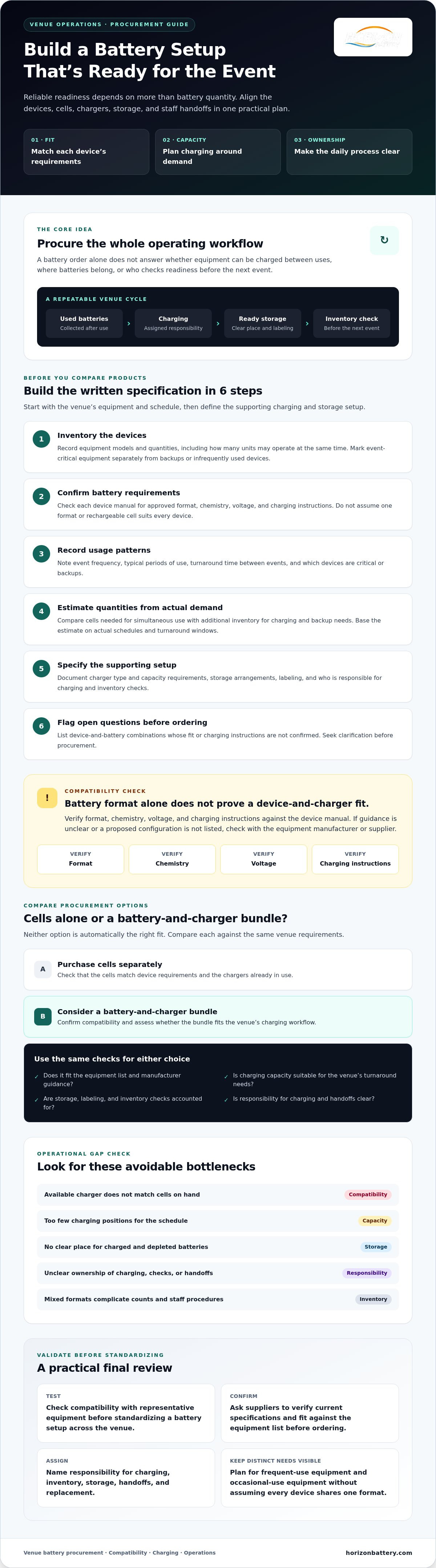
A sound procurement process carries the decision from equipment audit through daily use. This sequence helps teams identify compatibility and workflow questions before they affect an event:
- Audit: List devices, models, battery requirements, usage frequency, and which equipment is essential for an event.
- Verify: Check device instructions and confirm uncertain battery or charger configurations with the manufacturer or supplier.
- Compare: Assess cell-only purchasing, charger-and-battery bundles, and charging hardware against the venue’s documented needs.
- Test: Check a proposed setup with representative devices and the staff who will manage it.
- Order: Purchase only after the specifications and configuration are confirmed.
- Label: Mark storage locations and establish a consistent way to identify charged, depleted, and backup batteries.
- Assign ownership: Name the people responsible for charging, inventory, storage, and event-day preparation.
Standardizing every device at once may seem simpler, but it can create problems if compatibility hasn’t been established. A controlled check with representative equipment gives the team a chance to identify questions before broader adoption. This is a practical fit check, not a lifespan study or a guarantee of performance over time.
How can a venue test a proposed battery setup?
Select representative devices and follow their manufacturer instructions. Check that the proposed batteries and charger suit the intended use, then walk through charging, storage, and handoffs with the staff involved. Record what worked, any observed issues, and unresolved questions. Use those notes to confirm the configuration before extending it to additional equipment.
How should staff manage charging and inventory after purchase?
Assign named roles for charge-status checks, inventory counts, storage, and event readiness. A simple check-in process can record when batteries move between use, charging, and storage. Consistent labels help different teams follow the same routine. For additional procedures, see a professional battery storage and management system.
These steps make professional rechargeable battery procurement for venues a repeatable operating process rather than a one-time purchase. To compare rechargeable battery and charging options against your venue’s requirements, review rechargeable battery options with Horizon Battery.
Choose a Venue Battery Supplier for the Full Charging Workflow
A supplier conversation is more useful when it covers the venue’s equipment inventory and operating routine, not just the cells under consideration. For professional rechargeable battery procurement for venues, assess whether the supplier can discuss batteries, charging hardware, and storage together, then provide current specifications and written confirmation of fit for the listed devices.
Bring equipment models, required battery formats, manufacturer guidance, event usage patterns, and existing charger details to the discussion. Ask the supplier to identify what can be confirmed and what still needs checking with the equipment manufacturer. A clear record helps your team compare options without treating a product category as a guaranteed match for every device.
What should procurement teams ask a battery supplier?
Use specific questions to clarify the proposed configuration before ordering:
- Can you provide current specifications for the batteries and chargers under consideration?
- Which listed devices and existing chargers have confirmed compatibility, and what remains unverified?
- What components are included in a charger-and-battery bundle, and what must be purchased separately?
- What information is needed to assess whether desktop or rackmount charging hardware fits our setup?
- Which storage options may suit the venue’s planned battery organization and handoff process?
Request written details for the proposed configuration. This makes it easier to compare supplier responses against your requirements and identify open questions before purchase.
How can Horizon Battery fit into a venue purchasing plan?
Operating since 1998, Horizon Battery offers rechargeable AA batteries, charger and battery bundles, the Pure Power Series, custom rackmount chargers, and battery storage. Evaluate these product categories against your venue’s documented needs rather than treating them as automatic recommendations. Confirm current availability, exact specifications, and suitability for your devices directly before ordering.
A useful supplier discussion connects the cell choice to the charging workflow and the way staff will store and manage inventory. Share your equipment list and ask for confirmation of the proposed fit, including any limitations or details that still need verification. That gives procurement teams a clearer basis for evaluating options while keeping operational requirements in view.
To take the next step, discuss your venue battery requirements with Horizon Battery.
Build a Battery Plan Your Team Can Rely On
Strong professional rechargeable battery procurement for venues starts with verified device requirements and extends through charging, storage, inventory, and event-day handoffs. A written specification helps teams compare standalone batteries, bundles, and charging hardware based on actual equipment needs rather than assumptions. A controlled compatibility check before wider adoption can also surface questions while changes are still manageable.
Horizon Battery has operated since 1998 and offers rechargeable AA batteries, charger and battery bundles, custom rackmount chargers, and battery storage. Assess these options against your venue’s equipment list, and confirm current specifications and suitability before ordering.
Ready to plan your next step? Discuss your professional venue battery requirements with Horizon Battery. With clear requirements and assigned responsibilities, your team can build a charging workflow that supports event preparation.
Frequently Asked Questions
Is a rechargeable battery system suitable for a professional venue?
It can be, provided the batteries and chargers match the venue’s equipment requirements and operating routine. Check device manuals, battery formats, charging instructions, and how quickly equipment needs to return to service. Then test the proposed workflow with representative devices. A venue-wide standard should follow verified compatibility, not the assumption that one battery type suits every device.
Can rechargeable AA batteries work in every wireless microphone?
No. Compatibility depends on the microphone model and its manufacturer specifications, including accepted battery format and chemistry. Check the manual before procurement, and confirm uncertainty with the equipment manufacturer or battery supplier. A rechargeable AA cell fitting the compartment doesn’t prove it’s suitable. Validate the battery and charging setup with representative microphones before standardizing across the venue.
How much battery inventory should a venue procure?
The right quantity depends on simultaneous device use, event schedules, charging turnaround, backup expectations, and the venue’s inventory process. List the equipment and estimate concurrent demand before setting quantities. Include charged spares where operations require them, then review the plan with the staff responsible for charging and storage. A generic quantity can’t replace an assessment based on your venue’s actual schedule and equipment.
What should a venue compare when choosing rechargeable batteries?
Compare verified device compatibility, battery format, charging requirements, storage needs, team workflow, and supplier information. Capacity may matter, but it doesn’t establish whether the charger suits your routine or whether staff can manage inventory consistently. Request current product specifications and check them against device manuals. A comparison table can help document trade-offs and highlight questions to resolve before placing an order.
Are charger and battery bundles better than buying batteries separately?
Bundles may simplify purchasing when the included batteries and charger suit the venue’s devices and workflow. Separate purchases may fit better if compatible chargers are already available or equipment requirements differ. Check what the bundle contains and verify the configuration rather than assuming compatibility. Consider charging access, storage, and staff procedures alongside purchasing convenience before deciding which option supports your operations.
What happens if a venue uses an incompatible charger?
An incompatible charger may not charge batteries as intended or may conflict with battery or device instructions. Check the specifications and follow the manufacturers’ guidance before use. Keep unverified combinations out of routine operation until their suitability is confirmed. If the venue uses different equipment models, document which battery and charger combinations are approved so staff can follow a consistent charging and handoff process.
How can a venue manage rechargeable batteries between events?
Assign clear responsibility for returning, charging, checking, and storing batteries after each event. Use labels or a simple inventory record to distinguish ready-to-use batteries from those awaiting attention. Follow manufacturer storage instructions and review stock before scheduled events. A consistent process helps teams spot shortages earlier and supports professional rechargeable battery procurement for venues beyond the initial purchase.