
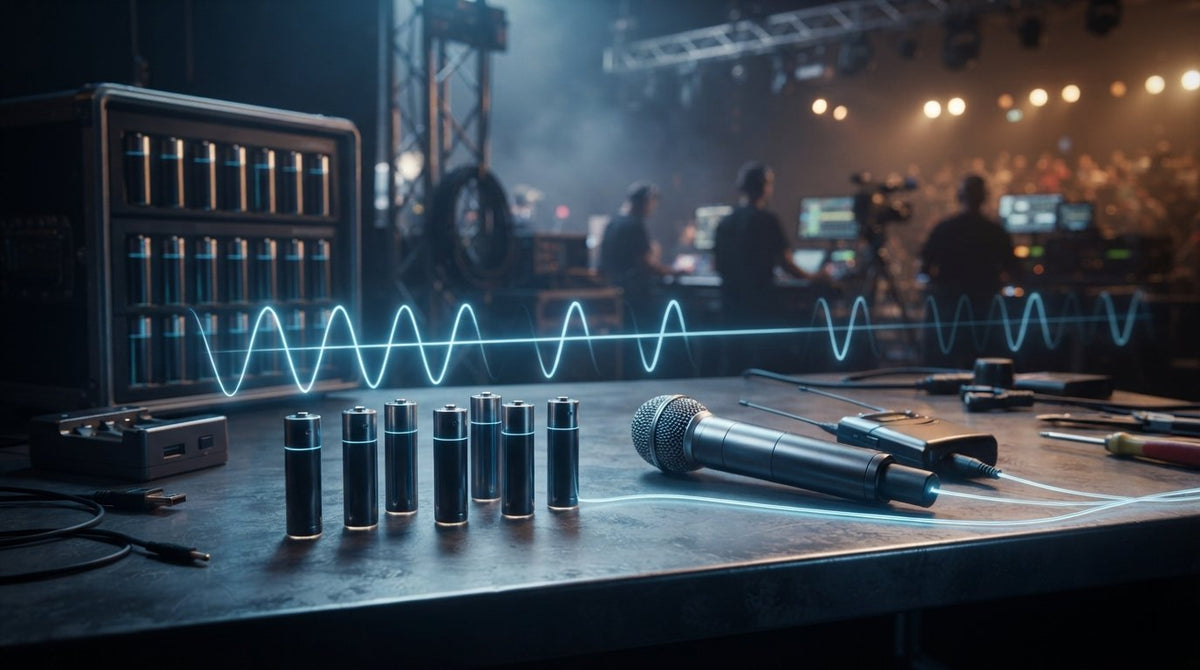
Why does your $5,000 wireless transmitter report a critical power failure when the batteries were charged just two hours ago? This frustrating phenomenon, known as voltage sag, is the hidden culprit behind signal distortion and unexpected RF dropouts. While teams have historically relied on alkalines, the adoption of constant voltage rechargeable AA batteries for production has become a necessity for modern digital wireless systems. For years, production crews settled for the sloping discharge curves of disposables or the inadequate 1.2V plateau of NiMH, but the professional standard has finally shifted.
You likely know the stress of watching a battery meter dance unpredictably during a live show or the logistical headache of managing thousands of single-use cells. In this 2026 guide, you'll discover why 1.5V constant voltage lithium-ion batteries are replacing NiMH in professional environments and how to choose the right system for your gear. We will explain how the Pure Power Series eliminates telemetry errors, reduces annual costs by over 80 percent, and scales through high-density rackmount charging. This shift ensures your equipment receives a steady flow of power until the moment the cell is depleted.
Key Takeaways
- Learn how to eliminate premature low-battery warnings and signal distortion by addressing the specific mechanics of voltage sag in professional wireless gear.
- Understand the role of internal buck converters in constant voltage rechargeable AA batteries for production to maintain a steady 1.5V output throughout the entire discharge cycle.
- Compare the performance and weight advantages of lithium-ion technology against traditional NiMH cells to optimize your handheld microphones and bodypacks.
- Discover how to transition from individual charging units to scalable enterprise infrastructure using custom rackmount chargers and dedicated battery storage systems.
- Identify the specific technical requirements for integrating professional-grade power solutions into high-volume touring and broadcast workflows.
The Problem with Voltage Sag in Professional Production Gear
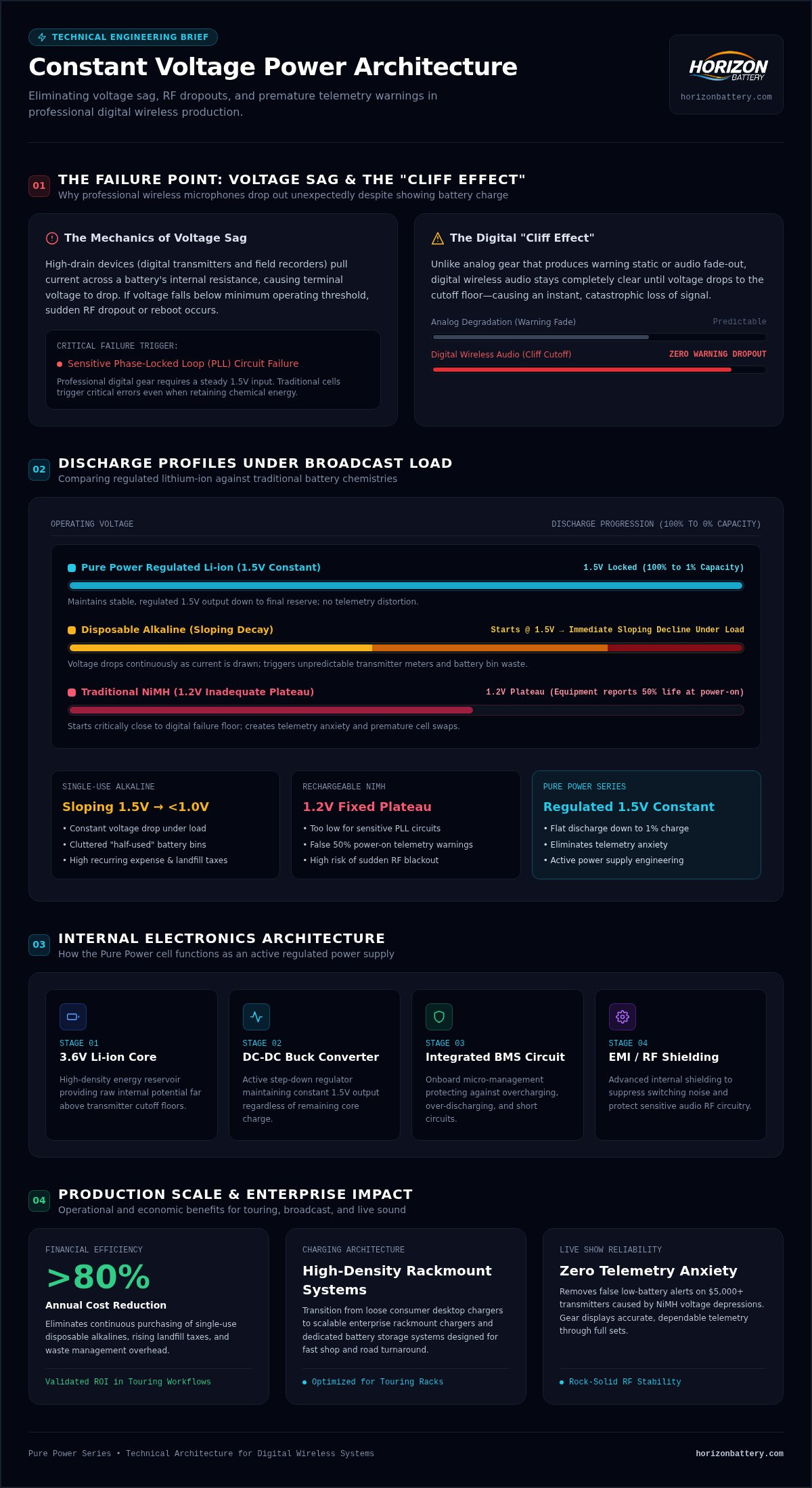
Voltage sag is the silent enemy of a reliable wireless signal. It occurs when a high-drain device, such as a digital transmitter or a field recorder, pulls current across a battery's internal resistance. This causes the terminal voltage to drop momentarily. If that voltage falls below the device's minimum operational threshold, you get a sudden RF dropout or an unexpected reboot. In a live environment, this is unacceptable. Most professional gear is designed to expect a steady 1.5V input, but many traditional rechargeables fail to deliver this consistently.
The core issue lies in the difference between nominal and operating voltage. Standard NiMH cells operate at a 1.2V plateau. While this is sufficient for a TV remote, it's often too low for the sensitive phase-locked loop (PLL) circuitry in digital microphones. Researching AA battery cell chemistries and discharge characteristics shows that while alkalines start at 1.5V, they begin a sloping decline immediately under load. To combat this, constant voltage rechargeable AA batteries for production utilize internal circuitry to lock the output at a regulated 1.5V until the cell is empty. Using constant voltage rechargeable AA batteries for production ensures that your gear sees the full voltage it was engineered to use.
How Voltage Affects Wireless Microphone Performance
Low voltage doesn't just trigger warnings; it degrades performance. Digital wireless systems are prone to the "cliff effect." The audio stays crystal clear until the voltage hits a specific floor, at which point the signal drops completely. There is no warning static or fade-out. Because 1.2V NiMH batteries start so close to this failure floor, equipment meters often report 50 percent life the moment they're turned on. This creates telemetry anxiety for engineers, leading to unnecessary battery swaps and disrupted workflows during a show.
The Hidden Cost of Disposable Alkalines in 2026
By 2026, the reliance on single-use alkalines has become a logistical and financial liability. Production houses face rising landfill taxes and the constant headache of managing "half-used" battery bins that clutter the shop. The environmental impact of discarding thousands of cells annually is now a major factor in corporate sustainability mandates. Moving to professional battery solutions allows teams to scale their power needs while achieving a significant long-term ROI. Regulated lithium-ion cells provide the high-drain performance that 2026 gear demands without the waste associated with disposables.
Pure Power Series: Engineering 1.5V Constant Output
The Pure Power Series represents a shift in how energy is delivered to professional AV equipment. Unlike standard cells that rely on raw chemical discharge, these units function as active power supplies. Each cell contains a high-density 3.6V Lithium-ion core paired with a sophisticated DC-DC buck converter. This internal regulator steps the voltage down to a precise 1.5V, maintaining that level regardless of the core's remaining charge. By utilizing constant voltage rechargeable AA batteries for production, engineers can eliminate the erratic behavior caused by the traditional decay of alkaline or NiMH chemistries.
This engineering approach directly solves the physical limitations of internal resistance and terminal voltage drop. In a typical battery, voltage decreases as the cell depletes or as current demand spikes. The Pure Power Series bypasses this by drawing from a higher-voltage reservoir. The result is a flat discharge curve. Your gear receives the same 1.5V at one percent capacity as it did at 100 percent. To ensure reliability in high-stakes environments, each cell includes a Battery Management System (BMS) that provides protection against overcharging, over-discharging, and short circuits.
The Internal Electronics of a Constant Voltage Battery
The integrated circuit (IC) within each Pure Power cell is the brain of the operation. It manages the conversion process with high efficiency, which is vital for controlling heat during long production days. If a battery runs too hot, it can damage sensitive handheld transmitters or cause mechanical expansion. The 2026 Pure Power models feature advanced EMI and RF shielding. This prevents the high-frequency switching of the buck converter from bleeding noise into your audio signal or interfering with wireless antenna reception. If you're managing a large inventory, you can find these specialized cells in our Pure Power Series collection.
Capacity vs. Usable Energy in Production
When evaluating constant voltage rechargeable AA batteries for production, milliwatt-hours (mWh) is a more accurate metric than milliamp-hours (mAh). Because the voltage is regulated, mAh ratings can be misleading. Total energy (mWh) tells you exactly how much work the battery can perform. This transparency allows for predictable runtimes. You can calculate exactly when a bodypack will power down, rather than guessing based on a fluctuating meter. While some applications still benefit from Ansmann high capacity batteries, the Pure Power Series is the preferred choice for digital wireless systems that require a strict 1.5V threshold to maintain sync and signal integrity.
Comparing 1.5V Lithium-Ion vs. 1.2V NiMH for Audio
Choosing the right cell chemistry requires understanding how energy is released over time. Nickel-Metal Hydride (NiMH) has been the industry workhorse for decades, but it operates at a nominal 1.2V. This voltage often dips to 1.1V or lower under the heavy load of a digital transmitter. In contrast, constant voltage rechargeable AA batteries for production utilize a regulated lithium-ion architecture to provide a consistent 1.5V. This distinction is critical because many modern wireless systems are calibrated for the higher voltage of alkaline cells, making NiMH a secondary choice that often triggers premature "low battery" alerts.
The physical advantages of lithium-ion extend beyond voltage regulation. According to this Department of Energy overview of battery mechanisms, the energy density of lithium-ion allows for a much lighter form factor. In practical production terms, a Pure Power Series cell is roughly 30 percent lighter than a high-capacity NiMH equivalent. This weight reduction decreases fatigue for talent using handheld microphones and reduces mechanical strain on beltpack clips. Charge times are faster too. These lithium cells typically reach full capacity in two hours, whereas high-capacity NiMH cells often require eight hours or more to reach a full state.
When to Choose NiMH over Lithium-Ion
While lithium-ion is superior for high-drain wireless audio, NiMH still has its place in a 2026 professional inventory. For low-drain devices like IEM receivers or simple IFB packs, the higher cost of regulated lithium may not be necessary. NiMH also tends to perform more predictably in extreme temperature environments where lithium-ion chemistry might face thermal constraints. Understanding the Ansmann technology vs Pure Power Series trade-offs helps you deploy the right cell for the specific environmental demands of your shoot.
Telemetry and Battery Meter Accuracy
A unique challenge with constant voltage batteries is how gear interprets their flat discharge curve. Because the battery stays at 1.5V until it's empty, a standard battery meter will show "100%" until the moment of shutoff. To manage this, engineers must adjust the "battery type" menu on their transmitters. Choosing a "Lithium" or "Regulated" setting allows the device to handle the hard shutoff gracefully. While a fading signal from a dying NiMH battery might seem like a warning, a clean, hard shutoff is actually safer for digital systems. It prevents the data corruption and erratic RF noise that occurs when a transmitter struggles to stay synced on a collapsing 1.1V supply.
Building a Production-Ready Battery System
Scaling a wireless operation for a tour or a large-scale house of worship requires moving beyond consumer-grade habits. When managing 50 or 200 channels of wireless, the logistical burden of individual chargers becomes a liability. Implementing constant voltage rechargeable AA batteries for production is only half the battle; the other half is building a repeatable system to manage that power. Professional environments require centralized hubs where depleted cells are sequestered, charged, and verified before returning to the stage.
Transitioning to an enterprise infrastructure reduces the risk of human error. Using a dedicated Battery Storage and management system ensures that "charged" and "dead" bins are never confused. Crew training is essential here. Staff must understand that regulated lithium cells require specific handling, particularly regarding their hard shutoff characteristics and the need for compatible charging profiles. This structured approach ensures that your inventory remains reliable over years of heavy use.
Custom Rackmount Chargers: The Pro Standard
For mobile production rigs and permanent broadcast installations, 19-inch rack integration is the gold standard. Custom Rackmount Chargers eliminate the "wall-wart" clutter that plagues many tech tables. These systems allow engineers to monitor the charge status of dozens of cells simultaneously. Modern enterprise racks can accommodate up to 44 charging bays in a single 2U or 3U enclosure. This density is vital for back-to-back shows where turnaround times are tight. By centralizing power, you reduce the load on individual power strips and minimize the risk of thermal build-up in disorganized charging arrays.
Managing Battery Cycles and Asset Tracking
A professional system relies on data to prevent failures. Labeling and rotating cells ensures even wear across your entire inventory. You can use enterprise battery charging solutions to track the health and cycle count of each cell. Since Pure Power cells are rated for up to 1,500 cycles, tracking prevents you from using a cell that has reached its end-of-life. When a battery no longer holds its rated capacity, it should be decommissioned immediately to maintain the 16-hour runtime standard your production depends on. To modernize your workflow, view our full range of professional charging bundles.
Why Production Houses Choose Horizon Battery
Since 1998, Horizon Battery has focused on the specific mobile power requirements of the professional AV industry. Production houses, broadcast facilities, and touring crews require more than just a battery; they need a validated power system. By specializing in constant voltage rechargeable AA batteries for production, we provide solutions that address the technical demands of high-stakes environments. Our portfolio includes the Pure Power Series and Ansmann professional batteries, curated to ensure every cell meets the rigorous standards of modern digital wireless gear. We act as a knowledgeable guide for facilities looking to move away from the unreliability of disposable cells.
The Horizon Advantage: Quality Control and Reliability
Reliability in a live show isn't accidental. It's the result of strict quality control. Every batch of Pure Power cells undergoes testing to verify voltage consistency and internal shielding performance. As mentioned in previous sections, 2026 models feature enhanced EMI and RF shielding to prevent interference with sensitive microphone capsules. Our clients receive direct access to custom rackmount chargers designed specifically for high-volume environments. These systems are engineered to handle hundreds of cells while maintaining thermal safety and independent channel monitoring. With fast shipping across the United States, we support tight production schedules where downtime isn't an option.
Next Steps: Outfitting Your Facility
Transitioning an entire facility to a regulated lithium system requires a methodical approach. First, you should evaluate your current gear's voltage requirements. While most modern transmitters benefit from the constant 1.5V output, some legacy devices may require different configurations. Consulting with a specialist allows you to design a custom charger build that fits your specific rack density and channel count. Whether you're managing a single theater or a global tour, we offer comprehensive charger and battery bundles that combine high-capacity cells with professional hardware.
By switching to a regulated system, production houses typically see an 80 percent reduction in annual battery costs. A single Pure Power cell provides 16+ hours of continuous runtime and is rated for 1,500 recharge cycles. This longevity translates to a significantly lower amortized cost over the ten-year life of the battery. You can request a quote for bulk professional battery kits to begin modernizing your inventory with a partner that understands the nuances of professional mobile power.
Standardizing Your Production Power Workflow
Transitioning to constant voltage rechargeable AA batteries for production represents a significant step toward total technical reliability. By replacing the unpredictable discharge curves of NiMH and alkalines with a regulated 1.5V output, you ensure your digital wireless systems operate at peak performance until the moment of depletion. This shift effectively eliminates telemetry anxiety and protects your signal from the distortion caused by voltage sag. Horizon Battery has supported the professional audio community since 1998, offering the specialized 1.5V Lithium-ion cells and custom rackmount charging options necessary for enterprise-scale management. Standardizing your power infrastructure not only reduces environmental waste but also secures your production against the most common causes of RF failure. It's time to move toward a more predictable, cost-effective energy solution that keeps your focus on the performance rather than the battery meter.
Take the final step in professionalizing your mobile power. Shop Professional Pure Power Series and Custom Charging Bundles to secure your gear for the 2026 season.
Frequently Asked Questions
Do 1.5V lithium-ion rechargeable batteries require a special charger?
Yes, 1.5V regulated lithium cells require a dedicated charger calibrated for their internal step-down circuitry. You cannot use legacy NiMH chargers because they utilize different charging profiles, such as delta-V or pulsed charging, which can cause circuit failure or thermal lockouts in lithium cells. Using constant voltage rechargeable AA batteries for production alongside a compatible Pure Power charger ensures the internal Battery Management System receives the correct 5V input profile for a safe and efficient recharge cycle.
Can I use constant voltage batteries in my Shure or Sennheiser wireless mics?
These batteries are specifically engineered for professional wireless systems like Shure Axient Digital and Sennheiser EW-D. Unlike consumer rechargeables that are often oversized, Pure Power cells adhere to strict dimensional tolerances to prevent sticking in battery sleds. They provide the steady 1.5V required by sensitive digital RF modems, eliminating the premature "low battery" warnings and signal instability often caused by the lower 1.2V output of standard NiMH rechargeable cells.
How many cycles can I expect from Pure Power Series AA batteries?
You can expect up to 1,500 recharge cycles from the Pure Power Series, which is a significant improvement over the 300 to 500 cycles typical of high-capacity NiMH. Based on a standard workflow of three recharges per week, these cells can provide up to 10 years of operational life. This longevity, combined with a 16-hour continuous runtime, makes them the most cost-effective solution for high-volume touring environments and broadcast facilities.
Will these batteries interfere with my RF signal or create audio hum?
Professional-grade cells like the Pure Power Series will not interfere with your signal. While early consumer-grade 1.5V lithiums occasionally emitted switching noise, our 2026 models integrate internal EMI and RF shielding. This specialized shielding blocks high-frequency electronic noise from the internal buck converter. This ensures your audio path remains clean and your antenna reception stays clear, even when the transmitter is used in close proximity to sensitive microphone capsules.
Do constant voltage batteries show an accurate percentage on my device's screen?
Because these batteries maintain a regulated 1.5V output until they are empty, your device will show a 100 percent charge level for nearly the entire discharge cycle. To manage this, you should set your transmitter's battery type menu to "Lithium" or "Regulated." This adjustment helps the device handle the hard shutoff safely. This predictable performance is a primary reason engineers choose constant voltage rechargeable AA batteries for production over the sloping discharge of alkalines.
Are 1.5V lithium-ion batteries safe for all production electronics?
These batteries are safe for any production gear designed for standard 1.5V AA cells, including field recorders, IFB packs, and digital transmitters. Each cell features an integrated Battery Management System that protects against overcharging, over-discharging, and short circuits. This active regulation prevents the voltage sag that can lead to data corruption in digital recorders. They offer a more stable power supply than alkalines, which can leak and damage expensive internal circuitry over time.
How do I store lithium-ion AA batteries during the off-season?
For long-term storage, you should keep your lithium-ion cells at approximately 40 to 50 percent charge in a cool, dry environment. Avoid storing them completely depleted or at a full 100 percent charge for several months, as this can degrade the chemical potential over time. Utilizing a dedicated battery storage system helps maintain inventory organization and prevents the cells from coming into contact with conductive materials, which ensures they remain ready for your next production season.
Why should I choose lithium-ion over high-capacity NiMH for production?
Lithium-ion is the superior choice because it provides a constant 1.5V output, weighs 30 percent less, and charges in just two hours. High-capacity NiMH cells operate at a 1.2V plateau that frequently trips "low battery" sensors on modern digital gear, even when plenty of capacity remains. The weight reduction of lithium-ion also reduces fatigue for talent using handheld microphones, while the faster charging cycles are essential for the rapid turnarounds required in professional theater and touring.