
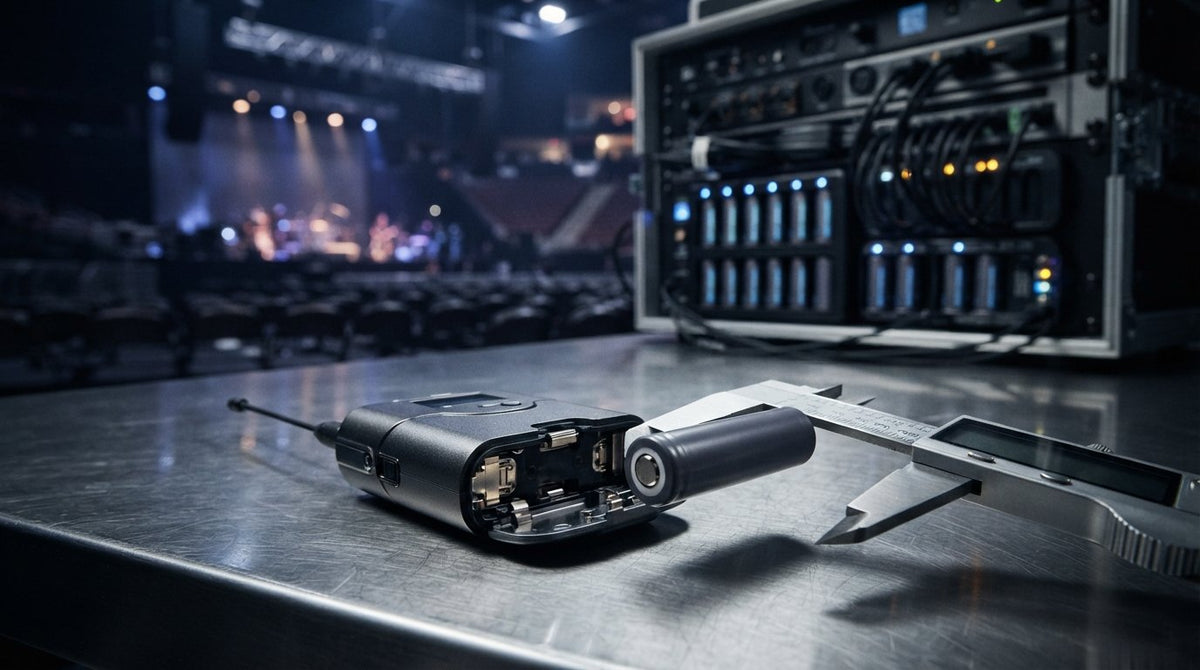
In professional audio, 0.15 millimeters is the difference between a flawless performance and a jammed $1,000 wireless transmitter. Every production engineer knows the frustration of a battery that slides in easily but refuses to come out of a Shure or Sennheiser bodypack during a critical mid-show change. You shouldn't have to choose between high-capacity runtime and physical reliability. The Ansmann slimline AA was engineered specifically to solve this clearance crisis, offering a thinner diameter without sacrificing the 2850 mAh power required for long production days.
This guide explores why these specialized cells are the industry standard for tight-tolerance gear and how to optimize your power workflow in 2026. We'll cover the technical specifications that guarantee 12 to 14 hours of continuous runtime, compare NiMH performance against the Pure Power Series, and examine the rackmount charging systems used by major venues. Whether you're managing a single church stage or a global touring fleet, you'll learn how to eliminate battery-related downtime for good.
Key Takeaways
- Understand why the 0.15mm diameter reduction in the Ansmann slimline AA is critical for preventing jammed battery trays in high-end Shure and Sennheiser wireless gear.
- Learn how to achieve up to 14 hours of continuous runtime using high-capacity NiMH cells engineered for the most demanding professional audio environments.
- Compare the linear discharge curve of NiMH against the constant 1.5V output of the Pure Power Series to select the optimal chemistry for your specific hardware fleet.
- Discover how to streamline large-scale productions by implementing custom rackmount charging systems that improve reliability and organization in 2026.
- Identify the benefits of partnering with a specialized distributor like Horizon Battery for expert consultation and direct access to professional-grade power solutions.
The "Tight Fit" Problem: Why Dimensions Matter in Pro Audio
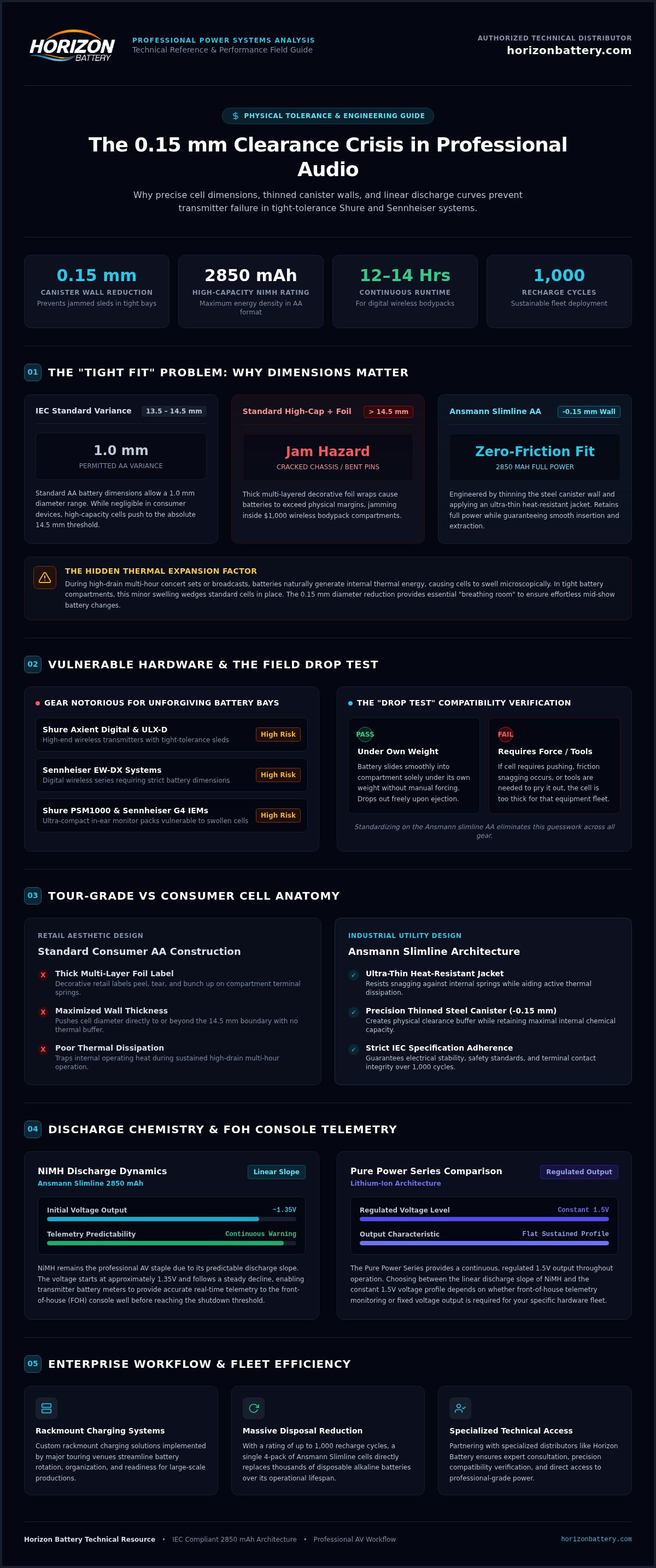
Professional audio equipment operates within incredibly narrow physical margins. The standard AA battery dimensions defined by international regulations allow for a diameter ranging from 13.5 mm to 14.5 mm. While this 1 mm variance seems negligible, it creates a significant hurdle for high-capacity rechargeable cells. To achieve a class-leading 2850 mAh rating, most manufacturers pack the internal canister with as much active material as possible, pushing the outer diameter to the absolute 14.5 mm limit. Once a brand adds a decorative foil wrap, the battery often exceeds the maximum threshold, leading to clearance issues in precision-engineered gear.
Ansmann engineered a solution to this specific frustration by thinning the actual steel wall of the battery canister. The Ansmann slimline AA features a diameter reduced by 0.15 mm compared to standard high-capacity NiMH cells. This specialized architecture ensures the battery maintains its high energy density while remaining compatible with the restrictive battery sleds found in professional wireless transmitters. Without this adjustment, technicians often find themselves using tools to pry stuck batteries out of expensive equipment, which leads to cracked chassis and bent terminal contacts.
Heat management plays a hidden role in this dimensional conflict. During high-drain operation, such as a multi-hour broadcast or a concert set, batteries naturally generate internal heat. This thermal energy causes standard NiMH cells to swell slightly. In a tight plastic tray, that microscopic expansion is enough to wedge a battery firmly in place. Using a slimline cell provides the necessary "breathing room" to account for this physical change, ensuring that mid-show battery swaps remain fast and stress-free.
The Anatomy of a Professional AA Cell
Professional cells differ from consumer-grade alternatives in their structural integrity. While consumer batteries often use thick, multi-layered foil labels that can peel or bunch up, the Ansmann Slimline utilizes an ultra-thin, heat-resistant jacket. This design choice aids in heat dissipation and prevents the label from snagging on the internal springs of a battery compartment. The Ansmann Slimline AA is a precision-engineered cell designed specifically for tight-tolerance battery compartments in high-end professional electronics. This focus on industrial utility over retail aesthetics is what defines tour-grade power in 2026.
Identifying Gear with Tight Battery Slots
Certain industry-standard models are notorious for their unforgiving battery bays. If you are operating Shure Axient Digital, ULX-D, or Sennheiser EW-DX systems, you've likely encountered the "stuck battery" phenomenon. In-ear monitor (IEM) packs, such as the Shure PSM1000 or Sennheiser G4 series, also feature compact internal designs that struggle with oversized rechargeables. You can verify compatibility using a simple "drop test." If a battery doesn't slide into the compartment under its own weight, or if it requires a forceful tug to remove, the cell is too thick for that specific device. Standardizing on the Ansmann slimline AA eliminates this guesswork across your entire equipment fleet.
Engineering Excellence: Inside the Ansmann 2850 mAh Slimline
Achieving a 2850 mAh capacity within a standard AA footprint requires maximizing the internal volume available for active chemistry. Ansmann manages this feat while strictly adhering to IEC physical and electrical specifications, ensuring the cell remains safe and efficient throughout its life. For audio professionals, this high energy density translates to roughly 12 to 14 hours of continuous operation in digital wireless transmitters. It's a level of performance that allows engineers to power through a full day of rehearsals and performances on a single charge.
Nickel Metal Hydride (NiMH) remains the staple chemistry for professional AV because of its predictable discharge slope. Unlike early lithium-ion cells that might drop off suddenly, NiMH allows transmitter battery meters to provide accurate telemetry to the front-of-house console. The voltage starts at approximately 1.35V and follows a steady decline. This linear progression gives technicians a clear, reliable warning well before the device reaches its shutdown threshold. These cells are rated for up to 1,000 recharge cycles, making them a sustainable alternative to disposable options. In a high-frequency production environment, a single 4-pack of the Ansmann slimline AA can replace thousands of alkaline batteries over its service life.
High-Capacity vs. Low Self-Discharge (LSD)
High-capacity cells like the 2850 mAh Slimline prioritize maximum runtime over long-term shelf life. While "Hybrid" or Low Self-Discharge (LSD) cells are designed to hold their charge for months in storage, they typically offer lower capacity, often capping at 2100 mAh. For 8 to 12 hour show cycles, the raw power of the Ansmann slimline AA is the superior choice. It's designed for active "charge today, use today" workflows where every milliampere counts toward show security. If your gear sits idle for weeks between uses, Hybrid cells may be appropriate; however, for professional touring and broadcast, capacity is king.
Reliability in High-Drain Applications
Modern wireless gear often experiences sudden peaks in current draw during RF transmission. The 2850 mAh Slimline features an exceptionally low internal resistance of ≤ 30-35 mΩ, which prevents the voltage sagging that can cause digital dropouts. This stability is critical when operating in the 2026 RF landscape, where digital transmitters require consistent power to maintain complex signal modulation. For a deeper look at how these specs compare across the product line, you can explore our comprehensive guide on Ansmann high capacity batteries. If you need to refresh your current inventory, you can find the latest 2026 stock at Horizon Battery to ensure your equipment fleet is show-ready.
Slimline NiMH vs. Pure Power Series Lithium-Ion
In 2026, the decision between Nickel Metal Hydride (NiMH) and Lithium-ion (Li-ion) depends on your specific gear requirements and existing infrastructure. While the Ansmann slimline AA remains the workhorse for high-capacity applications, the Pure Power Series offers a distinct alternative for devices sensitive to voltage drop. Understanding the Department of Energy battery fundamentals regarding ion transfer helps clarify why these two chemistries behave so differently under load. NiMH cells provide a nominal 1.2V with a gradual discharge slope, whereas regulated Li-ion cells maintain a constant 1.5V until the final stage of their cycle. This difference dictates how your transmitter battery meter reflects remaining runtime on the console.
Weight and physical comfort are critical factors in professional production environments. Lithium-ion cells are roughly 30% lighter than NiMH, which reduces the physical burden on performers wearing multiple body packs or holding microphones for extended sets. Beyond ergonomics, large facilities must consider their environmental footprint and sustainability goals. Both options significantly reduce e-waste compared to disposables, but the choice often comes down to charging logistics. Mixing these technologies requires strict management; you cannot use a NiMH charger for Li-ion cells or vice versa without risking equipment failure. Standardizing on one chemistry per department helps prevent these dangerous charging errors and ensures a smoother workflow.
When to Stick with Slimline NiMH
Many production houses and churches have invested heavily in legacy charging infrastructure. The Ansmann slimline AA is compatible with these existing systems, providing a lower cost-per-cell that makes it ideal for facilities managing hundreds of wireless channels. NiMH also demonstrates proven reliability in extreme temperatures, making it the preferred choice for outdoor festivals or unconditioned broadcast environments. It's a dependable, high-volume solution that integrates naturally into traditional workflows without requiring a complete overhaul of your charging racks.
The Pure Power Series Advantage
Some modern wireless circuits are designed for the 1.5V output of alkaline batteries and can experience reduced RF range or audio artifacts when voltage drops below 1.1V. The Pure Power Series addresses this by delivering a flat 1.5V output throughout 95% of its discharge cycle. These cells also support significantly faster charging times, allowing for rapid turnarounds between back-to-back performances. For a detailed breakdown of these lithium solutions and their specific technical specifications, see our Pure Power Series guide. Choosing this series is often the right move for high-drain digital gear that demands peak voltage for maximum stability.
Implementing a Professional Battery Management Workflow
Professional production environments in 2026 require more than just high-quality cells; they demand a structured system to maintain them. The transition to enterprise battery charging solutions marks a shift from chaotic desktop setups to organized, high-density power hubs. Custom rackmount chargers serve as the foundation of this workflow, reducing the clutter of individual wall adapters and providing a central point for battery distribution. By integrating charging directly into your equipment racks, you ensure that every Ansmann slimline AA is accounted for and ready for the next call.
Inventory rotation is essential for maintaining a healthy battery fleet. High-capacity NiMH cells perform best when they are cycled regularly rather than left sitting in a state of deep discharge. Technicians should implement a first-in, first-out (FIFO) rotation to ensure even wear across all cells. This prevents a small subset of batteries from taking the brunt of the workload while others lose capacity due to inactivity. Proper storage is equally vital. When the production wraps, cells should be removed from gear and placed in a climate-controlled environment to minimize self-discharge and chemical degradation.
Rackmount Charging for Large Facilities
Large-scale venues benefit significantly from 8, 16, or 48-bay charging systems. These professional units do more than just provide power; they monitor individual cell health using delta-V detection and thermal sensors. This allows engineers to identify "lazy" batteries or cells with rising internal resistance before they fail during a performance. Standardizing on a single brand across your entire facility ensures predictable charging curves and simplifies the training process for stagehands and volunteers. A unified system means every charger in the building treats your Ansmann slimline AA inventory with the same precision, extending the overall service life of your investment.
Battery Storage and Asset Tracking
Effective management requires clear visual cues. Utilizing specialized Battery Storage cases allows teams to organize cells by their charge status. Many houses of worship and touring companies use a simple color-coding system, such as green labels for show-ready batteries and red for spent cells awaiting a charge cycle. Transitioning from disposable alkalines to a managed Ansmann system typically pays for itself within the first six months of a heavy production schedule by eliminating recurring consumable costs. This ROI is further improved when assets are tracked and stored in protective cases that prevent terminal shorting and physical damage during transit.
To build a more reliable power infrastructure for your facility, you can browse our custom rackmount chargers and storage solutions at Horizon Battery.
Why Horizon Battery is the Professional Choice for Ansmann
Horizon Battery has served as a specialized distributor for high-capacity power solutions since 1998. We provide production houses, churches, and educational institutions across the United States with direct access to the latest 2026 Ansmann slimline AA inventory. Our role extends beyond simple distribution; we act as a knowledgeable partner for facilities that cannot afford power failures during live events. By maintaining deep stock levels of professional-grade cells and custom rackmount chargers, we ensure that your team always has the energy required for mission-critical applications.
Selecting the right power platform requires an understanding of both electrical requirements and physical constraints. Our experts provide tailored consultation to help you choose between high-capacity NiMH and the Pure Power Series based on your specific equipment fleet. We offer custom charger and battery bundles that match your exact channel count. This approach eliminates the waste of over-purchasing while ensuring you aren't under-equipped for a major production. Our history in the industry allows us to guide you through the transition from disposables to a professional rechargeable workflow with quiet confidence.
The Horizon Battery Advantage
Our team consists of industry veterans who understand the specific demands of professional audio and high-drain electronics. We provide technical support that goes beyond a standard spec sheet, offering practical advice on fleet management and cell longevity. When a show is on the line, our fast national shipping ensures that replacements arrive before the next curtain call. For large-scale facility upgrades, we provide bulk pricing structures that make the transition to professional rechargeables economically viable and sustainable for the long term.
Standardizing Your Power
Moving away from disposable consumables is a strategic shift that requires careful planning. You can learn more about the logistical and financial benefits of switching to rechargeable batteries for business through our dedicated guide. Once you are ready to upgrade, we can provide a custom quote for rackmount infrastructure tailored to your facility's layout. Standardizing your power workflow reduces long-term costs and improves the reliability of every performance across your entire organization. Contact Horizon Battery for a professional power audit to optimize your equipment's performance.
Powering the Future of Professional Production
Achieving reliable power in 2026 requires a balance of high-capacity chemistry and physical precision. The Ansmann slimline AA provides this balance by offering a reduced diameter that prevents jammed transmitters while delivering the 2850 mAh energy density needed for full production days. By implementing structured management workflows and custom rackmount charging, your facility can eliminate the high costs and environmental waste associated with disposable batteries. These strategic upgrades ensure that your equipment performs at its peak without the risk of physical damage or mid-show power failures.
Horizon Battery has been a trusted partner for professional audio engineers since 1998. As a national distributor for authentic Ansmann products, we provide the specialized inventory and custom-engineered charging racks required for large-scale facilities. Whether you're managing a house of worship or a global tour, our team is ready to assist with expert consultation and technical support. We understand the unique demands of the production industry and are committed to providing solutions that offer both longevity and security.
Shop Ansmann Slimline AA 2850 mAh Batteries at Horizon Battery
We're here to help you build a more sustainable and dependable power infrastructure for your next performance.
Frequently Asked Questions
What is the difference between Ansmann Slimline and standard AA batteries?
The Ansmann slimline AA features a diameter reduced by 0.15 mm compared to standard high-capacity NiMH cells. This specialized design prevents the "stuck battery" issue common in tight-tolerance professional gear. While many consumer AA batteries reach the absolute 14.5 mm limit allowed by international standards, the Slimline variant ensures smooth insertion and removal. It provides a necessary physical buffer without sacrificing the high 2850 mAh energy density required for long production days.
Do Ansmann 2850 mAh batteries fit in Sennheiser G3/G4 wireless packs?
Yes, these batteries were specifically engineered to fit Sennheiser G3 and G4 wireless packs, alongside Shure and Lectrosonics hardware. These transmitters feature restrictive battery bays that often jam when technicians use standard rechargeable cells. By choosing the Slimline model, you ensure that the batteries slide out effortlessly during quick mid-show changes. This compatibility makes them the standard choice for touring professionals and theater technicians who demand reliability across North America.
How many charge cycles can I expect from Ansmann Slimline AA batteries?
You can expect up to 1,000 recharge cycles from these NiMH cells when using professional maintenance protocols. In high-demand production environments, this longevity allows a single battery to replace thousands of disposable alkalines over its service life. The actual cycle count depends on your charging hardware and discharge depth. Using custom rackmount chargers with delta-V monitoring helps maximize this lifespan by preventing overcharging and managing thermal levels during each cycle.
Do I need a special charger for Ansmann Slimline 2850 mAh NiMH cells?
While they work with standard NiMH chargers, using professional-grade smart chargers is highly recommended for 2026 workflows. High-capacity cells require precise termination to avoid overheating during the final stage of charging. Enterprise solutions, such as custom rackmount chargers, provide individual cell monitoring and active cooling. These specialized systems ensure that your Ansmann slimline AA inventory is charged safely and efficiently, which is critical for maintaining consistent performance in large-scale facilities.
Why do some high-capacity batteries swell and get stuck in equipment?
Swelling occurs due to internal heat generation during high-drain discharge or rapid charging cycles. As the cell heats up, the internal components expand slightly. In tight battery compartments, even a microscopic increase in diameter can wedge the cell firmly against the chassis. Standard high-capacity cells are already at the maximum physical limit of the AA specification. The Slimline design provides a critical buffer, allowing for natural thermal expansion without causing the battery to jam.
Can I use Ansmann Slimline batteries in high-drain digital wireless systems?
These batteries are designed specifically for high-drain digital wireless systems like Shure Axient Digital and Sennheiser EW-DX. These modern devices require consistent current to maintain stable RF modulation and digital signal processing. The low internal resistance of the 2850 mAh cells prevents voltage sags that can lead to audio dropouts. For gear that requires a constant 1.5V output throughout the cycle, you might consider the Pure Power Series lithium-ion alternatives instead.
How should I store my Ansmann batteries between production seasons?
Store your batteries in a cool, dry environment using dedicated battery storage cases to prevent terminal shorting. NiMH cells perform best when stored with a partial charge, typically around 40% to 50%, rather than being completely depleted. If your facility shuts down for several months, top them off every 30 days. This simple maintenance prevents the cells from falling into a deep discharge state, which can permanently reduce the total capacity of your fleet.
Is the 2850 mAh capacity real or just marketing?
The 2850 mAh rating is a verified electrical specification representing the total energy capacity available under standard discharge conditions. In real-world professional audio applications, this translates to roughly 12 to 14 hours of continuous runtime. While some consumer brands inflate their numbers, Ansmann provides conservative minimum capacity ratings to ensure professional reliability. Horizon Battery has distributed these authentic cells since 1998, confirming their performance in thousands of demanding production environments across the country.