
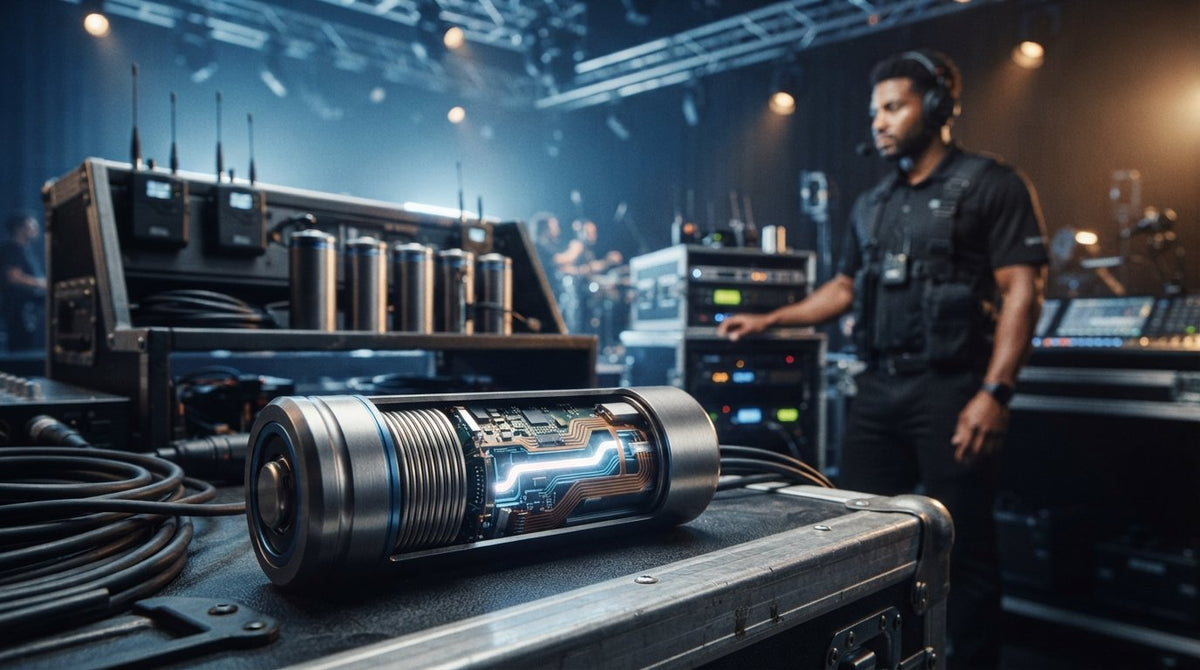
What if the difference between a flawless live performance and a technical disaster was just 0.15 millimeters? For sound engineers and production managers, the frustration of a battery jamming in a wireless transmitter or a sudden voltage drop is a constant risk. You understand that in high-stakes environments, consumer-grade cells eventually fail when you need them most. Ansmann battery technology is engineered specifically to eliminate these vulnerabilities through superior German design and chemical precision.
You've likely dealt with the "cliff dropoff" where lithium cells die without warning, or high-capacity batteries that swell and get stuck in tight equipment slots. We'll show you exactly how Ansmann solves these issues to provide the professional standard for mobile power in 2026. This deep dive covers the integrated micro-circuitry that maintains a flat 1.5V output, the slimline housing tolerances that prevent jamming, and the chemistry that supports up to 1,500 charge cycles. You'll gain the technical justification needed for enterprise-level upgrades that ensure long-term ROI and rock-solid reliability for every event.
Key Takeaways
- Learn why professional environments require the industrial-grade durability and precision engineering found in Ansmann battery technology.
- Discover how the Pure Power series utilizes integrated circuitry to deliver a consistent 1.5V output, preventing premature equipment shutdowns.
- Understand the engineering behind "slimline" dimensions that ensure high-capacity cells fit perfectly into restricted battery compartments.
- Explore how custom rackmount charging systems and microprocessor-controlled monitoring protect your battery assets from overcharging.
- Identify the specific financial advantages and long-term ROI of transitioning large-scale facilities from disposable alkaline to rechargeable systems.
The Evolution of Ansmann Battery Technology for Professional Use
Ansmann battery technology isn't just about providing power; it's about providing certainty. Since 1998, Horizon Battery has acted as the expert guide for organizations needing more than what retail stores offer. This partnership has brought German engineering to the forefront of the North American professional market, focusing on industries where a power failure is not an option. Understanding the foundation of Ansmann battery technology helps technical directors justify the switch from alkaline consumables to enterprise-level rechargeable systems.
From Consumer Cells to Professional Standards
Standard retail batteries are designed for intermittent use in low-stakes devices like TV remotes or toys. In contrast, professional environments require cells that can handle constant high-drain loads without significant voltage sag. Ansmann engineering focuses on reducing internal resistance and optimizing heat dissipation. These factors are critical because heat is the primary enemy of battery longevity. By maintaining lower operating temperatures, these cells sustain their health across more charge cycles than consumer alternatives.
Batch consistency also remains a hallmark of the brand. For large-scale wireless microphone deployments, having a uniform discharge curve across every cell in the fleet simplifies asset management and prevents unexpected dropouts. When you're managing dozens of transmitters, you can't afford for one cell to deplete faster than the others. Ansmann's manufacturing process ensures that the internal chemistry of every battery in a batch meets the same rigorous performance benchmarks.
The 2026 Landscape of Mobile Energy
The year 2026 has seen a shift toward more complex mobile energy needs. Modern Ansmann high capacity batteries now serve as the backbone for hybrid power ecosystems in large-scale facilities. These systems often rely on sophisticated battery management systems to ensure peak performance and safety. Reliability now involves data as much as chemistry. Key trends in 2026 include:
- High-drain stability for digital wireless systems that require constant voltage.
- Superior thermal regulation during rapid charging in high-turnover environments.
- Enhanced cycle life to maximize long-term ROI for schools and churches.
Capacity is only one part of the equation. Professional users prioritize how a cell behaves at the end of its runtime and how many times it can be recharged before capacity begins to fade. Ansmann's evolution reflects this need for predictable, industrial-grade performance. By focusing on the physics of energy delivery rather than just the mAh rating, they've set a standard that consumer brands simply don't match. It's a methodical approach to power that ensures your equipment stays operational through the longest performances.
Core Engineering: NiMH vs. Pure Power Lithium-Ion Architectures
Professional equipment demands specific voltage profiles to operate at peak performance. Ansmann battery technology addresses these needs through two primary architectures: Nickel-Metal Hydride (NiMH) and the regulated Pure Power Lithium-Ion series. While both formats provide reliable energy, their internal physics dictate how they perform under the heavy loads typical of live production and industrial use. Choosing the right chemistry isn't just about capacity; it's about matching the battery's discharge curve to your device's sensitivity.
The Physics of the Pure Power Series
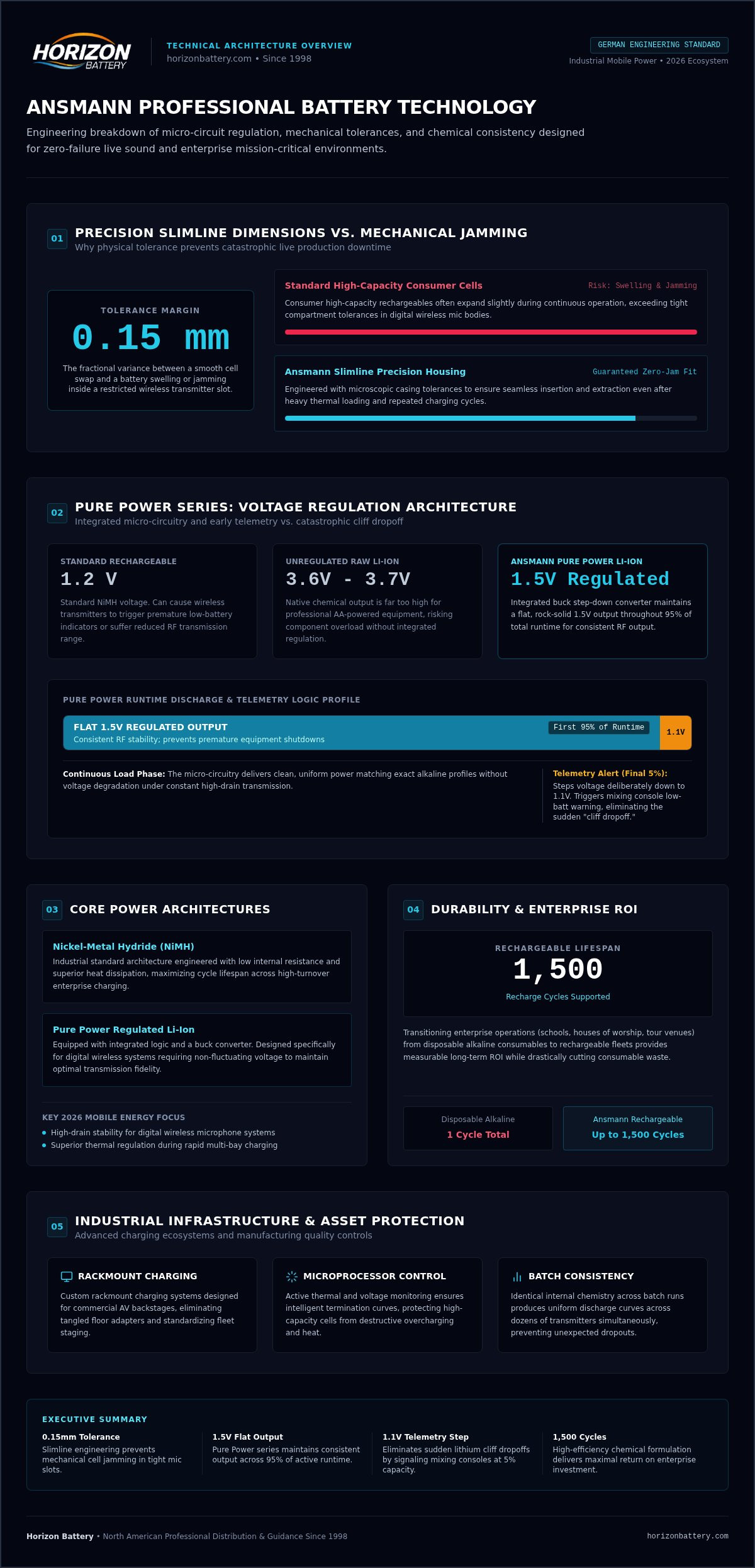
Standard lithium-ion cells naturally output 3.6V to 3.7V, which is far too high for AA-powered gear. To solve this, the Pure Power Series utilizes an integrated buck step-down converter. This micro-circuitry regulates the output to a constant 1.5V throughout 95% of the runtime. This is a critical engineering feat because standard rechargeables often sit at 1.2V, which can cause wireless microphones to report a low battery or lose RF range prematurely.
A common failure point for regulated lithium cells is the "cliff dropoff," where the power cuts out instantly without warning. Ansmann's internal logic solves this by deliberately stepping the voltage down to 1.1V when the cell reaches 5% capacity. This triggers the low-battery telemetry on your mixing console, giving you enough time to swap cells before a total blackout. Additionally, these lithium cells are significantly lighter than NiMH alternatives, reducing the fatigue of performers using handheld transmitters for several hours.
NiMH Engineering and Low Self-Discharge (LSD)
NiMH remains the industrial workhorse for low-to-medium drain gear. Ansmann's 2850 mAh cells are designed with a high-density chemical structure that provides up to 14 hours of field capability. These cells utilize "Hybrid" technology to combat self-discharge. While older NiMH batteries would lose significant charge just sitting on a shelf, these professional cells retain their energy for months of standby, ensuring they're ready when you pull them from storage.
Maintaining the health of these cells requires sophisticated NiMH charging algorithms and full-charge detection. Ansmann chargers use negative delta-V (-ΔV) termination, which monitors the slight voltage drop that occurs when a cell is fully saturated. This prevents "overcooking" the chemistry, which is the leading cause of reduced cycle life in high-capacity batteries. If you're looking to streamline your inventory, you can browse our professional battery bundles to see how these different architectures are paired with specialized charging hardware.
The long-term ROI also varies significantly between these two paths. While high-capacity NiMH cells typically sustain around 300 cycles in high-drain environments, the Pure Power lithium cells are rated for 1,200 to 1,500 cycles. This 4x increase in longevity often offsets the higher initial cost for large facilities like schools and churches that cycle their inventory daily. By understanding these core engineering differences, you can build a power fleet that eliminates technical failures while maximizing your budget.
Solving Professional Challenges with Precision Slimline Design
Ansmann battery technology addresses more than just chemical output; it solves the physical limitations of high-capacity cells. Many production houses find that standard rechargeable batteries are a hair too thick for the precision-engineered battery sleds found in high-end wireless transmitters. This "tight slot" problem isn't just an inconvenience. It often leads to mechanical failure or stuck batteries that require damaging expensive equipment to remove. For technicians, a battery that binds in a transmitter during a live show is a liability that capacity alone cannot fix.
Dimensional Tolerances in Pro-Audio Gear
Manufacturers like Shure and Sennheiser design their battery compartments to strict ANSI/IEC primary alkaline tolerances. Standard high-capacity rechargeable batteries often utilize thicker internal layers to pack more energy, which can cause the cell to swell slightly during discharge or over time. The Ansmann AA 2850 mAh Slimline battery (Part # 5035212-US) solves this by reducing the barrel diameter by exactly 0.15 mm compared to standard industrial rechargeables. This minute adjustment ensures a perfect fit in 100% of ANSI-specified sleds, including demanding models like the Shure UHF-R and ULX-D, without the risk of binding.
Capacity vs. Size: The Engineering Trade-off
Achieving high capacity within a smaller physical footprint requires advanced material science. Ansmann uses thinner, high-strength steel casings to maximize internal volume for the active chemical components. This precision engineering allows the cell to reach 2850 mAh without the radial expansion common in consumer-grade high-capacity cells. Understanding the fundamental rechargeable battery electrochemistry helps explain why these thermal and cyclic swelling issues occur in the first place, especially under the heavy drain of digital wireless systems.
In real-world applications, this physical reliability is paramount. Venues that have switched to high-capacity AA batteries for professional audio report far fewer mechanical issues during quick-change transitions. When a performer is waiting in the wings, a battery that slides in and out smoothly is just as important as the voltage it provides. By prioritizing these dimensional tolerances, Ansmann ensures that their technology doesn't just power the gear but respects the mechanical integrity of the devices it fuels. This focus on the "Slimline" standard reflects a deep understanding of the daily challenges faced by A/V technicians and field engineers who cannot afford to struggle with equipment in the dark.
Industrial Charging and Asset Management Infrastructure
Managing a fleet of fifty wireless microphones requires more than a handful of consumer-grade tabletop chargers. Professional asset management relies on industrial infrastructure that can handle high volume without sacrificing cell health. Ansmann battery technology extends beyond the cell itself into the sophisticated hardware used to maintain it. For large facilities like schools and churches, the move to centralized charging is the only way to ensure every device is ready for a performance. This systematic approach reduces the "human error" factor that leads to dead batteries on stage.
The core of this infrastructure is intelligent charging logic. Ansmann chargers utilize microprocessor supervision with negative delta-V (-ΔV) cutoff. This technology monitors the slight voltage drop that occurs when a cell reaches full saturation. By detecting this precise moment, the charger prevents "overcooking" the internal chemistry, which is the leading cause of premature cell failure. This level of precision is vital for protecting your investment and ensuring that your inventory reaches its maximum rated cycle life.
Custom Rackmount Charging Solutions
Production crews often struggle with cable clutter and slow technical prep times. Integrating enterprise battery charging solutions directly into existing 19-inch AV racks streamlines the entire workflow. These rackmount systems often feature modular drawers that provide up to 44 simultaneous, individually monitored charging channels from a single power line. This density doesn't come at the cost of safety. The chassis designs prioritize thermal management and airflow, ensuring that even under a full charging load, the equipment remains within safe operating temperatures.
The Intelligence of Ansmann Charging Circuits
Traditional bank chargers treat a group of batteries as a single unit, which often leads to uneven charging and damaged cells. Ansmann circuits provide individual cell monitoring, where each slot is supervised by its own microprocessor. This allows the system to identify defective cells immediately. If a battery is identified as faulty, the charger flags it before it ever enters the field, preventing a technical failure during a live event. For older NiMH inventory, these chargers also offer refresh and discharge functions to help revive cells that have lost their peak performance.
Finally, proper Battery Storage is essential for safety. Loose batteries in a drawer or bag can short circuit if their terminals touch, creating a fire hazard. Using dedicated storage solutions keeps your inventory organized and protected. To upgrade your facility's power infrastructure, you can view our custom rackmount chargers to find a solution that fits your specific needs.
Maximizing ROI with Ansmann Enterprise Power Systems
The financial justification for adopting Ansmann battery technology becomes clear when you analyze the total cost of ownership over a multi-year period. While alkaline batteries appear inexpensive at the point of purchase, they represent a recurring operational drain that never ends. For large facilities, the sheer volume of disposable waste is a logistical and financial burden that compounds every week. By switching to rechargeable batteries for business, organizations replace thousands of single-use units with a managed inventory of high-performance cells. This transition doesn't just save money on consumables; it simplifies the procurement process and ensures every department has access to the same reliable power standard.
Sustainability and Operational Efficiency
Professional AV operations in 2026 are increasingly judged by their environmental footprint. Beyond the reduction in landfill waste, operational efficiency improves when battery management is standardized across a facility. Tracking charge cycles and identifying expiration dates ensures that no cell stays in rotation longer than its peak performance window. This prevents the "mystery failure" of a battery that's been cycled too many times. Training staff on proper handling, such as using dedicated storage cases and following correct charging protocols, further extends the life of these assets. This methodical approach transforms power from a variable expense into a predictable, high-ROI infrastructure.
The Horizon Battery Advantage
Partnering with a veteran distributor like Horizon Battery provides more than just hardware. With nearly 30 years of industry experience, we offer technical support that helps production houses and churches build the right power kits from the start. Access to specialized charger/battery bundles ensures new facilities are equipped with the exact chemistry and charging hardware needed for their specific gear. We've seen how Ansmann battery technology has evolved to meet the demands of modern digital wireless systems, and we use that knowledge to guide our clients toward the most stable solutions.
We understand the mission-critical nature of your work. Our role is to ensure supply chain reliability so your team never has to worry about the science of their power source during a live event. Standardizing your equipment with professional-grade cells and custom rackmount chargers eliminates the guesswork from technical prep. When you invest in a professional power ecosystem, you aren't just buying batteries. You're buying the security of knowing your equipment will perform exactly as expected, every single time the curtain rises.
Securing Your Power Infrastructure for 2026 and Beyond
Transitioning to a professional power ecosystem ensures your equipment performs at its peak without the risk of mechanical jams or sudden voltage dropouts. Ansmann battery technology provides the precision needed for high-stakes environments, combining high-capacity chemistry with the specific physical tolerances required by pro-audio gear. Whether you're deploying regulated 1.5V lithium cells or high-density Slimline NiMH, the focus remains on steady reliability and long-term ROI.
Since 1998, Horizon Battery has served as the authorized source for these innovations, supporting over 50,000 churches and schools across North America. Our expertise in specialized custom rackmount hardware and enterprise-level distribution makes us a trusted partner for organizations that don't have room for technical failure. We provide the guidance and high-capacity solutions necessary to move away from the waste of alkaline disposables and toward a managed, sustainable inventory.
Ready to eliminate the uncertainty of disposable power? Explore Ansmann Professional Battery Solutions at Horizon Battery to find the right bundles and charging infrastructure for your facility. With the right engineering behind your fleet, you can focus on the performance while we handle the power.
Frequently Asked Questions
What is the difference between Ansmann NiMH and Pure Power Lithium-ion?
NiMH is a traditional rechargeable chemistry with a 1.2V nominal output, making it a cost-effective workhorse for low-to-medium drain equipment. The Pure Power Lithium-ion series uses integrated micro-circuitry to provide a regulated 1.5V output throughout the discharge cycle. This makes Pure Power ideal for high-drain digital wireless systems that require stable voltage, while NiMH remains a reliable choice for less sensitive gear. Lithium cells also offer a significantly lower weight profile.
Why do some rechargeable batteries not fit in my wireless microphone?
Many high-capacity batteries use thicker internal layers to pack more energy, which causes the cell diameter to exceed standard alkaline dimensions. Professional audio gear is designed to strict ANSI/IEC tolerances. Ansmann solves this with "Slimline" engineering, reducing the barrel diameter by 0.15 mm compared to standard industrial cells. This ensures a perfect fit in tight battery sleds without the risk of jamming or mechanical damage during quick-change transitions between sets.
How many cycles can I expect from Ansmann 2850 mAh batteries?
You can generally expect around 300 charge cycles from high-capacity 2850 mAh NiMH batteries in high-drain professional environments. While consumer cells might claim higher numbers, industrial use involves deeper discharges and faster recharge rates that impact longevity. To maximize these cycles, it's essential to use microprocessor-controlled chargers that prevent overcharging and thermal stress. For significantly higher longevity, the Pure Power lithium series supports between 1,200 and 1,500 charge cycles.
Is it safe to use 1.5V lithium-ion batteries in professional audio gear?
Yes, the Ansmann Pure Power series is specifically engineered for professional audio gear. These cells include an internal buck converter that regulates the native 3.7V lithium chemistry down to a safe, constant 1.5V. This matches the original voltage profile of alkaline batteries while eliminating the leakage risks associated with disposables. The integrated circuitry also provides protection against over-discharge, ensuring the cells remain stable and safe throughout their entire operational life.
How does Ansmann technology prevent the 'voltage sag' common in other rechargeables?
Ansmann battery technology prevents voltage sag through active internal regulation in the Pure Power series. While traditional NiMH cells drop from 1.4V to 1.1V during use, these lithium-ion cells maintain a flat 1.5V output for 95% of their runtime. This stability ensures that wireless transmitters maintain their full RF range and audio quality until the very end of the charge, rather than fading prematurely as the battery chemistry depletes over several hours.
Do I need a special charger for the Ansmann Pure Power Series?
Yes, you must use chargers specifically designed for the Pure Power lithium-ion series or cells with integrated charging ports. Standard NiMH chargers use negative delta-V detection which is incompatible with the constant voltage and constant current profile required by lithium cells. Using an incorrect charger can damage the internal regulation circuitry. Horizon Battery offers specialized charger and battery bundles to ensure you have the correct hardware for your specific battery chemistry and fleet.
What are the benefits of using a rackmount charger for my facility?
Rackmount chargers centralize your power management and eliminate the clutter of multiple tabletop units. These custom-engineered systems provide high-density charging, often supporting up to 44 individual AA or AAA channels in a single rack space. This allows production crews to monitor the health of every cell in the fleet simultaneously. Centralizing your charging infrastructure also improves thermal management and ensures your high-capacity batteries are always ready for the next performance or service.
Can I mix different Ansmann battery capacities in the same device?
You should never mix batteries of different capacities, chemistries, or ages in the same device. Mixing a 2850 mAh cell with a 2100 mAh cell causes the lower capacity battery to deplete first, potentially leading to a deep discharge state that damages the cell. For the best performance and safety, always use a matched set of batteries that were charged together. Standardizing your power kits helps maintain this vital consistency across your entire facility.