
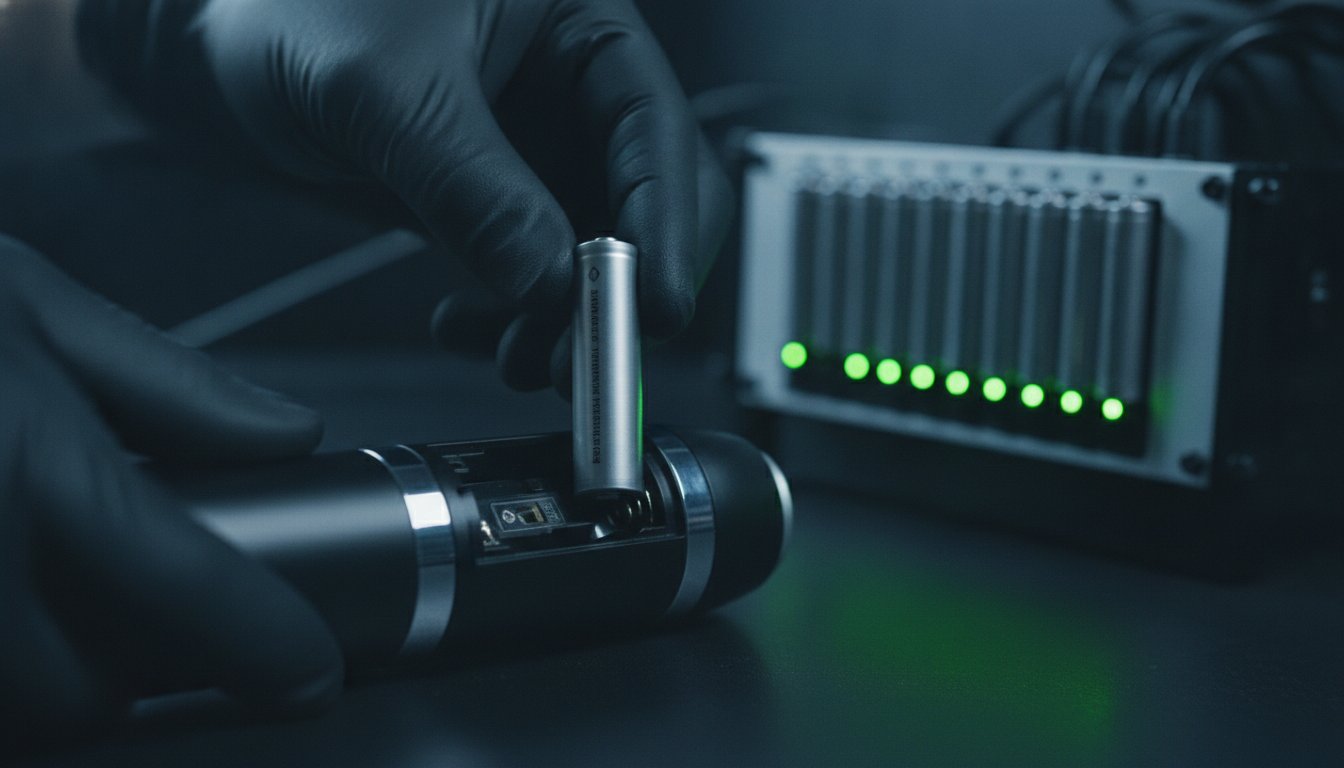
That 2800mAh rating on your retail battery pack is a lie if it can't maintain the voltage required to keep a wireless transmitter synced during a live performance. When you're managing a fleet of gear for a church or an AV house, the debate between professional vs consumer rechargeable batteries isn't just about price. It's about the difference between a successful event and a silent stage.
You've likely felt the frustration of a battery that fits too tightly in a handheld mic or a cell that shows a full charge only to drop out twenty minutes later. It's a common pain point that stems from subtle engineering gaps most users never see. This 2026 reliability guide explores the critical technical distinctions that separate off-the-shelf cells from professional-grade power solutions to ensure your mission-critical gear never fails.
Discover how to achieve zero-failure performance and secure a higher long-term ROI through superior cycle life and standardized charging. We'll examine everything from 1.5V constant output in the Pure Power Series to the logistics of custom rackmount solutions for large-scale operations.
Key Takeaways
- Learn why internal resistance determines a battery's professional utility and why consumer-grade ceilings cause unexpected failures in mission-critical environments.
- Understand the mechanics of voltage sag to prevent equipment from shutting down prematurely even when your cells still hold a charge.
- Evaluate the technical performance of professional vs consumer rechargeable batteries by comparing high-capacity Ansmann 2850 mAh cells against standard retail options.
- Identify the ideal power source for your specific gear, including when to prioritize 1.2V NiMH or the 1.5V constant output found in the Pure Power Series.
- Explore how to transition from individual chargers to enterprise-level infrastructure with custom rackmount charging solutions designed for large-scale equipment fleets.
The Professional Power Gap: Why 'Rechargeable' Isn't a Single Category
Many procurement managers assume that any NiMH cell will suffice as long as the size matches the slot. This assumption creates a "consumer grade" ceiling where shelf-bought cells frequently fail in demanding environments. When evaluating professional vs consumer rechargeable batteries, the distinction lies in the engineering priorities of the manufacturer. Consumer cells are designed for low-drain remotes and toys, while professional solutions are built for the rigors of the stage, the hospital, and the field.
The Illusion of High Capacity
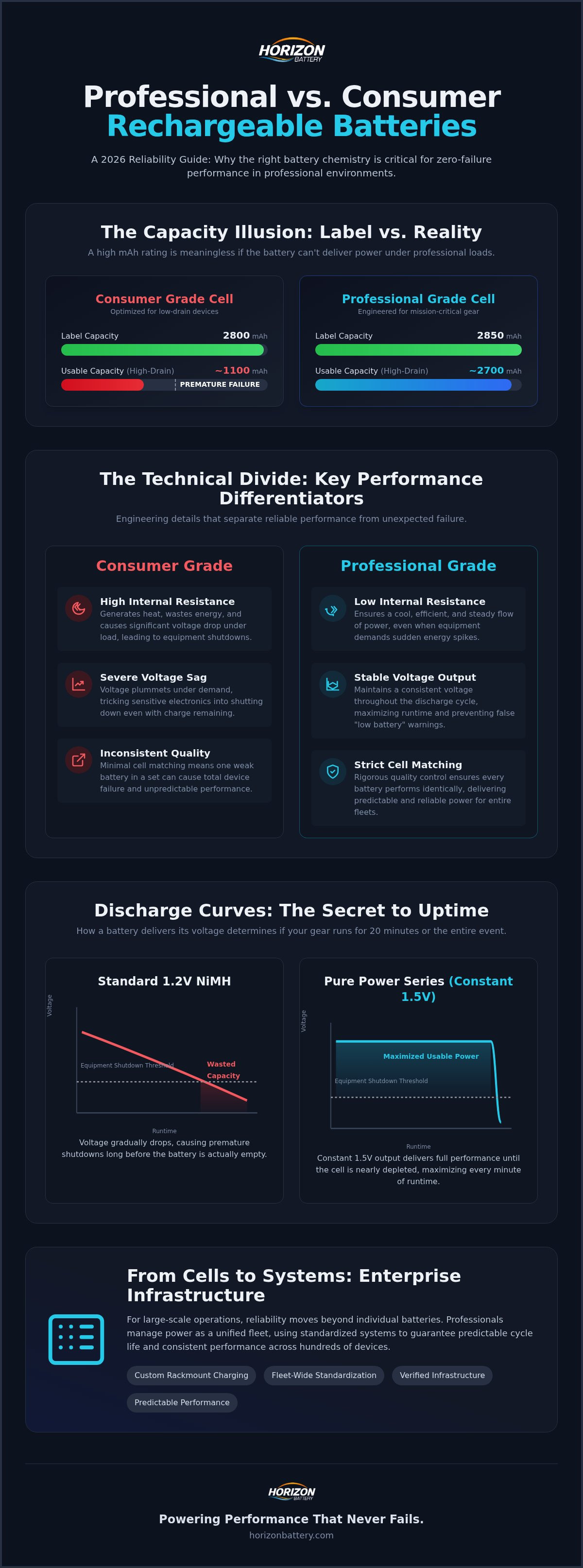
Capacity ratings, measured in milliamp hours (mAh), are often the only metric a consumer sees on a retail blister pack. However, these numbers are frequently misleading because they don't account for discharge rates. A retail battery might claim a high mAh rating, but that capacity often disappears under professional loads. This is the difference between "label capacity" and "usable capacity" in high-drain gear. If a battery cannot sustain its voltage under load, its total capacity is irrelevant because the equipment will shut down prematurely.
Internal resistance is the opposition to the flow of current within a battery, which directly impacts how much heat is generated during use. This technical factor is a primary differentiator in rechargeable battery technology. High internal resistance in consumer cells leads to voltage sag and heat buildup. Professional cells maintain a lower resistance to ensure a steady, cool flow of power even when the device's circuitry demands a sudden spike in energy.
Reliability as a Professional Requirement
The hidden cost of a battery failure is massive. If a cheap cell fails during a $10,000 live production or a critical broadcast, the upfront savings are lost instantly. Professional batteries undergo significantly stricter quality control and cell matching processes than their retail counterparts. This ensures that every battery in a pack has a nearly identical internal chemistry and discharge profile. It prevents the common issue where one weak cell drags down the performance of an entire device, leading to unexpected dropouts.
By 2026, the industry has moved toward managing power as a fleet rather than as individual cells. Organizations are standardizing on Ansmann high capacity batteries to achieve enterprise-level reliability. This shift allows for predictable cycle lives and consistent performance across large inventories of equipment. Instead of hoping a random battery works, professionals use verified infrastructure to guarantee their gear stays powered through every mission-critical moment.
Technical Performance: Voltage Stability and High-Drain Resilience
Performance in the field depends on more than just total energy storage. It relies on how that energy is delivered under stress. When comparing professional vs consumer rechargeable batteries, the most immediate difference is how they handle voltage sag. Many high-drain devices, such as wireless transmitters and medical monitors, have strict voltage cutoffs. If a battery's voltage drops below a certain threshold, the device shuts down, even if the cell is still half-full. Consumer cells often experience rapid voltage drops under load, leading to those dreaded "low battery" warnings only minutes after a fresh swap.
Voltage Curves and Gear Performance
The discharge profile of a battery determines its reliability. Traditional NiMH cells have a nominal voltage of 1.2V, which gradually slopes downward as the battery drains. In contrast, the Pure Power Series utilizes lithium-ion technology to provide a constant 1.5V output until the cell is nearly empty. This steady delivery prevents the premature shutdown issues common in sensitive AV equipment. Understanding these nuances is key to avoiding rechargeable battery performance myths that suggest all cells behave the same way under load.
Temperature also plays a critical role in professional environments. High-drain applications generate heat, which can cause consumer cell chemistry to destabilize. Professional-grade cells are engineered with superior thermal management. They maintain their internal chemistry at higher temperatures, ensuring that a camera flash or a wireless mic remains stable during back-to-back use in hot venues or under stage lights.
The Slimline Advantage
Physical engineering is an often-overlooked factor that makes a massive difference in the field. Retail battery manufacturers often use thick, multi-layer plastic wraps to accommodate bright branding and marketing text. This "over-wrapping" increases the battery's diameter. In precision-engineered equipment like Shure or Sennheiser wireless transmitters, these extra fractions of a millimeter cause batteries to get stuck in the gear slots. Removing a stuck battery often requires tools that can damage the transmitter's internal contacts.
Ansmann professional batteries prioritize "Slimline" dimensions. They adhere to strict physical tolerances, ensuring they slide in and out of tight gear slots with zero resistance. This attention to detail reflects a broader commitment to longevity. Professional cells are built to maintain at least 80% of their original capacity far longer than consumer alternatives, providing a reliable foundation for your equipment fleet. For those managing large-scale operations, exploring specialized battery bundles ensures your hardware remains both powered and protected.
Comparison Framework: Ansmann 2850 mAh vs. Standard Consumer Cells
While hobbyist forums frequently recommend low-self-discharge batteries for household remotes, those cells often struggle to survive an eight-hour shift in a 500mW wireless microphone system. The real-world performance of professional vs consumer rechargeable batteries is most evident when comparing sustained high-current discharge rates. Consumer cells are built for intermittent use. Professional cells, like the Ansmann 2850 mAh, are built for constant, heavy loads.
Standardizing on professional cells changes the Total Cost of Ownership (TCO) calculation. While a consumer 4-pack might seem cheaper initially, those cells often suffer significant capacity loss after just 50 high-drain cycles. Professional cells are rated for much higher cycle stability, often retaining their utility through 500 cycles or more. Beyond cycle life, using a retail charger on professional cells is a recipe for failure. Consumer chargers often rely on basic timers or heat sensors that can overcharge and bake high-capacity cells, while professional chargers utilize precise peak detection to terminate the charge at exactly the right moment.
Ansmann 2850 mAh: The Professional Standard
The Ansmann 2850 mAh NiMH cell is specifically engineered for the digital high-drain era of 2026. It handles high-current pulses from digital transmitters without the internal overheating that plagues prosumer retail brands. This stability ensures that your equipment receives clean power from the first minute of the show to the last. This cell is the benchmark for AV houses that require maximum capacity without sacrificing cell longevity.
The Pure Power Series Distinction
For applications where 1.2V NiMH isn't enough, the transition to the Pure Power Series Lithium-ion offers a decisive advantage. These cells include integrated safety circuitry to manage the high energy density of lithium chemistry. Beyond the 1.5V constant output, these cells provide significant weight reduction. This makes them ideal for handheld equipment and bodypacks where every ounce affects the comfort and mobility of the user during long events. Switching to professional lithium cells ensures your gear operates with the same voltage profile as a fresh alkaline battery but with the economic benefits of a rechargeable system.
Application-Specific Selection: Matching Power to Gear
Selecting the right power source is a granular process that depends entirely on the circuitry of your equipment. When deciding between professional vs consumer rechargeable batteries for your facility, the choice should be dictated by the specific power profile of your most critical gear. A handheld recorder has vastly different needs than a high-intensity camera flash or a wireless IEM system. Matching the cell chemistry to the application prevents the malfunctions that occur when gear is underpowered or physically incompatible.
The AV Production Power Profile
Churches and theaters often struggle with "The Battery Drawer," which is a disorganized collection of half-charged cells that risk a mid-service dropout. These environments prioritize standby reliability and ease of organization for large fleets. Standardizing on Ansmann Hybrid NiMH provides the consistency these venues require for weekly operations. Low Self Discharge (LSD) technology ensures that batteries retain the majority of their charge even when sitting idle for weeks between services, which is a critical benefit for standby gear.
For audio professionals, the noise floor is a significant consideration. Portable field recorders and high-end preamps require stable voltage to keep the signal clean. Consumer cells that fluctuate in output can introduce unwanted artifacts into the recording. Using professional-grade cells ensures a steady voltage floor, maintaining the sonic integrity of the production from start to finish. If your setup involves multiple bodypacks, you can buy battery storage solutions to keep your inventory organized and ready for the next event.
Industrial and Emergency Use
In medical and industrial settings, reliability is a functional requirement rather than a preference. Professional cells offer predictable discharge curves that allow technicians to schedule maintenance cycles with confidence. These cells are also engineered to perform in outdoor productions where extreme temperatures can cause consumer cell chemistry to fail. Whether it's the heat of a summer festival or the cold of a winter broadcast, professional cells maintain their internal stability and discharge capacity.
Transitioning to these systems is also a primary strategy for reducing corporate battery waste. By moving away from thousands of single-use alkalines, organizations lower their environmental impact while securing a better return on their infrastructure investment. Standardizing your equipment on high-capacity professional cells ensures that every device in your fleet—from emergency flashlights to industrial sensors—is powered by a cell designed for the task at hand.
Horizon Battery: Professional Infrastructure for Enterprise Power
Managing a professional facility requires more than just a drawer full of loose batteries. It requires a systematic approach to power management that individual retail chargers cannot provide. When evaluating professional vs consumer rechargeable batteries, the infrastructure surrounding the cells is just as vital as the chemistry inside them. Horizon Battery provides the industrial-grade hardware needed to maintain large inventories of high-capacity AA and Pure Power Series cells, ensuring that your power supply is never the weak link in your production chain.
Rackmount Charging Systems
Centralizing power management is essential for large AV teams who cannot afford to hunt for outlets or manage a dozen messy desktop chargers. Custom Rackmount Chargers are engineered specifically for 19-inch equipment racks, allowing technicians to monitor cell health during every charge cycle. This setup significantly reduces technical booth clutter and eliminates the fire hazards often associated with daisy-chained consumer power strips. By integrating charging directly into the rack, facilities ensure their power supply is as organized and reliable as their signal path.
These systems move beyond the limitations of individual cell management by providing a visual confirmation of readiness for every bodypack and handheld mic in the fleet. Monitoring individual cell health during the charge cycle allows technicians to identify and retire aging batteries before they cause a failure on stage. This proactive approach to maintenance is what separates a professional operation from a prosumer setup that relies on guesswork and luck.
Horizon's Role as a Strategic Partner
As an authorized distributor of Ansmann's 2026 professional line, Horizon Battery acts as more than just a vendor. We function as a strategic partner for churches, theaters, and broadcast houses across North America. Our expertise allows us to provide custom kit building and Charger / Battery Bundles tailored to specific production requirements. Standardization is the key to longevity. By working with a veteran distributor that has operated since 1998, organizations gain access to technical support and inventory management strategies that ensure their mission-critical gear is always ready for use.
Expert consultation for facility-wide battery standardization is the final step in securing a zero-failure environment. Our team evaluates your specific equipment list to determine the optimal mix of NiMH and lithium-ion cells. This ensures you don't overspend on capacity you don't need or underspecify for high-drain digital transmitters. We help clients move away from the retail mentality that leads to technical waste, focusing instead on high-performance cells and the battery storage solutions necessary to protect those investments. Whether you are managing a small church or a national touring company, we provide the steady reliability your gear demands.
Securing Your Mission-Critical Power Strategy
Reliability in professional environments is built on technical precision rather than marketing claims. As we have explored, the choice between professional vs consumer rechargeable batteries impacts everything from the signal integrity of your audio to the physical safety of your equipment slots. By prioritizing cells with stable voltage curves and slimline dimensions, you eliminate the common failure points that plague consumer-grade setups.
Effective power management requires moving beyond individual chargers toward centralized infrastructure. Standardizing your facility with high-capacity AA cells and specialized rackmount charging solutions provides the predictability needed for complex productions. Horizon Battery has served as an authorized Ansmann distributor and a trusted partner for professional AV teams since 1998, providing the specialized expertise required for large-scale battery fleet management.
Don't let a retail battery compromise your next event. Upgrade your gear with professional Ansmann and Pure Power solutions at Horizon Battery. With the right power infrastructure in place, you can focus on the performance while we handle the energy.
Frequently Asked Questions
What is the main difference between professional and consumer rechargeable batteries?
The primary distinction lies in internal resistance and voltage stability under high-drain loads. Consumer cells are engineered for low-demand household electronics, while professional cells prioritize consistent energy delivery for mission-critical equipment. This engineering difference ensures that professional-grade power solutions don't suffer from the rapid voltage sag that causes retail batteries to fail prematurely during live events or critical broadcasts.
Can I use a standard consumer charger for Ansmann professional batteries?
Using a standard retail charger for high-capacity professional cells is not recommended. Consumer chargers often lack precise peak detection and instead rely on basic timers or thermal sensors. This can result in undercharged cells or, more dangerously, overheating that permanently damages the battery's chemistry. For optimal longevity and safety, always pair your cells with specialized chargers designed to handle high-capacity professional discharge profiles.
Why do professional batteries like the Pure Power Series maintain 1.5V?
The Pure Power Series maintains a constant 1.5V output to mimic the voltage profile of a single-use alkaline battery. Many digital wireless transmitters and medical devices are designed with strict voltage cutoffs. While traditional NiMH cells operate at 1.2V, they can trigger "low battery" warnings prematurely as the voltage slopes downward. Constant 1.5V lithium-ion technology ensures the device operates at peak performance until the cell is nearly empty.
Is it worth the extra cost to buy professional batteries for my church's wireless mics?
Investing in professional vs consumer rechargeable batteries is highly beneficial for churches managing wireless microphone fleets. While the upfront cost is higher, professional cells provide a significantly better return through increased cycle life and reduced failure rates. A single audio dropout during a service can be more costly in terms of production quality than the price of a professional battery bundle that lasts for years.
What does 'Slimline' mean in the context of AA batteries?
Slimline refers to batteries manufactured with precise physical tolerances to ensure they fit within tight equipment slots. Retail batteries often feature thick, multi-layer plastic wraps for marketing purposes, which increases their diameter. Professional Slimline cells, such as those from Ansmann, avoid over-wrapping. This ensures they slide easily into Shure or Sennheiser transmitters without getting stuck or damaging the internal battery contacts of the device.
How do I calculate the ROI of switching from consumer to professional batteries?
To calculate ROI, compare the total number of successful high-drain cycles before capacity drops below 80%. Consumer cells often degrade after 50 to 100 high-drain uses in professional gear, requiring frequent replacement. Professional cells typically maintain their utility through 500 cycles or more. Multiply the cost of a single-use alkaline or a short-lived consumer cell by the number of events to see the long-term savings of a professional system.
Which is better for pro audio: NiMH or Lithium-ion rechargeables?
The choice depends on your specific equipment requirements. NiMH cells like the Ansmann 2850 are excellent for high-capacity needs and thermal stability in most wireless systems. However, lithium-ion is superior for gear that requires a constant 1.5V output to avoid premature shutdowns. Lithium-ion cells also offer weight reduction, which is a practical advantage for performers wearing bodypacks during long rehearsals or live performances.
Do professional rechargeable batteries have a longer shelf life than consumer ones?
Professional rechargeable batteries featuring Low Self Discharge (LSD) technology have a much longer shelf life than standard rechargeables. These hybrid cells are designed to retain approximately 80% of their charge after a year of storage. This makes them ideal for emergency equipment or standby gear in theaters where batteries might sit idle between weekly uses. Consumer cells without this technology often drain completely within weeks of being charged.