
What if the most vulnerable point in your entire signal chain isn't the digital console or the wireless receiver, but the rechargeable cell powering the lead microphone? For production teams and venue managers, a single battery failure during a live event is a risk that simply cannot be ignored. You likely already understand the frustration of disorganized charging stations overflowing with cables and the hidden costs of heat damage that prematurely kills expensive high-capacity cells. Relying on consumer-grade hardware for a professional workload often leads to unpredictable performance when the pressure is highest.
Selecting a dedicated NiMH battery charger for professionals is a strategic infrastructure investment rather than a peripheral purchase. This 2026 guide explains how to implement professional-grade charging systems that protect your battery investment and ensure total reliability for critical gear. You'll discover how to transition to clean, rack-integrated solutions that utilize smart conditioning to extend cell life. We'll also preview the Pure Power Series and the latest microprocessor-controlled systems that provide predictable power for every event, ensuring your team stays focused on the production instead of the power levels.
Key Takeaways
- Learn why industrial-grade microprocessor systems are essential for maintaining mission-critical reliability in high-volume professional environments.
- Understand the technical advantages of a NiMH battery charger for professionals, including pulse charging and precise maintenance currents that prevent heat damage.
- Evaluate the benefits of custom rackmount chargers versus desktop solutions to create an organized, cable-free charging infrastructure.
- Discover how to implement a standardized battery rotation system to ensure every cell in your fleet is ready for immediate deployment.
- Gain insights into protecting high-capacity investments through advanced conditioning cycles that significantly extend the lifespan of your AA cells.
What Defines a NiMH Battery Charger for Professionals?
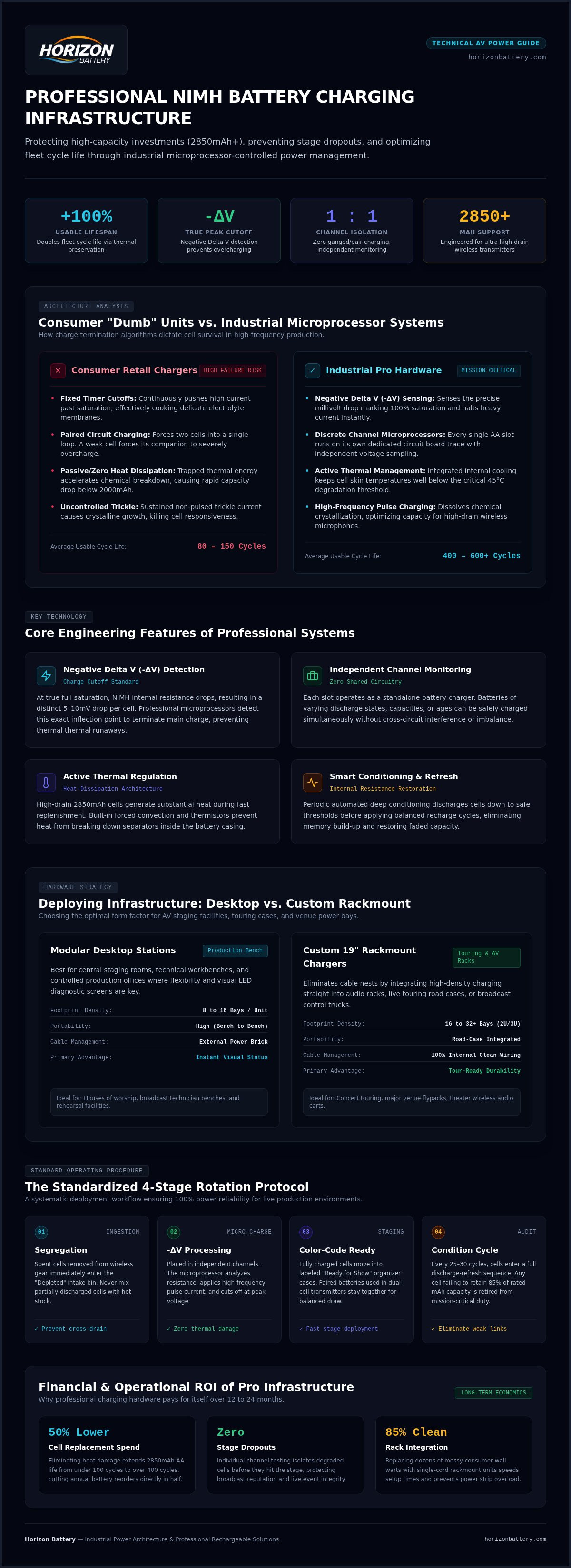
In a commercial production environment, power is a mission-critical utility rather than a simple convenience. A professional-grade charging system is defined by its use of sophisticated microprocessor-controlled circuits designed for high-volume, repetitive use. While consumer models might handle a few dozen cycles a year, a NiMH battery charger for professionals is built to manage hundreds of cells in demanding, fast-paced settings. These industrial systems prioritize individual circuit monitoring, ensuring that every cell in a fleet of high-capacity AA rechargeable batteries receives the exact current it requires without the risk of overcharging.
The primary distinction between standard retail units and industrial hardware lies in how they handle energy delivery and heat. High-end systems function as intelligent smart chargers, utilizing complex algorithms to monitor the internal resistance and state of charge for every individual battery. This level of precision is vital for maintaining the longevity of high-capacity cells (2850mAh+), which are particularly sensitive to the thermal stress caused by "dumb" or low-quality charging circuits.
The Cost of Failure in Professional Environments
Battery failure during a live broadcast or a house of worship service carries a heavy price tag in terms of reputation and production quality. Most entry-level chargers use basic timers to cut off power, which is the leading cause of premature cell death. These "dumb" chargers often continue to push current into a battery that's already full, effectively "cooking" the internal chemistry. Many organizations are switching to rechargeable batteries for business to cut costs, but the success of that transition depends entirely on the charging infrastructure. Professional hardware eliminates this risk by identifying the precise moment a cell reaches peak capacity. By preventing thermal damage, these systems can double the usable cycle life of your batteries, allowing the hardware to pay for itself through reduced cell replacement costs.
Core Features of Professional-Grade Hardware
To achieve 100% reliability, professional systems utilize specific technical protocols that go beyond basic voltage monitoring. Industrial-grade hardware provides dedicated channels for every cell, housed in ruggedized chassis or custom rackmount chargers that are built to withstand the physical demands of touring. Key features include:
- Negative Delta V (-ΔV) Detection: The gold standard for charge termination, as it senses the slight voltage drop that occurs exactly when a NiMH cell reaches its maximum capacity.
- Individual Channel Monitoring: Professional gear avoids the "pair-charging" limitation where two batteries share a single circuit. Dedicated monitoring prevents one weak cell from causing the charger to undercharge its partner.
- Active Thermal Management: Integrated sensors and ventilation prevent heat buildup during rapid charging cycles, protecting the delicate chemistry of high-capacity cells.
- Industrial Build Quality: These units feature durable components designed for the rigors of mobile production and permanent AV installations.
Smart Charging Technology: Protecting Your High-Capacity Investment
High-capacity NiMH cells, specifically those rated at 2850mAh or higher, are the workhorses of modern high-drain professional gear. These cells feature a dense chemical structure that demands extremely precise charge curves to reach full capacity without sustaining damage. A specialized NiMH battery charger for professionals employs high-frequency pulse charging to break down the lead-sulfate crystals that can form on internal plates, ensuring a more thorough charge. Unlike consumer models that use constant current, professional hardware monitors NiMH charging algorithms and cutoff mechanisms to switch to a safe maintenance trickle current the moment peak capacity is reached.
Many production houses are now utilizing a hybrid approach by integrating the Pure Power Series into their energy infrastructure. This strategy allows teams to leverage the high-drain reliability of lithium-ion alongside the cost-effective volume of NiMH. Managing these diverse chemistries requires a disciplined charging strategy that prioritizes cell health through intelligent analysis and consistent monitoring.
Thermal Management and Cell Longevity
Heat is the primary enemy of battery longevity. During rapid charging, elevated temperatures can degrade the internal separator of NiMH cells, leading to increased internal resistance and eventual failure. While smaller units rely on passive cooling through vents, a high-density NiMH battery charger for professionals often features active cooling fans to maintain a stable operating temperature. Modern 2026 microprocessor chargers utilize real-time temperature sensors to prevent thermal runaway by automatically reducing current if a cell exceeds safe operating limits.
Conditioning and Analyzing Modes
New cells, such as Ansmann high capacity batteries, often require a "break-in" period to reach their stated mAh rating. Analyzing modes allow technicians to run a full discharge and charge cycle, providing a digital readout of the actual capacity. This data is invaluable for matching battery sets; pairing two cells with identical mAh readouts ensures that wireless microphone pairs drain at the same rate, preventing unexpected dropouts. This process also identifies cells with high internal resistance, allowing you to retire them before they fail during a live event. Establishing a rotation based on these metrics ensures your gear remains reliable, and you can start standardizing your fleet with high-performance Ansmann high capacity batteries to maximize your equipment's uptime.
Comparing High-Volume Solutions: Desktop vs. Rackmount
Managing a high-volume fleet of rechargeable cells requires more than just high-quality hardware; it requires a strategy for physical organization and power distribution. While many retail guides focus on 4-cell or 8-cell units, a true NiMH battery charger for professionals must handle the throughput of a full production house or touring company. Selecting between desktop and rackmount hardware depends on your specific workflow, the total number of cells in rotation, and whether your equipment stays in a fixed location or travels between venues. For facilities managing fifty or more batteries, enterprise battery charging solutions provide the necessary scale to ensure every cell is accounted for and properly conditioned.
These professional systems utilize sophisticated NiMH charge algorithms and cutoff methods to manage high-density charging without the heat buildup often found in clustered desktop units. By moving beyond simple consumer chargers, organizations can maintain a NiMH battery charger for professionals that provides consistent, data-driven results for every cell in the fleet.
The Advantages of Rack-Integrated Charging
Custom rackmount chargers represent the ultimate infrastructure for permanent AV installations and touring racks. One of the most immediate benefits is the elimination of "wall wart" power supply clutter. A single rack unit can replace a dozen individual power cables, significantly reducing the risk of a tripped breaker or a loose connection. Beyond organization, rack integration improves asset security. It's much harder for a rackmount unit to be misplaced or removed from a job site compared to a small desktop charger. Front-panel accessibility allows technicians to swap batteries quickly during a show, while rear-rack cable management keeps the workspace clean and professional.
Multi-Channel Desktop Analyzers
Desktop chargers remain essential when portability is the priority. They're the best choice for small teams or individual workstations where a full rack isn't feasible. While these units are more compact, they shouldn't compromise on cell health. High-quality desktop analyzers serve as excellent secondary testing stations. If a cell's performance becomes questionable on the main rack, a desktop unit with a detailed LCD readout can provide the granular data needed to decide if that battery should stay in service. They offer a balance between charge speed and precision, making them a versatile tool for any professional battery management kit.
Building a Professional Battery Management Infrastructure
Building a professional battery management infrastructure transforms energy from a recurring headache into a streamlined utility. The process begins with standardizing your cell fleet. When switching to rechargeable batteries for business, consistency is vital. Mixing different brands or capacities within the same device leads to uneven discharge rates and premature failure. By using a uniform fleet of high-capacity cells, you ensure that every device in your inventory has a predictable and reliable runtime.
Once you have standardized your cells, implement a strict "Charged vs. Dead" rotation system. This physical workflow prevents the common mistake of grabbing a half-depleted battery for a critical event. A high-quality NiMH battery charger for professionals should be the centerpiece of this station. Establish a quarterly conditioning schedule where every cell is run through a full discharge and analyze cycle. This practice identifies degrading cells before they fail on site. Centralizing your power needs with custom rackmount hardware keeps the charging station organized and accessible. Finally, train your staff on proper cell handling. Simple habits, such as keeping terminals clean and avoiding extreme temperatures, significantly extend the life of your investment.
Organizing Large-Scale Battery Assets
Physical organization is the foundation of reliability. Many facilities use color-coded Battery Storage cases to track charge status at a glance. For example, green cases signify ready-to-use cells, while red cases indicate batteries needing a charge. It's also essential to label battery sets to keep them in "married" pairs. This ensures that the two cells used in a wireless transmitter always age at the same rate. Creating a clear "In/Out" station for technicians reduces confusion during high-pressure show environments and ensures that used batteries are immediately returned to a NiMH battery charger for professionals for processing.
Safety and Compliance in Commercial Facilities
High-density charging stations require specific safety considerations. Fire safety is a priority in commercial environments where dozens of cells might be charging simultaneously. Ensure your charging area has proper ventilation to dissipate the heat generated during rapid cycles. Many institutional buildings, such as schools and government offices, have strict compliance standards for electrical equipment. Professional rackmount systems often meet these rigorous safety requirements better than loose desktop chargers. If you're ready to upgrade your facility, browse our selection of Custom Rackmount Chargers to secure your power infrastructure.
Horizon Battery: Specialized Solutions for Professional Power
Horizon Battery has been a primary source for production houses and AV professionals since 1998. We understand that in the high-stakes world of live events, power isn't just a detail; it's the foundation of every signal. Our role as a veteran distributor allows us to act as a knowledgeable guide for clients who need to scale their energy infrastructure without the risk of equipment failure. By choosing a NiMH battery charger for professionals from our specialized inventory, you're investing in hardware that has been vetted for industrial-grade performance. We offer more than just products. Our team provides expert consultation to match charging hardware to your specific industry needs, ensuring your fleet performs at its peak.
Whether you're managing a touring rig or a permanent house of worship installation, we help you navigate the technical requirements of high-capacity energy management. Our focus remains on providing steady, reliable solutions that eliminate the variables of power failure. This commitment to reliability is why high-profile clients have trusted our expertise for over two decades.
Custom-Engineered Charging Systems
Our Custom Rackmount Chargers are designed specifically for the standard 19-inch AV rack environment. Unlike generic desktop units, these systems feature precision-tuned electronics that support high-capacity AA rechargeable batteries with the exact charge curves they require. This level of engineering prevents the common issues of overcharging and thermal stress mentioned earlier in this guide. Because we prioritize reliability, our hardware is backed by US-based support and technical expertise. You aren't just buying a charger; you're gaining a partner that understands the rigorous demands of professional production. These systems provide the order and clarity needed to manage large cell counts in high-pressure environments.
Standardizing with Horizon Bundles
Reducing procurement complexity is essential for busy production managers. We provide pre-configured Charger / Battery Bundles that are ready for immediate deployment in any professional facility. These kits ensure total compatibility between our high-drain Pure Power Series and the charging hardware, eliminating the guesswork that often leads to poor battery performance. Standardizing your fleet with these bundles allows for a more predictable workflow and simplified inventory management. If you're looking to eliminate the chaos of disorganized charging stations, shop our professional bundles to upgrade your facility today and experience the security of a truly professional NiMH battery charger for professionals.
Securing Your Power Infrastructure for 2026 and Beyond
Transitioning to a professional energy management system is about more than just buying new hardware; it's about building a reliable foundation for your production environment. By moving away from consumer-grade chargers and implementing a dedicated NiMH battery charger for professionals, you protect your high-capacity cells from thermal damage and ensure mission-critical reliability. Whether you choose custom rackmount integration for permanent installations or high-volume desktop analyzers for mobile teams, the result is a clean, organized workflow that eliminates the chaos of tangled cables and unpredictable power levels.
Horizon Battery has served the professional AV and production industries since 1998, providing custom-engineered rackmount solutions and high-capacity cells trusted by major US media houses. We're ready to help you standardize your fleet and secure your equipment's performance. Upgrade your production rack with Horizon Custom Chargers to take the first step toward a more efficient, dependable power strategy. Your gear deserves a power source that's as professional as the work you produce.
Frequently Asked Questions
Can I charge high-capacity NiMH batteries in a standard consumer charger?
Yes, but it's not recommended for long-term reliability. Consumer chargers often lack the precise termination sensors required for 2850mAh+ cells. They may either undercharge the battery, leading to short runtimes, or overcharge it, which causes permanent heat damage. A professional system provides the individual circuit monitoring necessary to maintain these high-capacity investments properly without the risk of cooking the internal chemistry and shortening the battery's lifespan.
How long does a professional charger take to charge 16 AA batteries?
Most professional systems complete a full charge for 16 batteries in roughly 2 to 4 hours. Because industrial-grade hardware uses independent charging channels, the time remains the same whether you're charging a single battery or a full rack. This efficiency is critical for production houses that need to cycle through hundreds of cells daily. It ensures that your gear is always ready for the next scheduled rehearsal or live performance.
What is the difference between a smart charger and an analyzing charger?
A smart charger uses a microprocessor to detect when a battery is full and stops the current automatically. An analyzing charger includes these features but adds a discharge function and a digital display. It provides a specific mAh readout for every cell, which is essential for matching battery pairs. This data helps you identify high internal resistance and ensures you only deploy cells that meet your professional performance standards.
How many cycles can I expect from professional NiMH batteries with a smart charger?
High-quality NiMH cells typically provide between 500 and 1,000 cycles when maintained correctly. Using a NiMH battery charger for professionals is the most effective way to reach these numbers. These chargers prevent the thermal stress and overcharging that often cause consumer batteries to fail prematurely. Investing in smart charging infrastructure ensures your battery fleet remains a reliable asset for several years of consistent, high-volume commercial use.
Is it safe to leave professional NiMH chargers plugged in 24/7?
It's safe to leave batteries in a professional charger because these units utilize maintenance trickle-charging. Once the primary charge cycle finishes, the microprocessor switches to a low-current pulse that offsets natural self-discharge. This keeps your batteries at peak capacity without the risk of overheating. In contrast, leaving batteries in a cheap "dumb" charger can lead to chemical degradation and significantly shortened lifespans due to continuous, unmonitored heat exposure.
Do I need a special charger for the Pure Power Series batteries?
The Pure Power Series batteries are compatible with any high-quality microprocessor-controlled system. However, to get the best performance from these high-drain cells, we recommend using a NiMH battery charger for professionals. These chargers provide the precise voltage termination and thermal monitoring needed to maintain the high-capacity chemistry of the Pure Power line. This combination ensures maximum reliability for wireless microphones and other critical production equipment during high-pressure events.
Why do professional chargers cost so much more than retail options?
Professional chargers cost more because they feature independent charging circuits and ruggedized components designed for 24/7 operation. Retail chargers often use a single circuit for multiple batteries, which leads to uneven charging and heat buildup. Industrial systems include advanced cooling, Negative Delta V detection, and individual channel monitoring. These features prevent battery failure during live events and extend the life of your cell fleet, providing a much higher long-term return on investment.
How often should I use the "Refresh" or "Condition" mode on my charger?
We recommend using the "Refresh" or "Condition" mode every ten to fifteen cycles or at least once per quarter. This process fully discharges the cell before recharging it, which helps maintain the internal chemistry and prevents voltage depression. Regular conditioning also ensures that the capacity readouts on your analyzing charger remain accurate. This allows you to match pairs effectively and retire cells that no longer meet your specific runtime requirements.