

Most professionals treat battery storage as a passive activity, yet this "set and forget" mentality is the primary cause of premature cell failure in high-stakes environments. It's a common frustration to reach for a supposedly fresh battery during a critical production only to find it's lost its charge or has begun to leak. Learning how to properly store rechargeable batteries is the difference between maintaining a reliable power inventory and managing a bin full of expensive, dead weight. You likely understand that heat and moisture are enemies of electronics, but the nuances of chemical self-discharge and voltage maintenance are often overlooked by even seasoned technicians.
This guide provides the professional framework you need to master the science of battery storage. We'll show you how to extend the lifespan of your NiMH and Lithium cells while ensuring peak performance for demanding applications. You'll learn the specific state-of-charge requirements, such as the 30% limit mandatory for certain lithium-ion transport under 2026 regulations, and how to implement an organization system that eliminates "dead cell" surprises. We'll cover everything from temperature control to the benefits of specialized storage cases to ensure your inventory remains a dependable asset rather than a liability.
Key Takeaways
- Establish a controlled environment between 59°F and 77°F to minimize self-discharge and preserve the internal chemistry of your professional cells.
- Understand the critical differences between NiMH and Lithium-Ion storage requirements to avoid permanent capacity loss and ensure long-term stability.
- Master how to properly store rechargeable batteries by implementing a First-In, First-Out (FIFO) rotation system to ensure your inventory remains fresh and reliable.
- Adjust state-of-charge levels based on your specific storage timeline to balance immediate operational readiness with chemical health.
- Integrate professional storage cases and rackmount charging solutions to streamline your workflow and maximize the lifecycle ROI of your power assets.
The Fundamentals of Battery Storage Environment
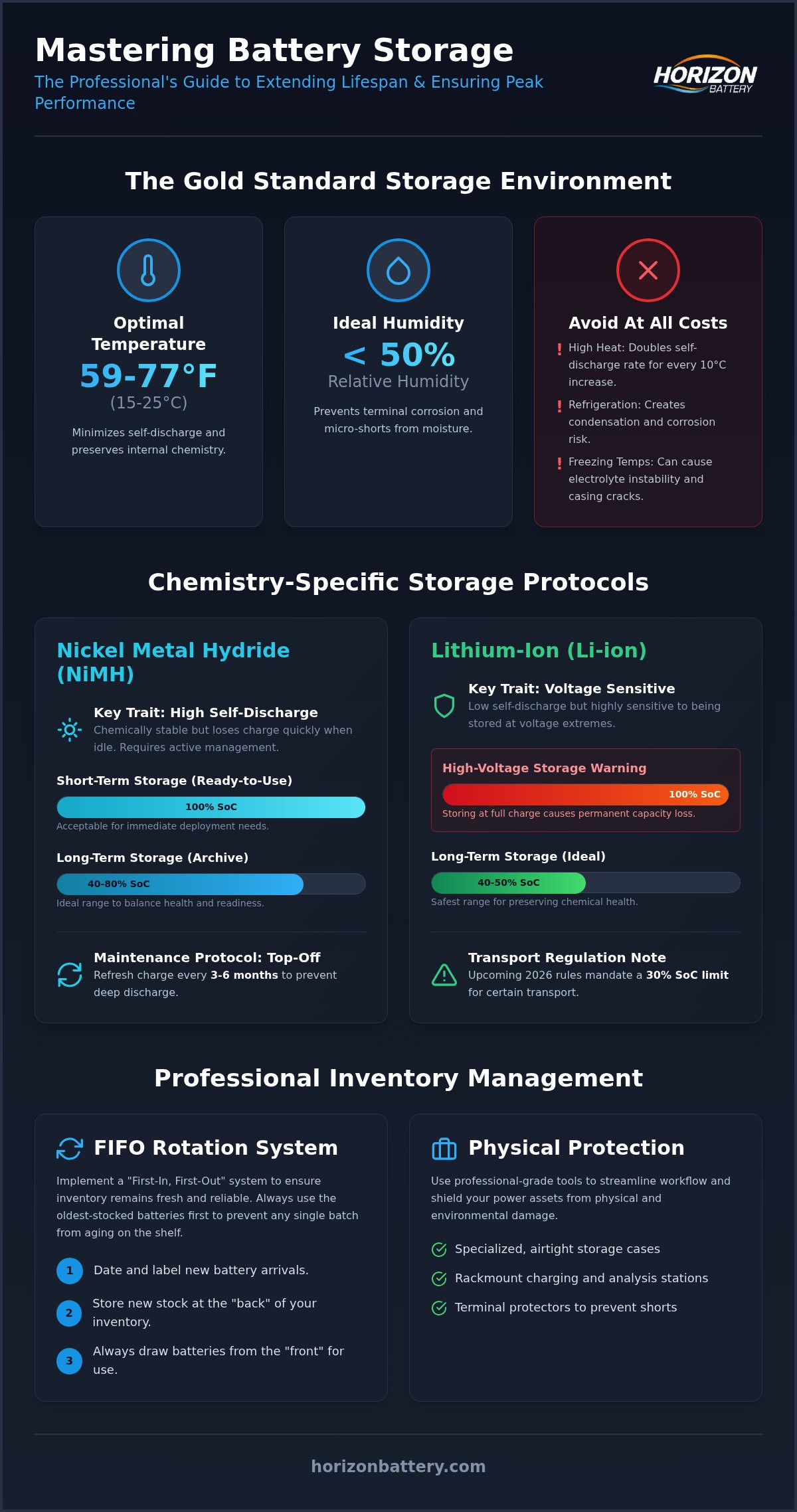
Proper battery storage involves the precise control of temperature, humidity, and physical orientation to minimize self-discharge and chemical degradation. While casual users might toss cells into a drawer, professionals recognize that learning how to properly store rechargeable batteries is an active maintenance task. The common advice to store at "room temperature" is often too vague for high-stakes environments. For maximum reliability, the professional gold standard is a controlled range between 59°F and 77°F (15°C to 25°C).
The debate over refrigerator storage continues, but industry experts typically advise against it. The risk of condensation upon removal is too high. When a cold cell meets warmer air, moisture forms on the terminals, creating a path for micro-shorts or accelerated corrosion. It's better to maintain a stable, dry environment than to chase the marginal gains of extreme cold. Since 1998, we've seen that consistent environmental management is the most effective way to protect high-capacity NiMH investments.
Temperature and Chemical Kinetics
High temperatures are the most significant threat to battery longevity because heat acts as a catalyst for internal chemical reactions. For every 10°C increase above the standard room temperature, the self-discharge rate of the cell approximately doubles. This rapid loss of energy can lead to deep discharge states that permanently damage the cell's capacity. Conversely, freezing temperatures are equally hazardous. Extreme cold can cause electrolyte instability or even physical casing cracks, rendering the battery unsafe for use. Understanding the Fundamentals of Battery Storage is essential for anyone managing large inventories of professional-grade cells like the Pure Power Series.
Humidity and Terminal Protection
Moisture is a silent killer of rechargeable cells. Professionals aim to maintain relative humidity below 50% to prevent oxidation on the contact points. When humidity levels are high, terminals can suffer from "creep," where corrosive materials migrate across the surface, or micro-shorts that slowly drain the cell's capacity. In facilities without dedicated climate control, airtight containers or specialized battery storage cases become essential. These tools create a micro-environment that shields the batteries from ambient moisture and keeps them physically separated. High-capacity NiMH cells are particularly sensitive to these factors, and keeping them in a dry, organized system is the best way to ensure they are ready for immediate deployment in wireless systems or production gear.
Chemistry-Specific Storage Protocols: NiMH vs. Lithium-Ion
When managing a professional inventory, you cannot use a single approach for different chemistries. Understanding how to properly store rechargeable batteries requires recognizing that Nickel Metal Hydride (NiMH) and Lithium-Ion (Li-ion) have contrasting needs regarding voltage levels and environmental sensitivity. While NiMH is valued for its stability in high-drain wireless applications, Li-ion offers superior energy density but requires stricter voltage monitoring during downtime. Mixing these protocols often leads to degraded performance or premature cell failure.
NiMH cells are the workhorses of the professional AV industry. They are chemically stable but suffer from high self-discharge rates. This means they lose energy even when sitting idle on a shelf. If you ignore them for too long, they can fall into a deep discharge state that is difficult to recover from. Proper management ensures these cells stay within their functional voltage range.
Storing High-Capacity NiMH (AA/AAA)
High-capacity cells, like the Pure Power Series, require active management to maintain their lifecycle ROI. For short-term needs, keeping them at 100% charge is acceptable for immediate deployment. However, for long-term storage, a state of charge between 40% and 80% is ideal. Because these cells naturally deplete, you should implement a "Top-Off" protocol. Refreshing your NiMH inventory every three to six months prevents the voltage from dropping too low. Using dedicated battery storage cases helps keep these cells organized and ready for the next event.
Storing Lithium-Ion (Li-ion) Cells
Lithium-Ion batteries operate differently. While they have a much lower self-discharge rate than NiMH, they are highly sensitive to voltage extremes. Storing a Li-ion cell at 100% charge for long periods causes internal stress and capacity fade. Conversely, storing them at 0% is dangerous. If the voltage drops below a critical threshold, the battery's protection circuit may trip, making it impossible to recharge. The industry standard for Lithium storage is a "Storage Voltage" of 3.7V to 3.8V per cell, which is roughly 40% to 50% state of charge.
Safety is paramount when handling large-scale inventories. Accidental shorts occur when terminals touch metallic objects or other batteries. Implementing professional battery storage systems ensures physical separation and prevents thermal runaway events. Always store cells in a way that keeps terminals isolated. This practice is especially critical for high-density lithium packs where a single short can lead to a significant fire hazard. Proper organization isn't just about efficiency; it's a fundamental safety requirement for any professional facility.
Professional Battery Storage Systems and Organization
Moving beyond disorganized bins is essential for operational readiness in any professional environment. Knowing how to properly store rechargeable batteries involves more than just climate control; it requires a structured system that supports rapid deployment and inventory longevity. Centralized storage areas reduce the time technicians spend hunting for power sources and minimize the risk of mixing fresh cells with depleted ones. When batteries are left in a "junk drawer" state, they're susceptible to physical damage and terminal shorts that can lead to premature failure or safety hazards.
A reliable system relies on the "First-In, First-Out" (FIFO) method to ensure your inventory rotates regularly. This prevents specific cells from sitting at the back of a shelf for months, which is particularly vital for NiMH batteries that suffer from higher self-discharge rates. Visual management tools, such as color-coded cases, provide an instant status check for your team. For example, using green cases for fully charged units and red for those requiring service eliminates guesswork during high-pressure live events.
Inventory Management for Facilities
Battery inventory management is the systematic tracking of cell health and availability. Large facilities, such as schools or theaters, should track the purchase dates and cycle counts of their Pure Power Series batteries to predict end-of-life failure before it occurs during a performance. Centralizing these assets in a single, climate-controlled location prevents "asset creep," where batteries are lost in various classrooms or production kits across a large campus. By maintaining a centralized log, managers can ensure that every cell is being utilized efficiently and retired at the correct time.
Storage Solutions for Mobile Production
For teams on the move, shock-resistant battery storage cases are mandatory. These specialized cases keep cells physically separated to prevent terminal contact, which remains a primary fire risk during transport. Professionals often scale their solutions by integrating custom rackmount chargers and storage drawers into their mobile racks. This approach combines charging and organization into a single, road-ready footprint. Even when dealing with compromised cells, following strict Chemistry-Specific Storage Protocols is vital to prevent accidents during transit. High-volume users find that custom rackmount chargers streamline their workflow by ensuring every cell is accounted for and maintained at the correct state of charge between locations.
State of Charge (SoC) for Short vs. Long-Term Storage
Professional power management requires a strategic approach to State of Charge (SoC) based on your operational timeline. If you're preparing for a production next week, your priorities differ significantly from a facility manager mothballing equipment for the summer. Understanding how to properly store rechargeable batteries involves balancing immediate readiness with long-term chemical health. Leaving a battery at the wrong charge level is one of the fastest ways to induce permanent capacity loss, regardless of how well you control the room temperature.
One common issue professionals face is "Voltage Sag." This phenomenon occurs when a battery appears dead or underpowered immediately after being removed from storage, even if it was put away fully charged. This is often due to increased internal resistance or natural self-discharge. To mitigate this, always implement a recovery protocol. This involves cycling the batteries through one or two full charge and discharge rounds before putting them into a high-stakes environment like a live broadcast or theatrical performance.
The Short-Term Readiness Protocol
For storage periods under 30 days, the priority is immediate deployment. High-capacity NiMH cells, such as those in the Pure Power Series, should be stored at 100% charge to ensure they are ready for wireless microphones and transmitters at a moment's notice. While some consumer chargers use aggressive trickle charging, professional systems use maintenance modes that monitor voltage without overstressing the chemistry. It is also vital to remove batteries from the device during storage. Even when turned off, many professional tools have a small parasitic draw that can drain a battery to dangerous levels within weeks.
The Long-Term Stability Protocol
When storage exceeds 90 days, you must prioritize chemical stability over readiness. For Lithium-Ion cells, storing them at 100% charge is a mistake. At full capacity, the internal components are under high voltage stress, which accelerates electrolyte oxidation and leads to permanent capacity fade. Instead, discharge Lithium cells to their nominal voltage, typically around 40% to 50% SoC. This "storage voltage" provides the best balance between preventing deep discharge and minimizing chemical wear.
Scheduled maintenance is the backbone of professional inventory management. We recommend a six-month check-up for all stored assets to verify voltage levels and prevent cells from falling below their critical thresholds. If you find your current charging setup doesn't support these specific storage modes, you should browse our custom rackmount chargers to find a system designed for professional maintenance and long-term cell health. Proper SoC management ensures that when you finally pull a battery from the shelf, it delivers the full runtime you expect.
Maximizing ROI with Horizon Battery Solutions
Achieving a high return on investment for your power inventory requires more than just following technical protocols. It demands high-performance hardware designed for the rigors of professional use. While understanding how to properly store rechargeable batteries is the first step, implementing that knowledge effectively is only possible with reliable tools. Horizon Battery provides the infrastructure needed to turn storage theory into operational reality. From high-capacity cells to centralized charging stations, we focus on solutions that prioritize longevity and performance. ROI in this industry is measured by the number of successful events per cell, and our systems are built to maximize that number.
Standardizing your equipment is a hallmark of a professional operation. Disorganized battery management leads to "dead cell" surprises and wasted budget on premature replacements. By utilizing professional battery bundles, you ensure that every component in your power chain is compatible. These kits provide a unified system that simplifies training for your staff. When every technician knows exactly which charger to use and which storage case signifies a ready cell, the risk of human error drops significantly. This level of standardization is what separates a seasoned production house from a disorganized one.
Engineered for Performance: Pure Power NiMH
Our Pure Power Series represents the pinnacle of NiMH engineering. These high-capacity AA rechargeable batteries are specifically designed for professional wireless systems where failure isn't an option. Unlike standard consumer cells, these batteries are built to maintain their chemical integrity through hundreds of charge and storage cycles. Since 1998, production departments and schools have relied on our expertise because we understand the specific demands of high-drain environments. These cells offer the durability required to withstand frequent rotation without the rapid capacity loss common in lower-tier alternatives. They are the ideal choice for those who need consistent runtimes after months of storage.
Streamlining Your Workflow
Efficiency in a busy facility comes from organization. Our specialized battery storage cases eliminate terminal damage by keeping cells physically separated and protected from environmental factors. For high-volume users, integrating custom rackmount chargers into your workflow is the ultimate solution for centralized management. These systems allow you to monitor and maintain large batches of batteries in a single, secure footprint. This centralized approach makes it easier to master how to properly store rechargeable batteries while protecting your bottom line. It moves your facility from reactive troubleshooting to proactive, methodical power management.
Optimize your battery management with Horizon Battery’s professional storage systems. Our team acts as a knowledgeable guide to help you select the right charger and battery bundles for your specific application, ensuring your equipment is always ready for the next high-stakes event.
Securing Your Power Inventory for the Future
Mastering how to properly store rechargeable batteries is a direct investment in your facility's operational reliability. By maintaining stable temperatures between 59°F and 77°F and adhering to chemistry-specific state-of-charge protocols, you effectively prevent premature cell failure and chemical degradation. Implementing a systematic organization through FIFO rotation and professional storage cases ensures your team never faces a "dead cell" surprise during a high-stakes live event. These small adjustments in maintenance lead to significant gains in battery lifecycle ROI.
Since 1998, Horizon Battery has served professional industries with steady, industrial-grade power solutions. Our specialized Pure Power Series is engineered for the rigors of high-drain devices, while our custom rackmount charging solutions provide the centralized management required for large-scale AV and production environments. Adopting these professional standards reduces long-term replacement costs and guarantees that your equipment is ready for immediate deployment. Upgrade your facility with professional battery storage and high-capacity cells to ensure your power assets remain a dependable resource. Your commitment to proper maintenance today ensures peak performance for every project that follows.
Frequently Asked Questions
Can I store rechargeable batteries in the refrigerator to make them last longer?
No, you shouldn't store professional rechargeable batteries in the refrigerator because the risk of condensation far outweighs any marginal gains in chemical stability. When you remove a cold battery from the fridge, moisture forms on the terminals, which can lead to corrosion or micro-shorts. It's much safer to maintain a dry, climate-controlled environment within the standard professional range of 59°F to 77°F.
What is the best charge level for storing Lithium-Ion batteries long-term?
For long-term storage, Lithium-Ion batteries should be maintained at a state of charge between 40% and 50%. Storing these cells at 100% causes internal chemical stress that leads to permanent capacity loss, while storing them at 0% risks a deep discharge that can trip the battery's protection circuit. Keeping them at their nominal voltage, typically 3.7V to 3.8V per cell, ensures the best chemical stability.
How often should I charge my NiMH batteries if they are in storage?
You should refresh your NiMH batteries every three to six months when they are kept in long-term storage. Because NiMH chemistry has a higher self-discharge rate than Lithium, the voltage will naturally drop over time. A periodic "top-off" charge prevents the cells from falling into a deep discharge state, which is vital for maintaining the longevity of high-capacity cells like the Pure Power Series.
Is it dangerous to store rechargeable batteries together in a bag?
Storing loose batteries together in a bag is dangerous because it allows terminals to touch, which can cause short circuits. This physical contact can lead to rapid heating or fire in professional inventories. Utilizing dedicated battery storage cases is a key part of how to properly store rechargeable batteries, as it ensures each cell is physically isolated and prevents accidental discharge during transport or long-term downtime. This is why safety-conscious retailers like VapeShop.bh emphasize the use of protective cases for any high-drain lithium batteries.
Should I remove batteries from my devices if I’m not using them for a month?
Yes, you should always remove batteries from your equipment if you don't plan to use them for 30 days or more. Many professional devices have a small parasitic draw that continues to pull power even when the unit is powered off. This slow drain can lead to a deep discharge that damages the battery's chemistry or, in some cases, causes the cell to leak and damage the device's internal components.
How can I tell if a battery has gone bad while in storage?
What temperature is too hot for battery storage?
Temperatures exceeding 104°F (40°C) are considered too hot for safe storage and will lead to accelerated chemical degradation. High heat acts as a catalyst for internal reactions that increase the self-discharge rate and permanently reduce the total capacity of the cell. Mastering how to properly store rechargeable batteries requires finding a climate-controlled space that stays well below these extreme thresholds to preserve the internal chemistry of your cells.
Does storing batteries on a concrete floor drain them?
Storing modern batteries on a concrete floor does not drain them. This is a persistent myth from the era of lead-acid batteries with wooden casings that could leak. However, concrete floors are often cold and damp, which can lead to moisture buildup or terminal corrosion. It is always better to store your cells on a shelf or in a rackmount system to ensure proper ventilation and protection from ground-level humidity.