
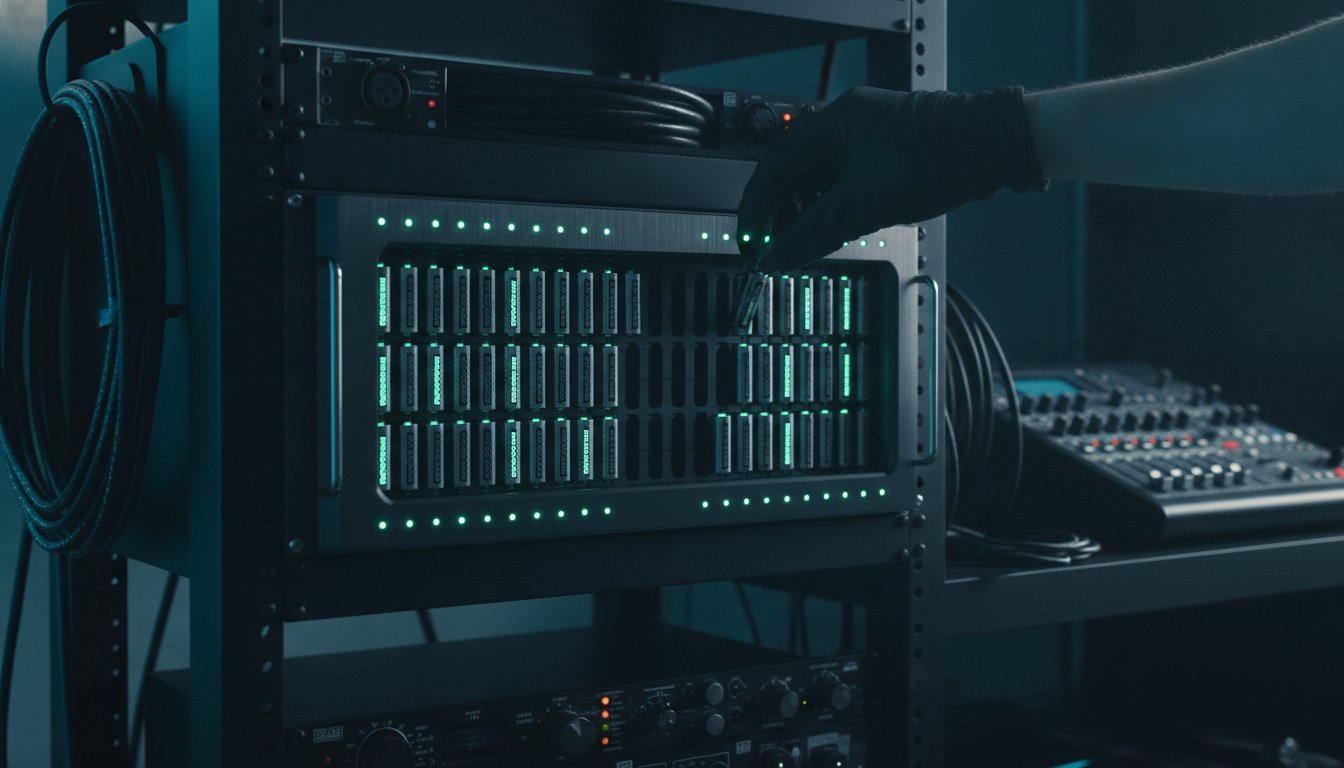
The most expensive component in your location sound kit isn't your mixer or your microphones. It is the silent failure of a low-quality battery during a once-in-a-lifetime take. If you have ever dealt with false low-battery alerts or the logistical headache of managing hundreds of loose AA cells on a busy set, you know that power management is a critical pillar of professional production. Choosing the right rechargeable batteries for field audio mixers involves more than just looking at a milliamp-hour rating. It requires a predictable, professional workflow that ensures your gear remains operational through every critical take.
Key Takeaways
- Identify the critical differences between battery chemistries to ensure consistent voltage and eliminate false low-battery warnings.
- Determine the specific capacity and internal resistance requirements necessary to power high-drain recorders through full production days.
- Implement a professional organization strategy using custom rackmount chargers to replace the logistical burden of loose cells.
- Select the most reliable rechargeable batteries for field audio mixers to maintain performance standards in demanding 2026 recording environments.
- Optimize long-term operating budgets by utilizing high-capacity battery bundles designed for professional facility management.
Reliable Power for Field Audio Mixers: Why It Matters in 2026
Modern field audio production has evolved into a high-stakes digital environment where power management is no longer a secondary concern. In 2026, the complexity of location sound kits has increased significantly. High-track-count recorders, integrated wireless receivers, and power-hungry preamps demand a level of electrical stability that traditional disposable cells cannot provide. For the professional recordist, using the right rechargeable batteries for field audio mixers is a strategic decision that directly affects the integrity of every recorded file.
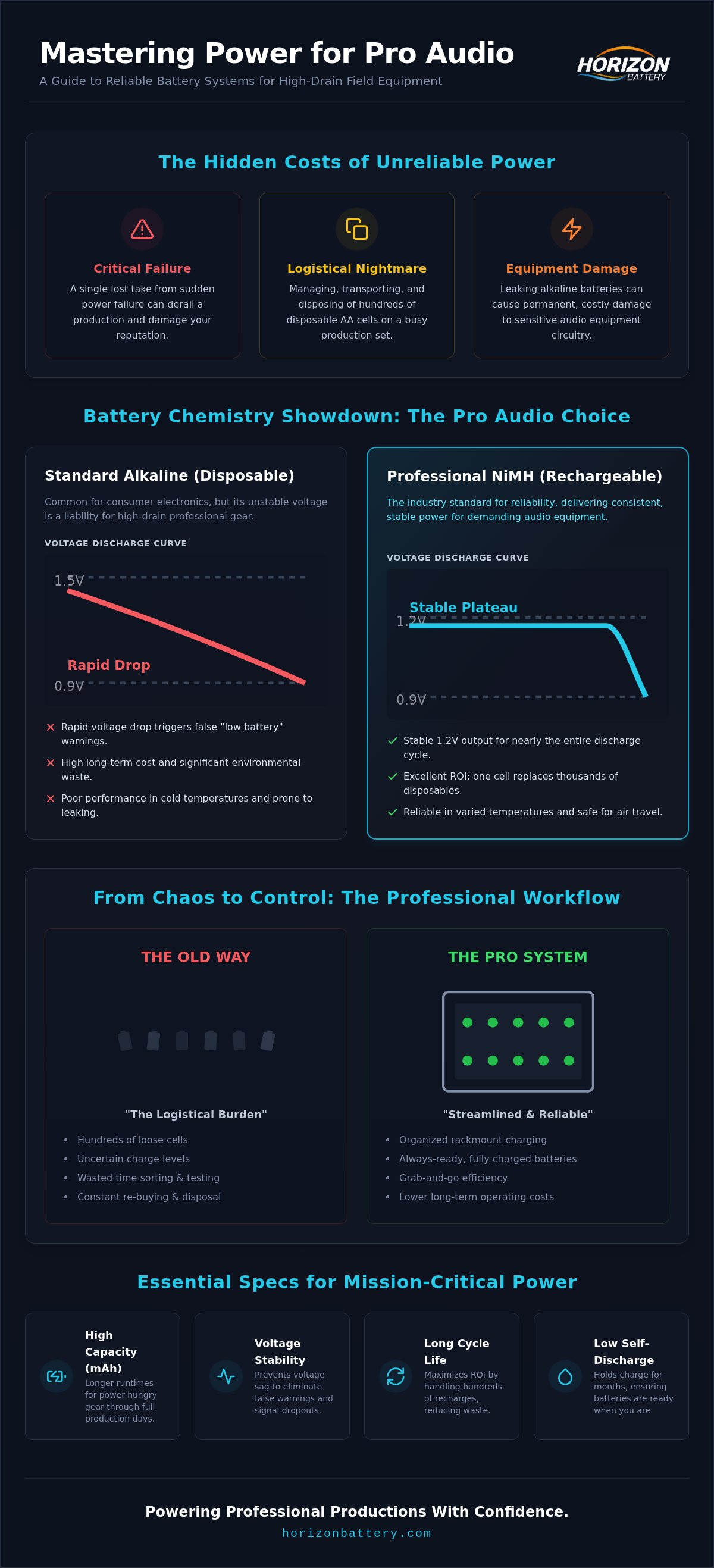
The financial implications of power failure are immediate and severe. A single lost take due to a sudden voltage drop can derail a production schedule and damage a recordist's reputation. Beyond the immediate risk of failure, the hidden costs of managing thousands of disposable batteries include increased logistics, disposal fees, and the constant threat of battery leakage damaging expensive circuitry. Professional reliability requires a predictable energy source that performs consistently under heavy loads.
The High-Drain Challenge for Modern Mixers
Current digital mixers and multi-track recorders operate more like high-performance computers than simple analog devices. They pull significant current to manage high-resolution processing and provide phantom power to multiple microphones simultaneously. When voltage drops in critical wireless audio transmitters, signal stability is compromised, leading to dropouts or increased noise floor issues. Standard consumer rechargeables often lack the sustained discharge rates required to prevent voltage sag in high-drain field recorders during peak operating hours. High-capacity cells designed specifically for these loads ensure that the device remains within its optimal voltage window even under heavy use.
Sustainable Production: Moving Beyond Alkalines
The production industry in 2026 is facing strict sustainability mandates that make disposable battery waste unacceptable on professional sets. Thousands of alkaline batteries used to end up in landfills after every season of a television series, creating a massive environmental footprint. Transitioning to professional NiMH systems is not just an ethical choice; it's a financial one. While the initial investment in high-capacity cells and charger/battery bundles is higher, the return on investment is realized within months. A comprehensive rechargeable battery overview shows that modern cells can handle hundreds of charge cycles, effectively replacing thousands of single-use units. By adopting professional rechargeable batteries for field audio mixers, production houses can meet green-set requirements while simultaneously reducing their annual equipment overhead.
Comparing Battery Chemistries for Professional Sound Gear
Selecting the ideal chemistry for your kit depends on your gear's voltage requirements and your specific operating environment. For most professional applications, the choice is between Nickel-Metal Hydride (NiMH) and Lithium-ion. While Lithium-ion is often praised for its weight, NiMH remains the industry standard for rechargeable batteries for field audio mixers due to its predictable discharge curve and air travel safety. Understanding technical metrics like discharge rates and nominal voltage is essential; for a deeper dive into these terms, refer to this Guide to Battery Specifications.
Voltage stability is a primary concern for location sound. Many users worry about the 1.2V nominal rating of NiMH compared to the 1.5V of alkalines. However, NiMH cells maintain that 1.2V level for nearly the entire discharge cycle. In contrast, alkaline voltage drops linearly, often triggering "low battery" warnings long before the cell is actually depleted. Temperature also affects reliability. NiMH performs consistently in cold conditions where chemical reactions in other types might slow down, though Lithium typically excels in extreme heat. From a safety perspective, NiMH cells are much easier to transport in bulk via air, as they don't face the same stringent IATA restrictions as high-capacity Lithium packs.
High-Performance NiMH: The Pro Audio Workhorse
High-capacity NiMH cells are the backbone of modern wireless microphone systems and portable mixers. Our Pure Power Series is engineered to provide the consistent current required by high-drain preamps without the voltage sag common in consumer-grade batteries. While NiMH cells do have a self-discharge rate, professional versions are designed to retain their charge for months when stored correctly. If you need a reliable foundation for your kit, choosing high-quality AA rechargeable batteries ensures your equipment stays powered through long production days.
Lithium Options for Field Recording
Regulated 1.5V Lithium AA cells offer a constant voltage output, which can be beneficial for specific older mixers that are sensitive to lower voltage. However, they present a unique challenge known as "sudden death." Because the internal circuitry regulates the output to a flat 1.5V, the battery meter on your mixer will show 100% until the moment the cell is empty, at which point the device simply shuts off. This lack of warning makes Lithium a risky choice for primary recording tracks. NiMH remains the safer bet for most digital mixers because it allows the device's internal telemetry to provide an accurate countdown to depletion.
Essential Specs: Capacity, Voltage, and Cycle Life for Mixers
Understanding technical specifications is the only way to avoid equipment failure during a shoot. While many users focus solely on the milliamp-hour (mAh) rating, this number is often a poor predictor of performance in high-drain devices. For professional applications, rechargeable batteries for field audio mixers must balance raw capacity with low internal resistance to maintain stable operation under load. High-capacity cells that lack professional-grade internal components will often fail to deliver their rated energy when the mixer's current draw peaks.
Internal resistance is the silent killer of audio takes. Consumer-grade batteries often have high internal resistance, which causes the voltage to sag as soon as the mixer begins drawing significant current. This sag triggers early low-battery warnings or, worse, introduces noise into the preamps. High-performance cells, like those in the Pure Power Series, are engineered with low internal resistance to ensure the voltage remains flat even when driving multiple phantom-powered microphones. Be wary of cells claiming capacities beyond 2700mAh for AA NiMH. These often sacrifice cycle life or safety for a higher number on the label. Transitioning to professional systems also addresses The Environmental and Financial Cost of Disposable Batteries, which is a major factor in modern production budgeting.
Calculating Your Runtime Requirements
Estimating runtime requires looking at your mixer's specific current draw and the number of active channels. A digital mixer with eight active preamps will deplete a battery bank much faster than a simple two-channel recorder. Phantom power (+48V) adds another layer of complexity, often increasing total power consumption by 20% to 30% depending on the microphone's requirements. The relationship between mAh and actual field runtime is determined by the total current draw of your 4-channel mixer, where a 2500mAh cell might provide five to six hours of continuous operation under moderate phantom power loads.
Battery Health and Performance Maintenance
Regular maintenance is vital for fleet reliability. You should retire cells that show signs of physical wear or those that no longer reach their full nominal voltage after a charge cycle. Voltage instability can manifest as subtle audio artifacts or digital clocking errors in modern recorders. Professional AA rechargeable batteries outperform consumer brands because they are tested for the sustained, high-drain discharge patterns specific to audio gear rather than low-drain household devices. Keeping your cells in dedicated battery storage containers prevents terminal shorting and ensures you can easily identify which units are ready for the next day of production.
Streamlining Production with Rackmount Charging and Storage
Managing a fleet of rechargeable batteries for field audio mixers requires more than just high-capacity cells. It requires a systematic approach to charging and inventory. In a fast-paced production environment, loose batteries in a bag are a technical liability. They can short circuit, get lost, or get mixed up, leading to "dead on arrival" power in the middle of a critical take. Professional organization isn't just about neatness; it's a prerequisite for ensuring equipment uptime and maintaining a consistent workflow on set. When you treat your power supply with the same care as your microphones, your reliability increases significantly.
Custom Rackmount Solutions for Facilities
For production houses and sound facilities, centralized charging is the gold standard for efficiency. Custom rackmount chargers allow you to consolidate your power management into a single, durable location within your equipment room. These units provide dedicated slots for dozens of AA cells simultaneously, ensuring that every battery is properly conditioned and ready for the next call. When integrated into a mobile sound cart, rackmount charging drawers save valuable space and eliminate the cable clutter associated with individual consumer chargers. Professional chargers should offer independent monitoring for each cell. This prevents a single faulty battery from affecting the charge cycle of the entire batch, which is common in cheaper, serial-circuit chargers.
Professional Battery Storage Systems
Effective Battery storage and inventory management involves a clear "Charged vs. Dead" system. Professional storage cases protect battery terminals from coming into contact with metal objects, which prevents accidental discharge or thermal events. Labeling your battery pools by purchase date allows for a reliable rotation strategy. This ensures that no single set of batteries is overused while others sit idle in a drawer. Many recordists use a simple orientation trick: terminals up for charged, terminals down for depleted. This visual cue prevents mistakes during high-pressure gear swaps. If you're looking to scale your production fleet, our Charger / Battery Bundles provide the organization and capacity required for large-scale location sound.
Centralizing your power management reduces the time spent hunting for fresh cells and ensures that your gear is always ready for the next take. By implementing these professional workflows, you move beyond the chaos of loose batteries and create a reliable energy infrastructure for your facility. This structured approach is what separates a professional sound recordist from a hobbyist.
The Horizon Advantage: Pure Power Series for Professional Mixers
Horizon Battery has served as a primary source for industrial power solutions since 1998. We developed the Pure Power Series specifically to meet the rigorous demands of location sound. These aren't generic cells rebranded for retail; they're specialized rechargeable batteries for field audio mixers that prioritize high-current discharge and long-term cycle life. By focusing on the unique electrical signature of digital preamps and wireless systems, we provide a level of security that consumer brands simply can't match. Our expertise as a veteran distributor ensures that every product we offer is vetted for professional performance.
For production houses and sound facilities, charger/battery bundles offer the most practical value. Purchasing components individually often leads to mismatched hardware and inconsistent charging results. Our bundles ensure that every cell in your rotation is conditioned by a charger designed for its specific chemistry and capacity. This holistic approach maximizes the lifespan of your investment. It also ensures that your entire battery fleet remains uniform, which is essential for predictable runtimes across multiple sound kits.
Why Production Pros Trust Horizon
Location sound recordists and sound designers rely on our custom-engineered charging hardware to keep their carts organized. Reliability is our core value. When you're on a remote set, you need to know that your power supply has been tested in professional environments. We provide comprehensive national support for our customers across the United States and Canada. This makes us a dependable partner for both large-scale facilities and independent owner-operators. Our role is to act as a knowledgeable guide, helping you find the right solution for your specific application without the pressure of high-sales tactics.
Getting Started with a Professional Bundle
Building your custom power kit begins with assessing your daily channel count and equipment load. We offer various configurations, including 8-slot, 16-slot, and custom rackmount setups, to fit any workflow. Whether you're running a compact bag rig or a full-scale production cart, there's a solution that fits your technical requirements. We recommend consulting with a power expert to determine the best configuration for your recorders and transmitters. This ensures you don't over-invest in capacity you don't need or, conversely, find yourself short on power during a long shoot day.
Browse our professional battery bundles for audio mixers to find the high-capacity solution that fits your next production. Our team is ready to help you streamline your workflow and secure your location sound power strategy for 2026 and beyond.
Securing Your Production Power Strategy for the Future
Transitioning from the waste of disposable cells to a professional NiMH system provides the technical and financial stability required for modern location sound. Success in the field relies on more than just high-capacity cells. It requires an understanding of internal resistance and the implementation of organized charging workflows to eliminate the risks associated with loose batteries. By centralizing your power management, you ensure that every piece of gear in your kit remains operational through the longest production days.
Choosing high-performance rechargeable batteries for field audio mixers is a critical investment in your professional reputation. Horizon Battery has served as an industry leader since 1998, offering the high-performance Pure Power Series and custom-engineered rackmount solutions designed specifically for the rigors of the set. It's time to move beyond consumer-grade hardware and embrace a system built for the demands of 2026. Shop the Pure Power Series and Custom Rackmount Chargers to professionalize your facility's workflow. With a reliable power infrastructure in place, you can focus on capturing perfect audio with total confidence.
Frequently Asked Questions
How long do rechargeable batteries last in a professional field mixer?
Runtime varies based on the mixer's current draw and the number of active phantom-powered microphones. Typically, a set of high-capacity AA cells provides between four and eight hours of continuous operation in a standard four-channel recorder. Power-intensive digital mixers with high-resolution processing will deplete cells faster than analog units. It's best to monitor your specific gear's telemetry during rehearsals to establish a baseline for your kit.
Are NiMH or Lithium batteries better for wireless microphones?
High-capacity NiMH is generally superior for wireless microphones because it offers a predictable discharge curve. This allows the transmitter's battery meter to provide an accurate warning before the unit shuts off. While regulated 1.5V Lithium cells offer a flat voltage, they often suffer from a sudden death effect where the power cuts without warning. NiMH remains the reliable standard for professional location sound recordists who prioritize take integrity.
Why does my mixer show a low battery warning even with fresh rechargeables?
This happens because most mixers are calibrated for the 1.5V nominal voltage of alkaline batteries. Since NiMH cells operate at a nominal 1.2V, the mixer's internal sensor may misinterpret the lower starting voltage as a depleted state. You can resolve this by adjusting the battery telemetry settings in your mixer's menu to the NiMH profile. This recalibration ensures the meter accurately reflects the remaining capacity of your rechargeable batteries for field audio mixers.
Can I use consumer AA chargers for professional high-capacity batteries?
It's not recommended to use consumer-grade chargers for professional high-capacity cells. Consumer units often charge batteries in pairs or use simple timers, which can lead to overcharging or uneven cell balancing. Professional chargers monitor each cell independently to ensure a full, safe charge cycle. Using specialized hardware like our custom rackmount chargers extends the cycle life of your battery pool and ensures every cell is ready for high-drain use.
How many cycles can I expect from the Pure Power Series batteries?
The Pure Power Series is engineered for longevity and typically provides between 500 and 1,000 charge cycles depending on usage patterns. Factors such as the depth of discharge and the quality of your charging hardware significantly impact this number. By avoiding complete depletion and using professional-grade chargers, you can maintain peak performance for several years. This high cycle life makes them a cost-effective alternative to disposable alkaline cells for production houses.
What is the best way to store rechargeable batteries between film shoots?
The best storage method involves keeping cells in a cool, dry environment inside dedicated battery storage cases. These cases prevent the terminals from touching metal objects, which eliminates the risk of short circuits or accidental discharge. We recommend using a visual orientation system, such as placing charged batteries with the positive terminal up and depleted ones down. This organization prevents the confusion of mixing fresh and dead cells during high-pressure gear swaps on set.
How do I calculate how many batteries I need for a full day of field recording?
To calculate your needs, multiply the hourly current draw of your mixer and wireless receivers by your total planned recording hours. It's standard practice to include a 30% safety buffer to account for unexpected overtime or cold weather performance drops. If your kit requires 12 AA cells to run for four hours, you should have at least three full sets prepared for a twelve-hour day. Professional rechargeable batteries for field audio mixers provide the consistency needed for these calculations.
Are high-capacity rechargeable batteries safe for air travel in 2026?
NiMH rechargeable batteries are generally unrestricted for air travel because they don't contain the volatile lithium metal found in other chemistries. They are considered safe for both carry-on and checked luggage under current IATA guidelines. However, if you're using high-capacity Lithium-ion packs, you must adhere to specific watt-hour limits and carry them in your cabin luggage only. For professionals traveling with sensitive gear, utilizing premium aluminum cases from ALEON ensures your entire power kit remains protected from the physical demands of transport. Always verify current airline regulations before departure to ensure your power kit meets all transport safety standards.