
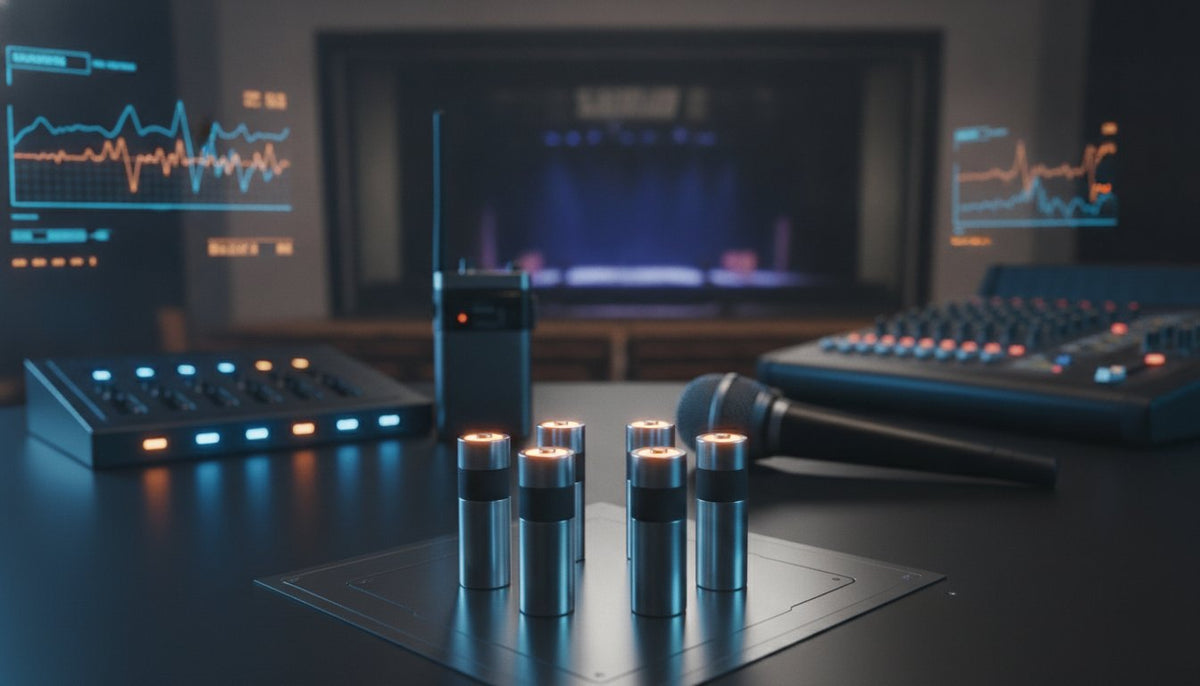
What if the household battery you trust for your TV remote is the very thing sabotaging your professional wireless audio system? It's a frustrating reality for many AV technicians who experience sudden signal dropouts right when the lights go up. When evaluating Duracell rechargeable vs Pure Power for high-drain professional gear, the choice goes beyond brand recognition. You need a power source that maintains steady voltage under pressure without the steep recurring costs of disposable alkalines.
We understand that equipment reliability is non-negotiable in live environments. You've likely dealt with the headache of inconsistent charging cycles and the fear of a microphone dying mid-sentence. This guide promises to show you how to eliminate those technical failures while reducing your long-term battery expenditure. We'll examine the technical specifications of the Pure Power Series alongside consumer staples to help you standardize a charging infrastructure that actually works. You'll discover the specific performance metrics that separate industrial-grade power from standard retail options in 2026.
Key Takeaways
- Identify the critical performance gap between consumer batteries designed for shelf life and professional cells engineered for mission-critical consistency.
- Evaluate the impact of voltage stability on high-drain gear to understand how the Duracell rechargeable vs Pure Power choice affects equipment reliability.
- Discover how to eliminate voltage sag and prevent wireless microphone dropouts during live events using advanced lithium-ion chemistry.
- Analyze the total cost of ownership to see how moving away from the alkaline trap provides significant long-term ROI for your facility.
- Learn why standardized charging infrastructure and specialized rackmount solutions are necessary to protect your battery investment and ensure operational readiness.
Understanding the Gap Between Consumer and Professional Power
Professional power requirements differ fundamentally from the needs of a standard household. While a consumer might only care if a battery works for a few months in a wall clock, an AV technician needs to know that a wireless transmitter will maintain signal for an eight hour shift without interruption. This distinction is the core of the Duracell rechargeable vs Pure Power debate. Consumer brands typically prioritize long shelf life and broad compatibility for low-drain devices. In contrast, professional series prioritize discharge consistency and voltage stability under heavy load.
When a battery fails in a professional setting, the cost isn't just the price of a single cell. It's the cost of a ruined recording, a silent keynote, or a delayed production. Using consumer-grade solutions in these high-stakes environments often leads to "voltage sag." This occurs when equipment shuts down prematurely because the battery cannot maintain the required voltage, despite still having a partial charge. Choosing the right energy partner means moving beyond retail convenience toward mission-critical reliability.
The Duracell Rechargeable Standard
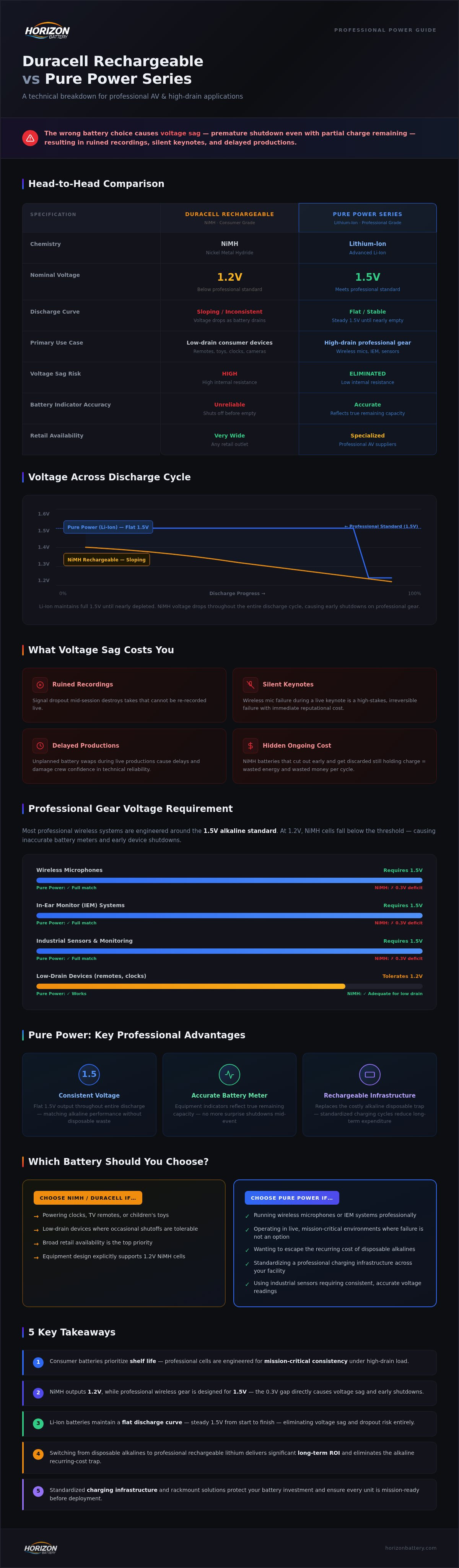
Duracell is a household name for a reason. Their rechargeable line utilizes Nickel Metal Hydride (NiMH) technology, which has served as a reliable standard for decades. These batteries are designed for maximum versatility. They power everything from digital cameras to children's toys and are available at almost any retail outlet. For low-drain devices where a sudden shutdown is merely a minor inconvenience, NiMH is a cost-effective choice. However, NiMH cells typically output 1.2V. This lower voltage can be problematic for professional gear that expects a steady 1.5V to function at peak performance.
The Pure Power Series Philosophy
Modern professional applications require a different chemical approach to ensure equipment remains operational. The Pure Power Series utilizes lithium-ion technology to provide a consistent 1.5V output throughout the entire discharge cycle. This engineering choice directly addresses the specific needs of high-drain equipment like wireless microphones, IEM systems, and specialized industrial sensors. It's a specialized solution for those who cannot afford technical failures.
Reliability is the primary focus of this series. Unlike consumer NiMH cells that lose voltage as they drain, lithium-ion cells maintain their peak performance until they are nearly empty. This stability ensures that your equipment's battery indicator remains accurate. It gives technicians the confidence to run long events without the fear of a sudden dropout. As organizations analyze Duracell rechargeable vs Pure Power for their facilities, the move toward professional-grade lithium solutions is becoming the industry norm for those prioritizing performance over retail availability.
Technical Deep Dive: Voltage Stability and Chemistry
Understanding the chemistry behind your power source is essential for maintaining equipment performance. The comparison of Duracell rechargeable vs Pure Power is fundamentally a study of Nickel Metal Hydride (NiMH) versus Lithium-ion technology. While Duracell utilizes NiMH cells, the Pure Power Series leverages advanced lithium-ion chemistry to meet the rigorous demands of professional electronics. This chemical difference dictates how much usable energy your device actually receives before shutting down. Analyzing Duracell rechargeable vs Pure Power through a technical lens reveals why one is suited for the living room while the other belongs on a professional stage.
Most professional wireless systems are designed around the 1.5V standard of alkaline batteries. NiMH rechargeables typically operate at a nominal 1.2V. As these cells discharge, their voltage continues to drop. When the voltage falls below a certain threshold, your equipment may report a low battery or shut off entirely, even if the cell still holds energy. This premature failure is a direct result of voltage sag. In contrast, professional lithium cells maintain a flat discharge curve. They deliver a steady 1.5V from start to finish. This ensures your gear performs at peak levels until the very end of the capacity cycle.
Eliminating Voltage Sag
Voltage sag is the temporary drop in voltage that occurs when a high-drain device draws current from a battery with high internal resistance. Standard NiMH batteries are particularly susceptible to this during peak transmission moments. By using 1.5V lithium-ion rechargeable batteries, you gain the "like-alkaline" experience of consistent power without the waste of disposables. Constant voltage is the ability of a power source to maintain its rated output regardless of the remaining capacity, which is vital for the stability of digital wireless systems. You can find these specialized AA rechargeable batteries - high capacity solutions to stabilize your infrastructure.
Cycle Life and Degradation
Longevity is another critical metric for any organization. Modern lithium-ion cells generally offer a superior cycle life compared to traditional NiMH batteries. While consumer-grade rechargeables may lose capacity after a few dozen heavy-use cycles, professional series are engineered for hundreds of consistent charges. Lithium-ion technology also eliminates the "memory effect" found in older chemistries, meaning you don't need to fully deplete them before recharging. Lower internal resistance in these cells translates to less heat generation and longer overall device runtime. This provides a more reliable return on your investment over several years of service.
Performance in Professional AV and High-Drain Gear
Wireless microphones and in-ear monitors represent the ultimate "torture test" for portable power. These devices require a constant, high-current draw to maintain a stable RF signal and clear audio. When looking at Duracell rechargeable vs Pure Power, the performance gap is most visible during active transmission. Consumer NiMH batteries often show full bars on a receiver in standby mode, only to drop significantly once the transmitter begins broadcasting. This inconsistency creates a risk that professional environments simply can't tolerate.
In high-interference environments, signal strength is directly tied to the stability of the power source. A drop in voltage often leads to a decrease in RF output, making the system more susceptible to external noise and dropouts. Beyond the chemistry, physical design matters. Many high-capacity consumer cells are slightly wider than standard alkalines, which can cause them to jam in the tight battery compartments of professional gear. Both Ansmann high capacity batteries and Pure Power cells are manufactured to precise dimensional tolerances, ensuring they slide in and out of expensive equipment without resistance.
Wireless Microphone Reliability
The most frequent question technicians ask is whether rechargeable cells will cause signal cut-outs. The answer depends entirely on the voltage regulation. While standard NiMH cells start at 1.2V and quickly sag under load, the Pure Power Series utilizes an internal regulator to maintain a steady 1.5V. This regulation is crucial for systems like Shure and Sennheiser, where the internal electronics are optimized for alkaline-level voltage. By providing a flat discharge curve, these professional cells prevent the audio distortion that occurs when a battery begins to fail mid-performance.
Professional Photography and Video
Photographers and videographers face similar challenges with high-drain equipment. For a photographer using a speedlight, the discharge rate of the battery determines how quickly the flash recycles. Consumer-grade batteries often struggle to deliver the burst of energy needed for rapid shooting, leading to missed shots. Similarly, portable field recorders and monitors require sustained power to ensure data isn't corrupted during a write cycle. Enterprise organizations frequently choose high-capacity AA batteries for professional audio and video because they provide the necessary current without the unpredictable voltage drops of retail alternatives.
Total Cost of Ownership: ROI for Organizations
Organizations often fall into the "Alkaline Trap" by focusing only on the low per-unit price of disposable batteries. For a facility using 1,000 or more disposables annually, the recurring expense and environmental waste are substantial. When comparing Duracell rechargeable vs Pure Power, the financial decision shifts from a simple purchase to a long-term investment strategy. While retail NiMH options offer some savings over disposables, the Pure Power Series provides the reliability needed to protect your organization's reputation during high-profile events. You aren't just buying cells; you're securing your operational uptime.
The hidden cost of disposables isn't just the purchase price; it's the labor. Staff spend hours testing half-used batteries and managing bins of waste. By switching to rechargeable batteries for business, you streamline operations and align with corporate sustainability initiatives. A professional energy system reduces the volume of hazardous waste leaving your building while stabilizing your annual budget. This move transforms a variable expense into a predictable asset.
Scaling for Large Facilities
Large venues like churches and theaters manage massive battery inventories that require strict organization. Mixing different brands or ages of batteries is a common cause of technical failure because mismatched discharge rates can lead to equipment malfunctions. Organizations weighing the benefits of Duracell rechargeable vs Pure Power often find that the professional series offers a faster path to true efficiency. Standardization is the only way to ensure predictable performance across multiple rooms or stages. Implementing a dedicated Battery Storage and management system allows your team to track cycle counts and maintain readiness. Searching for "good" batteries minutes before a show starts is a stress you don't need.
Calculating Your ROI
The payback period for a Pure Power transition is the specific amount of time it takes for the savings from eliminated disposables to equal the initial cost of the rechargeable hardware. Most high-use facilities reach this point within the first year of operation. You should also consider the durability of your infrastructure. An industrial charging station is built to withstand daily enterprise use, whereas a consumer charger often fails after a few months of heavy cycling. Ultimately, the return on investment includes the value of a successful event. A single battery failure during a recorded session or live broadcast can cost an organization thousands in lost time or brand damage. You can secure your facility's operational future by investing in AA Rechargeable Batteries - High Capacity bundles today.
The Infrastructure Solution: Chargers and Bundles
A professional battery is only as reliable as the infrastructure supporting it. Even the highest-grade cell will underperform if it is paired with a charging system that cannot manage its specific chemical requirements. When comparing Duracell rechargeable vs Pure Power, the most critical operational difference lies in the charging hardware. Consumer chargers, like those typically bundled with retail NiMH batteries, are designed for occasional use in low-stakes environments. They often lack the sophisticated circuitry needed to monitor individual cell health, leading to uneven charges and shortened battery lifespans.
Using a consumer charger with professional lithium-ion cells is more than just inefficient; it's a safety and performance risk. Lithium-ion technology requires precise voltage regulation and thermal monitoring during the charge cycle. Professional facilities should prioritize enterprise battery charging solutions that are engineered for high-volume, daily use. Standardizing your facility with specialized Charger / Battery Bundles ensures that every cell in your inventory is treated with the same precision, eliminating the variables that cause mid-event failures.
Custom Rackmount Charging
For organizations managing dozens of wireless channels, loose wall-wart chargers create a chaotic and heat-prone environment. Custom Rackmount Chargers allow you to integrate your power management directly into your existing AV rack. This centralized approach simplifies cable management and allows for better control over heat and airflow, which are the primary enemies of battery longevity. Horizon Battery's custom solutions are designed to prevent overcharging by utilizing intelligent "trickle" and "cutoff" features. These systems protect your investment by ensuring that cells are never subjected to the thermal stress common in cheap, retail-grade charging docks.
Making the Switch
Transitioning your organization to the Pure Power Series requires a methodical approach to ensure total compatibility across your gear. The Duracell rechargeable vs Pure Power choice is often the catalyst for a broader infrastructure audit. Follow these steps to modernize your power system:
- Audit your current inventory: Identify every device that requires AA power and check for tight battery compartments that may require precisely-sized professional cells.
- Verify charging compatibility: Ensure you have dedicated lithium-ion chargers before deploying new cells to your team.
- Standardize your bundles: Deploy matched sets of batteries and chargers to specific departments to prevent cross-contamination of chemistries.
- Establish a rotation: Use a simple labeling system to track the age and cycle count of your inventory.
If you aren't sure where to start, professional guidance can prevent costly mistakes in hardware selection. You can Contact Horizon Battery for a professional power audit to determine the exact charging and storage configuration your facility requires for 2026 and beyond.
Securing Your Professional Energy Future
Choosing between Duracell rechargeable vs Pure Power is ultimately a decision about the operational standards of your facility. While consumer brands provide a convenient solution for household electronics, professional-grade gear requires the 1.5V stability and consistent discharge curves only found in specialized lithium-ion chemistry. By moving away from the limitations of retail NiMH cells, you eliminate the risk of voltage sag and ensure your wireless systems perform at peak capacity throughout every event.
Horizon Battery has provided reliable mobile energy solutions since 1998. We specialize in supporting AV and enterprise clients with custom rackmount charging systems and dedicated technical support. Standardizing your infrastructure with the Pure Power Series reduces long-term expenditure and simplifies your inventory management. It's time to stop managing battery failures and start focusing on your production quality. Upgrade your professional gear with the Pure Power Series today and experience the difference that industrial-grade reliability makes for your organization.
Frequently Asked Questions
Can I use my existing Duracell NiMH charger for Pure Power lithium-ion batteries?
You cannot use a standard NiMH charger with the Pure Power Series. These professional lithium-ion cells require a dedicated charger designed for their specific chemistry and voltage regulation. NiMH chargers operate on a different charging curve that won't properly top off a lithium cell and could lead to internal damage. To ensure safety and longevity, it's best to use the matched chargers found in our Charger / Battery Bundles.
Is the Pure Power Series compatible with all wireless microphone brands?
The Pure Power Series is engineered for universal compatibility with all major wireless microphone brands, including Shure, Sennheiser, and AKG. Because these cells maintain a constant 1.5V output, they mimic the performance of a standard alkaline battery. This prevents the compatibility issues often seen with 1.2V NiMH rechargeables. Additionally, their physical dimensions adhere to strict standards, ensuring they fit securely in tight battery compartments without jamming.
How many times can a Pure Power Series battery be recharged compared to Duracell?
Professional lithium-ion batteries typically offer a significantly higher cycle life than consumer-grade NiMH options. While retail rechargeables often begin to show capacity loss after several dozen heavy-use cycles, the Pure Power Series is built for industrial longevity. This increased durability makes them a more reliable choice for organizations that cycle their batteries daily. When comparing Duracell rechargeable vs Pure Power, the professional series provides a more stable long-term return on your investment.
What happens to the voltage as a Pure Power battery nears 0% charge?
Unlike traditional batteries that gradually lose voltage as they drain, Pure Power cells maintain a steady 1.5V output until they are nearly depleted. Once the internal capacity reaches a critical threshold, the onboard circuitry shuts off the power to protect the cell. This flat discharge curve ensures your equipment performs at peak levels without the signal degradation or voltage sag that typically occurs as a battery nears the end of its charge.
Are professional lithium-ion batteries safe for use in medical or critical devices?
Professional lithium-ion batteries are safe and highly effective for use in many critical devices that require a steady AA power source. Their ability to provide consistent voltage makes them ideal for equipment where a sudden drop in power could lead to technical failure. However, you should always consult your equipment's manual to ensure lithium-ion rechargeables are recommended for your specific device. Our team provides dedicated support for enterprise clients to help verify these requirements.
How much money can a church save by switching from Duracell alkalines to Pure Power?
While specific savings depend on your weekly volume, most organizations realize a full return on their investment within the first year of operation. By eliminating the need to purchase thousands of disposable alkalines, a church can transform a recurring variable expense into a one-time infrastructure cost. This transition also reduces labor costs associated with testing and replacing batteries before every service. Moving away from the Alkaline Trap allows for better long-term budget predictability.
Do Pure Power batteries have a 'memory effect' like older rechargeables?
No, the lithium-ion technology used in the Pure Power Series does not suffer from the memory effect found in older Nickel-Cadmium (NiCd) batteries. You don't need to fully deplete these cells before placing them back on a charger. This allows technicians to top off their battery inventory between events without worrying about reducing the total capacity or lifespan of the cells. It's a much more flexible solution for fast-paced professional environments.
Why does my equipment report 'low battery' almost immediately with some NiMH rechargeables?
This issue occurs because many professional devices are calibrated for 1.5V alkaline batteries. Since standard NiMH rechargeables only provide 1.2V, the device's internal sensors interpret the lower voltage as a nearly depleted battery. This is a common pain point when evaluating Duracell rechargeable vs Pure Power. By switching to a 1.5V lithium-ion solution, you provide the exact voltage the equipment expects, which ensures the battery indicator remains accurate and the device stays powered.