

What if the most critical point of failure in your production rack isn't the signal processor or the switch, but a simple set of uncharged AA batteries? For professional AV technicians, the sight of messy desktop chargers and tangled power strips is a clear sign of a workflow waiting to fail. Transitioning to Custom Rackmount Chargers allows you to treat your power management with the same precision as your audio signal. You understand that reliability is the foundation of every successful event, yet battery management is often left as an afterthought until a wireless microphone cuts out mid-performance.
By integrating these systems into your 19-inch infrastructure, you can eliminate uncertainty and reclaim your workspace. This professional guide will teach you how to select and install high-density charging systems that support 12 to 44 batteries simultaneously while protecting your investment in high-capacity NiMH or Pure Power Series Li-ion cells. We will cover heat management strategies, cable organization, and the specific configurations needed to ensure your hardware is always ready when the show starts.
Key Takeaways
- Eliminate production downtime by moving from unorganized desktop chargers to a standardized 19-inch rack infrastructure.
- Select the ideal capacity for your workflow, with options for Custom Rackmount Chargers that manage anywhere from 12 to 44 batteries in a single unit.
- Protect your investment in high-capacity cells by utilizing intelligent charging algorithms designed to maintain long-term battery health and performance.
- Optimize your rack ergonomics by following proven integration steps for mid-rack placement and dedicated power distribution.
- Calculate your required battery buffer to ensure reliable power is available for every wireless device during high-stakes, back-to-back performances.
Why Professionals Are Switching to Custom Rackmount Chargers
A rackmount charger is a standardized unit designed to charge multiple batteries within a professional equipment rack. It's built to the 19-inch rack standard, allowing it to sit securely alongside your wireless receivers, mixers, and processors. Professionals are switching to Custom Rackmount Chargers because they turn a chaotic mess of cables into a streamlined, technical asset. This centralization allows for better technical oversight and ensures that your power source is as reliable as your audio hardware. By integrating charging into the rack, you eliminate the risk of batteries being misplaced or left uncharged on a distant table.
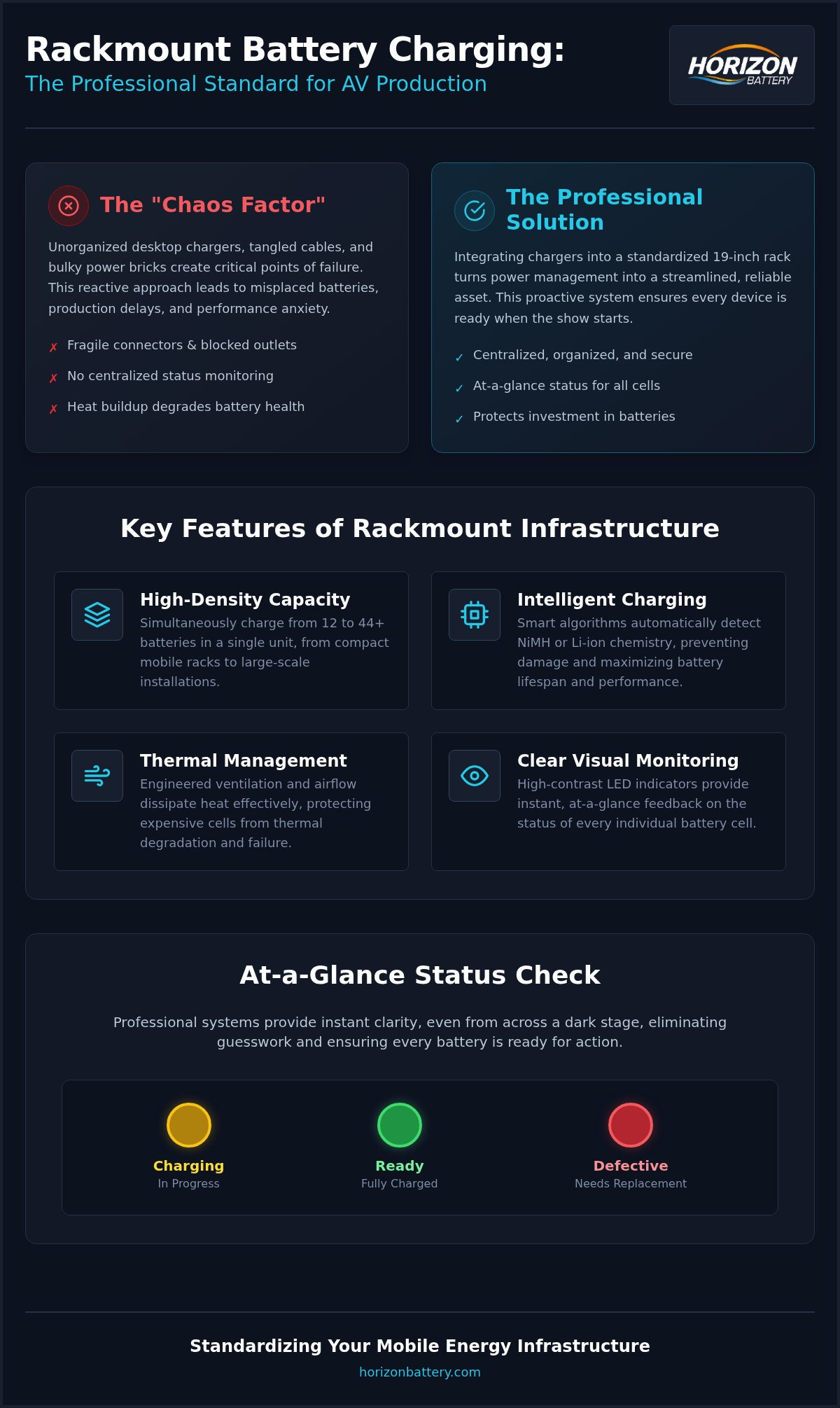
The "Chaos Factor" is a real threat to production stability. Consumer chargers use fragile connectors and bulky "wall-wart" power supplies that often block adjacent outlets on a power strip. In a high-pressure environment, these small failure points lead to uncharged batteries and technical delays. Professional rack units solve this by integrating power distribution internally. They also handle thermal management far more effectively than consumer-grade plastic housings. While small chargers often trap heat, Custom Rackmount Chargers are engineered with ventilation that dissipates warmth, protecting the chemistry and longevity of your expensive high-capacity cells.
The Limits of Desktop Charging for Enterprise
Desktop chargers rely on external power bricks that easily disconnect during transport or setup. They also lack clear, centralized status indicators, making it nearly impossible to track the charge state of 30 or 40 individual cells at a glance. This lack of visibility creates anxiety during the final hours before a show. Heat is another enemy that desktop units fail to manage, often leading to premature cell degradation. The charging bottleneck is the operational delay caused when battery replenishment cannot keep pace with the equipment's consumption rate during back-to-back production cycles.
Standardizing Your Mobile Energy Infrastructure
Integrating power management into your rack aligns your workflow with modern enterprise battery charging solutions. This transition is about more than just organization; it's about electrical consistency and equipment protection. Professional rack units provide stable voltage that protects sensitive wireless microphone transmitters from the spikes or dips common in cheaper, unconditioned hardware. You move from a reactive "hope it's charged" mindset to a proactive, methodical cycle. This ensures that every cell in your inventory is maintained at peak health, providing the steady reliability required for high-stakes media environments and large-scale church productions.
Key Features of Professional Rackmount Infrastructure
Professional grade hardware goes beyond simple power delivery. Custom Rackmount Chargers utilize sophisticated logic to ensure every cell is treated as a critical asset. For example, Perfect-7 technology manages the entire charging process from initial capacity testing to final trickle charging. This prevents the "memory effect" in older chemistries and ensures your wireless gear receives maximum runtime. By treating battery management as a technical discipline, you reduce the likelihood of mid-show failures and extend the operational life of your inventory.
Density and flexibility are the primary drivers for rack integration. You can choose compact 12-cell kits for smaller mobile racks or high-density 44-cell drawers for large-scale permanent installations. Visual monitoring is another hallmark of this infrastructure. High-contrast LED indicators provide instant feedback on charge status, even from across a dark stage or equipment room. You can distinguish between a cell that's charging, fully ready, or defective in a split second. This clarity is vital when handling multi-chemistry environments where you might mix NiMH and Pure Power Series Li-ion cells. The charger automatically detects the chemistry and applies the correct profile, removing the risk of human error.
Thermal Management and Safety Circuitry
Heat is the primary enemy of Ansmann high capacity batteries. High-density charging generates significant thermal energy that can degrade cells if it isn't managed. Professional rack designs prioritize airflow, using either active cooling fans or strategic passive ventilation to keep temperatures within safe limits. This is critical when following Lithium-Ion Battery Safety guidelines to prevent thermal runaway. Safety circuitry like Delta-V detection acts as a fail-safe. It detects the tiny voltage drop that occurs when a battery reaches full capacity and immediately switches to a maintenance charge to prevent overheating.
Repair and Refresh Modes
Professional chargers don't just give up on older batteries. They use "Refresh" modes to cycle cells, breaking down crystalline structures that reduce capacity over time. These systems feature repair modes that can identify and revive deeply discharged cells using low-current pulses. This automated maintenance means your team doesn't have to manually track which batteries need conditioning. It's a set it and forget it solution that protects your bottom line. If you want to see how these features fit into a broader facility plan, reviewing enterprise battery charging solutions can help you map out your specific infrastructure needs.
How to Choose the Right Rackmount Configuration
Choosing the right Custom Rackmount Chargers involves more than just counting your current batteries. You need to calculate a "buffer" to maintain a continuous workflow. If you operate 20 wireless channels, charging exactly 20 batteries is a recipe for failure. Aim for at least 1.5 times your active device count. This ensures a fresh set is always ready while the depleted set undergoes a full charge cycle. This proactive approach prevents the technical delays often seen in back-to-back rehearsals or long performance schedules.
Rack real estate is a premium resource. A 1U kit like the LMS Powerline 8 offers a slim profile for compact mobile racks. Alternatively, 2U drawer-based systems provide significantly higher density for permanent installations. Fixed faceplate units offer immediate visibility of charging status, while custom drawers keep cells protected behind a secure panel. Modular solutions allow you to scale your infrastructure as your wireless inventory grows, moving from basic 12-cell kits to expansive 44-cell configurations as your needs evolve.
Matching Charger Density to Facility Size
Small churches and educational facilities typically find their sweet spot with 12 to 16-cell configurations. These units occupy minimal vertical space but provide the same industrial reliability as larger systems. Large theaters and media production houses require a different scale. A 44-cell high-density drawer allows a lead technician to manage a massive battery fleet from a single central location. When planning your layout, consider the physical footprint. Drawer-based systems require sufficient depth for the slide mechanism to operate fully without hitting internal cabling or power distribution units.
NiMH vs. Lithium-Ion Charging Needs
Battery chemistry is the most critical factor in your selection process. You cannot use a legacy NiMH charger for Pure Power Series Li-ion cells. The termination logic for Lithium-ion is entirely different; using the wrong charger can damage the cells or compromise safety. Lithium-ion cells are increasingly popular because they provide a constant 1.5V output throughout the entire discharge cycle. This prevents the "low battery" warnings that sometimes occur prematurely with NiMH cells in sensitive wireless transmitters. While some dual-chemistry rack solutions exist, many professionals prefer dedicated banks to ensure the most precise charging profile for their specific battery fleet.
Step-by-Step: Integrating Your Rackmount Charger
Integrating Custom Rackmount Chargers into your technical environment requires a strategic approach to both physical placement and power management. Ergonomics play a vital role in long-term success. You should position the unit at mid-rack height, typically between 20U and 30U in a standard tall rack. This placement allows technicians to monitor LED status indicators at eye level and swap batteries without bending or reaching into dark corners. It also minimizes the amount of floor dust drawn into the unit's ventilation system, which is essential for maintaining internal component health over years of service.
Electrical isolation is another key consideration for a professional setup. While it's tempting to plug everything into a single strip, using a dedicated Power Distribution Unit (PDU) for your charging infrastructure is a smarter choice. This prevents potential charging noise from bleeding into your audio signal path. Airflow is equally critical. Even with advanced thermal management, leaving a 1U gap or using a vented blanking panel above the charger provides the necessary space for heat to dissipate. This simple step protects both the charger and the equipment mounted directly above it from unnecessary thermal stress.
Physical Installation in a 19-Inch Rack
Before you begin, gather your standard rack screws and cage nuts. Ensure your rack rails are clean and properly aligned. When securing the unit, tighten the screws in a cross pattern to ensure the weight is supported evenly across the chassis. Cable dressing is the final step of a clean installation. Use hook-and-loop ties to secure the power cord along the rack's vertical support. Keep these power lines as far as possible from your sensitive wireless antenna cables or microphone lines to maintain a low noise floor and prevent interference.
Establishing a Daily Charging Workflow
A reliable hardware setup only works if your team follows a consistent workflow. Implementing a "Charged vs. Uncharged" rotation system is the most effective way to manage a large battery fleet. Many facilities use a simple left-to-right docking rule or color-coded bins to track cell status. At the end of every show, all batteries must be docked immediately to allow for a full replenishment cycle. In the morning, a quick verification of the LED indicators confirms readiness. Training your staff to recognize specific error codes, such as a flashing red light for a defective cell, prevents faulty batteries from reaching the stage. To start building your integrated power solution, you can explore our full range of Custom Rackmount Chargers today.
Standardizing with Horizon Battery Custom Solutions
Horizon Battery has served as a primary source for specialized technical power since 1998. Transitioning to Custom Rackmount Chargers isn't just a matter of organization; it's a strategic financial decision. By moving away from disposable batteries and unmanaged desktop units, professional facilities report reducing their annual battery spend by up to 90%. This return on investment is driven by the longevity of high-performance cells and the precision of the charging hardware that maintains them. You aren't just buying a charger; you're investing in a system that protects your most frequently used assets.
Bundling these chargers with Ansmann high capacity batteries creates a unified ecosystem designed for the rigors of touring and permanent installation. We act as a knowledgeable guide, leveraging over 25 years of experience to ensure your facility avoids the common pitfalls of technical power management. Our role as a distributor for industry leaders like Fischer Amps and Ansmann allows us to provide hardware that is specifically engineered for the professional AV market rather than adapted from consumer designs. This industrial focus ensures that your charging infrastructure remains as reliable as your signal processors.
Custom Configurations for 12 to 44 Cells
Every production environment has unique density requirements. The LMS Powerline 8 Rackmount Kit serves as a versatile entry point, offering a modular approach for those managing smaller wireless inventories. For enterprise-level management, our high-capacity drawers support up to 44 AA or AAA batteries in a single 2U space. These configurations allow you to tailor your charger density exactly to your microphone count, ensuring no rack space is wasted. Whether you need a slim 1U solution or a deep drawer for high-volume rotation, our systems provide the technical oversight required for modern media houses.
Next Steps: Outfitting Your Facility
Selecting the right hardware is the first step toward a more reliable technical workflow. We provide expert support to help you navigate the transition to professional-grade charging infrastructure, including comprehensive warranty coverage and technical assistance. If you're managing a large-scale installation or a mobile production rig, you can request a custom quote to find the specific configuration that fits your needs. Take control of your power management and Explore our full range of Custom Rackmount Chargers here to eliminate battery downtime for good.
Mastering Your Professional Power Infrastructure
Standardizing your battery management is a fundamental step toward technical excellence. By moving away from unmanaged desktop units and embracing Custom Rackmount Chargers, you ensure that every wireless channel remains active when it matters most. You've learned how to calculate your required buffer, optimize airflow for thermal safety, and establish a daily workflow that protects your cells. These small adjustments to your 19-inch rack setup create a foundation of reliability that supports every performance.
Horizon Battery has been a primary source for expertly engineered power solutions since 1998. As an authorized distributor for Ansmann and Fischer Amps, we provide customized configurations ranging from 12 to 44 cells to fit any facility size. Our focus remains on industrial reliability and long-term performance for the professional AV community. Take the next step in organizing your technical environment and Shop Professional Custom Rackmount Chargers today. Your production team will appreciate the clarity and confidence that comes with a fully charged, well-managed battery fleet.
Frequently Asked Questions
Can I charge both AA and AAA batteries in the same rackmount unit?
Yes, most professional units like the Ansmann Comfort Smart drawer feature hybrid slots or interchangeable trays. They automatically detect the battery size and chemistry to apply the correct charging current. This allows a technician to manage a mixed fleet of wireless handhelds and belt packs within a single 19-inch space, ensuring all equipment is ready for the next production cycle without requiring multiple separate chargers.
Do rackmount chargers generate a lot of heat inside the rack?
Charging multiple high-capacity batteries simultaneously does generate thermal energy. However, Custom Rackmount Chargers are engineered with internal cooling fans or strategic passive ventilation to dissipate this heat safely. While consumer chargers often trap heat in plastic housings, these industrial units maintain a safe operating temperature to protect your cells from degradation. It's still recommended to leave a small gap for optimal airflow.
Are custom rackmount chargers compatible with all rechargeable battery brands?
Professional rackmount units are compatible with most high-quality NiMH or Li-ion brands, provided the chemistry matches the charger's profile. While they work with various manufacturers, performance is most reliable when paired with industrial cells like the Ansmann high-capacity series. Using low-quality consumer batteries may trigger error codes because the intelligent algorithms detect internal resistance inconsistencies that could lead to safety issues during high-speed charging cycles.
What is the difference between a charging drawer and a fixed rackmount charger?
A fixed rackmount charger features a stationary faceplate where batteries are inserted directly into the front of the unit. A charging drawer, such as the Ansmann Comfort Smart, uses a sliding mechanism to house batteries inside the rack. Drawers typically offer higher density, supporting up to 44 cells, and keep the batteries protected from dust. Fixed units provide faster visual access to LED indicators for smaller inventories.
How many rack units (U) do these chargers typically occupy?
Most Custom Rackmount Chargers occupy either 1U or 2U of rack space. Slimmer kits like the LMS Powerline 8 are designed for a 1U footprint, making them ideal for compact mobile rigs where vertical space is limited. Larger high-density drawers usually require 2U to accommodate the sliding drawer hardware and internal cooling systems. Always check the specific depth requirements of your rack to ensure the unit fits behind the front rails.
Do I need a special power conditioner for my rackmount battery charger?
While not strictly required, connecting your charger to a professional Power Distribution Unit or a power conditioner is a best practice. These chargers feature internal voltage regulation, but external conditioning protects the sensitive charging logic from line noise and surges. This is especially important in venues with unstable power. Using a dedicated circuit for your charging infrastructure also prevents electrical interference from reaching your wireless receivers or signal processors.
Can I charge Lithium-ion batteries in an Ansmann Comfort Smart rackmount?
No, the standard Ansmann Comfort Smart drawer is specifically engineered for NiMH chemistry. Charging Lithium-ion cells in a NiMH-only unit is dangerous and can lead to thermal runaway. If your facility uses the Pure Power Series or other Li-ion batteries, you must use a charger with a dedicated Lithium-ion profile. Always verify the chemistry compatibility of your rackmount unit before docking any cells to ensure safe and efficient operation.
What happens if a battery is defective or damaged during the charging cycle?
Professional chargers use intelligent monitoring to detect faulty cells immediately. If a battery has a short circuit or high internal resistance, the unit will stop the charging process for that specific slot and trigger a visual error code. This prevents a single bad battery from overheating or affecting the rest of the fleet. The unit simply bypasses the defective cell while continuing to charge all other docked batteries in the system.