
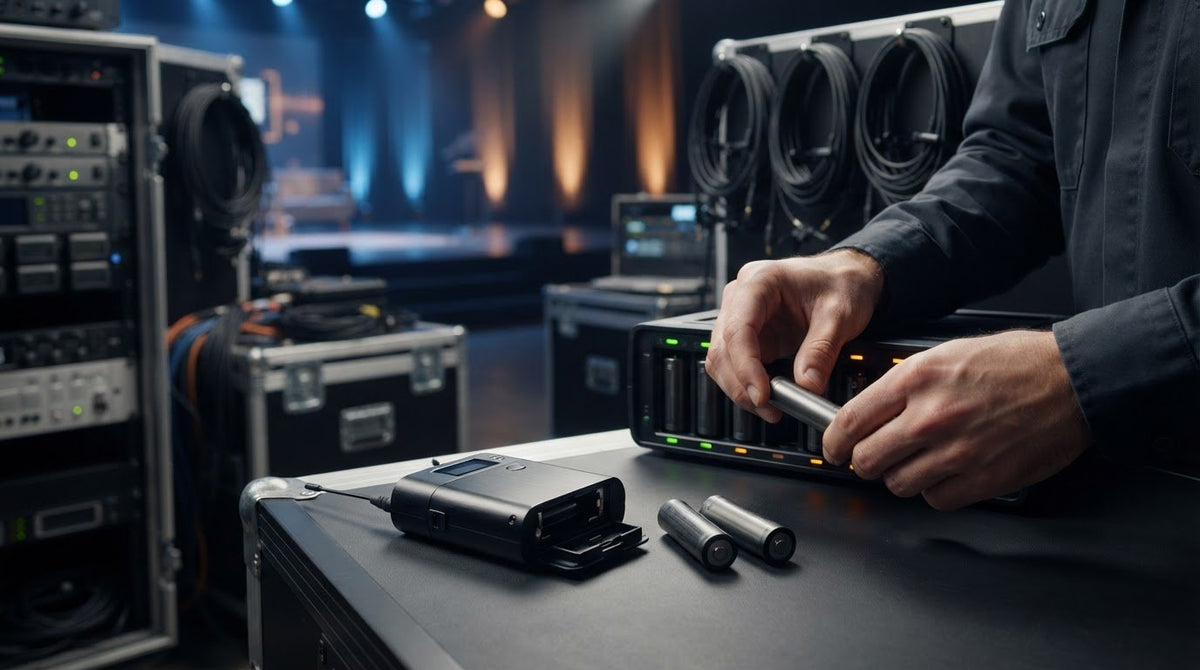
Chasing the highest capacity rating on the label is often the fastest route to dead air. When it comes to mission-critical live audio, choosing rechargeable batteries for lavalier microphone transmitters isn't simply a matter of buying maximum milliamp-hours. True transmitter reliability demands matching chemistry voltage discharge profiles and precise outer dimensions to the exact power requirements of modern bodypacks.
Tossing hundreds of disposable alkaline cells into the trash each season drains operating budgets, but dealing with sudden voltage sag, inaccurate receiver telemetry, or jammed battery doors is far worse. You shouldn't have to sacrifice rock-solid RF performance to secure the long-term savings of rechargeable power. This guide details how to select the right cells for 6 to 10 hours of continuous runtime, reliable metering, and a disciplined charging workflow designed for demanding multi-channel turnarounds.
Key Takeaways
- Selecting the proper rechargeable batteries for lavalier microphone transmitters prevents sudden voltage sag and RF dropouts during mission-critical productions.
- Physical cell dimensions matter just as much as rated capacity; choosing precision slimline designs prevents dangerous swelling and jamming in compact bodypack compartments.
- Matching battery discharge curves to your transmitter hardware ensures accurate runtime telemetry displays on both the bodypack and rack receivers.
- Transitioning to dedicated multi-bay rackmount charging systems controls thermal build-up, extends overall cell longevity, and streamlines fast-paced weekly turnarounds.
Why Standard Rechargeable Batteries Fail in Lavalier Microphone Transmitters
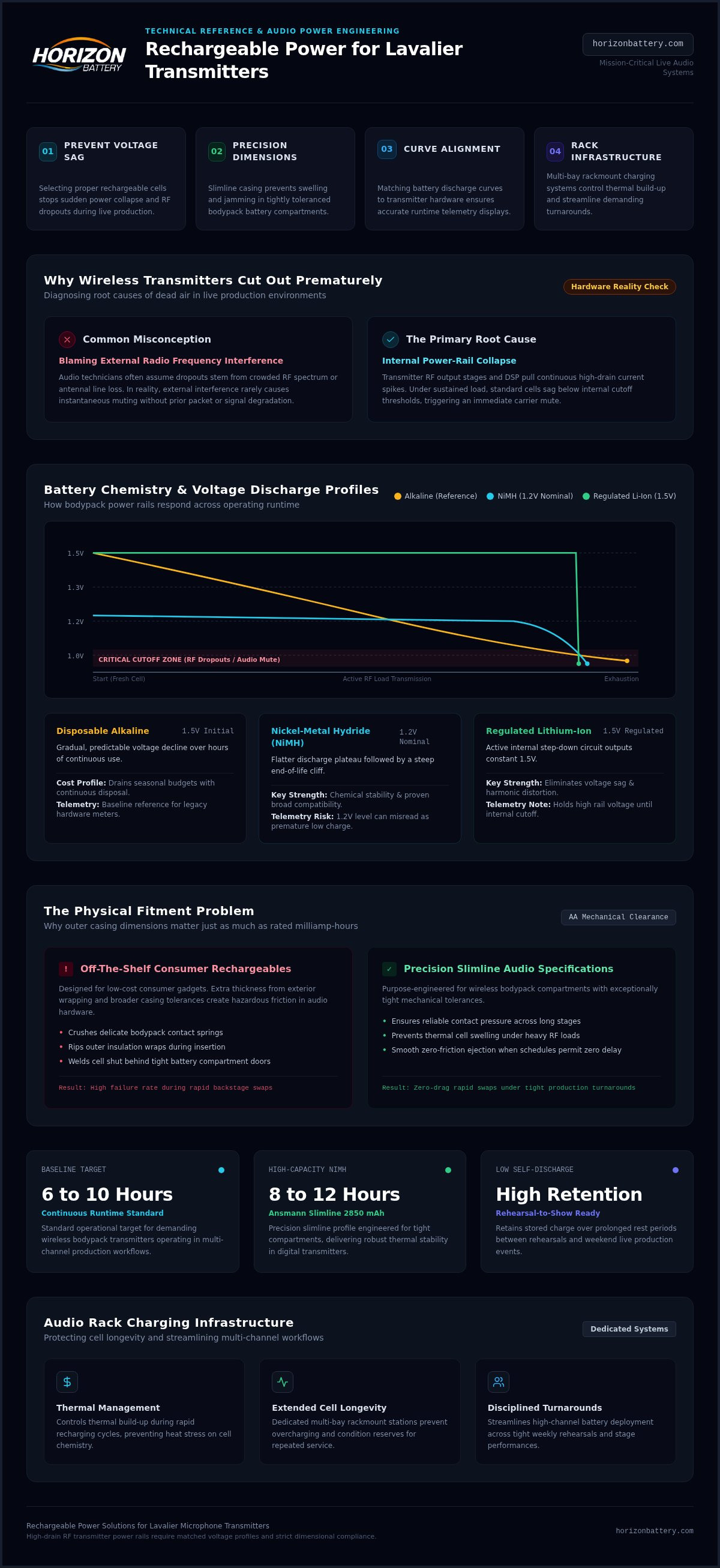
RF audio gear is notoriously unforgiving on internal power rails. Digital and analog bodypack transmitters do not draw power in a flat, predictable line. Instead, the RF output stage and internal digital processing pull continuous, high-drain current spikes that place sustained stress on cell chemistry. When audio engineers encounter sudden wireless dropouts, they often blame external radio frequency interference. In reality, power-rail collapse is a primary root cause. A standard consumer rechargeable battery frequently fails under continuous RF load, dipping below the transmitter's internal low-voltage cutoff threshold and instantly muting the audio path.
The Critical Role of Discharge Curves in RF Transmission
Alkaline cells exhibit a gradual, predictable voltage decline over hours of continuous use. In contrast, standard consumer NiMH cells operate at a lower nominal 1.2V baseline. Under active RF transmission, their discharge curve stays relatively flat before falling off a sudden cliff. This steep drop wreaks havoc on bodypack monitoring circuitry. Transmitters read the sudden plunge as instant exhaustion, triggering premature flashing warnings on receiver racks or muting the RF carrier entirely. Without steady voltage, transmission range degrades and harmonic distortion creeps into the preamplifier. Selecting high-grade rechargeable batteries for lavalier microphone transmitters ensures the sustained voltage stability needed to keep digital audio circuits operating within safe margins.
The Physical Fitment Problem: Battery Compartment Tolerances
Electrical stability means little if a cell jams inside the bodypack. Wireless microphone manufacturers design compact compartments with exceptionally tight mechanical tolerances. Standard off-the-shelf rechargeables frequently feature thicker outer labels and slightly wider steel casings that exceed standard AA exterior specifications. Forcing an oversized cell into a precision compartment can crush delicate contact springs, rip outer insulation wraps, or weld the cell shut behind the door. Professional live environments demand strict dimensional compliance. Using purpose-built slimline cells ensures reliable contact pressure, smooth ejection, and rapid swaps when backstage schedules leave zero room for delay.
Comparing Battery Chemistries for Wireless Bodypacks: NiMH vs. 1.5V Lithium-Ion
Operating voltage dictates transmitter performance. While consumer marketing highlights raw milliamp-hour (mAh) ratings, professional wireless bodypacks respond to the interaction between battery chemistry, output voltage, and internal telemetry circuits. When selecting rechargeable batteries for lavalier microphone transmitters, audio technicians primarily choose between proven nickel-metal hydride (NiMH) cells and active 1.5V regulated lithium-ion designs. Each format presents distinct operational advantages:
- Nickel-Metal Hydride (NiMH): Operates at a nominal 1.2V baseline with chemical stability, excellent cycle life, and broad hardware compatibility.
- Regulated Lithium-Ion: Uses an internal step-down circuit to deliver a constant 1.5V output from start to finish, preventing RF degradation.
Transmitter telemetry circuits read these chemistries differently. Digital bodypacks calibrated for standard alkaline discharge curves can misread the 1.2V NiMH plateau as a low-charge state, even when the cell holds hours of reserve power. Conversely, regulated lithium cells supply consistent power but maintain high rail voltage until their internal cutoff triggers. Managing these chemistries across demanding schedules requires an organized infrastructure, such as a dedicated professional battery charging station, to keep reserves conditioned and ready for service.
High-Capacity NiMH: The Resilient Stage Workhorse
Modern low-self-discharge NiMH cells retain charge over long rest periods between rehearsals and weekend productions. They deliver robust thermal stability, withstanding ambient heat inside stage bodypacks without voltage collapse. High-capacity AA rechargeable batteries, including precision Ansmann high capacity batteries featuring slimline 2850 mAh profiles, provide up to 8 to 12 hours of reliable run-time in digital transmitters while fitting tight compartments effortlessly.
1.5V Regulated Lithium-Ion: Pure Power for Modern Digital Mics
Digital wireless units with high transmission power modes demand uncompromised voltage rails. Regulated lithium cells incorporate internal micro-circuitry to step internal core voltage down to a steady 1.5V. This ensures transmitters operate at full RF output with pristine signal-to-noise ratios. Facilities running mission-critical digital rigs often deploy the Pure Power Series to maintain uniform voltage performance. To explore tailored hardware packages for your production rig, view the complete inventory at Horizon Battery.
Essential Criteria When Buying Rechargeable Batteries for Lavalier Transmitters
Evaluating power cells for wireless audio requires moving past basic retail ratings. Live audio environments expose cells to continuous current demands that consumer electronics rarely encounter. Selecting dependable rechargeable batteries for lavalier microphone transmitters requires an assessment based on four fundamental engineering criteria:
- True Usable Capacity: Total milliamp-hours delivered above the transmitter low-voltage cutoff.
- Dimensional Compliance: Adherence to strict outer diameter and length limits to eliminate mechanical binding.
- Internal Resistance: Low internal impedance to withstand abrupt RF power spikes without dropping rail voltage.
- Self-Discharge Stability: Sustained charge retention over idle periods between weekly production dates.
Facilities evaluating an organizational overhaul can review the financial metrics of switching to rechargeable batteries for business to quantify long-term savings over disposable cells.
Matching Cell Capacity to Transmitter Power Consumption
Transmitter run-time calculations must factor in actual operating parameters. Boosting RF transmission from 10mW to 50mW noticeably accelerates current consumption. Supplying bias voltage to active condenser lavalier capsules adds further electrical overhead. Consult official Audio-Technica battery recommendations to check manufacturer guidelines for your hardware. Building a realistic 25% safety margin into run-time estimates ensures continuous transmission through unexpected program delays.
Dimensional Fit and Slimline Casing Design
The International Electrotechnical Commission (IEC) defines AA dimensions, yet slight factory variations can create severe friction. Consumer cells with thick plastic exterior wraps often exceed standard diameters by fractions of a millimeter. In tightly machined bodypacks from Shure or Sennheiser, oversized cells bind against internal walls or crush contact terminals. Always verify seamless entry and exit using slimline casing designs before rolling out replacement cells across an entire production inventory.
Low Self-Discharge and Shelf Retention
Uncontrolled chemical decay between events leaves wireless audio vulnerable. Conventional rechargeable cells can bleed substantial capacity sitting inside storage trays over a five-day gap. Low self-discharge (LSD) engineering prevents this passive drain, ensuring backup cells retain up to 85% of their charge for months on the shelf. Technicians can prep bodypacks days ahead, confident the hardware will deliver full operational run-time when the production goes live.
Deploying Professional Charging and Storage Infrastructure in Audio Racks
Consumer desktop chargers create chaotic bottlenecks in commercial production environments. Tangled wall warts, crowded power strips, and loose plastic caddies introduce operational friction that invites human error. In fast-paced multi-channel workflows, leaving loose cells on a folding table makes it remarkably easy to mistake spent batteries for fresh ones. When your wireless inventory scales beyond a handful of channels, maintaining professional rechargeable batteries for lavalier microphone transmitters requires an engineered charging and storage workflow built directly into your technical infrastructure.
Thermal management is another critical reason to abandon consumer chargers. Packing dozens of individual rapid-charge blocks into an enclosed backstage rack generates concentrated heat pockets. Excessive thermal stress degrades cell chemistry, reduces total recharge cycles, and can cause internal thermal protection circuits to trip unexpectedly. Moving to structured, multi-bay systems eliminates these localized heat hazards while establishing clean, centralized battery turnover across high-pressure show schedules.
The Advantage of Custom Rackmount Chargers
Integrating hardware into standard 19-inch equipment racks consolidates operational workflow directly alongside master receiver units. Dedicated multi-bay rackmount hardware provides individual channel intelligence, actively monitoring cell resistance, voltage levels, and thermal conditions rather than charging in blind pairs. This granular oversight isolates tired cells before they reach the stage. Production facilities can explore comprehensive enterprise battery charging solutions to streamline continuous multi-channel rotation.
Implementing Structured Battery Storage Systems
Cell reliability depends heavily on physical handling protocols between performances. A disciplined staging routine segments inventory through clear visual markers:
- Deployment Stage: Cells fully conditioned, tested, and staged in dedicated ready trays for immediate load-in.
- Replenishment Stage: Depleted bodypack pulls routed immediately to isolated charging channels.
- Quarantine Stage: Cells that fail internal impedance or capacity thresholds pulled from rotation.
Implementing purpose-built Battery Storage enclosures shields inventory from temperature swings and humidity during transit. To safeguard your stage audio with professional rack-integrated power hardware, explore custom charging systems at Horizon Battery.
Selecting the Right Horizon Battery Solution for Your Audio Setup
Selecting the right rechargeable batteries for lavalier microphone transmitters comes down to matching chemical characteristics with real-world production demands. Since 1998, Horizon Battery has served professional audio, broadcast, and house of worship facilities nationwide with specialized mobile power systems. Eliminating dead air requires pairing verified cell performance with reliable charging infrastructure rather than piecing together unvetted consumer accessories. Transitioning your facility to a professional rechargeable workflow begins with an audit of transmitter hardware and operational run-time requirements.
Pure Power Series vs. High-Capacity NiMH: Finding Your Fit
Every audio facility has unique transmission demands. Matching your hardware to the correct chemistry prevents operational headaches before the curtain rises:
- Pure Power Series: Engineered specifically for digital transmitters that require flat 1.5V power rails. By maintaining a regulated 1.5V output throughout discharge, these cells safeguard RF stability and audio clarity in modern digital bodypacks without premature voltage dropouts.
- High-Capacity NiMH: Built for extended analog runs and demanding all-day schedules. Options like Ansmann 2850 mAh slimline cells deliver deep reserves, proven thermal resilience, and easy fitment in tight battery slots.
Both chemistries deliver substantial multi-year return on investment, eliminating recurring disposable waste while providing dependable duty cycles across hundreds of production dates.
Turnkey Charger and Battery Bundles
Piecing together chargers from one brand and cells from another often leads to mismatched current rates, incomplete charges, and shortened cell longevity. Turnkey Charger / Battery Bundles eliminate this guesswork entirely by coupling precision cells with charging electronics designed to manage their specific thermal and voltage curves.
Whether you're managing 16 wireless channels for a worship platform or equipping a touring theater ensemble, coordinated hardware streamlines weekly turnarounds. Bundles combine multi-channel desktop units or custom rackmount chargers with precision cells and durable battery storage cases to keep AV benches organized. Production teams and audio directors can explore professional wireless mic battery bundles to implement a dependable, cost-effective power platform built for continuous live audio reliability.
Upgrade Your Wireless Rig with Dependable Mobile Power
Eliminating live audio dropouts and mechanical jams requires a deliberate power strategy. Securing the best rechargeable batteries for lavalier microphone transmitters isn't just about cutting recurring battery costs; it's about matching voltage curves, low internal resistance, and precision slimline dimensions to your specific wireless bodypacks. Whether you rely on the flat 1.5V output of the Pure Power Series for digital systems or high-capacity NiMH cells for marathon stage runs, purpose-built chemistry keeps RF links stable.
Since 1998, Horizon Battery has equipped audio engineers, broadcast studios, and worship facilities nationwide with dependable mobile energy solutions. Pairing tested high-capacity AA cells with centralized rackmount charging systems ensures your team never questions battery health when the curtain rises. Explore professional wireless mic battery bundles at Horizon Battery to build a dependable, tour-grade power infrastructure for your stage today.
Frequently Asked Questions
Can I use 1.2V NiMH rechargeable batteries in transmitters designed for 1.5V alkalines?
Yes, modern wireless transmitters operate reliably on 1.2V NiMH rechargeable cells because their internal switching power supplies accept lower baseline input voltages. However, you should check transmitter settings to ensure the battery telemetry profile is toggled from alkaline to NiMH. If left set to alkaline, the receiver battery gauge will read artificially low from the start because it expects a higher 1.5V starting point.
Why do rechargeable batteries get stuck inside certain wireless lavalier transmitters?
Batteries get stuck because many consumer rechargeable cells have slightly thicker exterior label wraps and larger steel cans that exceed standard IEC dimensions. Transmitter battery compartments from brands like Shure and Sennheiser feature extremely narrow physical clearances. Using oversized cells causes them to wedge tightly against compartment walls or damage delicate terminal springs. Selecting precision slimline cells avoids this mechanical binding during live swaps.
How many hours of continuous runtime can I expect from high-capacity rechargeable AAs in a bodypack?
High-capacity NiMH cells like 2850 mAh slimline models typically deliver between 8 and 12 hours of continuous runtime in standard digital bodypacks. Regulated 1.5V lithium options generally provide a dependable 6 to 9 hours of uninterrupted operation. Actual duration depends on transmission power settings, capsule phantom draw, and RF environmental conditions, making a 20% to 25% scheduling buffer best practice.
What causes the battery indicator on my wireless receiver to drop suddenly from full to empty?
A sudden drop happens when the transmitter internal telemetry expects the gradual linear slope of an alkaline cell while running a chemistry with a flat discharge curve. Standard rechargeable batteries for lavalier microphone transmitters maintain a stable voltage output for hours before experiencing rapid voltage dropoff. Without selecting the correct chemistry setting in your transmitter menu, the receiver cannot accurately interpret the remaining capacity.
Are 1.5V rechargeable lithium-ion batteries safe to use in sensitive audio transmitters?
Yes, regulated 1.5V rechargeable lithium-ion cells are safe for sensitive transmitters when manufactured specifically for professional audio applications. Products like the Pure Power Series feature internal step-down circuitry that caps output strictly at 1.5V. This design eliminates the over-voltage hazards historically linked to unregulated lithium chemistries, providing stable voltage rails without introducing interference, RF degradation, or component stress to sensitive preamps.
How many recharge cycles can professional lavalier transmitter batteries deliver before retiring?
Professional-grade NiMH cells typically deliver between 500 and 1,000 full recharge cycles, while regulated lithium-ion options can withstand 1,000 to 1,600 cycles under proper care. Total lifespan depends heavily on your charging infrastructure. Utilizing smart multi-bay chargers with individual channel monitoring prevents overheating and cell damage, allowing production facilities to cycle the same rechargeable batteries for lavalier microphone transmitters across multiple seasons of heavy use.
Can I charge 1.5V lithium-ion rechargeable batteries in a standard NiMH charger?
No, you cannot charge 1.5V lithium-ion batteries in a standard NiMH charger. NiMH chargers rely on negative delta-V or thermal cutoffs calibrated exclusively for 1.2V chemistry, which can cause severe charging errors or damage lithium internal control circuits. Regulated 1.5V lithium cells require dedicated smart chargers engineered to supply the exact 5V input needed by their internal power management microchips.