
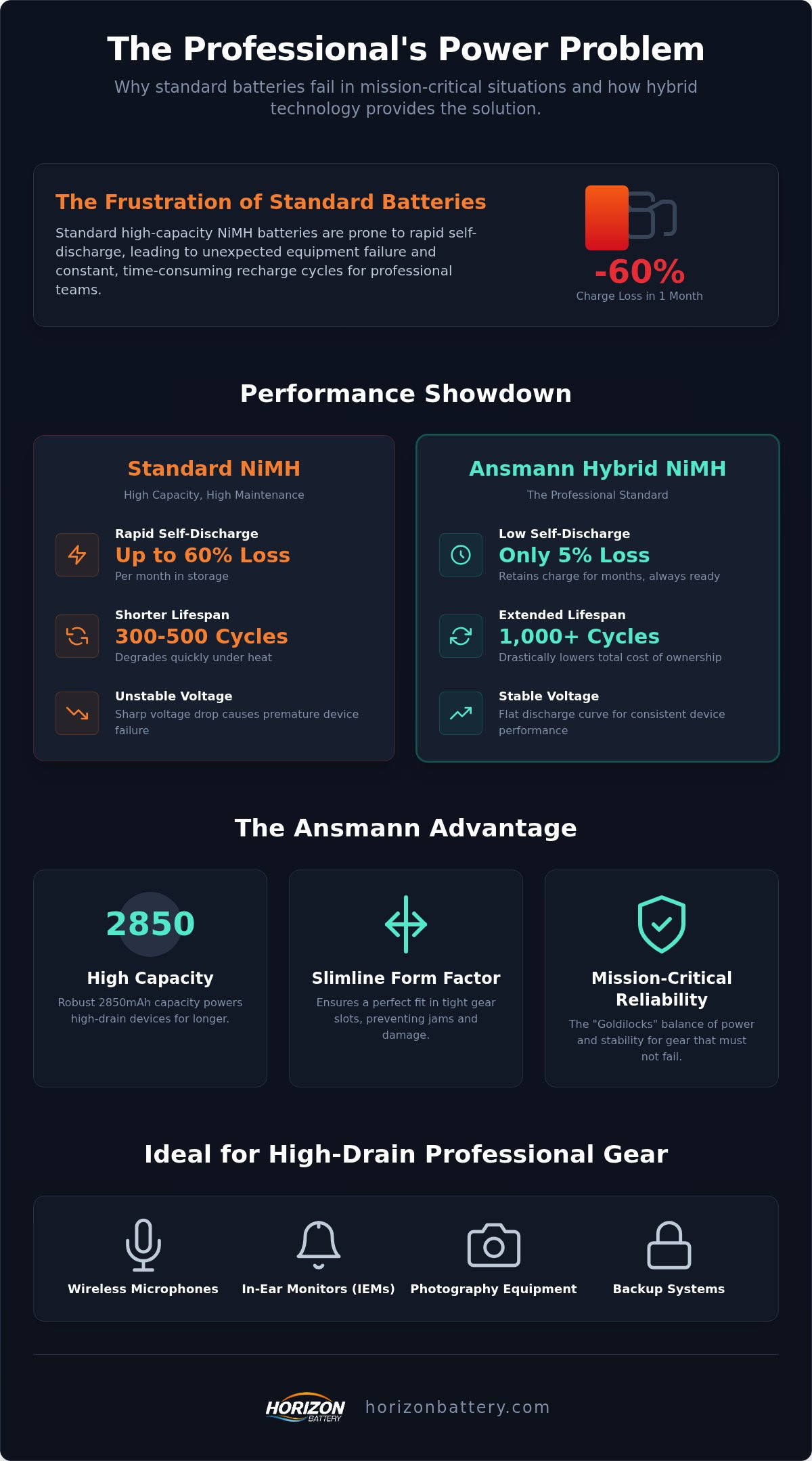
Did you know that standard high-capacity NiMH batteries can lose up to 60% of their charge in a single month while sitting idle in a gear drawer? For AV professionals and production teams, this leads to the constant frustration of mid-performance failures and the endless cycle of recharging gear before every event. Utilizing Ansmann hybrid NiMH technology addresses these power gaps by combining high capacity with low self-discharge stability. You need power that stays ready until the moment you hit the stage. It's a common challenge that often results in the frequent replacement of low-cycle consumer batteries.
We understand that reliability is the most important factor when managing a professional battery fleet. This guide explains why these cells have become the industrial standard for mission-critical gear. You'll discover how to eliminate downtime by maintaining a low 5% monthly self-discharge rate. We will also examine how to extend your fleet's lifespan to over 1,000 cycles while ensuring your high-drain devices have the steady power they require. This overview provides the technical context you need to secure your power supply for any large-scale deployment.
Key Takeaways
- Understand why the "Goldilocks" balance of high capacity and shelf stability makes hybrid technology the industry standard for professional use.
- Compare the 5% monthly discharge rate and 1,000-cycle lifespan of Ansmann hybrid NiMH cells against standard consumer-grade rechargeables.
- Identify the best applications for 2850mAh cells, including wireless microphones, IEMs, and high-drain photography equipment.
- Learn how to optimize your battery fleet's ROI by implementing smart charging practices that prevent thermal stress and overcharging.
- Discover the benefits of partnering with an authorized distributor to ensure genuine cell quality and long-term technical reliability.
What is Ansmann Hybrid NiMH Technology?
Ansmann hybrid NiMH technology represents a significant shift in how professional battery fleets are managed. Historically, users had to choose between high energy density and shelf stability. Traditional cells provided high capacity but suffered from rapid self-discharge; conversely, early low-discharge options lacked the "punch" needed for high-drain electronics. Ansmann engineered a solution that eliminates this compromise. By utilizing a specialized low-self-discharge nickel-metal hydride battery chemistry, these cells provide a robust 2850mAh capacity while remaining ready for use months after their last charge.
The engineering behind Ansmann differs from generic consumer-grade batteries through its focus on physical and chemical consistency. Many high-capacity cells are physically larger, which causes them to jam in tight professional gear slots. Ansmann's Slimline form factor ensures these 2850mAh batteries fit perfectly in wireless microphone beltpacks and IEM receivers without the need for forced insertion or removal. This attention to detail makes them the preferred choice for industrial applications where equipment downtime isn't an option. It's a professional-grade power source designed for the rigors of touring and permanent installations.
The Evolution of NiMH Chemistry
The journey to hybrid technology involved solving a persistent chemical trade-off. Traditional NiMH batteries offer high capacity but can lose up to 60% of their charge in just 30 days. This forced technicians to recharge entire fleets immediately before every event. Standard LSD batteries stabilized the charge but typically capped capacity at approximately 2000mAh. The Ansmann hybrid NiMH breakthrough achieved the high-capacity 2850mAh threshold while maintaining the low-discharge stability previously only found in much smaller cells.
Why "Hybrid" Matters for Professional Reliability
In a professional environment, reliability is measured by readiness. Hybrid NiMH serves as the technical bridge between high-capacity output and the long-term storage stability required for mission-critical deployments. Because these cells retain their charge, gear remains operational even after weeks in storage. This stability reduces the need for frequent "top-off" charging. Constant recharging of partially full batteries can lead to thermal stress and chemical degradation over time. By minimizing unnecessary cycles, users can realistically reach the 1000-cycle lifespan promised by the Ansmann professional series.
Ansmann Hybrid vs. Standard NiMH: A Performance Comparison
Standard high-capacity NiMH batteries often fail professional users because of their chemistry's inherent instability. While a traditional cell might boast high initial capacity, it typically loses up to 60% of that energy every month it sits idle. In contrast, Ansmann hybrid NiMH cells are engineered to retain their charge, losing only 5% of their capacity over the same period. This difference isn't just about convenience; it represents a fundamental shift in reliability for equipment that must remain ready for immediate deployment.
Voltage stability is another critical differentiator. Professional AV gear requires a flat discharge curve to maintain consistent performance throughout a shift. Standard cells often experience a sharp voltage drop once they reach 50% capacity, causing wireless microphones to chirp or fail unexpectedly. Hybrid cells maintain a higher, more consistent voltage under load, ensuring that your equipment performs predictably until the battery is nearly empty. If you're managing a large-scale event, you can browse our AA Rechargeable Batteries - High Capacity to see how these professional specs translate to real-world reliability.
The 5% Monthly Discharge Advantage
The low self-discharge rate provides significant operational savings. In a typical production environment, technicians spend hours "topping off" batteries that have sat in storage for a few days. With low self-discharge rechargeable batteries, this labor-intensive process becomes unnecessary. Gear pulled from a drawer after three weeks is still at 95% capacity. This stability is vital for emergency backup systems and "standby" equipment where immediate power is a requirement rather than a luxury.
Recycle Counts and Long-Term ROI
Investing in professional-grade cells drastically reduces the total cost of ownership. Standard high-capacity consumer batteries often degrade after 300 to 500 cycles because they can't handle the internal heat generated during heavy use. Ansmann hybrid cells are rated for 1000+ recycles. This longevity is supported by superior thermal management, which protects the internal chemistry from the stresses of fast charging. Technical reports on Charging and Maintenance highlight how proper heat dissipation and cycle management are the primary drivers of NiMH longevity. By doubling or tripling the usable life of each cell, you reduce both your hardware budget and your environmental footprint through decreased battery waste.
Critical Applications for Ansmann Hybrid 2850mAh
In high-stakes environments, the choice of power source determines the success of a production or operation. Wireless microphones and In-Ear Monitor (IEM) systems are particularly sensitive to voltage fluctuations. These devices require a consistent power supply to maintain signal integrity over 4 to 8-hour shifts. Because Ansmann hybrid NiMH cells provide a stable 1.2V discharge curve, they prevent the audio dropouts and "low battery" warnings that plague lower-capacity alternatives. This reliability extends to medical and emergency gear, such as portable monitors and scanners, where a battery failure is not merely an inconvenience but a critical risk.
Industrial handheld devices also benefit from the endurance of 2850mAh cells. Scanners and testers used in warehouse or field environments must survive full workdays without mid-shift battery swaps. Academic research into low self-discharge NiMH battery technology confirms that this classification of chemistry is uniquely suited for devices that alternate between periods of high-drain activity and long-term standby. This makes the hybrid cell a versatile asset across diverse professional sectors.
Standardizing Power for Church and School AV
Volunteer-run organizations often struggle with "dead mic" syndrome, where equipment is left in storage for days only to fail during a service or assembly. Ansmann Hybrid cells solve this by retaining 95% of their charge for up to a month. Their Slimline design is a functional necessity here; it ensures the batteries fit easily into various battery compartments, from older Sennheiser packs to modern Shure digital transmitters. To maximize your fleet's efficiency, we recommend implementing a simple workflow:
- Utilize color-coded battery storage cases to separate "ready" cells from "depleted" ones.
- Rotate your inventory so that no single set of batteries bears the entire workload.
- Perform a capacity test once per quarter to identify and retire aging cells.
High-Drain Performance in Digital Media
Professional photography demands peak current delivery, especially during rapid-fire flash sequences. A 2850mAh capacity is the recognized threshold for professional-grade digital camera performance, providing the necessary energy for fast flash recycle speeds. While some photographers may consider the Pure Power Series for specific lithium-ion requirements, the hybrid NiMH remains the industrial standard for those who prioritize a 1000-cycle lifespan and consistent standby readiness. These cells ensure that your flash is ready to fire the moment you pull your camera from the bag, even after weeks of storage between assignments.
Optimizing Life Cycles: Charging and Maintenance
Achieving the 1,000-cycle potential of Ansmann hybrid NiMH cells requires more than just high-quality hardware. It demands a charging strategy that prioritizes chemical health over sheer speed. Smart chargers utilize negative delta V (-∆V) detection to stop the charging process the moment a cell reaches its full capacity. This prevents overcharging, which is the leading cause of internal pressure buildup and electrolyte leakage in high-capacity batteries. Avoiding "dumb" chargers that rely on simple timers is essential for preserving the integrity of the 2850mAh chemistry.
Storage conditions also play a vital role in maintaining low self-discharge properties. While these cells are designed for shelf stability, extreme heat can accelerate chemical degradation and increase the discharge rate. We recommend storing your battery fleet in a cool, dry environment between 10°C and 25°C. For organizations managing large inventories, you can explore our Charger / Battery Bundles to ensure your maintenance hardware matches the quality of your power cells.
Using Custom Rackmount Chargers for Fleet Management
For organizations managing 50 or more batteries, individual desktop chargers create a logistical bottleneck. Custom Rackmount Chargers provide a centralized, professional infrastructure that streamlines the workflow for tech teams. These systems offer independent multi-channel monitoring, allowing a technician to see the specific health status of every cell in the rack. If a battery has reached its end-of-life or shows high internal resistance, the charger flags it for replacement. This proactive approach ensures that faulty cells are removed from the rotation before they can cause a failure during a live event.
Maintenance Routines for Maximum Longevity
Modern NiMH chemistry has largely eliminated the "memory effect" found in older nickel-cadmium cells. However, voltage depression can still occur if batteries are consistently subjected to shallow discharge cycles. To combat this, we recommend a "refresh" or "recondition" cycle every six months. This process involves a full discharge followed by a controlled recharge to recalibrate the chemical balance. You should also regularly check terminal cleanliness. Wipe the battery contacts with a dry, lint-free cloth to remove oils and oxidation. This simple step ensures optimal current transfer and prevents the charger from misreading the battery's voltage due to contact resistance.
Why Professionals Source Ansmann from Horizon Battery
Choosing a power partner is as important as selecting the hardware itself. As an authorized distributor, Horizon Battery ensures that every 2850mAh cell in your order is a genuine product direct from the manufacturer. This is critical in a professional market where counterfeit or lower-grade cells are often passed off as high-capacity equipment. We've served churches, schools, and production houses since 1998, providing the industry-specific expertise required to manage large-scale battery deployments. Our role isn't just to sell a product; we act as a knowledgeable guide for your technical team. We offer technical guidance for professional battery asset management, helping you track cycle counts and maximize the return on your investment.
Our reach extends across the United States and Canada, maintaining a professional-grade inventory that's ready for immediate shipping. We provide comprehensive solutions that scale with your needs, from individual cells for small kits to Custom Rackmount Chargers for permanent installations. Beyond the power cells, we offer specialized Battery Storage and organization solutions to help facilities maintain order. Every professional Ansmann cell we provide is backed by a 2-year warranty, reflecting our confidence in the 1000-cycle lifespan. This long-term support turns a simple purchase into a strategic investment in your facility's operational reliability.
The Horizon Battery Advantage
When you partner with a veteran distributor, you gain access to a decade of mobile energy experience. We understand the specific pressures of live sound and broadcast environments. Our inventory is curated to include only the highest-performing cells, such as the Ansmann hybrid NiMH series, which has been tested in the most demanding tour environments. We don't just provide batteries; we provide a system for reliability. This includes advising on the best rackmount solutions for your specific gear rack and ensuring your team has the organization tools needed to prevent lost or mismatched cells.
Getting Started with a Hybrid Fleet
Transitioning to an Ansmann hybrid NiMH fleet is a straightforward process that begins with assessing your current power consumption. If you're currently relying on alkaline disposables or standard NiMH cells, the first step is selecting a charging infrastructure that can support your volume. We recommend starting with one of our Charger / Battery Bundles to ensure your hardware is perfectly matched to the hybrid chemistry. When you move away from high-waste alkaline systems, you aren't just saving money; you're also streamlining your facility's workflow. You can begin the transition by replacing your most frequently used mic packs first, then expanding to secondary gear as your budget allows. This phased approach lets you see the immediate ROI of high-capacity cells without a massive upfront overhaul. Explore our Ansmann Hybrid NiMH selection and professional bundles today.
Securing Your Professional Power Infrastructure
Transitioning to a high-capacity LSD system is a strategic move for any production environment. By choosing Ansmann hybrid NiMH technology, you solve the dual problem of rapid self-discharge and insufficient power for high-drain devices. These cells provide a true 2850mAh capacity while maintaining the shelf stability required for critical standby equipment. It's a solution that balances high performance with long-term reliability.
Since 1998, Horizon Battery has served as a veteran resource for churches, schools, and professional AV teams. As an authorized Ansmann distributor, we provide the genuine hardware and technical expertise needed to manage large-scale battery deployments effectively. Implementing a fleet of these industrial cells ensures your gear is ready the moment the curtain rises. You can trust our decades of experience to guide your selection of cells and charging infrastructure.
Upgrade your gear with professional Ansmann Hybrid NiMH batteries and experience the reliability of a power system designed for mission-critical performance. We look forward to helping you optimize your facility's mobile energy needs.
Frequently Asked Questions
What is the difference between Ansmann Hybrid and standard NiMH batteries?
Hybrid technology integrates low self-discharge properties into a high-capacity nickel metal hydride chemistry. Standard NiMH cells often lose a significant portion of their charge while sitting idle, but hybrid cells retain their energy for months. This makes the Ansmann hybrid NiMH version superior for professional equipment that isn't used every day but must remain ready for immediate deployment without a last-minute recharge.
How long do Ansmann Hybrid 2850mAh batteries hold their charge in storage?
These batteries are engineered to retain approximately 95% of their charge after one full month of storage. Even over longer periods, the discharge rate remains remarkably slow compared to traditional rechargeable cells. This shelf stability ensures that gear pulled from a storage locker after several weeks remains operational, providing peace of mind for event technicians who manage large, rotating equipment inventories.
Can I use a standard NiMH charger for Ansmann Hybrid batteries?
You can use standard chargers, but professional results require an intelligent "smart" charger with negative delta V detection. Basic chargers often rely on simple timers that can lead to overcharging or thermal stress. To protect your investment and reach the maximum cycle life of your cells, we recommend using a charging system that monitors each battery channel independently to prevent chemical degradation.
Are Ansmann Hybrid batteries suitable for high-drain wireless microphones?
They are specifically designed for the high-drain demands of wireless microphones and IEM systems. The 2850mAh capacity provides the necessary runtime for long shifts, while the stable voltage curve prevents the sudden drop-outs common with lower-quality cells. They are currently the primary choice for professional AV technicians in high-stakes environments where consistent signal strength is a non-negotiable requirement for the production.
How many times can I recharge Ansmann Hybrid NiMH batteries?
Ansmann hybrid NiMH batteries are rated for up to 1,000 recharge cycles. This longevity significantly reduces the total cost of ownership compared to consumer-grade batteries that often fail after only 300 cycles. Maintaining proper charging habits and avoiding extreme temperatures are the keys to reaching this high recycle count, ensuring your battery fleet remains a reliable asset for several years of heavy use.
Do Ansmann Hybrid batteries suffer from memory effect?
Modern hybrid chemistry has virtually eliminated the "memory effect" found in older nickel-cadmium technology. However, consistently shallow discharges can sometimes lead to a condition known as voltage depression. We recommend performing a full discharge and refresh cycle every six months. This maintenance step keeps the chemical balance optimized and ensures the cells continue to provide peak performance throughout their entire operational lifespan.
What is the "Slimline" design in Ansmann 2850mAh batteries?
The Slimline design refers to the precise physical dimensions of the cell, ensuring it meets strict AA standards. Many high-capacity batteries are slightly oversized, which causes them to jam in tight microphone battery compartments or handheld scanners. Ansmann's design ensures a perfect fit in all professional gear without the risk of physical damage to the device or the battery casing during insertion or removal.
Why should professionals choose 2850mAh capacity over lower LSD options?
Professionals choose the 2850mAh capacity because it provides the maximum possible runtime without sacrificing the benefits of low self-discharge. While lower-capacity LSD batteries exist, they often fail to power high-drain devices for a full 8-hour shift. The 2850mAh threshold offers the necessary energy density for mission-critical applications while maintaining the professional reliability required for large-scale deployments in churches, schools, and theaters.