
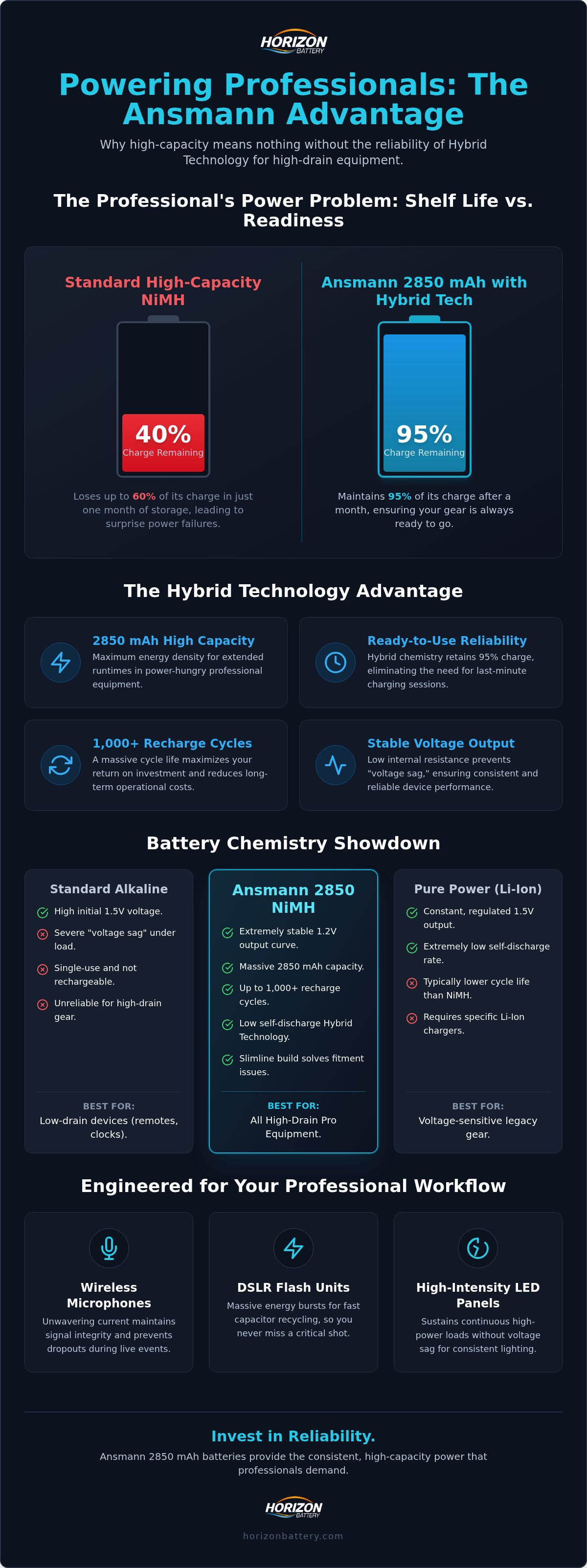
Standard high-capacity NiMH batteries can lose up to 60% of their charge in a single month of storage, leaving professionals in the lurch during critical events. If you've ever faced a flashing "low battery" light midway through a live broadcast or found that your spares drained while sitting in a gear bag, you understand the frustration of unreliable power. Many production teams now find themselves evaluating the Ansmann 2850 mAh vs Pure Power Series to determine which chemistry best supports their specific workflow and hardware constraints.
We've spent years as a dedicated distributor for professional power solutions, and we know that capacity means nothing without consistency. This guide explains how Ansmann 2850 mAh technology utilizes hybrid engineering to bridge the gap between massive energy density and the dependable performance required for high-drain applications. You'll discover how these slimline cells solve fitment issues in narrow wireless mic slots while providing up to 1,000 recharge cycles. We will break down the technical differences between established NiMH reliability and the newer lithium-ion alternatives to help you lower long-term operating costs and ensure your gear never cuts out when it matters most.
Key Takeaways
- Understand how Ansmann Hybrid technology maintains a 95% charge after a month of storage, eliminating the unreliability of standard high-capacity NiMH cells.
- Compare the technical specifications of the Ansmann 2850 mAh vs Pure Power Series to determine whether NiMH or lithium-ion chemistry is better suited for your specific gear.
- Solve fitment issues in narrow equipment slots with slimline cell engineering that meets strict AA dimensional standards without sacrificing runtime.
- Maximize your return on investment by achieving up to 1,000 recharge cycles in high-drain devices like wireless microphones and DSLR flash units.
- Learn how to standardize your battery fleet and implement enterprise charging solutions to reduce technical confusion during live events.
The High-Drain Challenge: Why Professional Gear Demands 2850 mAh Performance
Professional production environments operate on a different scale than consumer electronics. While a household remote might draw a few microamps, equipment like wireless microphone transmitters and DSLR flashes requires a sustained, high-current draw. This is the definition of a high-drain application. In these scenarios, the battery must deliver significant power without its voltage dropping below the device's operational threshold. When comparing the Ansmann 2850 mAh vs Pure Power Series, the choice often hinges on how a specific device handles these intense energy demands.
Identifying High-Drain Professional Equipment
Wireless microphone transmitters are perhaps the most demanding tools in a pro-audio kit. They require a constant, unwavering current to maintain signal integrity over several hours. If the voltage wavers even slightly, the transmitter may experience frequency drift or complete signal dropout. Similarly, professional photography strobe units demand massive bursts of energy to recharge capacitors quickly. A battery that cannot keep up leads to longer recycle times, causing photographers to miss critical shots during live events. High-intensity LED lighting panels also fall into this category, as they pull a continuous load that can quickly deplete low-quality cells.
Why Standard AA Batteries Fail Under Pressure
The most common issue with consumer-grade batteries is "voltage sag." This occurs when the internal resistance of the battery is too high to handle the current being pulled. As the load increases, the voltage drops. Standard alkaline batteries are particularly prone to this. While they may start at 1.5V, their voltage drops rapidly under continuous use, often falling below the 1.1V cutoff most professional gear requires within minutes. Nickel-metal hydride (NiMH) battery technology was designed to address this by offering a much flatter discharge curve.
Ansmann 2850 mAh cells represent the current peak of reliable NiMH energy density. Unlike many consumer rechargeables that boast high numbers but fail to deliver under load, these cells are engineered for low internal resistance. This ensures that the labeled capacity matches the usable capacity in the field. Professionals don't just need a battery that lasts; they need one that stays above the required voltage until the very end of the charge cycle. Understanding the nuances of the Ansmann 2850 mAh vs Pure Power Series helps technicians select the chemistry that provides the most stable performance for their specific rack or camera bag.
Inside the Engineering: How Ansmann Solves the High-Capacity Self-Discharge Problem
High capacity used to come with a significant trade-off. In the early years of NiMH development, a higher milliamp-hour rating almost always meant a higher self-discharge rate. Technicians frequently found that batteries charged on a Friday were half-empty by Monday morning. Ansmann solved this by developing Hybrid technology, which combines the massive energy density of 2850 mAh cells with the stability of low self-discharge chemistry.
The difference in performance is measurable. While standard high-capacity cells can lose 60% of their charge within a single month of storage, Ansmann’s engineering limits that loss to just 5%. This reliability is why the comparison of Ansmann 2850 mAh vs Pure Power Series isn't just about total capacity, but about operational readiness. If your gear sits in a flight case between shows, you need a cell that remains ready to work without a last-minute refresh.
The Hybrid Advantage Explained
The secret lies in the specialized chemical separator. This physical barrier between the positive and negative electrodes uses high-purity materials designed to prevent the internal micro-discharges that plague lower-quality cells. By refining this barrier, Ansmann reduced internal resistance, which helps the battery maintain stability during performance tests in high-drain devices. Hybrid NiMH stands as the definitive standard for ready-to-use professional power.
Cycle Life and Longevity Factors
Most high-capacity batteries utilize thinner internal components to make room for more active material, which usually results in a shorter overall lifespan. Ansmann mitigated this by focusing on chemical purity and thermal stability. These cells are rated for up to 1000 recharge cycles, even when used in demanding professional environments. When evaluating the Ansmann 2850 mAh vs Pure Power Series for long-term use, the NiMH option often provides a superior cycle count for daily-use gear.
Managing heat during the charging process is vital; excess heat breaks down the chemical lattice of the battery over time. By using high-purity materials, Ansmann ensures the battery stays cooler under load and during fast-charging cycles. This engineering focus provides a significantly better return on investment than standard alkaline options. If you're ready to upgrade your equipment, consider investing in Ansmann high-capacity solutions to ensure your gear has the power it needs. For those managing large inventories, choosing professional charging solutions ensures these cells reach their full 1000-cycle potential.
Ansmann 2850 mAh vs Pure Power Series: Choosing the Right Chemistry
Selecting the ideal power source for professional gear often comes down to the trade-off between raw capacity and voltage regulation. The comparison of the Ansmann 2850 mAh vs Pure Power Series highlights two distinct approaches to fundamental battery chemistry. NiMH cells like the Ansmann 2850 mAh are designed for devices that can handle a standard 1.2V discharge curve while providing the highest possible runtime. In contrast, Lithium-ion options offer a regulated output that remains consistent until the cell is depleted.
For many standard-voltage applications, the Ansmann 2850 mAh remains the industry workhorse. It provides a massive energy reservoir that excels in high-drain environments where total milliamp-hour (mAh) capacity is the primary metric for success. As digital transmitters become more sensitive to voltage drops, the decision-making process becomes more nuanced for technical directors and sound engineers alike.
Understanding the 1.5V Lithium-ion Advantage
The Pure Power Series addresses a specific pain point: early low-battery warnings. Many professional devices are calibrated for 1.5V alkaline cells. These units may signal a "low battery" state when a standard NiMH cell drops toward 1.1V, even if plenty of capacity remains. Pure Power batteries use internal circuitry to regulate output at a constant 1.5V. These cells are also significantly lighter than NiMH, improving ergonomics for handheld gear like wireless microphones or portable recorders. These Lithium-ion cells require dedicated chargers and aren't compatible with standard NiMH-only units.
Total Cost of Ownership (TCO) Analysis
When businesses evaluate the ROI of their power solutions, the numbers favor high-capacity rechargeables. A single Ansmann 2850 mAh set can replace up to 1,000 alkaline batteries over its operational lifespan. This shift drastically reduces physical waste and lowers long-term operating costs. When analyzing the Ansmann 2850 mAh vs Pure Power Series from a financial perspective, the return on investment becomes clear for both technologies. While the upfront investment for a professional Lithium-ion system might be higher, the consistent performance and reduced weight often justify the cost for high-stakes production environments. Standardizing on enterprise-grade rechargeables is a strategic move detailed in our Switching to Rechargeable Batteries: 2026 Business Guide.
Operational Excellence: Dimensions and Fitment in Professional Gear
Professional gear is built with tight tolerances to ensure electronics are protected and connections are secure. However, this precision creates a significant hurdle for many high-capacity rechargeable batteries. A common issue in the field is the "thick battery" problem. As manufacturers try to squeeze more active material into a cell to reach 2500 mAh or higher, the physical diameter of the battery often increases slightly. This extra fraction of a millimeter is enough to make a battery get stuck inside a wireless microphone or a camera grip.
Ansmann addressed this directly with their Slimline engineering. By refining the internal construction and the outer jacket thickness, they managed to maintain the 2850 mAh capacity while strictly adhering to international AA dimensional standards. When evaluating the Ansmann 2850 mAh vs Pure Power Series, technicians must consider that both lines are designed to avoid these fitment issues, ensuring they slide in and out of equipment without resistance. You can find detailed measurements and technical drawings in our Ansmann High Capacity Batteries: 2026 Professional Guide.
The Slimline Design Advantage
The tolerance limits of professional battery compartments leave no room for error. If a battery is too wide, it can put pressure on the internal spring terminals or even crack the battery sled. Ansmann maintains the 2850 mAh capacity without increasing the cell diameter by using higher-density materials and a more efficient internal layout. Dimensionally accurate cells prevent mechanical failure and housing damage in wireless microphone transmitters. This reliability is vital during fast-paced live events where a battery swap must happen in seconds.
Gear Compatibility List
Ensuring your battery fleet is compatible with your entire inventory reduces operational friction. The Ansmann 2850 mAh series is widely tested for fitment across several categories:
- Audio Gear: Shure, Sennheiser, and AKG wireless transmitters and belt packs.
- Photography: Professional camera battery grips and external flash power packs.
- Industrial Tools: Handheld barcode scanners, data collection terminals, and portable test equipment.
Fitment is ultimately a safety and reliability issue. Forcing a battery into a slot can lead to terminal damage or, worse, the need for tools to extract a stuck cell during a performance. Whether you choose the Ansmann 2850 mAh vs Pure Power Series, you're investing in a cell designed for the rigorous demands of professional hardware. If you need to refresh your inventory with cells that actually fit your gear, view our full range of AA rechargeable batteries today to find the right match for your equipment.
Implementing Ansmann 2850 mAh into Your Professional Workflow
Standardizing your power inventory is the final step in achieving operational reliability. When managing a large facility, mixing battery brands and chemistries leads to technical confusion and equipment downtime. By committing to a specific ecosystem, you ensure that every staff member knows exactly which charger to use and how long a cell will last in the field. This is particularly important when navigating the choice between the Ansmann 2850 mAh vs Pure Power Series, as these differing chemistries require specific charging protocols to maintain peak health.
A unified fleet simplifies logistics during high-pressure events. When every wireless transmitter uses the same high-capacity NiMH cell, your team can predict runtime with much greater accuracy. This consistency eliminates the guesswork that often leads to premature battery swaps or, worse, mid-show power failures. Proper implementation turns your battery inventory from a recurring expense into a reliable asset.
Enterprise Charging Infrastructure
Scaling up your operations requires moving beyond individual wall-mounted chargers. For churches, schools, and theaters, Enterprise Battery Charging Solutions like multi-channel rackmount systems provide a centralized power hub. These systems offer more than just speed; they include essential "Refresh" and "Test" modes. These features are critical for maintaining the health of 2850 mAh cells by deep-cycling them to eliminate voltage depression. Centralizing your power management allows technical directors to verify that every battery in the rack is fully conditioned and ready for the next performance.
Developing a Rotation Strategy
Implementing a strict rotation strategy is the most effective way to maximize your return on investment. We recommend color-coding your battery sets or using small labels to track their purchase date and cycle count. This lifecycle management ensures that you aren't accidentally pairing a brand-new cell with one that has already seen 800 cycles. Scheduled testing should be a part of your monthly routine to identify and retire underperforming cells before they fail during a live event.
Training your production staff on proper handling is equally important. NiMH batteries perform best when they aren't left in a completely discharged state for long periods. While the Ansmann 2850 mAh vs Pure Power Series comparison often focuses on raw capacity, the long-term ROI is determined by how well you manage your inventory. Proper storage protocols and consistent charging habits will ensure your fleet reaches its full 1,000-cycle potential, keeping your operating costs significantly lower than any alkaline-based workflow.
Securing Your Professional Power Infrastructure
Professional production demands more than just raw capacity; it requires a reliable energy ecosystem that works every time you hit the power switch. By utilizing Hybrid technology, Ansmann has eliminated the reliability issues of traditional NiMH, offering a cell that loses only 5% of its charge per month. This ensures your spares are ready for use even after sitting in storage. Additionally, the slimline engineering guarantees that these high-capacity cells fit perfectly into the precision-machined battery slots of your most sensitive wireless gear.
Choosing between the Ansmann 2850 mAh vs Pure Power Series allows you to tailor your power fleet to specific device requirements and voltage needs. Since 1998, we've acted as a knowledgeable guide for pro-audio and industrial users, providing the expertise needed to implement enterprise-level charging and rotation strategies. This structured approach protects your investment and ensures you achieve the full 1,000-cycle potential of these professional cells. Upgrade your production gear with Ansmann 2850 mAh Performance cells today and experience the peace of mind that comes with industry-leading true capacity. We look forward to helping you power your next successful event.
Frequently Asked Questions
Is the Ansmann 2850 mAh battery compatible with standard NiMH chargers?
Yes, the Ansmann 2850 mAh is fully compatible with all standard NiMH chargers. Since it uses established Nickel-Metal Hydride chemistry, you don't need specialized equipment to maintain these cells. However, when evaluating the Ansmann 2850 mAh vs Pure Power Series, it's vital to remember that the Pure Power line requires a dedicated charger. For the 2850 mAh NiMH cells, any high-quality smart charger will safely manage the charging process.
What is the difference between Ansmann 2850 mAh Slimline and standard versions?
The primary difference lies in the external diameter of the battery casing. Standard high-capacity cells often exceed official AA dimensions to pack in more active material, which can cause them to get stuck in tight equipment slots. The Slimline version is engineered with a thinner jacket and refined internal layout to ensure a perfect fit in narrow wireless microphone transmitters. This precision prevents mechanical damage to expensive gear during high-pressure live events.
How long will an Ansmann 2850 mAh battery last in a wireless microphone?
You can generally expect between 8 and 10 hours of continuous use, depending on your specific transmitter's current draw. High-drain digital systems from brands like Shure or Sennheiser benefit significantly from this high capacity. While lower-capacity cells might fail after 5 or 6 hours, these professional-grade batteries provide the extra headroom needed for long rehearsals or multi-set performances without requiring a risky mid-show battery swap.
Does the Ansmann 2850 mAh have a memory effect?
No, modern NiMH technology, including the Ansmann 2850 mAh series, does not suffer from the memory effect that plagued older Nickel-Cadmium batteries. You can recharge these cells at any stage of their discharge cycle without reducing their total capacity. To maintain peak performance over several years, we recommend using a smart charger with a refresh mode every few months. This process conditions the chemistry and helps maintain optimal voltage levels for your gear.
Can I use Ansmann 2850 mAh batteries in low-drain devices like remote controls?
You can certainly use them in low-drain devices, but it isn't the most efficient use of the technology. These batteries are specifically engineered for high-current applications where power density is critical. In a remote control or wall clock, the high capacity is largely wasted. You'll get better value by reserving these cells for professional gear like camera flashes and wireless microphones that actually require the 2850 mAh output to function correctly.
What happens if I leave my Ansmann batteries in storage for several months?
Thanks to Ansmann Hybrid technology, these batteries will retain most of their charge even after sitting in a gear bag for several months. While standard NiMH cells can lose up to 60% of their energy in 30 days, these professional cells lose only about 5% per month. If you pull them out after a quarter of storage, they'll still have plenty of power for an emergency, though we suggest a top-off for critical events.
Why should I choose 2850 mAh over lower capacity options like 2100 mAh?
Choosing 2850 mAh provides approximately 35% more runtime than 2100 mAh cells in high-drain environments. When comparing the Ansmann 2850 mAh vs Pure Power Series or lower-capacity NiMH alternatives, the primary benefit is the extended operational window. This extra capacity is often the difference between finishing a three-hour broadcast on one set of batteries or being forced to stop for a battery swap during a live signal.
How many times can I realistically recharge the Ansmann 2850 mAh?
You can realistically expect up to 1,000 recharge cycles when using proper charging and storage protocols. This longevity provides a massive return on investment compared to disposable alkaline batteries. To reach this number, you should avoid over-discharging the cells and use a high-quality smart charger that prevents overheating. In a professional workflow with daily use, a single set can reliably power your equipment for several years before needing replacement.