
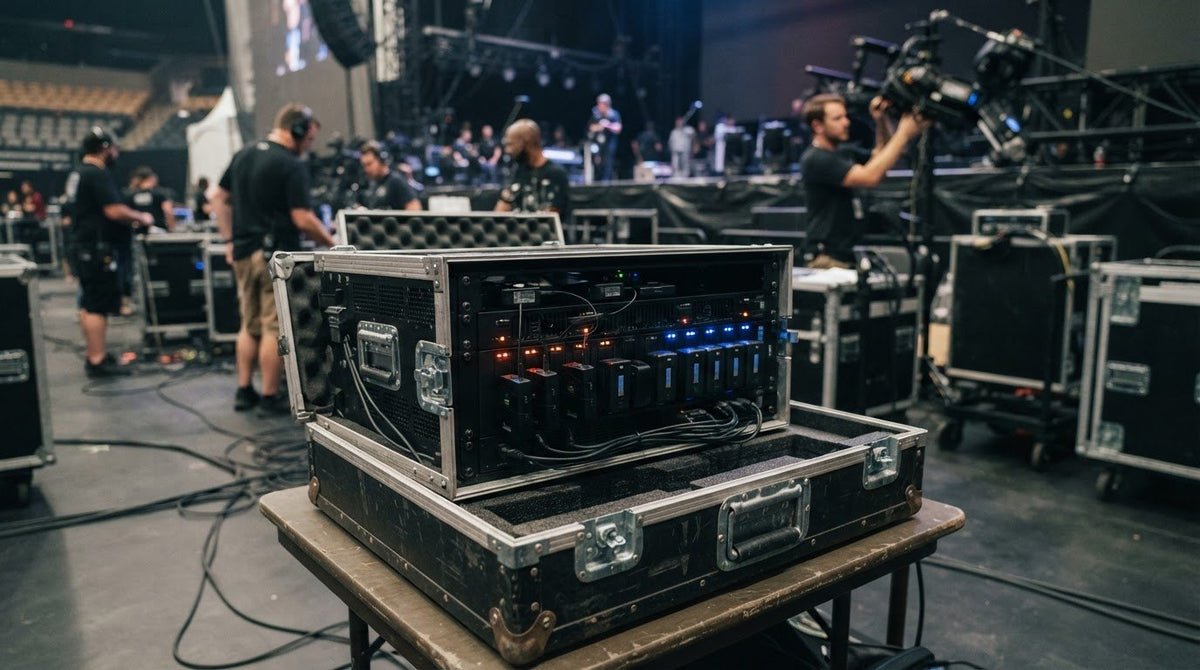
Pumping brute amperage into depleted cells isn't the secret to fast backstage turnarounds; true rapid charging protects cell longevity through intelligent thermal monitoring rather than raw current. If you've ever waited on sluggish six-hour consumer chargers, watched heat shorten transmitter runtimes, or sorted through tangled webs of loose desktop docks minutes before call time, you know the frustration. Touring rigs and broadcast facilities require dedicated rapid charging stations for wireless audio batteries that deliver swift turnarounds without compromising long-term cell stability.
You shouldn't have to risk your audio inventory just to keep packs powered between rehearsal and showtime. In this guide, you'll discover how to evaluate, select, and integrate professional rapid charging stations for wireless microphone and audio battery systems into your production workflow. We'll examine the structural shift toward custom rackmount bays inside road cases, outline the thermal safeguards needed for safe sub-two-hour replenishment, and show you how to maintain predictable cell telemetry for zero onstage audio dropouts.
Key Takeaways
- Learn how microprocessor-controlled rapid charging stations for wireless audio batteries manage thermal thresholds to prevent premature cell degradation during fast turnarounds.
- Discover why upgrading from scattered desktop docks to integrated custom rackmount chargers eliminates backstage cable clutter and streamlines workflow in production road cases.
- Master the critical specification matrix to balance per-bay current output against cell chemistry for safe, repeatable sub-two-hour cycles.
- Establish systematic cell rotation schedules and battery storage practices to maintain predictable telemetry and eliminate onstage audio dropouts.
- Understand the operational advantages of deploying matched Charger / Battery Bundles calibrated specifically for stable voltage delivery in wireless audio transmitters.
Core Architecture of Rapid Charging Stations for Wireless Audio Batteries
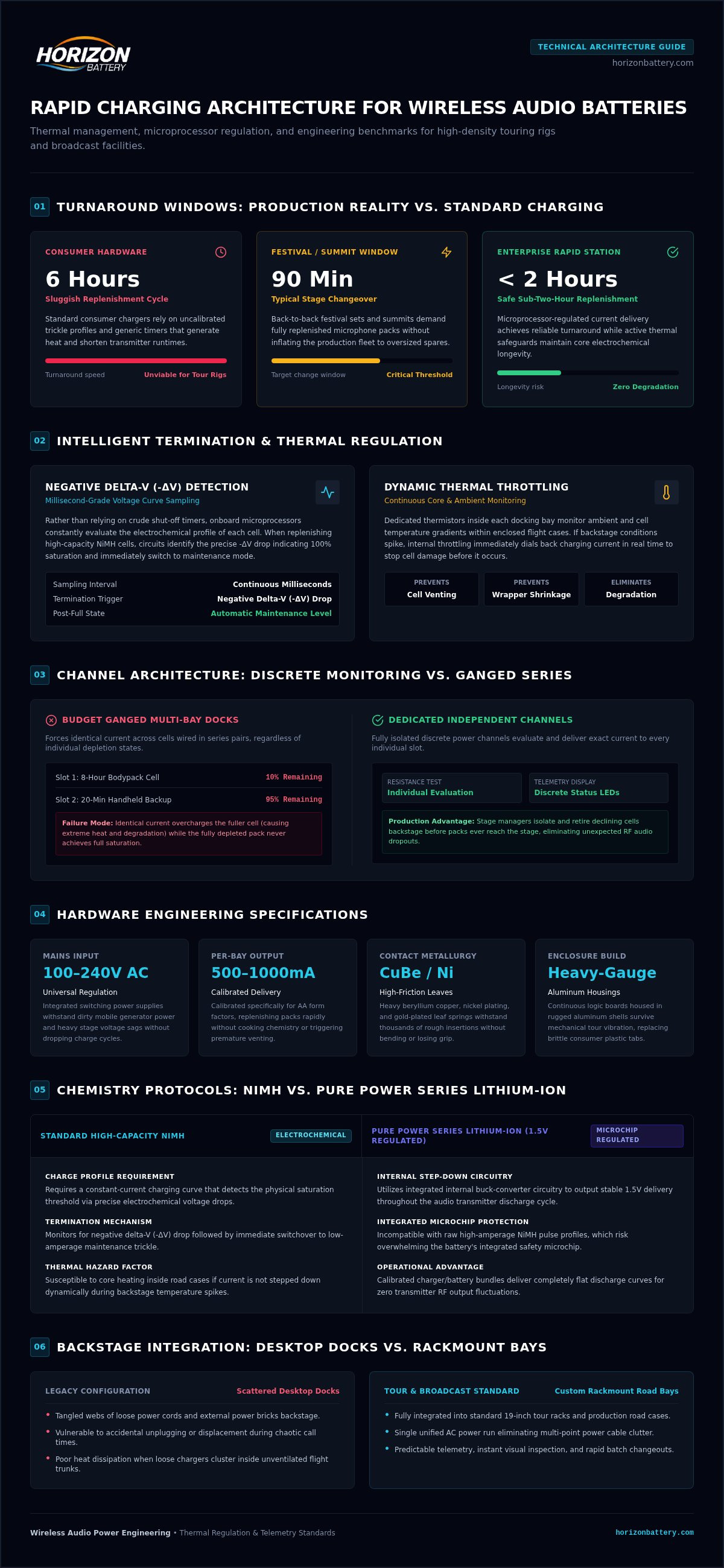
Commercial rapid charging stations for wireless audio batteries are purpose-built power distribution tools engineered to survive the mechanical grind of touring racks and back-to-back broadcast schedules. Standard consumer chargers rely on flimsy plastic tabs and generic trickle profiles that degrade under road conditions. In contrast, industrial charging stations utilize heavy-gauge aluminum housings, gold-plated leaf springs, and continuous logic boards designed for thousands of rough insertions. During multi-act festivals or corporate summits with 90-minute changeovers, dependable high-speed turnaround keeps microphone transmitters online without requiring an oversized fleet of spare packs. Meeting these timelines requires deep compatibility with modern rechargeable battery technologies, where precise voltage and thermal curves dictate whether a cell lasts three seasons or three months.
Microprocessor-Controlled Termination and Thermal Regulation
Intelligent charging stations continuously analyze the electrochemical profile of each cell rather than relying on crude shut-off timers. When replenishing high-capacity NiMH cells, onboard microprocessors sample voltage curves milliseconds apart to identify the exact negative delta-V (-ΔV) drop that signifies full chemical saturation. Once detected, the circuit immediately drops to a maintenance level. Individual bay thermistors monitor ambient and core thermal gradients to prevent heat buildup inside enclosed flight cases. If temperatures spike backstage, internal current throttling steps down amperage in real time, preventing internal cell venting, wrapper shrinkage, and irreversible electrode degradation.
Independent Channel Monitoring vs Ganged Multi-Bay Docks
Budget chargers often gang charging slots together in series pairs, forcing identical current through two cells regardless of their actual state of charge. In professional wireless audio, where a bodypack transmitter runs for eight hours while a backup handheld runs for twenty minutes, paired bays are dangerous. Overcharging the fuller cell generates extreme heat, while the depleted cell never reaches capacity. Dedicated rapid charging stations for wireless audio batteries provide fully isolated, discrete channels for every dock. Each slot measures individual internal cell resistance, isolates declining units, and illuminates clear status LEDs so stage managers can retire exhausted batteries before they hit the stage.
Crucial Specifications to Evaluate in Professional Audio Charging Stations
Specifying enterprise hardware requires looking beyond raw slot count. Tour switchboards, dirty mobile generator power, and back-to-back festival schedules will quickly expose low-grade hardware. Reliable rapid charging stations for wireless audio batteries balance fast turnaround times against chemical safety margins while enduring physical punishment. To make an objective assessment, evaluate these primary electrical and mechanical criteria:
- Universal Mains Regulation: Switching power supplies with wide input acceptance (100-240V AC) to handle stage voltage sags without dropping the charge cycle.
- Current Output Per Bay: Calibrated current delivery (typically 500mA to 1000mA for AA form factors) that replenishes packs quickly without cooking internal chemistry.
- Industrial Contact Architecture: Heavy beryllium copper or nickel-plated contact leaves rated for thousands of high-friction insertions without bending or losing contact pressure.
Chemistry Compatibility: NiMH vs Pure Power Series Lithium-Ion
Cell chemistry dictates charge termination rules. Standard nickel-metal hydride cells require a constant current profile terminating on a voltage drop, whereas advanced 1.5V regulated lithium cells rely on internal buck-converter step-down circuitry. Feeding a high-amperage NiMH pulse profile into a lithium cell can overwhelm its integrated safety microchip. To review safe charge envelopes and voltage discharge curves, consult our Pure Power Series guide. Aligning charging protocols with institutional lithium-ion battery best practices prevents internal thermal runaway and ensures consistent wireless transmitter performance.
Charge Speeds and Turnaround Metrics for Production Schedules
Overnight trickle stations taking six to eight hours create severe bottlenecks during dual-show days. A true production-ready rapid station targets an 80% to 100% state of charge within a 90- to 120-minute turnaround window. This timeframe fits comfortably between soundcheck and house open. Once maximum capacity is reached, intelligent systems transition from rapid current to pulse-maintenance float modes. This ensures transmitters pulled after sitting docked for four hours are fully saturated, cool to the touch, and ready for immediate deployment.
Form Factor and Physical Housing Construction
Consumer desktop chargers rely on fragile plastic snaps that crack inside production trunks. Touring rigs demand extruded aluminum or steel chassis construction. Positive bay retention mechanisms, such as tensioned slide sleds or deep recessed cradles, prevent cells from jarring loose while rolling over arena thresholds. High-bay densities generate concentrated heat, making quiet internal ball-bearing fans and slotted aluminum louvers necessary to maintain stable operational temperatures backstage. If you want to configure a dependable rig for your venue, explore the commercial solutions available through Horizon Battery.
Desktop Multi-Bay Docks vs Custom Rackmount Chargers
Backstage real estate is notoriously limited. Between rack trunks, monitor desks, and production road cases, allocating tabletop space for charging gear quickly leads to operational bottlenecks. A common setup involves daisy-chaining consumer desktop multi-bay chargers across power strips, but this introduces loose wall adapters, fragile barrel connectors, and tangled wiring. A single bumped power strip can quietly knock out charging for a dozen transmitters. Choosing the right layout between modular docks and centralized hardware is a foundational step detailed in our guide to enterprise battery charging solutions.
Custom Rackmount Chargers for Centralized Wireless Racks
For touring rigs, broadcast mobile units, and large theatrical venues, integrated 19-inch rack units offer clear advantages over loose equipment. Custom rackmount chargers fit directly into standard road cases and equipment racks, sitting immediately alongside the wireless microphone receivers they support. This layout provides tangible benefits for daily production work:
- Single-Cable Power Integration: A single rear IEC or powerCON chassis connector replaces dozens of separate external wall adapters, drawing clean, regulated power directly from the rack's power distribution unit.
- Maximized Density in Small Footprints: Rackmount chargers consolidate up to 40 charging slots into a single 19-inch rack unit, saving valuable floor and desk space.
- Transit-Ready Durability: Solid metal faceplates and rigid internal chassis prevent bays from shifting during transit, keeping high-capacity cells securely seated over rough transport.
Centralizing your energy infrastructure directly inside the RF rack creates an efficient workflow. Audio crews pull depleted microphone packs from artists, drop the exhausted cells straight into the rack bay, and insert fresh pairs without walking across the stage.
Modular Desktop Docks for Distributed Breakout Stations
While rack-mounted solutions represent the enterprise standard for central RF racks, modular desktop docks still serve specific operational roles. Breakout corporate meeting spaces, satellite interview booths, and secondary side-stage podiums often operate only two to four wireless channels. In these scenarios, deploying a full 19-inch touring rack is impractical. Compact modular docks provide targeted power where space is tight, provided they are placed on ventilated, non-flammable surfaces away from heavy fabric drapes and heat-generating amplifiers.
Managing loose desktop chargers requires strict visual organization. Pairing modular docks with a structured Battery Storage system keeps charged packs physically separated from spent inventory, helping small crews avoid accidental swaps during fast turnovers.
Deploying Rapid Charging Stations in Demanding Audio Facilities
Integrating professional power hardware into a live production environment requires disciplined backstage protocols. Even the best equipment underperforms if crews lack a structured staging system. Successfully deploying rapid charging stations for wireless audio batteries means treating energy management with the same precision applied to frequency coordination and antenna distribution.
Power Distribution and Rack Thermal Clearance
High-density battery charging draws meaningful current, especially when dozens of depleted cells hit the bulk-charge phase simultaneously. When calculating total circuit draw inside a rack, account for charging inrush current alongside receivers and active splitters so you don't trip breaker circuits on mobile generators. Backstage environments can get hot, and charging hardware produces its own thermal load during fast cycles.
Always maintain at least 1RU of vented blank space between high-heat rack components, such as power amplifiers or distributed power supplies, and your charging drawers. Trapping heat inside road cases artificially triggers internal thermal sensors, forcing the charger into thermal throttling and delaying your turnaround times. Always connect your charging hardware to clean, surge-protected mains lines to shield onboard microprocessors from dirty generator power spikes.
Operational Rotation and Channel Labeling Protocols
Randomly grabbing loose batteries from a bin creates uneven wear, pairing fresh cells with heavily degraded ones in dual-battery transmitters. To ensure consistent runtimes, implement a rigid operational rotation:
- Color-Coded Matched Pairs: Band two cells together with matching heat-shrink labels or colored markers. Keep them paired for their entire operational lifespan so they cycle and discharge at identical rates.
- Physical Staging Trays: Establish an explicit "depleted" drop tray on stage left and an "available" rack drawer on stage right. Transmitters returning from morning soundchecks go straight to charging, while freshly charged sets are staged for evening sets.
- Post-Charge Cool-Down: Allow batteries to rest for ten to fifteen minutes after rapid charge termination before inserting them into bodypacks. This stabilizes internal chemistry and nominal terminal voltage.
- Lifecycle Tracking: Use onboard station capacity readouts to log deliverable milliamp-hours. When a matched pair drops below 80% of its original rated capacity, retire it from primary stage duty and shift it to tech comms.
Establishing these habits preserves pack health and guarantees reliable power across demanding touring schedules. To equip your facility with hardware built for high-cycle production environments, explore custom charging systems at Horizon Battery.
Selecting Complete Charger / Battery Bundles for Long-Term Audio Reliability
Procuring charging docks and loose cells from unrelated vendors creates hidden operational liabilities. Mixing random retail cells with uncalibrated commercial bays frequently leads to impedance mismatches, shortened runtime performance, and premature cell retirement. Standardizing on matched Charger / Battery Bundles ensures the charger's logic board and internal charging curves align precisely with the chemical tolerances of the cells. For production facilities, houses of worship, and touring companies, this single-source procurement strategy protects your initial hardware investment and ensures dependable performance on stage.
When selecting professional gear, pair high-capacity cells with stations engineered to support their specific electrochemistry. High-demand RF transmitters benefit significantly from high-capacity options such as Ansmann high capacity batteries, which provide sustained voltage under dense multi-channel RF loads.
Preventing Impedance Mismatch with Matched Hardware
Consumer charging docks typically use crude internal resistance thresholds designed for low-drain domestic electronics. When faced with high-capacity pro audio batteries, these chargers often misread healthy internal resistance as a defect, rejecting fully usable cells or terminating the cycle prematurely. Conversely, pairing high-capacity cells with mismatched rapid charging stations for wireless audio batteries can deliver excessive initial current that spikes cell temperature before the chemical substrate can absorb it. Evaluating system requirements against our Ansmann Technology vs Pure Power Series review will help you match cell chemistries and charging stations accurately.
Long-Term System Warranty and Technical Support Access
Commercial hardware represents a multi-season investment. Touring road cases endure constant shock, vibration, and dust, making ongoing hardware support a practical operational necessity rather than an afterthought. When evaluating hardware platforms, prioritize manufacturers and distributors who provide direct nationwide technical support and maintain an active inventory of replacement components.
- Field-Serviceable Bay Modules: Verify that spring contacts, individual bay slider assemblies, and retention tabs can be replaced individually without scrapping the complete rack chassis.
- Cooling Fan Maintenance: Confirm access to replacement ball-bearing exhaust fans to preserve rack thermal clearance across multi-year tours.
- Unified Warranty Coverage: Procuring hardware through matched bundles guarantees that charging docks and batteries are covered under a cohesive support system.
Standardizing your mobile power infrastructure eliminates guesswork backstage. Operating nationwide as a dedicated professional power specialist since 1998, Horizon Battery helps production managers configure dependable custom rackmount chargers and high-capacity battery packages. Reach out to our technical team today to audit your wireless microphone power setup and build a matched energy system tailored to your production demands.
Standardize Your Production Power for Flawless Audio Delivery
Flawless live audio depends as much on disciplined energy management as it does on clean RF coordination. Upgrading to purpose-built rapid charging stations for wireless audio batteries fundamentally transforms your backstage workflow. By replacing uncalibrated consumer docks with intelligent, microprocessor-governed hardware, you eliminate thermal runaway risks, extend cell longevity, and achieve dependable sub-two-hour turnarounds. Centralizing this power inside your road cases clears floor clutter and guarantees every pack performs reliably from soundcheck through the final encore.
Powering professional broadcast, theater, and church audio networks since 1998, Horizon Battery delivers custom-engineered rackmount systems designed specifically for wireless audio workflows. Paired with matched battery bundles, our charging infrastructure gives audio engineers complete control over their mobile energy. Don't let power bottlenecks compromise your show. Explore Custom Rackmount Chargers and Audio Battery Systems today to secure predictable runtimes and elevate your production standard.
Frequently Asked Questions
Can rapid charging stations damage my wireless microphone rechargeable batteries?
No, professional charging systems will not damage cells if they use microprocessor-controlled thermal regulation and isolated bay management. Cell damage occurs primarily when unmonitored consumer fast chargers pump high amperage without temperature sensing. Professional rapid charging stations for wireless audio batteries continually regulate current per bay and terminate before thermal thresholds are exceeded, preserving cell health over hundreds of production cycles.
How fast do professional rapid charging stations recharge depleted AA audio cells?
High-grade commercial charging stations complete a full charge cycle in approximately 90 to 120 minutes. This turnaround fits comfortably within standard rehearsal intervals and backstage dinner breaks. While some consumer units claim thirty-minute turnaround, they generate excessive heat that shortens cell life. The two-hour window delivers the optimum balance between speed, thermal control, and multi-year cell longevity.
Why should production teams choose rackmount chargers over desktop charging strips?
Custom rackmount chargers eliminate backstage cable tangles, fragile external wall transformers, and loose desktop clutter. Integrating charging bays directly into 19-inch touring cases places mobile power right next to your wireless receivers. The entire assembly runs from a single protected power feed, saves floor space, and keeps batteries firmly seated during rough transport between show stops.
Can I charge NiMH and 1.5V lithium batteries in the same rapid charging station?
Only if the station features multi-chemistry logic or isolated microprocessors calibrated for both profiles. Standard NiMH cells charge at 1.2V using delta-V termination, whereas 1.5V regulated lithium cells require specific constant-voltage curves to protect internal buck converters. Always verify chemistry compatibility before mixing formats, or maintain dedicated charging hardware calibrated for each individual battery system.
How do intelligent charging stations know when a battery is fully charged?
Intelligent stations monitor rapid micro-changes in voltage and internal cell temperature. For high-capacity NiMH cells, onboard microprocessors identify the negative delta-V voltage drop that occurs precisely when chemical saturation is reached. Internal bay thermistors provide secondary safety, automatically throttling or terminating current if ambient or cell temperatures climb beyond safe limits.
What rack space is required to install multi-bay audio charging stations safely?
Most commercial rackmount chargers require between 1U and 3U of standard 19-inch rack space. However, safe touring deployment also requires thermal planning. Production teams should maintain a 1RU vented space above or below the unit when installing directly adjacent to high-heat equipment like power amplifiers. This clearance preserves airflow and lets internal cooling fans exhaust heat properly.
Do rapid battery chargers generate electrical interference with wireless mic receivers?
Commercial rapid charging stations for wireless audio batteries are built with RF-shielded enclosures and filtered power supplies to prevent audible interference. Cheap consumer chargers often lack proper electromagnetic shielding, emitting high-frequency switching hash that can leak into nearby antenna lines. Industrial units isolate switching noise within solid steel or aluminum chassis to protect clean audio transmission.