
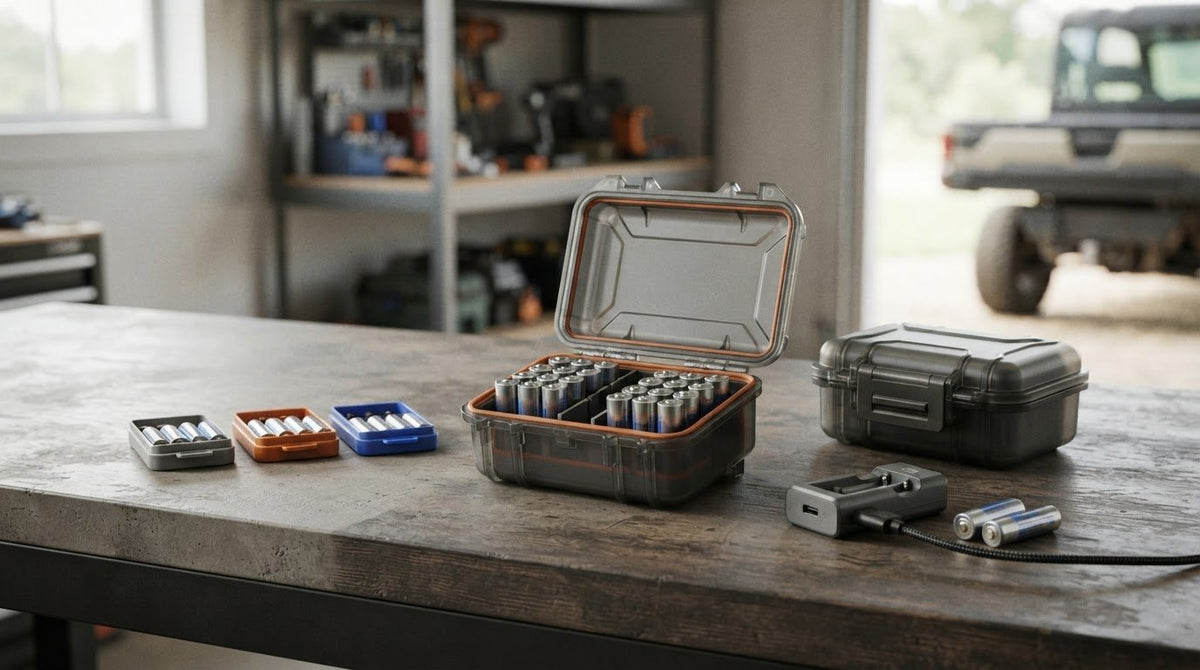
Could a battery holder that works on a shelf leave your AA cells exposed during travel? Choosing durable AA battery transport containers means looking beyond capacity. Loose cells can become difficult to count, get mixed up, or come into contact with other items. An open holder may not provide the protection you need when batteries are on the move.
These concerns are familiar to anyone carrying batteries between workstations, field locations, or storage areas. The right format should suit the handling conditions and make it easy to identify what’s ready to use, what needs charging, and what needs replenishment.
This guide explains how to compare protective cases with open holders, assess durability for your transport conditions, and choose an organization style that supports reliable inventory handling. You’ll also learn which practical features help keep cells contained, easy to identify, and simple to count. Horizon Battery offers rechargeable AA batteries, charger and battery bundles, and battery storage. Knowing how a container fits into a broader battery-handling workflow can help you make a more informed choice.
Key Takeaways
- Match durable AA battery transport containers to the movement and handling they’ll face, rather than choosing by capacity alone.
- Check that the case closes securely and each cell fits its compartment without force.
- Compare compact cases, multi-cell cases, bulk organizers, and wired holders by access speed, separation, and portability.
- Set up individual kits and shared inventories differently to support clear counts and consistent replenishment.
- Use a repeatable carry, return, recharge, and restock routine to keep batteries organized and ready for use.
What Durable AA Battery Transport Containers Should Do
Durable AA battery transport containers are enclosures or organized cases designed to carry AA cells between locations while keeping them contained and separated. Depending on the design, they can help prevent terminals from contacting other cells or loose metal objects, reduce the chance of cells spilling out, and make the contents easier to count. Their purpose is practical: keep batteries together and organized while they’re being moved.
Transport protection, home storage, and in-device holders serve different purposes. A storage box may keep household stock in one place but may not be convenient for repeated movement. A carrying case is intended to travel with cells. A wired holder positions cells and connects them to power a device or project, so it isn’t a case for spare batteries. The basic function of a battery holder helps clarify the distinction: it holds cells for an electrical application rather than enclosing a loose supply for transport.
How a battery transport case differs from a holder
A closed case is designed to contain batteries as it’s carried, with a closure that helps keep the cells inside. An open organizer may sort batteries into slots and make selection quick, but without a lid or enclosure, it may not provide the same containment during travel. Wired holders serve a separate role by connecting cells to equipment. Choose the format based on whether you need to carry spare cells, sort stock, or power a device.
When durable AA containers are useful
A dedicated case can help when batteries move regularly between storage, a charging station, equipment, and a work area. Separate compartments or clearly marked sections can keep charged cells apart from depleted ones, reducing mix-ups during a busy handoff. The container supports an organized routine, but it doesn’t replace checking cell condition or following the device and battery instructions.
For example, a personal kit might prioritize compact carry and quick access, while a field-equipment kit may need cells held securely through frequent movement. A professional audio team could organize spare batteries for equipment changes, while a production team might maintain a shared supply for several workstations. Replenishment stock may call for a larger organizer that makes quantities easier to review. The best arrangement depends on who handles the batteries, how often they move, and how quickly users need to identify the right cells.
Which Durability Features Matter in an AA Battery Container?
A case’s durability depends on how it’s built and how it will be used. A container carried occasionally in a personal bag has different demands from one opened throughout a workday or moved between equipment areas. Assess the construction you can observe, then match it to the expected handling instead of relying on a broad label such as “heavy-duty.”
Closure, fit, and construction
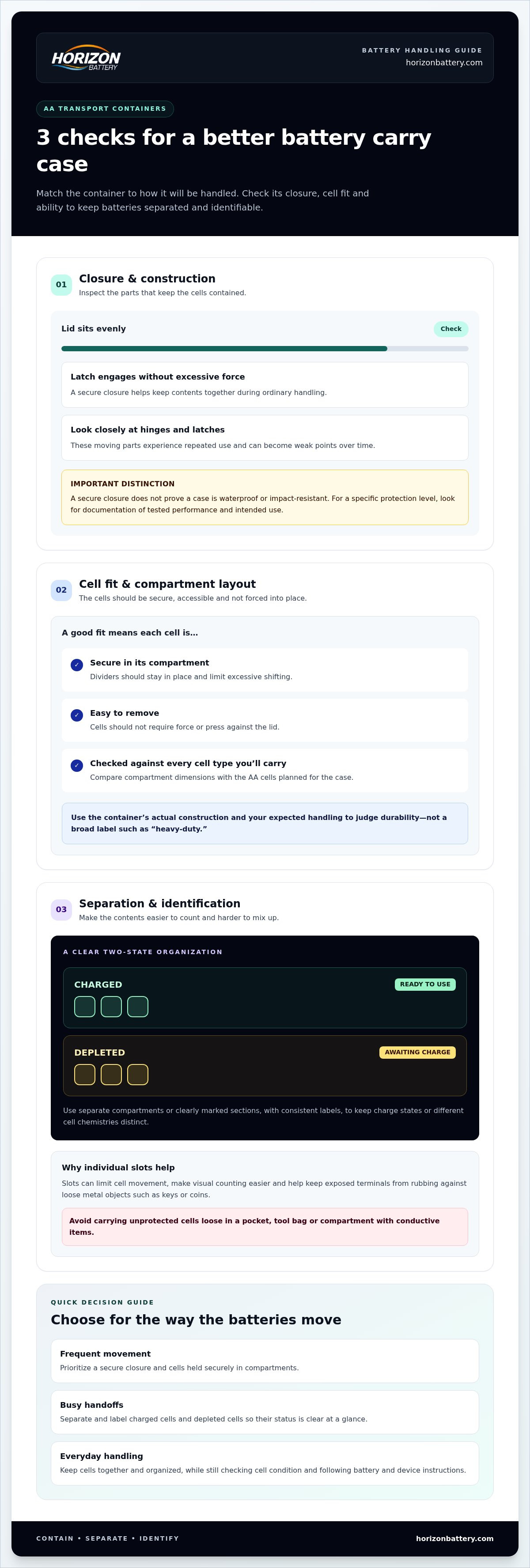
Start with the lid and latch. Close the case and check whether the lid sits evenly and the latch engages without excessive force. A secure closure helps keep the contents together during ordinary handling, but it doesn’t prove the case is waterproof or impact-resistant. Inspect hinges and latches closely, since these moving parts experience repeated use and can become weak points over time.
Fit matters too. Compare the compartment dimensions with the AA cells you plan to carry. Cells should sit securely and be easy to remove, without requiring force or pressing against the lid. If you’ll carry different AA cell types, check the fit of each one. Dividers should stay in place and leave enough room for cells without allowing them to shift excessively.
Material and finish can offer clues about construction, but they don’t establish a performance rating. Treat claims such as “waterproof,” “crushproof,” or “impact-resistant” as specific manufacturer claims, not assumptions based on appearance. If a particular level of protection matters, look for documentation describing the container’s tested performance and intended use.
Protection from contact and mix-ups
Individual slots can limit cell movement and make a visual count easier. They also help keep exposed terminals from rubbing against loose metal objects such as keys or coins. Avoid carrying unprotected cells loose in a pocket, tool bag, or compartment with conductive items. A closed, well-organized case adds separation, but it doesn’t replace careful handling.
Organization should make the contents clear at a glance. If a kit includes cells with different chemistries or charge states, assign separate compartments or sections and identify them with consistent labels. For example, designate one area for charged cells and another for depleted cells awaiting charging. This reduces the chance that a handoff or inventory count will mix up what’s ready to use.
When planning a complete battery workflow, consider how storage and charging fit with your container choice. Rechargeable AA batteries and charging options can be part of that broader plan.
AA Battery Transport Container Formats Compared
Container format affects how quickly you can access cells, how easily you can track stock, and whether the contents stay contained as they move. Compare the main options against the job they need to do, not capacity alone. More slots help only when they match your battery rotation. Extra capacity can add bulk without making a kit easier to manage.
| Format | Enclosure | Access speed | Cell separation | Portability | Repeated movement |
|---|---|---|---|---|---|
| Compact case | Usually closed | Quick for a small supply | Often individual slots | Easy to carry in a small kit | Suitable when its closure and construction fit the handling conditions |
| Multi-cell case | Usually closed | Quick access to a grouped set | Often separated by cell | Moderate, depending on size | Useful for moving a defined working supply |
| Bulk organizer | May be closed or open | Fast for sorting and visual checks | Varies by layout | Less convenient to carry when large | Best assessed for its closure and intended handling |
| Wired holder | Open, not an enclosure | Cells are accessible for installation | Cells are positioned for a circuit | Depends on the device or project | Not intended for carrying loose spare cells |
Compact cases versus high-capacity organizers
A compact format can suit a personal kit or a small number of spare cells. It keeps the carry load modest and makes the contents easy to review. A larger organizer is more practical for grouped inventory that needs sorting or quick visual checks, but it may take up more space and be slower to move between work areas. Choose capacity based on how many cells are actually in rotation, rather than the largest available layout.
Closed cases versus open and wired holders
Choose a closed case when containing cells during transport is the priority. An open organizer favors frequent access and visibility, so it may work better as a sorting point than as a travel container. A wired holder serves a different task: it positions cells to supply power in an assembly or device. It isn’t a substitute for a case carrying spare batteries.
Transport and long-term storage also have different roles. A carry case supports movement, while a storage arrangement helps manage stock between uses. For a broader approach to organizing inventory, see professional battery storage and management. Matching each format to its place in the workflow makes durable AA battery transport containers more useful, without asking one organizer to serve every purpose.
How to Choose an AA Transport Container for Your Workflow
A useful choice starts with the battery routine, not the case’s advertised capacity. Consider where the cells travel, how often people open the container, how many are needed at once, and how you’ll track used and ready-to-use stock. This helps ensure durable AA battery transport containers suit both the journey and the way batteries are managed between uses.
A five-step selection checklist
- Map the route. Note whether the case stays in one kit, moves between rooms, or travels with field equipment. Consider how frequently it will be carried and handled.
- Estimate the working quantity. Count the cells needed for a typical task, then account for practical spares. Avoid choosing capacity based only on an occasional peak if it leaves the container bulky the rest of the time.
- Match access to the task. Choose enclosed compartments when carrying cells securely is the priority, an open organizer when quick access and stock visibility matter, or a wired holder when cells need to power a device or project.
- Plan separation and identification. Decide whether cells need to be grouped by type, equipment, or charge status. Use compartments, dividers, or labels that make the arrangement easy for every user to follow.
- Build in replenishment. Establish where used cells go and how the working supply is restored. A container should make it straightforward to see what’s available and what needs attention.
Organizing rechargeable AA cells for repeat use
For rechargeable cells, establish consistent places for charged, depleted, and ready-to-test batteries. Label sections when charge status or cell type could otherwise be unclear. Pair that arrangement with compatible charging and rotation procedures, and follow the battery and charger instructions. A container supports the process, but it doesn’t determine whether a cell is ready for use.
An individual carry kit may be organized around one person’s equipment and a manageable reserve. A shared professional inventory benefits from clear labels and a layout multiple users can understand, so returning cells and replenishing the supply don’t depend on one person’s memory. For more context on integrating rechargeable cells into an operation, see battery management for professional operations. If high-capacity cells are part of your plan, review this high-capacity AA battery guidance.
Connect your container plan with the batteries and charging equipment in your workflow. Explore rechargeable AA batteries and charger options.
Putting a Durable AA Battery Transport System into Practice
A container becomes more useful when it’s part of a repeatable process. In a shared kit, every user should know where ready-to-use cells go, where depleted cells are returned, and how the supply is restored. Clear steps reduce uncertainty during handoffs and make it easier to see when the working supply needs attention.
Set up a repeatable battery rotation
Keep the routine simple enough to follow during a busy shift. Assign a consistent location for each status, then use short, readable labels such as “Ready,” “Depleted,” and “Check.” If the kit contains different battery types, identify them separately so users can distinguish them without relying on memory.
- Carry: Take the quantity needed for the task, organized in the appropriate case.
- Return: Put used cells in the designated section rather than mixing them with ready-to-use stock.
- Recharge or inspect: Follow the battery and charger manufacturer’s instructions for charging and handling.
- Restock: Return prepared cells to the correct section and note when the working supply needs replenishment.
For shared kits, keep labels and steps consistent across locations where practical. A clear convention helps a colleague understand the contents at a glance, even if someone else prepared the kit. Make sure labels reflect your actual process, and update them if the team changes how cells are sorted or handled.
Match the container to professional battery management
Portable cases and dedicated storage arrangements have related but distinct roles. A case keeps a working supply organized as it moves to equipment or a production area. A storage system supports the wider stock between uses, while charging equipment serves the recharge process. A case can travel from storage to a work area and back, but it shouldn’t replace broader storage and charging arrangements.
This distinction helps equipment and production teams maintain access to batteries without turning every portable kit into a full inventory station. Choose the case for the quantity and movement it needs to support. Keep reserve stock and charging organized separately, with handling guided by manufacturer instructions. Together, these steps give durable AA battery transport containers a defined place in a practical battery-management workflow.
Horizon Battery offers mobile energy products, including rechargeable AA batteries, charger and battery bundles, and battery storage. Explore battery storage solutions as part of planning an organized system for portable and reserve supplies.
Put Your AA Battery Workflow on a Stronger Footing
The right container supports more than transport. Match its closure, cell fit, and format to how batteries move and how often they’re accessed. Then make organization repeatable with clear separation for ready-to-use and depleted cells, plus a consistent return and replenishment routine.
Remember that a carrying case, an open organizer, a wired holder, and a dedicated storage system each serve a different purpose. Assigning the right role to each helps keep batteries easier to manage across individual kits and shared inventories. Horizon Battery offers rechargeable AA batteries, charger and battery bundles, and battery storage.
Build a battery workflow that’s organized from charging through transport and storage. Explore Horizon Battery’s professional battery storage solutions.
Frequently Asked Questions
What makes an AA battery transport container durable?
A durable container has construction and a closure suited to how often and where it will be carried. Check that the lid sits evenly, the latch stays engaged, and AA cells fit their compartments without force or excessive movement. For a frequently used case, inspect hinges and latches for wear. Don’t assume a material or “heavy-duty” label means the case is waterproof or impact-resistant. Look for manufacturer documentation for specific performance claims.
Can AA batteries be carried loose in a bag?
It’s better to keep spare AA batteries in a case, original packaging, or another method that protects their terminals. Loose cells can shift in a bag and contact metal items such as keys or coins, or one another, creating a short-circuit risk. Keep cells contained and separated, especially in a shared equipment bag. A case also makes the quantity easier to check before leaving and after returning.
How many AA batteries should a transport case hold?
Choose capacity based on the number of cells needed for a typical task, plus the practical spares your workflow requires. A small personal kit may need only a compact case, while shared equipment may call for a larger organized supply. Account for how often cells are replenished and how convenient the case is to carry. Extra capacity isn’t automatically useful if it adds bulk or makes stock harder to manage.
Are AA battery cases suitable for rechargeable batteries?
Yes, a case can hold rechargeable AA cells if its compartments fit them properly and its closure suits the expected movement. Organize cells by status so charged batteries don’t get mixed with depleted ones, and label different cell types if needed. Use compatible charging equipment and follow the battery and charger manufacturers’ instructions. The case supports sorting and transport, but it doesn’t determine whether a cell is charged or ready for use.
What is the difference between an AA battery case and a battery holder?
An AA battery case encloses or organizes cells for carrying or storage. A battery holder positions cells for an electrical task, such as supplying power to a device or project, and may include wiring or contacts. An open organizer can make cells easy to access and count, but it doesn’t necessarily contain them during movement. Select a closed case for transporting spare cells and a holder for powering equipment.
How should charged and depleted AA batteries be organized?
Assign separate, consistent places for charged cells, depleted cells, and any cells awaiting inspection or testing. Use clear labels or a simple divider system that everyone handling the kit can understand. Return used cells to the designated section rather than mixing them with ready-to-use stock, then follow your charging procedure and manufacturer instructions. This makes handoffs clearer and helps users see when the supply needs replenishment.
Can a battery storage organizer also be used to transport AA batteries?
It can, if it closes securely, keeps cells contained, and is practical to carry under the conditions you expect. Some storage organizers prioritize capacity and visibility over portability, while open trays may leave cells exposed during movement. Check the closure, compartment fit, and how easily the organizer can be handled when full. A transport case supports movement, while a dedicated storage setup manages reserve stock between uses.