
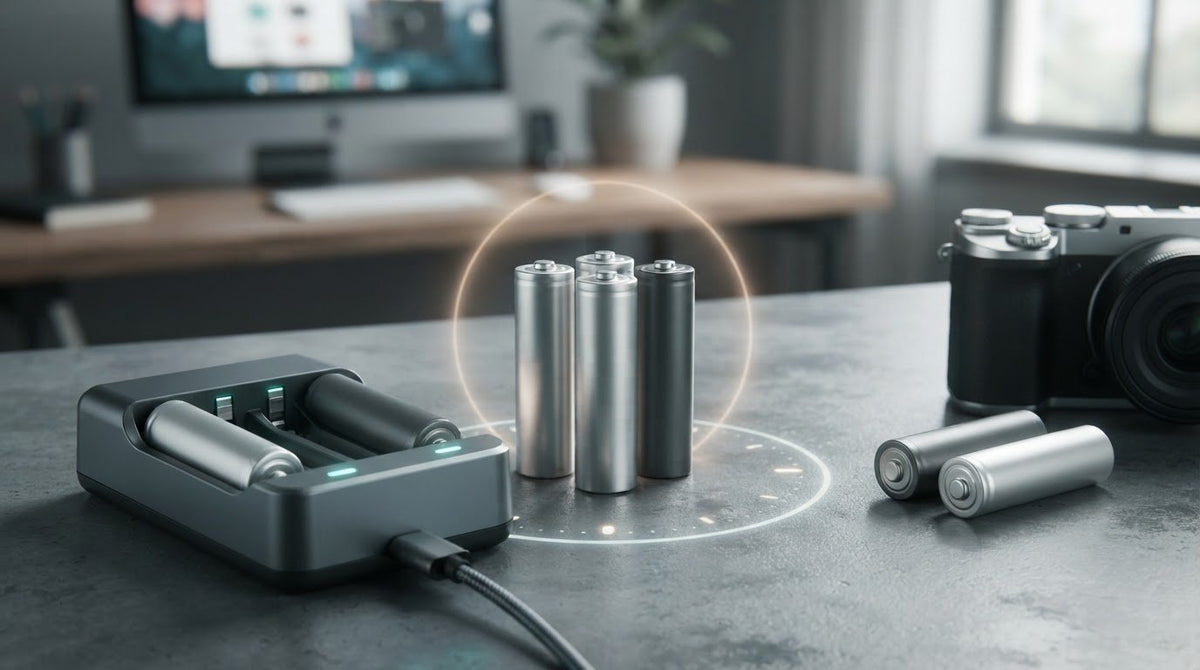
The AA battery with the highest capacity isn’t always the best choice. If your devices sit unused between uses, charge retention may matter more than the largest number on the label. It’s frustrating to reach for rechargeable cells and find they’ve lost power in storage, especially when capacity and retention claims are difficult to compare. Low self-discharge NiMH AA batteries are designed to stay charged longer between uses, but they still need to suit the demands of your device.
This guide explains what low self-discharge means in practical terms and how to weigh storage readiness against capacity. You’ll learn what to consider for frequently used devices and equipment kept in reserve, and why NiMH’s 1.2-volt nominal voltage can affect compatibility with some electronics. We’ll also cover charging and storage practices that help keep cells ready for use. By matching batteries and charging solutions to how often your devices run, how much power they need, and how long they may sit unused, you can make a more useful comparison.
Key Takeaways
- Low self-discharge NiMH AA batteries can help devices stay ready between uses, though they still lose charge gradually in storage.
- Compare storage readiness and capacity against how often you use each device and how much power it requires.
- Start with the device manual to verify AA compatibility and check whether NiMH’s voltage is suitable.
- Choose a charger designed for NiMH AA cells, then follow the battery and charger instructions for charging and storage.
- Use the comparison guide to weigh low self-discharge cells against standard NiMH and alkaline batteries for your needs.
What Are Low Self-Discharge NiMH AA Batteries?
Low self-discharge NiMH AA batteries are rechargeable nickel-metal hydride cells designed to reduce charge loss while they’re stored. The term describes storage behavior, not a different battery chemistry or size. “NiMH” identifies the chemistry, “AA” identifies the cell format, and “low self-discharge” describes how the cell is designed to hold its charge while idle.
This feature is useful for equipment that isn’t used every day. A camera flash kept in a drawer, spare batteries packed for a trip, or backup equipment may need cells ready after a period without use. Low self-discharge reduces the chance that stored cells will need charging before use, but it doesn’t prevent charge from gradually declining. For background on the underlying chemistry, see this overview of the Nickel-metal hydride battery.
Storage readiness is only one factor in choosing cells. These are still NiMH rechargeables in the AA format, so the device needs to support that battery type. Capacity, often printed on the label, indicates how much energy is available for use. Self-discharge describes what happens to the charge while the battery sits idle. Compare the two characteristics separately rather than treating a higher capacity rating as proof of better storage readiness.
How Is Self-Discharge Different from Battery Capacity?
Capacity is the amount of energy a fully charged cell can supply, usually expressed in milliamp-hours (mAh). Self-discharge is the gradual charge loss that occurs while a cell isn’t powering a device. Think of capacity as the energy stored at the start, and self-discharge as some of that stored energy diminishing during idle time. A capacity rating doesn’t, by itself, tell you how ready the cell will be after storage.
What Does Low Self-Discharge Mean for AA Batteries?
Compared with conventional NiMH designs, low self-discharge cells are intended to retain more of their charge between uses. That can make them a practical choice for devices and spare sets that may sit unused. Retention varies by product and storage conditions, so compare manufacturers’ specifications instead of assuming every low self-discharge cell performs alike.
Low self-discharge means a rechargeable battery is designed to lose charge more slowly in storage, not to hold its charge indefinitely. For frequently used devices, capacity may be a higher priority. For infrequently used equipment, readiness after storage may matter more. The right balance depends on how the device is used.
How Low Self-Discharge NiMH Batteries Retain Charge
A NiMH cell can lose some of its stored charge even when it isn’t connected to a device. Internal electrochemical processes continue while the battery is idle, so a cell taken from storage may have less charge than it had when put away. Low self-discharge designs reduce this gradual storage loss compared with conventional NiMH cells, helping stored batteries remain more ready for use. They don’t stop the process entirely.
Storage loss is different from capacity fade. Self-discharge describes charge declining while a cell sits unused. Capacity fade is a longer-term reduction in how much energy a cell can deliver, which may result from age, wear, or repeated charging and use. A cell can lose charge during storage without that alone proving its usable capacity has permanently declined. If an older battery runs down quickly after a full charge, its condition may also be a factor.
What Happens to NiMH Cells During Storage?
While stored, a NiMH battery gradually loses some charge without supplying power to a device. The amount depends on the cell and storage conditions, so don’t assume a spare kept for months is ready just because it was charged before storage. Check its charge before relying on it, particularly for equipment that needs to work when called on. This simple check helps distinguish a ready spare from one that needs charging.
Which Conditions Affect Charge Retention?
Temperature, time in storage, and cell condition all influence real-world readiness. Heat can accelerate charge loss and may contribute to battery deterioration, while longer storage gives gradual loss more time to accumulate. A cell’s age and prior use also matter. Normal storage in a suitable environment is different from prolonged exposure to heat, dampness, or other conditions outside the manufacturer’s recommendations.
There’s no single retention rate or storage-life promise that applies to every NiMH cell. Follow the manufacturer’s guidance for storage temperature and handling, and check stored cells before putting them into service. For equipment that must be ready after sitting unused, build periodic checks into your routine rather than relying on the low self-discharge label alone.
Stored-cell readiness depends on the battery’s design, storage time and temperature, and the cell’s age and condition. Keeping cells organized in suitable battery storage options also makes it easier to track which spares need checking before use.
Low Self-Discharge NiMH vs. Standard NiMH and Alkaline AA
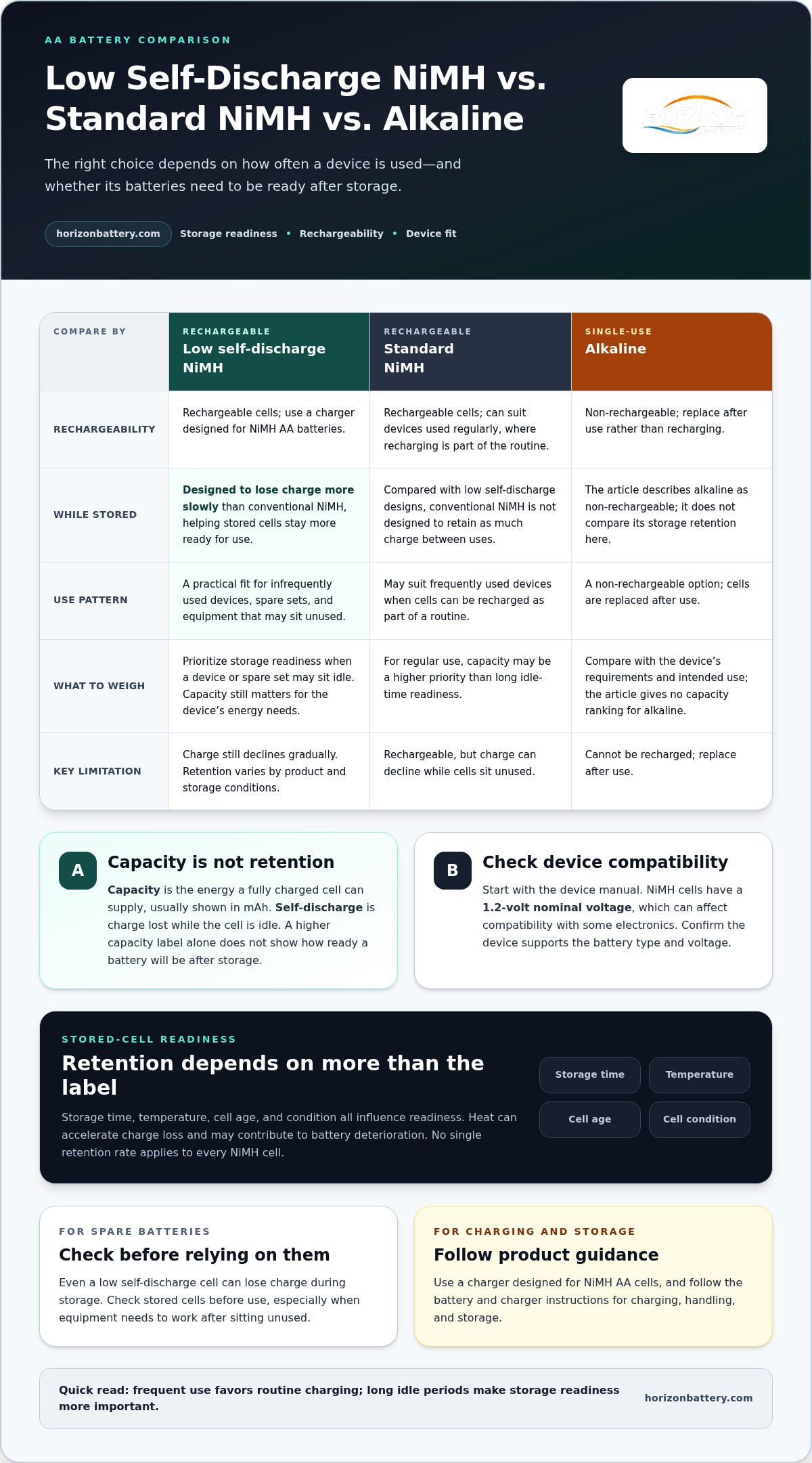
The right AA battery depends on how often a device is used and whether cells need to be ready after storage. Low self-discharge NiMH is designed to hold charge better while idle than standard NiMH. Standard NiMH may suit devices used regularly, where cells can be recharged as part of a routine. Alkaline cells are different: they’re non-rechargeable, so they’re replaced after use rather than recharged.
| Battery type | Rechargeability | Storage readiness | Typical use consideration |
|---|---|---|---|
| Low self-discharge NiMH | Rechargeable | Designed to reduce charge loss during storage | Useful when cells may sit between uses and should be ready when needed |
| Standard NiMH | Rechargeable | Can lose charge while stored; check before use | May fit frequently used devices with a regular charging routine |
| Alkaline AA | Non-rechargeable | Not recharged for later use | A single-use option; replace the cell when depleted |
This is a practical distinction, not a ranking. Low self-discharge NiMH AA batteries can be useful for stored spares, while standard NiMH may be convenient where cells are used and recharged often. Neither rechargeable type is automatically suitable for every device. NiMH cells have a 1.2-volt nominal voltage, compared with 1.5 volts for alkaline AA batteries, so check the device manual for supported battery types and voltage requirements.
When Is Low Self-Discharge NiMH a Better Fit?
Consider low self-discharge cells for household remotes, backup equipment, and infrequently used accessories, especially if the batteries may remain unused for an extended period. Their reduced storage loss can make a charged spare more useful when it’s needed. Confirm that the device supports NiMH and follow the device manufacturer’s battery guidance before switching.
When Might Another AA Battery Type Make Sense?
For equipment used frequently, standard NiMH cells may work well if you can recharge them on a predictable schedule. Alkaline batteries may suit devices where you prefer a non-rechargeable cell, but they aren’t a direct rechargeable equivalent. For organizations planning repeat-use battery routines, see this guide to switching to rechargeable batteries for business.
How to Choose Low Self-Discharge NiMH AA Batteries
Choose cells by starting with the device, not the capacity number on the package. These steps help you check compatibility, performance needs, and storage readiness before buying.
1. Read the device manual. Confirm that the device accepts AA batteries and supports rechargeable NiMH cells. Check any voltage or battery-type guidance, especially for electronics with specific power requirements.
2. Match capacity to demand. Capacity, shown in milliamp-hours (mAh), is one factor in how much energy a cell can supply. Consider the device’s power needs and typical run time. The highest capacity rating isn’t automatically the best choice for every use.
3. Compare the full specifications. Check chemistry, cell format and dimensions, manufacturer-provided charge-retention information, and recommended charging method. Confirm that your charger is intended for NiMH AA cells.
4. Factor in use frequency. Think about how often the device runs and how long its batteries may sit unused. Low self-discharge NiMH AA batteries can be a practical match for stored spares, while frequent-use devices may call for a predictable charging routine.
Which Specifications Should You Compare?
Use mAh as a comparison point, not a complete performance verdict. Look for the manufacturer’s stated storage or charge-retention information, where available, and compare products under the conditions specified. Check that the cell dimensions and NiMH chemistry suit the device, then confirm that the recommended charging method matches your charger. Use manufacturer documentation for model-specific claims.
How Should You Match Batteries to Your Usage?
Sort devices into practical groups: those used frequently, those used occasionally, and those that need backup cells ready after storage. For equipment with rotating battery sets, label each set and keep compatible cells together. This makes it easier to track use and charging without mixing cells with different histories.
If capacity is a priority in your comparison, review this Ansmann high-capacity battery guide for additional context. For rechargeable AA options, browse rechargeable AA batteries and compare the listed specifications with your device requirements.
How to Charge and Store Low Self-Discharge NiMH AA Batteries
Good charging and storage habits help keep low self-discharge NiMH AA batteries ready for use. Use a charger designed for NiMH chemistry and the AA cell format, and follow the instructions supplied with both the batteries and charger. Charging time and handling guidance can vary by product, so don’t assume one schedule suits every cell.
Before charging, check that the cells are in sound condition and seated correctly in the charger. Use the charger as directed, and remove or store the batteries according to its instructions when charging is complete. Avoid mixing cell types or formats in a charger unless its instructions specifically permit it. A compatible charger-and-battery bundle helps match the charging equipment to your rechargeable cells.
How Should You Store Rechargeable AA Cells?
Keep batteries in a dry, organized place and follow the manufacturer’s stated storage conditions. Avoid prolonged exposure to heat or dampness. Store loose cells in a suitable case or holder so their terminals can’t contact keys, coins, or other conductive objects. For more structured inventory practices, see this professional battery storage and management guide.
How Can You Keep Stored Batteries Ready?
Set a simple routine for spare and infrequently used cells. Label sets, note when they were last checked, and inspect stored batteries before critical or long-duration use. A low self-discharge design reduces charge loss, but it isn’t a substitute for checking readiness before relying on a battery.
- Charged: Cells checked and ready for storage or deployment.
- In use: Cells currently installed in equipment or assigned to a device.
- Awaiting inspection: Returned or long-stored cells that need checking before reuse.
Keep compatible cells together, and rotate sets according to your usage pattern. This basic separation helps prevent a charged spare from being confused with a depleted or unchecked cell. For rechargeable AA batteries and compatible charging solutions, explore Horizon Battery’s rechargeable AA batteries and charging solutions.
Choose Cells That Fit Your Routine
The right AA battery depends on more than its capacity rating. Check the device manual for compatibility, then weigh power needs against how long cells may sit unused. Low self-discharge NiMH AA batteries can help keep spare cells more ready between uses, but charge still declines over time. A suitable charger and a simple storage-check routine help you manage readiness without relying on one schedule for every battery.
Horizon Battery offers high-capacity rechargeable AA batteries and charger-and-battery bundles. Compare the product specifications with your device requirements and charging setup to find a practical fit.
Explore Horizon Battery’s rechargeable AA batteries and charging solutions to find a practical starting point for your devices. With the right match and sensible care, you can build a battery routine that keeps your equipment prepared for everyday use and the moments you need it most.
Frequently Asked Questions
How long do low self-discharge NiMH AA batteries hold their charge?
There isn’t one storage period that applies to every low self-discharge NiMH battery. Charge retention varies by product, storage conditions, cell condition, and manufacturer specifications. Review the manufacturer’s retention information for the specific cell, and don’t treat a general claim as a guarantee for every use. If batteries have been stored for an extended period, check their charge before relying on them, especially for equipment that needs to be ready.
Are low self-discharge NiMH batteries better than standard NiMH batteries?
They can be a better fit when batteries may sit unused, because low self-discharge designs are intended to reduce charge loss during storage. Standard NiMH cells may suit equipment used frequently, where batteries can be recharged on a regular routine. Neither type is best for every device or schedule. Consider how often you use the equipment, how long cells sit between uses, and the device manufacturer’s battery guidance.
Can low self-discharge NiMH AA batteries replace alkaline batteries?
Sometimes, but confirm compatibility in the device manual first. NiMH AA cells are rechargeable and have a nominal voltage of 1.2 volts, while alkaline AA cells are non-rechargeable and nominally 1.5 volts. Some devices may not work as intended with the lower NiMH voltage, even though the cells share the AA format. Follow the device maker’s recommendations, particularly for electronics with specific voltage requirements.
Do low self-discharge NiMH batteries lose charge while stored?
Yes. Low self-discharge NiMH batteries are designed to slow charge loss during storage, not stop it completely. How ready a stored cell is depends on the battery, how long it has been stored, storage conditions, and its age and condition. Check spare cells before use, and recharge them if needed according to the battery and charger instructions. Don’t assume a stored battery is fully ready just because it was charged before storage.
Can I charge low self-discharge NiMH AA batteries in any NiMH charger?
Use a charger intended for NiMH batteries and the AA cell format, and follow the instructions for both the charger and the cells. Don’t assume every NiMH charger is suitable for every battery or charging situation. Check the charger’s supported cell formats and guidance on charging and removal. Avoid mixing battery chemistries or sizes unless the charger instructions explicitly allow it. A compatible charger-and-battery bundle can simplify matching equipment.
How should I store rechargeable AA batteries between uses?
Store rechargeable AA batteries in a dry, organized place under the conditions stated by their manufacturer. Keep loose cells in a case or holder so their terminals can’t touch conductive objects such as keys or coins. Separate charged cells from batteries in use or awaiting inspection, and label sets if you rotate them. Check stored cells before critical or extended use, then charge them as directed if they need replenishing.