
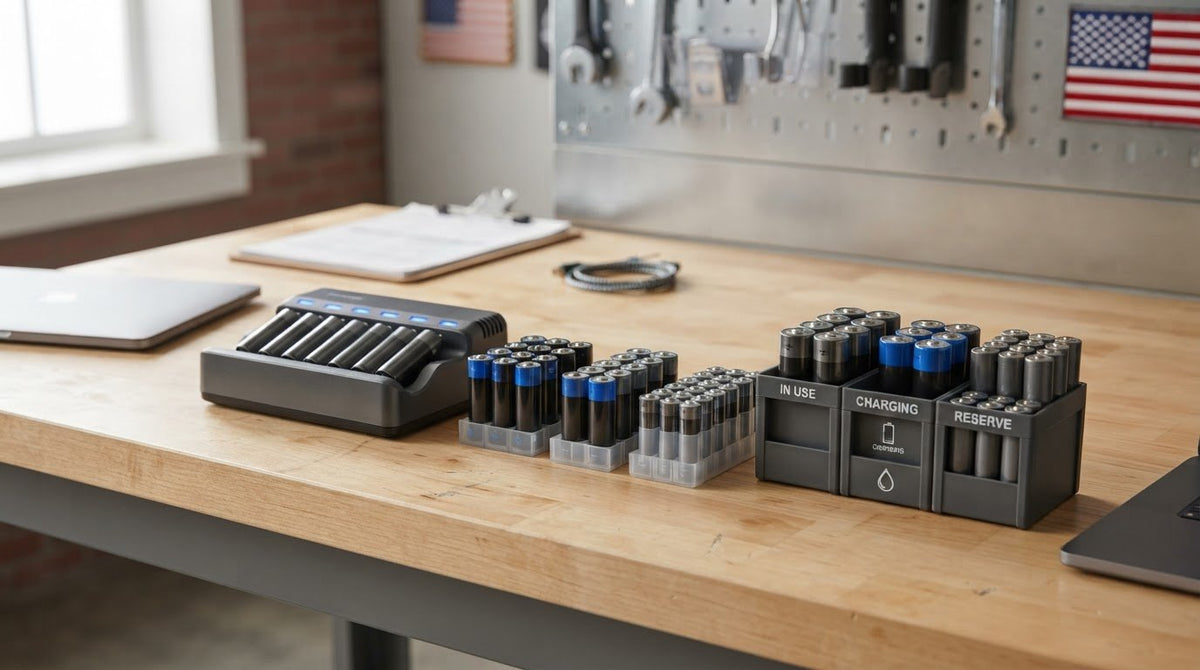
Choosing commercial multi-pack AA rechargeable batteries is about more than the number of cells in a pack. Your supply needs to keep devices running while another set charges, and the right quantity depends on equipment requirements, usage patterns, and charging capacity.
A practical setup starts with compatible cells, enough inventory for active use and charging, and a rotation your team can manage. This guide shows how to compare battery specifications, estimate a useful quantity, and match batteries with charging hardware and storage.
Horizon Battery supplies high-capacity AA rechargeable batteries, charger-and-battery bundles, and battery storage options. Consider these parts together to plan a battery pool around your equipment and operating schedule.
Key Takeaways
- Plan a commercial multi-pack AA rechargeable batteries purchase around how cells move between equipment, charging, and backup, not just the number of devices.
- Compare chemistry, capacity, voltage, and intended device use using consistent units and manufacturer documentation.
- Consider batteries and charging hardware together, including how the charger’s channels fit your team’s rotation.
- Estimate working inventory from device requirements and charging turnaround, then set a separate reserve based on operational risk.
- Use a checklist for compatibility, quantity, charging, and storage to build a setup suited to your equipment and daily operating rhythm.
Commercial Multi-Pack AA Rechargeable Batteries: What Buyers Need to Plan
A commercial multi-pack AA rechargeable battery supply is a planned pool of cells for repeated use across an organization’s compatible equipment.
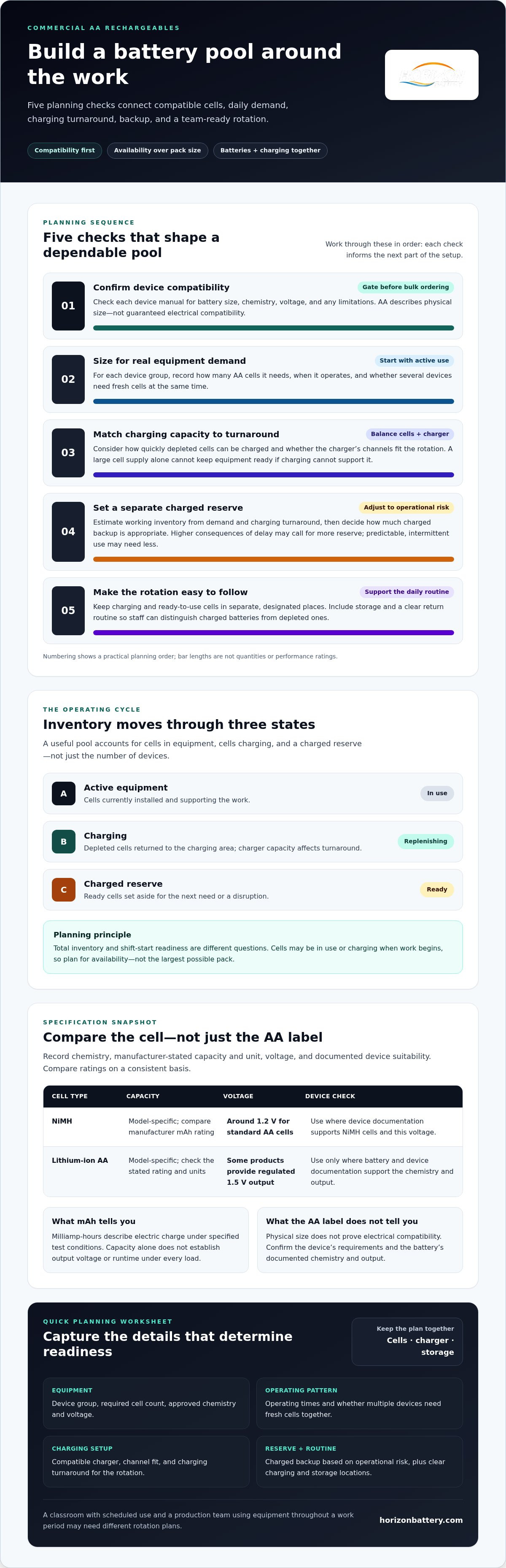
That pool moves through three states: cells installed in active equipment, cells being charged, and charged reserve cells ready to use. The right balance depends on how often equipment runs and how quickly depleted cells can be recharged. There is no single pack quantity or fixed ratio that suits every team.
Which organizations commonly use rechargeable AA batteries?
Audiovisual teams, schools, production crews, and workplace operations may use AA-powered equipment. Wireless microphones are one example, but models vary. Check each device’s requirements rather than assuming it takes AA cells.
For frequently used equipment, a predictable rotation helps staff return depleted cells to a designated charging area and take ready cells from a separate supply. This reduces last-minute searches and confusion about which batteries are charged. Understanding the basics of rechargeable battery technology can also help buyers recognize why chemistry matters when comparing batteries and charging requirements.
What does a multi-pack purchase need to solve?
Start with the equipment that uses AA cells. For each device, note how many cells it needs, when it operates, and whether several devices need fresh batteries at the same time. A classroom with scheduled equipment use has a different demand pattern from a production team using several devices throughout a work period. Device count alone does not show how many cells will be in use while others are charging.
Separate total inventory from shift-start readiness. You may have enough cells to cover every device but still come up short if too many are depleted or charging when work begins. Estimate active demand, account for charging turnaround, and set a charged reserve based on the consequences of a delay. Higher operational risk may call for more backup, while predictable, intermittent use may need less.
Plan for availability, not the largest possible quantity. Commercial multi-pack AA rechargeable batteries should support a clear rotation, with charging and storage considered alongside the cells. Horizon Battery offers high-capacity AA batteries, charger-and-battery bundles, and battery storage options to support this broader workflow.
Compare AA Rechargeable Battery Specifications Before Buying in Bulk
Before selecting commercial multi-pack AA rechargeable batteries, compare chemistry, capacity, voltage, and documented equipment suitability. A higher capacity rating alone does not prove that a battery is suitable or will perform the same way in every device.
How should buyers compare capacity and chemistry?
Milliamp-hours (mAh) describe the electric charge a battery can provide under specified test conditions. The figure is useful, but it does not tell you the output voltage or how long the cell will run under every load. Compare mAh ratings on a consistent basis, and review each product’s stated chemistry, capacity, and voltage in its manufacturer documentation.
NiMH and lithium-ion are different rechargeable chemistries with different electrical characteristics. Standard NiMH AA cells have a nominal voltage of around 1.2 volts. Some rechargeable lithium-ion AA products provide a regulated 1.5-volt output. These types are not automatically interchangeable, so check the battery and device documentation rather than relying on AA size alone.
| Chemistry | Stated capacity | Nominal voltage | Documented device suitability |
|---|---|---|---|
| NiMH | Model-specific; compare the manufacturer’s mAh rating | Around 1.2 V for standard AA cells | Use in devices whose documentation supports NiMH cells and this voltage |
| Lithium-ion AA | Model-specific; compare the manufacturer’s stated rating and units | Some products provide regulated 1.5 V output | Use only where the battery and device documentation support the chemistry and output |
For a useful comparison, record each cell’s chemistry, manufacturer-stated capacity and unit, nominal voltage, and documented device suitability. Compare ratings on a consistent basis. Capacity figures without chemistry and voltage provide an incomplete picture, especially across different battery technologies.
Will rechargeable AA batteries work in the equipment?
Start with the device manual. Confirm its required battery size, chemistry, and voltage, then review any stated limitations. An AA form factor confirms physical size, not electrical compatibility. If the documentation specifies alkaline cells, a particular chemistry, or a voltage range, do not assume another rechargeable option is suitable.
When standardizing equipment, record the approved battery type for each device group before ordering in bulk. Horizon Battery offers high-capacity rechargeable AA batteries and charger-and-battery bundles. Explore the rechargeable AA battery options as part of a specification-led purchasing plan.
Choose Between AA Battery Packs, Charger Bundles, and Charging Setups
Battery quantity and charging capacity need to work as one plan. A large supply of cells will not keep equipment ready if the charging setup cannot support the rotation. Likewise, a suitable charger is of little use if you do not have enough compatible cells. Compare the batteries and charger together, including documented compatibility and the routine staff will follow.
When does a charger-and-battery bundle make sense?
A charger-and-battery bundle can simplify planning for a new equipment rollout by putting cells and charging hardware in the same purchasing decision. Compare the bundle specifications with device requirements and your intended rotation. Do not assume contents or compatibility from the word “bundle” alone. Horizon Battery offers charger-and-battery bundles alongside high-capacity rechargeable AA batteries.
For an established battery pool, buying cells separately may suit a straightforward replenishment need if the existing chargers remain compatible and have enough capacity. Reassess the charger if the equipment count, operating schedule, or simultaneous demand has changed. In either case, check the charger documentation for supported cell chemistry, size, and charging requirements.
What should a commercial charging workflow include?
Give each stage a place and a routine. Staff should know where to return depleted cells, where charging takes place, how to identify ready cells, and where charged cells are stored. Clear handoffs matter in shared environments. Without them, charged and depleted cells can be difficult to distinguish at shift change.
Charging-channel count shows how many cells can be handled at once, but it does not establish turnaround time or suitability by itself. Check the charger’s specifications, including supported cell types and channel capacity, against the team’s schedule and the number of cells likely to need charging together. Review the full charging instructions rather than relying on channel count alone.
- Collect: Return depleted cells to a designated location.
- Charge: Load the compatible charger according to its instructions.
- Check and store: Separate charged cells from those awaiting charging, then keep ready stock in a defined storage location.
- Return to service: Make the charged supply easy for staff to access before equipment is needed.
Larger operations may need a more organized, centralized approach to charging and storage. Horizon Battery provides professional charging hardware, including custom rackmount chargers. A guide to enterprise battery charging solutions can help frame additional planning considerations for larger charging operations.
Assess commercial multi-pack AA rechargeable batteries as part of a complete supply system: compatible cells, suitable charging equipment, and clear staff routines all contribute to ready-to-use inventory.
Size a Commercial AA Battery Pool for Daily Use and Backup
To estimate a rechargeable AA battery pool, count compatible devices, the AA cells each device requires, peak simultaneous use, operating periods, charging turnaround, and the reserve needed for operational risk. Use actual schedules and charging records where available instead of applying a universal pack-size rule.
How many rechargeable AA batteries does a team need?
Build the estimate in stages. Minimum working inventory covers the equipment expected to operate at the same time. The full pool also accounts for cells that are depleted or charging, plus a reserve sized to the consequences of running short.
- List compatible devices. Count only equipment documented to use the selected rechargeable AA cells.
- Calculate peak active demand. For each device group, multiply the number operating at the busiest point by the AA cells required per device. Add the group totals to find minimum working inventory.
- Review usage periods. Note when equipment is in use and when cells are returned. Overlapping schedules can create more simultaneous demand than the total device count suggests.
- Account for charging turnaround. Use the charger’s documented process and your team’s observed charging cycle to estimate how many cells may be unavailable while equipment remains in use.
- Set a risk-based reserve. Decide how much additional ready inventory is appropriate if charging is delayed, demand rises, or a cell is unavailable. Keep this reserve separate from the minimum needed to operate equipment.
If several device groups have different schedules, calculate peak demand for each group instead of assuming every device runs at once. Then account for cells out of service during charging. This produces a pool based on actual use rather than a generic ratio.
How can teams keep charged cells ready?
Make the rotation visible and repeatable. Set one return point for depleted cells and a separate, clearly marked location for charged cells. Labels or a simple inventory log can track each set’s status and help staff avoid treating cells awaiting charging as ready stock.
- Record cells or sets issued, returned, and sent for charging.
- Mark charging status clearly, including when cells are ready to return to service.
- Review usage and charging records periodically, then adjust working inventory or reserve as operating needs change.
For deeper inventory planning, consult a battery storage and management system guide alongside your team’s rotation records. To support organized storage and a planned supply, explore battery storage solutions from Horizon Battery.
Select a Commercial Multi-Pack AA Solution for Your Operation
The right purchase fits both your equipment and the way your team uses it. Before ordering commercial multi-pack AA rechargeable batteries, bring together device requirements, expected demand, charging capacity, and storage practices. A setup based on your operating rhythm is more useful than choosing a pack size simply because it seems standard.
A final checklist for commercial battery purchasing
- Confirm device requirements: Check equipment documentation for battery format, chemistry, and electrical requirements. AA size alone does not establish compatibility.
- Estimate working quantity: Record how many devices use AA cells, how many cells each requires, and how many devices operate simultaneously during the busiest period.
- Plan for charging and reserve: Account for charging turnaround and the ready-to-use reserve your operation needs. Base that reserve on the impact of a shortage, not a universal ratio.
- Match the charger: Verify that charging equipment supports the selected cells and fits the team’s routine. Consider how many cells may need charging at once.
- Set up storage and ownership: Separate depleted, charging, and ready cells. Assign responsibility for recording status and maintaining the rotation.
This checklist makes comparisons more practical. Two teams with the same device count may have different needs if one uses equipment simultaneously or has less time for charging between uses. Use schedules and inventory records to refine the plan as needs change.
How Horizon Battery supports rechargeable power needs
Horizon Battery supplies rechargeable battery and charging solutions, including high-capacity rechargeable AA batteries and charger-and-battery bundles for planned deployments. The Pure Power Series is part of its rechargeable battery range. Compare product specifications and charging requirements with your equipment and workflow.
For further product education, the Ansmann high-capacity batteries guide can provide another reference point as you consider battery characteristics and use. Keep your selection grounded in documented compatibility, team demand, and a charging and storage process you can maintain.
Explore Horizon Battery’s rechargeable AA batteries and charger-and-battery bundles to plan a battery pool for your operation.
Build a Battery Rotation Your Team Can Rely On
A rechargeable battery supply starts with equipment compatibility, not pack size alone. Compare chemistry, capacity, and voltage with device documentation, then estimate how many cells must be active, charging, or ready in reserve. A sound commercial multi-pack AA rechargeable batteries plan also accounts for peak demand, charging turnaround, and clear storage and handoff routines.
Horizon Battery supplies high-capacity rechargeable AA batteries, charger-and-battery bundles, professional charging hardware, and battery storage solutions. Considering these parts together can help align cell selection with your team’s needs, whether you are equipping a new deployment or replenishing an established pool.
Explore Horizon Battery’s rechargeable battery and charging solutions to plan a setup around your equipment and operating rhythm. Choose compatible specifications and establish a consistent rotation to help keep shared devices ready for use.
Frequently Asked Questions
Are rechargeable AA batteries suitable for commercial equipment?
Rechargeable AA batteries can suit commercial equipment when the device manufacturer’s requirements support the battery’s chemistry, voltage, and format. Check equipment documentation before standardizing cells across a team. Then consider how often devices are used and how cells will be charged and rotated. For shared equipment such as microphones or other portable devices, a consistent process helps staff identify ready cells and return depleted ones for charging.
How many rechargeable AA batteries should a business buy?
Base the quantity on your equipment and operating schedule, not a standard pack size. Count compatible devices, the cells each device needs, and how many devices operate at the busiest time. Then account for charging turnaround and a separate reserve based on the impact of a shortage. A team with overlapping shifts may need more available cells than one using equipment intermittently. Use operating records to refine your estimate.
Can rechargeable AA batteries be used in any device that takes AA batteries?
No. The AA label describes physical size, but does not guarantee electrical compatibility. Check the device manual for accepted chemistry, voltage, and restrictions, then compare those requirements with the battery documentation. Rechargeable AA cells can differ in chemistry and electrical characteristics. Follow the equipment’s stated requirements rather than assuming every AA rechargeable cell is suitable.
Should a business buy rechargeable AA batteries with a charger?
A charger-and-battery bundle can be practical for a new deployment because it brings cells and charging equipment into the same purchasing decision. Review the charger’s documented compatibility and capacity against your planned rotation. If you already have chargers, buying cells separately may suit replenishment, provided the chargers support those cells and can handle demand. Either way, consider charging workflow alongside battery quantity.
How do you manage rechargeable AA batteries across a team?
Set a clear return point for depleted cells and a separate location for charged cells ready to use. Mark their status with labels or use a simple log to record when cells are issued, returned, and placed on charge. Assign responsibility for maintaining the rotation. A shared process helps staff distinguish ready inventory from cells awaiting charging and makes recurring shortages easier to spot.
What should I compare when buying commercial multi-pack AA rechargeable batteries?
Compare chemistry, stated capacity, nominal voltage, and documented device suitability using manufacturer specifications and consistent units. Confirm device requirements first, since a higher capacity figure alone does not establish compatibility. Also consider the quantity needed for active use, charging turnaround, and reserve, along with charger capability and storage. A well-planned commercial multi-pack AA rechargeable batteries purchase supports the full rotation, not just the initial cell count.