
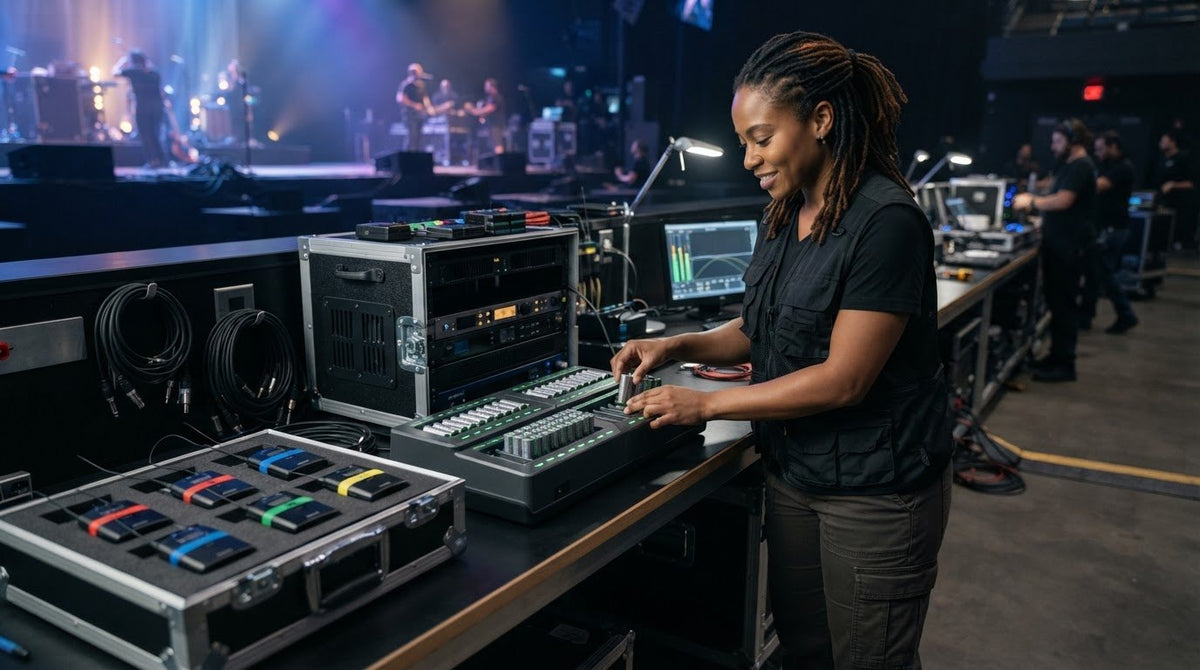
A wireless microphone dropout onstage is rarely an RF coordination failure; it is almost always the preventable result of unmonitored battery sag. Every audio engineer and stage technician knows the friction of managing dozens of wireless beltpacks across tight production schedules. Juggling mismatched charge levels, premature cell degradation, and backstage workbenches cluttered with hazardous power strips creates unacceptable risks for live productions. Deploying an industrial multi-bay AA smart charger for AV crews transforms that chaotic routine into an organized, dependable energy workflow.
Consumer-grade trickle units simply don't hold up to the continuous demands of live sound, touring rigs, and house of worship facilities. You need active individual cell monitoring and rapid turnover you can trust. In this 2026 guide, you will discover how professional charging infrastructure eliminates mid-show transmitter failures, speeds turnaround times between sets, and protects the operational lifespan of your rechargeable inventory. We review the top desktop hubs and clean rackmount systems built to keep your audio channels stage-ready.
Key Takeaways
- Understand why consumer series charging damages professional cell pairs and how isolated bay monitoring eliminates unexpected transmitter dropouts.
- Identify essential technical safeguards, including negative delta-V termination and thermal controls, that extend the working lifespan of high-capacity rechargeable inventories.
- Compare the workflow advantages of custom rackmount chargers against high-density desktop bays for touring road cases and broadcast studios.
- Calculate your active channel counts, turnaround windows, and backup margins to deploy the optimal multi-bay AA smart charger for AV crews.
- Establish structured rotation routines, color-coding protocols, and routine capacity testing to guarantee stage-ready power for every performance block.
Why Live AV Production Requires Dedicated Multi-Bay Smart Chargers
Live audio production leaves zero margin for technical hesitation. Wireless bodypack transmitters and in-ear monitor (IEM) receivers place continuous, demanding loads on portable cells throughout rehearsals, sound checks, and performances. When an audio engineer sends a performer onstage, the wireless link must remain stable. A sudden voltage collapse does more than cut the mix; it derails the performance, disrupts broadcast feeds, and instantly damages client confidence. Preventing these catastrophic dropouts begins at the charging station, where deploying a professional multi-bay AA smart charger for AV crews establishes the baseline for total stage reliability.
The Demands of High-Channel Wireless Audio
Modern digital wireless microphones rely on steady operating voltage to maintain RF output stability and clean digital transmission. A slight drop in cell voltage can trigger premature squelch cuts or audio muting before an alkaline battery's standard discharge curve would indicate total depletion. Production environments frequently deploy 8 to 40 wireless channels simultaneously. Managing that volume requires an organized workflow where dozens of batteries rotate smoothly between sessions without guesswork or performance discrepancies.
The Hidden Vulnerability of Consumer Tabletop Chargers
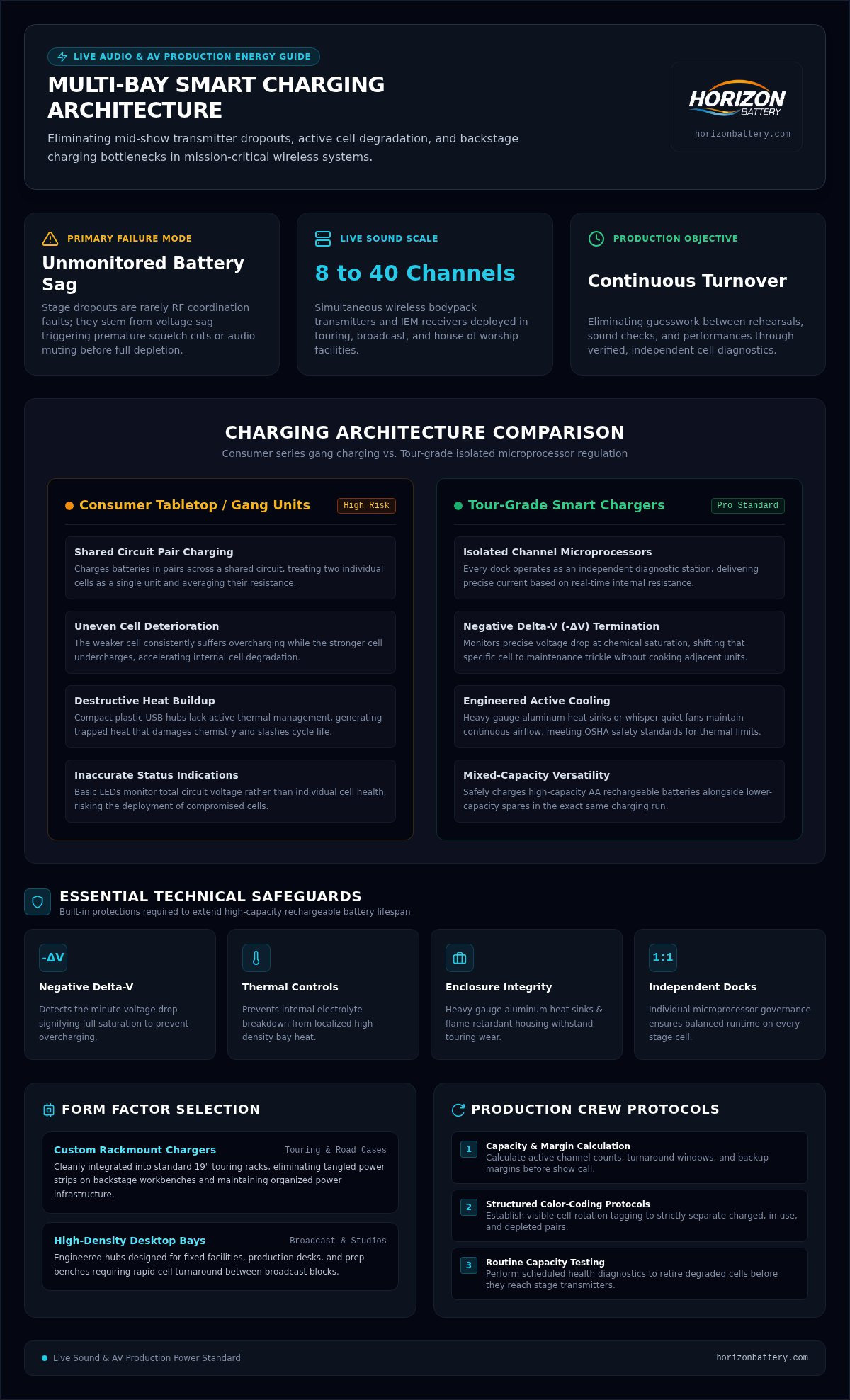
Consumer-grade chargers are designed for low-drain household devices, not back-to-back touring schedules. Most budget units charge batteries in pairs across a shared circuit, treating two individual cells as a single unit. This architecture creates severe vulnerabilities for stage inventories:
- Uneven Cell Deterioration: When two mismatched cells share a circuit, the charger averages their resistance. The weaker cell consistently suffers overcharging while the stronger cell undercharges, accelerating internal cell degradation.
- Destructive Heat Buildup: Compact, plastic USB hubs lack active thermal management. Continuous charging cycles generate trapped heat that damages cell chemistry and slashes cycle life.
- Inaccurate Status Indications: Basic LEDs monitor total circuit voltage rather than individual cell health, leading crew members to deploy compromised cells that sag under live RF transmission loads.
Professional facilities require equipment engineered around proven rechargeable battery technologies, where isolated microprocessors monitor the exact condition of each individual bay. Investing in a dedicated multi-bay AA smart charger for AV crews ensures that every cell deployed to the stage delivers verified, balanced runtime from the first sound check to the final encore.
Core Technical Features of a Tour-Grade Smart Charger
A tour-grade charging station functions as a diagnostic laboratory for cell health. Rather than forcing continuous current through a shared trace, an advanced multi-bay AA smart charger for AV crews employs dedicated microprocessors across every dock. This isolated architecture guarantees that each battery receives precise current based on real-time internal resistance and actual state of charge.
Independent Channel Regulation vs. Gang Charging
Gang-charging circuits blindside crews by treating batches as a collective load. In contrast, true independent regulation monitors negative delta-V voltage drops to identify the exact moment of chemical saturation. When termination triggers, the charger shifts that specific cell to a maintenance trickle without cooking adjacent units. This process allows technicians to charge high-capacity AA rechargeable batteries alongside lower-capacity spares in the same run. You can explore how enterprise battery charging solutions establish this automated control across large venue infrastructures.
Thermal Management and Enclosure Integrity
Densely packed charging bays generate intense localized heat. Left unchecked, thermal stress accelerates internal electrolyte breakdown and ruins cycle life. Tour-ready chassis utilize heavy-gauge aluminum heat sinks or whisper-quiet cooling fans to circulate airflow continuously through the housing. Backstage prep areas must observe proper OSHA safety standards regarding ventilation and equipment safety to prevent overheating risks. Solid, flame-retardant enclosures also endure the heavy vibration and mechanical shocks typical of life in mobile road cases.
Diagnostic Telemetry and Visual Monitoring
Smart hardware eliminates the guesswork of simple colored lights. Backlit digital displays deliver granular telemetry, revealing real-time voltage, elapsed charging time, and actual milliamp-hour capacity transferred into the cell. Integrated conditioning cycles run automated discharge-recharge routines to clear crystalline formation on older cells, restoring original capacity. When internal resistance spikes beyond safe thresholds, immediate fault alerts warn technicians to pull the cell before it reaches a live transmitter. For production environments requiring consistent power across dozens of wireless channels, pairing high-drain cells with proven systems from Horizon Battery ensures dependable backstage monitoring day after day.
Form Factor Comparison: Custom Rackmount Chargers vs. Desktop Bays
Physical workflow dictates show-day success just as much as electrical specifications. When production crews manage dozens of wireless systems backstage, the physical layout of the charging area directly influences turnover speed and equipment longevity. Choosing the right multi-bay AA smart charger for AV crews requires balancing rack space limitations, transportation durability, and setup environments.
Advantages of Rack-Integrated Charging Hardware
Touring audio systems depend on standard 19-inch flight cases for mobility and protection. Rack-integrated hardware brings mission-critical energy management into that same shock-mounted framework. The functional advantages include:
- No Fragile Wall Warts: Industrial rack units incorporate rugged internal power supplies, eliminating flimsy external bricks that break or disconnect in transit.
- Consolidated Cabling: Power connects via a single robust IEC cord or standard power distribution unit inside the rack, removing hazardous cable tangles.
- Unified Workflow: Positioned directly adjacent to multichannel wireless receivers, charging trays allow technicians to pull freshly conditioned cells and load transmitters in a single motion.
When Desktop Multi-Bay Chargers Make Sense
Permanent rack units aren't practical for every production scenario. Desktop multi-bay units excel in mobile broadcast environments, temporary breakout rooms, and remote video shoots where gear moves between isolated tables. They provide flexible deployment on staging workbenches far from the main audio patch bay. However, their exposed chassis require dedicated, padded transit cases to survive the rough handling of local transport and freight logistics.
Evaluating Channel Density per Rack Unit
Rack space remains prime real estate inside touring cases. High-density charging drawers that accommodate 16 to 32 bays per rack unit maximize efficiency without requiring extra flight cases. Engineering these systems demands deliberate bay spacing and integrated ventilation channels to ensure high charging currents don't bake adjacent audio receivers. Production facilities often specify Custom Rackmount Chargers to balance extreme channel density with reliable thermal clearance. Selecting an appropriate multi-bay AA smart charger for AV crews ultimately hinges on whether your operation prioritizes portable tabletop mobility or permanent, road-hardened tour integration.
How to Evaluate and Select the Right Multi-Bay System
Specifying charging infrastructure requires calculating the practical operational math behind your production schedule. An undersized charging setup creates severe bottlenecks when sound checks blend into live performances. Selecting the proper multi-bay AA smart charger for AV crews means assessing channel counts, turnaround windows, and charging currents so your backstage crew never scrambles for fresh cells.
Calculating Channel Counts and Rotation Ratios
Professional audio crews use the classic rule of three for battery logistics: one set actively running in transmitters, one fully charged set standing by on the prep bench, and one set cycling in the bays. If your venue operates 12 wireless channels (including handhelds, beltpacks, and in-ear monitors), you are actively managing 36 cell pairs. Your charger capacity must accommodate at least one full show rotation simultaneously to keep pace. Understanding how switching to rechargeable batteries for business lowers long-term consumable costs helps production managers justify sizing their charging capacity correctly from day one.
Matching Charging Current to Cell Longevity
Charge speed is an engineering compromise between turnaround time and thermal stress. Pushing aggressive currents into cells creates excessive heat that degrades internal chemistry. Conversely, trickle rates below 300mA often fail to produce a distinct negative delta-V voltage drop, causing the processor to miss termination and cook the battery. For pro-grade NiMH cells, maintain these working parameters:
- Target Charge Current: 500mA to 1000mA per bay for high-capacity cells.
- Turnaround Window: 2 to 4 hours from full depletion to verified saturation.
- Thermal Ceiling: Active monitoring to cut power if ambient cell temperature rises unexpectedly.
Chemistry Compatibility: NiMH vs. Advanced Lithium-Ion
Modern live sound inventories increasingly rely on mixed chemistry types. Traditional nickel-metal hydride offers durable cycle life, while modern 1.5V regulated lithium-ion options supply a flat voltage curve ideal for high-draw digital transmitters. When running high-performance gear, consult the Pure Power Series to align your transmitter profiles with dedicated lithium cells. To eliminate charging mismatch risks entirely, deploy pre-tested Charger / Battery Bundles that guarantee your smart hardware and high-capacity cells operate in complete electrical synergy. To build a reliable power workflow tailored to your venue's channel count, explore the complete range of charging stations at Horizon Battery.
Best Practices: Managing Battery Workflows for Production Crews
High-grade hardware solves only half of the backstage power equation. Even the most advanced multi-bay AA smart charger for AV crews requires disciplined operating procedures to eliminate human error during fast-paced stage changes. Establishing consistent staging rules, physical tracking protocols, and periodic diagnostic audits guarantees that spent or compromised batteries never make their way into active transmitters.
Stage-Ready Cell Organization and Tracking
Chaos backstage inevitably leads to accidental battery mix-ups. To keep your workflow organized under low-light conditions, implement strict physical separation between charged and depleted inventory:
- Dedicated Staging Trays: Use high-visibility green bins for fully charged, verified inventory and red bins for depleted cells awaiting turnaround. Never let loose cells sit on audio workbenches.
- Numbered Married Pairs: Label cells in sequential pairs (e.g., A1/A2, B1/B2) using heat-shrink wraps or industrial markers. Dual-cell wireless transmitters discharge batteries simultaneously, so keeping pairs together ensures balanced internal wear over their operating lifespan.
- Terminal Protection: Store stage-ready inventory in protective cases. Adopting organized systems for Battery Storage prevents terminal short circuits and accidental discharge during transit in equipment trunks.
Routine Health Audits and Decommissioning Rules
Rechargeable inventories degrade gradually with every discharge cycle. Waiting for a cell to die during a performance is unacceptable. Schedule an automated capacity audit every 60 days using your smart charger's refresh and analyze functions. The system fully charges the cell, applies a measured discharge load, and records total capacity delivered. Apply clear decommissioning thresholds across your entire inventory:
- The 80 Percent Rule: Immediately retire any rechargeable cell that delivers less than 80 percent of its factory-rated milliamp-hour capacity.
- Physical Inspections: Decommission cells showing outer wrap tears, dented positive terminals, or signs of localized heat swelling.
- High Internal Resistance: Pull cells that consistently trigger excessive voltage drops or thermal alerts during charging.
Selecting Long-Term Energy Supply Partners
Touring schedules and multi-week broadcast events demand reliable supply chains. Enterprise production facilities need consistent access to matched, high-capacity cells that behave predictably across high-density charging banks. Serving enterprise entertainment and production facilities nationwide since 1998, Horizon Battery engineers professional mobile power solutions, custom charging hardware, and high-capacity cells built specifically to handle the uncompromising demands of live sound.
Power Your Wireless Rigs with Uncompromising Stage Reliability
Eliminating onstage audio dropouts comes down to moving past consumer trickle units and adopting isolated cell intelligence. Clean RF signals require consistent voltage, and verified bay-by-bay telemetry ensures every transmitter delivers full runtime. Pairing disciplined rotation habits with the right physical form factor keeps workbenches clear and production schedules on track. Integrating an engineered multi-bay AA smart charger for AV crews streamlines backstage turnover and protects your battery inventory against premature thermal wear.
Serving pro audio, touring, and broadcast facilities nationwide since 1998, Horizon Battery designs energy systems built for the punishing realities of live production. From engineered rackmount solutions to complete high-capacity cell inventories, our hardware ensures your wireless channels perform without hesitation. Explore Professional Multi-Bay Chargers and Bundles at Horizon Battery to equip your crew with reliable stage power.
Frequently Asked Questions
Can AV crews charge different brands or capacities of AA batteries in the same multi-bay charger?
Yes, provided the hardware features independent microprocessor regulation for each individual bay. Tour-grade units monitor cell resistance and voltage curves separately. Mixing brands or capacities on consumer chargers with shared gang circuits causes overcharging, but a professional multi-bay AA smart charger for AV crews safely manages mismatched cells without cross-channel interference.
How quickly can a professional multi-bay smart charger safely recharge high-capacity AA batteries?
Most professional smart chargers recharge high-capacity AA cells in approximately 2 to 4 hours. This turnaround window uses safe charging currents between 500mA and 1000mA per bay. Rapid consumer chargers boasting 15-minute turnaround pump extreme amperage into cells, generating destructive heat that destroys internal cell chemistry and shortens usable cycle life.
Why do consumer battery chargers cause wireless microphones to drop out during live performances?
Consumer chargers typically gang charging bays in series pairs, leading to imbalanced charge states across married battery pairs. When one cell reaches full charge early, the shared circuit either terminates prematurely or severely overcharges the companion cell. The undercharged cell drops voltage rapidly under high-drain RF loads, causing digital transmitters to mute or squelch mid-performance despite showing full charge on basic meters.
What is the difference between a rackmount battery charger and a standard multi-bay tabletop charger?
Rackmount chargers integrate directly into standard 19-inch equipment racks and feature rugged, internal power supplies rather than external power bricks. While tabletop units sit on workbenches and require separate wall-wart power supplies, rack units live securely inside shock-mounted tour cases alongside wireless receivers. This eliminates loose cables, centralizes AC connections, and keeps high-density charging bays protected during transit.
How do negative delta-V cutoffs protect rechargeable batteries from overheating?
Negative delta-V detection monitors the precise drop in voltage that occurs when a nickel-metal hydride cell reaches complete chemical saturation. Once a cell is fully charged, additional energy cannot convert into stored power and instantly turns into thermal energy. The charger detects this minute voltage dip, automatically stopping the primary current and switching to a harmless maintenance trickle before dangerous heat buildup occurs.
When should an AV crew retire and replace rechargeable AA batteries from their active touring stock?
Crews should retire active cells as soon as their verified capacity drops below 80 percent of the original factory rating. Running automated capacity audits every 60 days reveals internal resistance spikes and declining milliamp-hour delivery before onstage failures happen. Technicians should also immediately decommission any battery exhibiting outer wrapper tears, terminal deformation, or excessive heat buildup during standard recharge cycles.
Can multi-bay smart chargers handle both NiMH and 1.5V lithium-ion rechargeable AA batteries?
Only chargers specifically engineered with dual-chemistry microprocessor algorithms can safely charge both NiMH and 1.5V regulated lithium-ion cells. Traditional NiMH cells charge at approximately 1.2V to 1.4V using negative delta-V detection, while 1.5V lithium batteries rely on internal step-down circuitry requiring a constant 5V charging profile. Deploying a multi-bay AA smart charger for AV crews verified for dual chemistry ensures voltage-specific profiles for both types.