
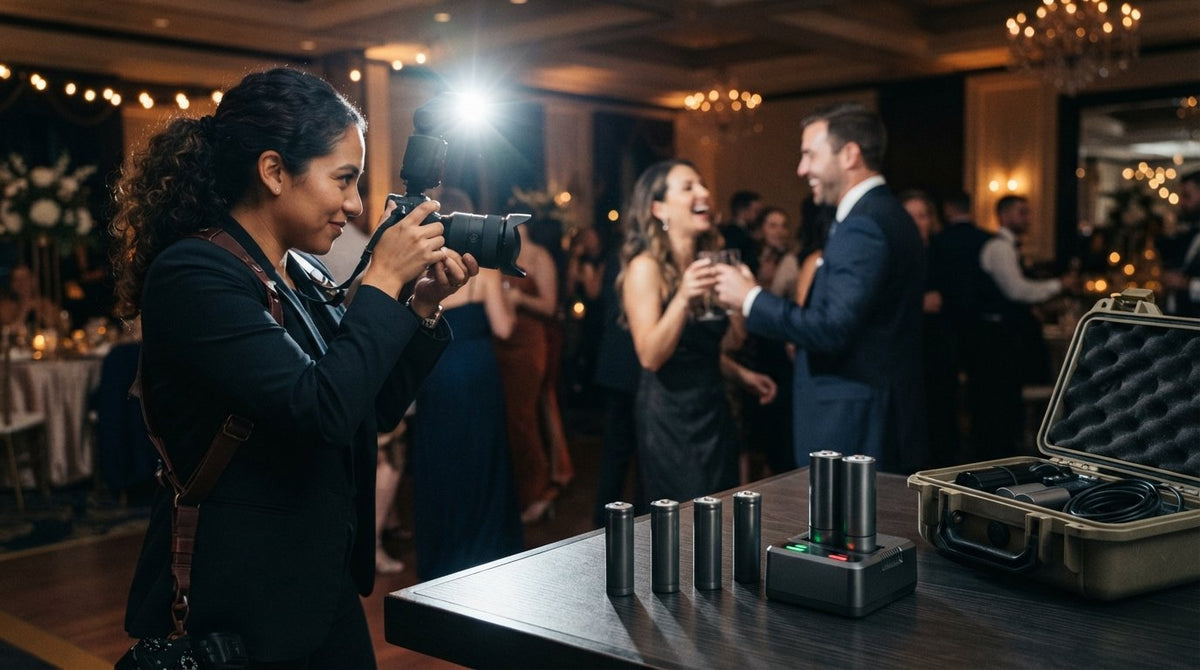
A higher milliamp-hour rating won't guarantee a faster camera flash. When recharging a capacitor after a full-power pop, a speedlight pulls an aggressive surge between 4.0 and 8.0 amps. That means cell internal resistance, not printed capacity, dictates whether your strobe fires or stalls. Every event photographer knows the frustration of watching a decisive moment pass while waiting on a sluggish recycle beep. Choosing the wrong AA rechargeable batteries for camera flash units leads directly to thermal throttling, severe voltage sag, and depleted cells right when you need them most.
You don't have to settle for missed frames or unpredictable power. This guide reveals how selecting the proper low-resistance cells will secure sub-two-second flash recycle times across an entire shoot day. We examine proven high-capacity NiMH options, analyze why 1.5V regulated lithium-ion alternatives often fall short under heavy burst demands, and detail professional charging strategies to extend working cell lifespan.
Key Takeaways
- Internal resistance dictates strobe performance under load, making low-impedance cell design far more critical than nominal milliamp-hour ratings.
- Compare chemistry tradeoffs to choose the best AA rechargeable batteries for camera flash units, balancing robust NiMH pulse handling against regulated lithium voltage curves.
- Low self-discharge retention protects your field kit, ensuring backup cells hold ready-to-fire energy after weeks or months in gear bags.
- Proper cell matching and individual-bay charging prevent reverse polarity damage, premature thermal cutoffs, and uneven discharge across four-cell speedlight arrays.
- Professional charging hardware and rugged storage systems streamline rotation workflows while significantly lowering long-term operating costs.
Why Camera Flash Units Demand Specialized AA Rechargeable Batteries
Most battery-powered electronics draw power in smooth, predictable currents. A camera speedlight works in complete contrast. When a strobe discharges at full power, its high-voltage main capacitor empties in milliseconds. Replenishing that capacitor demands an instantaneous, violent surge of electrical current. Choosing capable AA rechargeable batteries for camera flash units ensures this heavy pulse transfers cleanly, keeping recycle intervals short and hardware protected.
High-Amperage Capacitor Charging Mechanics
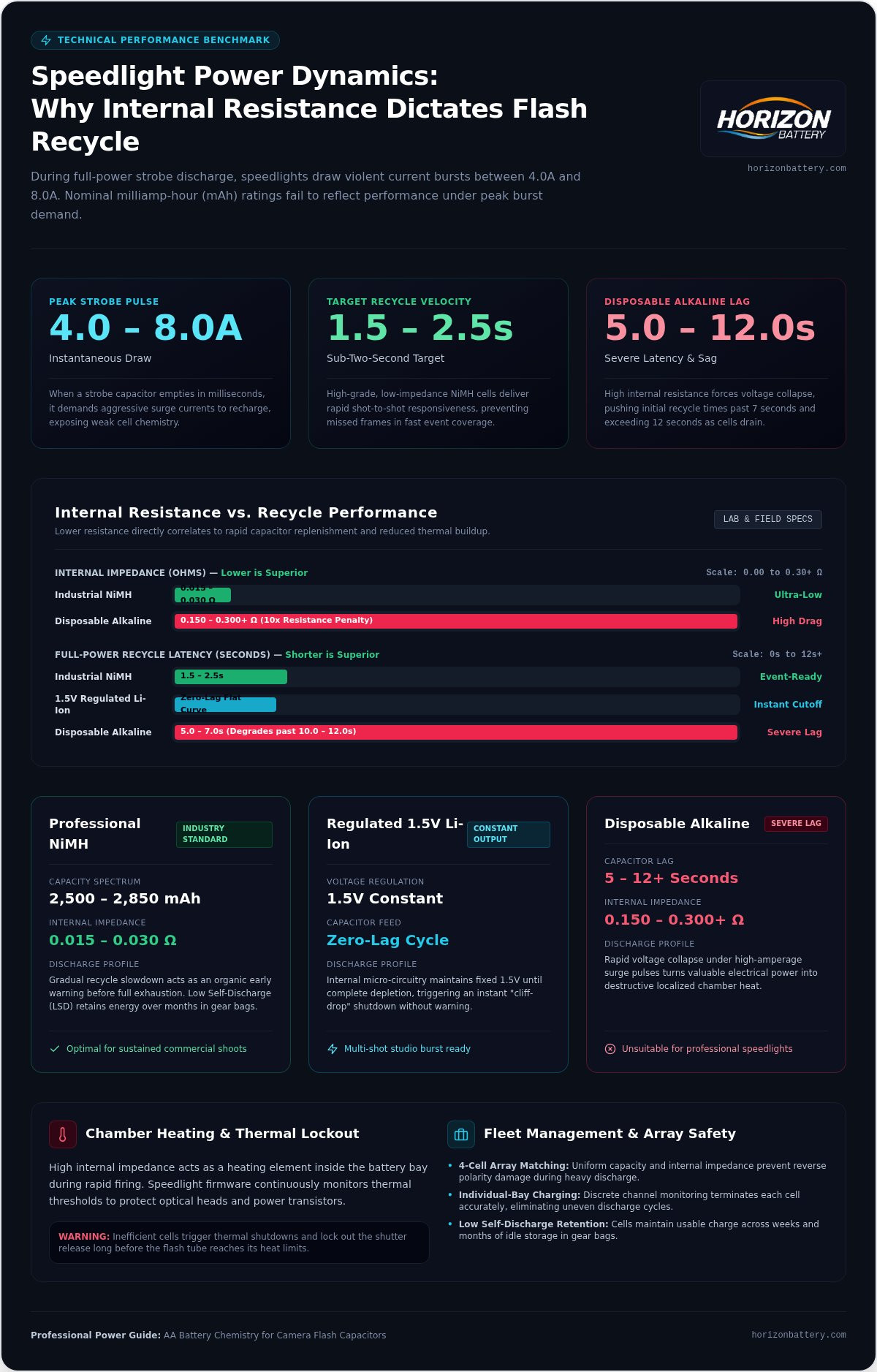
Standard household AA cells buckle during the recharge cycle. A modern speedlight demands burst currents between 4.0 and 8.0 amps to fill the capacitor after a 1/1 discharge. Under that strain, cell internal impedance dictates performance:
- Disposable alkalines: Fresh alkaline batteries feature high internal resistance (0.15 to 0.30 ohms or more), causing severe voltage collapse under load and pushing recycle times past 5 to 7 seconds.
- High-drain rechargeables: Industrial-grade nickel-metal hydride (NiMH) battery chemistry delivers exceptionally low internal resistance (0.015 to 0.030 ohms), replenishing capacitors in roughly 1.5 to 2.5 seconds.
Higher impedance converts valuable electrical energy into unwanted heat instead of filling the capacitor. That energy loss creates lag, causing shot-to-shot latency that can disrupt fast-paced continuous event coverage.
Thermal Throttling and Flash Protection Circuitry
Modern flash units feature integrated thermal protection. Sensitive optical heads and internal power transistors can melt under extreme heat, prompting factory firmware to monitor thermal thresholds continuously. When temperatures spike past safe operating limits, the strobe forces an emergency shutdown, locking the shutter release out entirely until the unit cools.
Batteries are a primary driver of this thermal buildup. High internal resistance turns the battery compartment into a localized heating element during sustained firing. Inefficient cells push the flash body toward thermal throttling long before the flash tube itself reaches critical heat. Investing in low-resistance AA rechargeable batteries for camera flash units minimizes chamber heat, allowing continuous firing without triggering forced shutdown sequences during high-volume sessions.
Comparing Battery Chemistries: NiMH vs. Li-Ion vs. Alkaline
Every photographer must decide how to balance continuous recycle velocity against overall operating lifespan. The chemistry powering your speedlight dictates not just shot-to-shot responsiveness, but also how the strobe communicates approaching battery exhaustion. Evaluating real-world discharge curves reveals why selecting the right AA rechargeable batteries for camera flash units transforms daily shooting performance.
High-Capacity Professional NiMH Performance
Nickel-metal hydride cells remain the backbone of commercial event kits. Premium cells deliver ratings reaching 2,500 to 2,850 mAh, providing extensive stamina during multi-hour assignments. Independent evaluations, including Wirecutter's lab testing of rechargeable AA batteries, emphasize that low self-discharge formulas retain usable charge across months of idle storage. As these cells deplete, recycle times lengthen gradually. That slight slowdown acts as an organic, non-disruptive early warning to swap packs before total power loss. Review our technical guide to Ansmann high capacity batteries for hardware-matched NiMH solutions.
Regulated 1.5V Lithium-Ion Technology
Regulated lithium-ion cells employ internal micro-circuitry to output an unyielding 1.5 volts throughout the discharge cycle. This steady feed delivers lightning-fast, zero-lag recycle speeds from your opening composition straight to complete capacity exhaustion. However, photographers should plan for the characteristic cliff-drop shutoff when the internal power management circuitry cuts power instantly. Explore the Pure Power Series to see how regulated voltage curves support rapid, multi-shot studio production.
Why Disposable Alkalines Cripple Speedlights
Alkaline disposables undermine professional assignments. Under high-drain pulses, alkaline voltage plummets instantly, dragging recycle delays past 10 to 12 seconds as the pack runs down. Even worse, forced high-amperage draws provoke thermal expansion that compromises terminal seals. Corrosive potassium hydroxide then leaks directly into the speedlight chamber, causing irreversible hardware corrosion.
The operational and environmental impact is clear:
- Extreme operational waste: Single-use disposables generate recurring packaging debris and constant replacement expenses for active studios.
- Erratic output curves: Rapidly lengthening recycle times ruin burst sequences during unscripted, fast-moving assignments.
- Hardware hazard: Chemical venting permanently destroys internal flash contact pins.
To upgrade your field workflow with dependable, high-output power, review the professional inventory at Horizon Battery to equip your gear kits properly.
Key Buying Criteria for Speedlight Rechargeable Batteries
Spec sheets rarely tell the whole story. While consumer battery marketing focuses entirely on nominal capacity numbers, professional photography demands a broader evaluation. Selecting the best AA rechargeable batteries for camera flash units requires analyzing real discharge performance under stress, self-discharge shelf stability, physical manufacturing tolerances, and long-term cycle durability.
Real-World High-Drain Capacity vs. Nominal Ratings
Consumer brands often print inflated milliamp-hour ratings derived from gentle 0.1C laboratory drain rates. Under the multi-amp surges demanded by photographic strobes, those low-grade chemical cores collapse, delivering a fraction of their advertised runtime. Industrial-grade formulations maintain low impedance to sustain repeated full-power discharges without voltage failure. For a deeper breakdown of sustained discharge performance across production equipment, read our analysis of high-capacity AA batteries for professional audio and imaging hardware.
Low Self-Discharge Retention in Gear Bags
Unused gear must remain production-ready. Standard legacy NiMH cells lose substantial charge within days just sitting idle in storage. Low self-discharge (LSD) chemistry solves this vulnerability by retaining approximately 85% of its energy after an entire year at room temperature. That retention eliminates panicked, morning-of-event charging cycles, ensuring your backup speedlight sets deliver full power whenever an unexpected shooting assignment arises.
Casing Dimensions and Slot Compatibility
A battery that cannot slide cleanly into a flash is useless. The physical dimensions of high-capacity cells vary substantially between manufacturers:
- Oversized consumer jackets: Certain consumer brands pack extra capacity by thickening the outer cell diameter or using thick decorative plastic wraps. These cells routinely jam inside tight battery doors from Canon, Nikon, and Godox, requiring tools or pliers to extract.
- Industrial precision casings: Professional-grade cells conform strictly to standard international form-factor dimensions, ensuring smooth insertion and ejection even during rapid, mid-reception swaps.
- Thermal deformation resistance: Rugged exterior sleeves prevent swelling when battery compartments reach elevated temperatures during sustained burst firing.
Long-term operating expense also hinges on cycle durability. Standard-capacity cells deliver up to 2,100 cycles, while high-capacity cells provide roughly 500 charge cycles under heavy loads. Maintaining matched four-cell groups and following Battery University's guide to charging nickel-metal-hydride cells protects this investment, preventing weak individual cells from dragging down your entire speedlight array.
Fleet Management: Charging Systems, Cell Matching, and Maintenance
Purchasing quality cells is only half the battle. Maintaining consistent strobe readiness across an entire production season requires disciplined fleet management. Without proper charging protocols and systematic tracking, even the finest AA rechargeable batteries for camera flash units suffer premature degradation, erratic runtimes, and unexpected failures during critical assignments.
Smart Charging Protocols and Independent Channels
Budget chargers often utilize paired channels that charge cells in series. This approach is dangerous. In a paired configuration, the charger terminates based on average circuit voltage, systematically undercharging weaker cells and cooking healthier ones with excess current. Microprocessor-driven units monitor each slot independently, utilizing negative delta-V (-ΔV) charge termination and thermal sensors to prevent destructive overcharging. Commercial studios running dozens of speedlights can streamline turnaround times by reviewing options in enterprise battery charging solutions for organized staging benches.
Cell Grouping and Rotation Best Practices
Speedlights place heavy series loads on multi-cell trays. To ensure uniform discharge, keep your batteries permanently matched in dedicated quads:
- "Marry" your sets: Always charge, discharge, and store sets of four together from day one. This prevents internal resistance divergence over the operational lifecycle.
- Prevent reverse charging: Pairing a depleted cell with three fresh ones can drive the weak cell into polarity reversal under heavy flash burst loads, permanently destroying its chemical structure.
- Label deployment batches: Number each quad and stamp the commission month on the exterior casing. Systematic batch labeling makes it simple to retire aging inventory before it causes sudden cutouts on set.
Asset Storage and Field Transport Organization
Loose cells drifting inside camera bags represent an electrical fire hazard. Accidental contact between conductive camera mounts, keys, and exposed battery terminals can trigger instant short circuits. Dedicated, terminal-insulating caddies prevent accidental discharges while establishing an intuitive visual workflow. Storing charged quads terminal-up and spent cells terminal-down lets you confirm your power reserves in seconds without testing meters. Discover Battery Storage best practices to maintain optimal inventory organization across your creative team.
Ready to upgrade your studio's operational workflow? Equip your production team with heavy-duty multi-bay systems and rugged field storage by exploring industrial gear solutions at Horizon Battery.
Recommended Professional Power Solutions for Flash Units
High-volume commercial shoots demand power systems built for sustained electrical throughput rather than casual retail use. Selecting the best AA rechargeable batteries for camera flash units means choosing hardware engineered specifically around extreme duty cycles, tight equipment tolerances, and efficient staging room workflows.
Ansmann High-Capacity NiMH for Endurance
For wedding photographers and event crews facing ten-hour assignments, such as the demanding shoots covered by One Vision Photography | South Wales Wedding Photographer, Ansmann high-capacity NiMH cells provide outstanding operational stamina. Engineered with low internal resistance, these heavy-duty cells deliver strong multi-amp discharge pulses without excessive heat buildup. Their precision casing dimensions eliminate the binding issues common with oversized consumer alternatives, ensuring effortless insertion across Godox, Canon, Nikon, and Sony speedlight compartments.
When high-cadence burst sequences allow zero tolerance for recycle lag, the Pure Power Series delivers regulated 1.5-volt output right up to full depletion. This sustained voltage eliminates the progressive slowdown seen in traditional cells, keeping shot-to-shot flash intervals exceptionally tight. Because lithium chemistry weighs significantly less than nickel-metal hydride, these cells reduce leverage and strain on hot-shoe mounts during handheld run-and-gun shooting. Onboard micro-circuitry guards each cell against over-discharge, short circuits, and thermal surges.
Turnkey Charger Bundles and Enterprise Systems
Managing large cell inventories across multiple camera bodies requires systematic infrastructure. Horizon Battery pairs performance cells with turnkey Charger / Battery Bundles, giving production teams verified hardware compatibility straight out of the box. For larger commercial studios and equipment rooms managing hundreds of loose cells, custom rackmount chargers transform cluttered workspaces into organized, high-efficiency staging bays.
Investing in industrial-grade AA rechargeable batteries for camera flash units protects delicate strobes while keeping recycle speeds completely predictable. Sourcing directly from an established distributor serving high-volume organizations across North America since 1998 ensures fresh, authentic cells backed by practical technical expertise. Whether deploying NiMH workhorses or regulated lithium technology, pairing matched cells with structured battery storage and enterprise multi-channel chargers keeps your flash hardware ready for every critical frame.
Upgrade Your Production Power for Zero-Lag Flash Performance
Achieving dependable burst firing on location comes down to understanding cell physics. Low internal resistance guarantees rapid capacitor replenishment, while disciplined cell grouping and smart individual-channel charging prevent premature pack cutouts. By pairing your speedlight workflow with verified, high-drain chemistries, you eliminate sluggish recycle delays and protect your strobes from thermal stress. Choosing the right AA rechargeable batteries for camera flash units turns your lighting hardware into a consistent, predictable tool for demanding shoots.
Since 1998, Horizon Battery has supplied mission-critical power solutions to creative and technical professionals across North America. As a specialized distributor of high-performance Ansmann engineering and Pure Power Series technology, we deliver complete equipment ecosystems, ranging from field-ready battery storage to custom rackmount charging systems for high-volume studios. You don't have to let weak power compromise an unrepeatable shot. Explore professional AA rechargeable batteries and charging bundles at Horizon Battery to keep your strobes firing at peak speed on every assignment.
Frequently Asked Questions
Why do AA rechargeable batteries recycle speedlights faster than standard alkaline batteries?
Rechargeable NiMH chemistry delivers significantly lower internal resistance than alkaline chemistry, allowing the flash to pull heavy burst currents without collapsing cell voltage. When drawing 4.0 to 8.0 amps to replenish the capacitor, alkaline cells suffer severe voltage sag under high impedance. In contrast, low-impedance AA rechargeable batteries for camera flash units maintain steady current flow, replenishing the capacitor in roughly 1.5 to 2.5 seconds compared to 5 to 7 seconds on alkalines.
Can 1.5V rechargeable lithium-ion batteries damage my camera flash unit?
No, 1.5V lithium-ion batteries won't damage your speedlight, but their internal circuitry can cause unexpected shooting interruptions. These cells use an integrated step-down converter to regulate voltage, keeping output flat until exhaustion. However, speedlights draw heavy current spikes that can trip the battery's internal management system. While this over-current protection shuts off the cell to prevent hardware damage, it causes your flash to drop offline instantly without warning during rapid bursts.
How many full-power flash pops can I expect from high-capacity NiMH rechargeable batteries?
A matched set of high-capacity NiMH cells typically yields between 250 and 400 full-power discharges depending on the strobe model and capacitor efficiency. When shooting at partial power, such as 1/4 or 1/8 output, that shot count scales into thousands of frames. Ambient temperature, firing cadence, and cell health also influence total yield. Quality high-capacity options prioritize energy density to deliver sustained output through long commercial assignments before requiring fresh cells.
What causes rechargeable batteries to get hot inside speedlights during rapid continuous shooting?
Battery heating is caused by high electrical current pushing against the internal resistance of the cells during back-to-back capacitor recharge cycles. Speedlights demand intense energy pulses over short intervals. As current flows through the electrolyte and cell terminals, natural electrical resistance converts a portion of that energy into thermal dissipation. Firing long bursts in rapid succession accelerates heat buildup, which can trigger the flash unit's built-in thermal protection sensors and force a temporary cooling lockout.
Why should I avoid mixing different battery brands or ages in the same speedlight?
Mixing mismatched cells causes uneven discharge rates that can force the weakest battery into reverse charging, permanently ruining the cell. In a four-cell speedlight circuit, cells discharge in series. When you mix different capacities or wear levels, the lowest-capacity battery exhausts first. The remaining active cells continue driving current through the depleted cell, causing chemical breakdown, venting, or leakage. Always run matched sets of AA rechargeable batteries for camera flash units to preserve pack balance.
How do I know when my AA rechargeable batteries have reached the end of their operational lifespan?
You know your batteries need retirement when recycle times become noticeably sluggish or when smart charger-analyzers report sharply diminished milliamp-hour capacity. As rechargeable cells age, internal resistance climbs and usable storage shrinks. High-capacity NiMH cells typically deliver around 500 charge cycles under heavy photographic loads. Testing cells on an analyzing charger lets you check actual discharge capacity and internal resistance, allowing you to retire degrading quads before they cause sudden mid-shoot failures on location.