
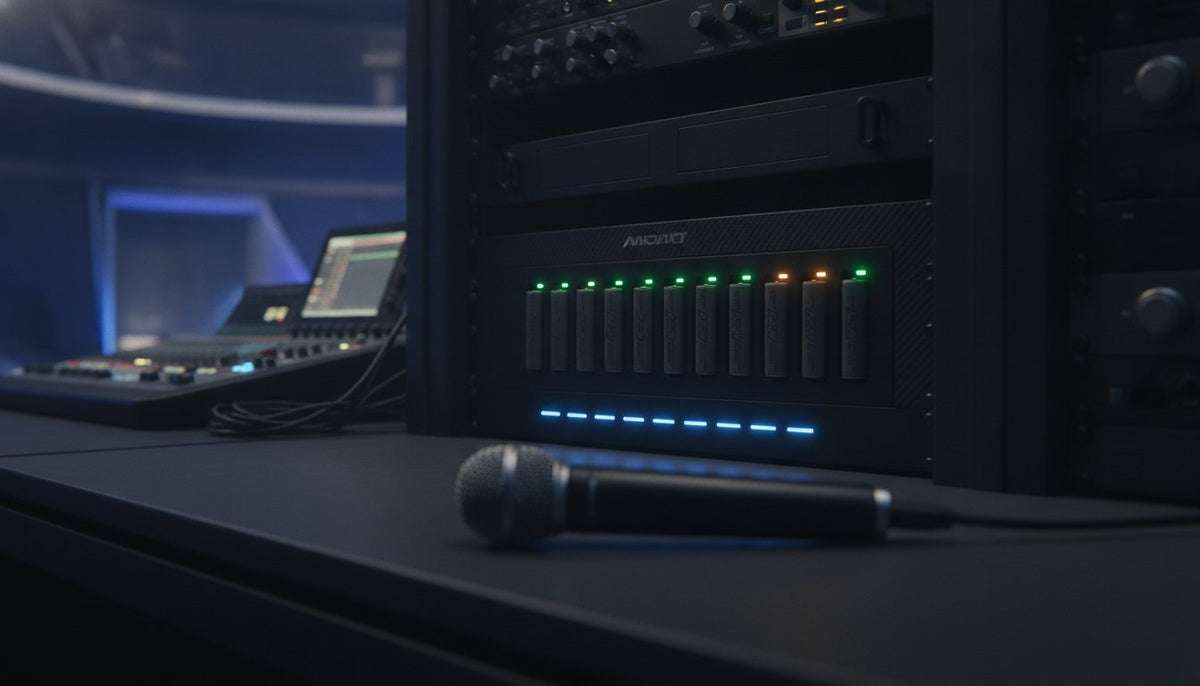
Imagine the sudden silence in a crowded auditorium when a lead vocal cuts out because a standard alkaline battery hit its voltage drop-off ten minutes earlier than expected. It is a high-stakes nightmare that every sound engineer or production manager has faced at least once. You likely agree that managing buckets of disposable cells is not only an environmental burden but also a financial drain that offers zero peace of mind during a live performance. Finding a professional wireless microphone battery and charger kit is no longer just a "green" initiative; it is a requirement for mission-critical audio reliability in a digital world.
This 2026 guide will help you master the transition from wasteful disposables to high-capacity rechargeable systems designed for the rigors of professional audio. We will show you how to secure a reliable 8-hour runtime for every transmitter and eliminate the physical fit issues common in Sennheiser and Shure packs. You will learn to implement a standardized charging workflow that delivers a significant return on investment within 12 to 24 months. We are moving beyond basic consumer cells to explore constant voltage solutions and Custom Rackmount Chargers that keep your production running flawlessly.
Key Takeaways
- Learn how to avoid the "battery jam" issue by selecting cells engineered specifically for the tight physical tolerances of professional wireless transmitters.
- Discover why a professional wireless microphone battery and charger kit featuring the Pure Power Series provides the constant 1.5V output required for accurate digital battery metering.
- Establish a fail-safe battery management workflow using simple visual cues to ensure volunteers and stagehands never deploy a depleted pack.
- Calculate the significant return on investment achieved by replacing thousands of single-use alkalines with a high-performance rechargeable infrastructure.
- Explore the benefits of scaling your operation with Custom Rackmount Chargers to eliminate cluttered power supplies and centralize charging in your AV rack.
The True Cost of Alkaline vs. Rechargeable Batteries for Wireless Microphones
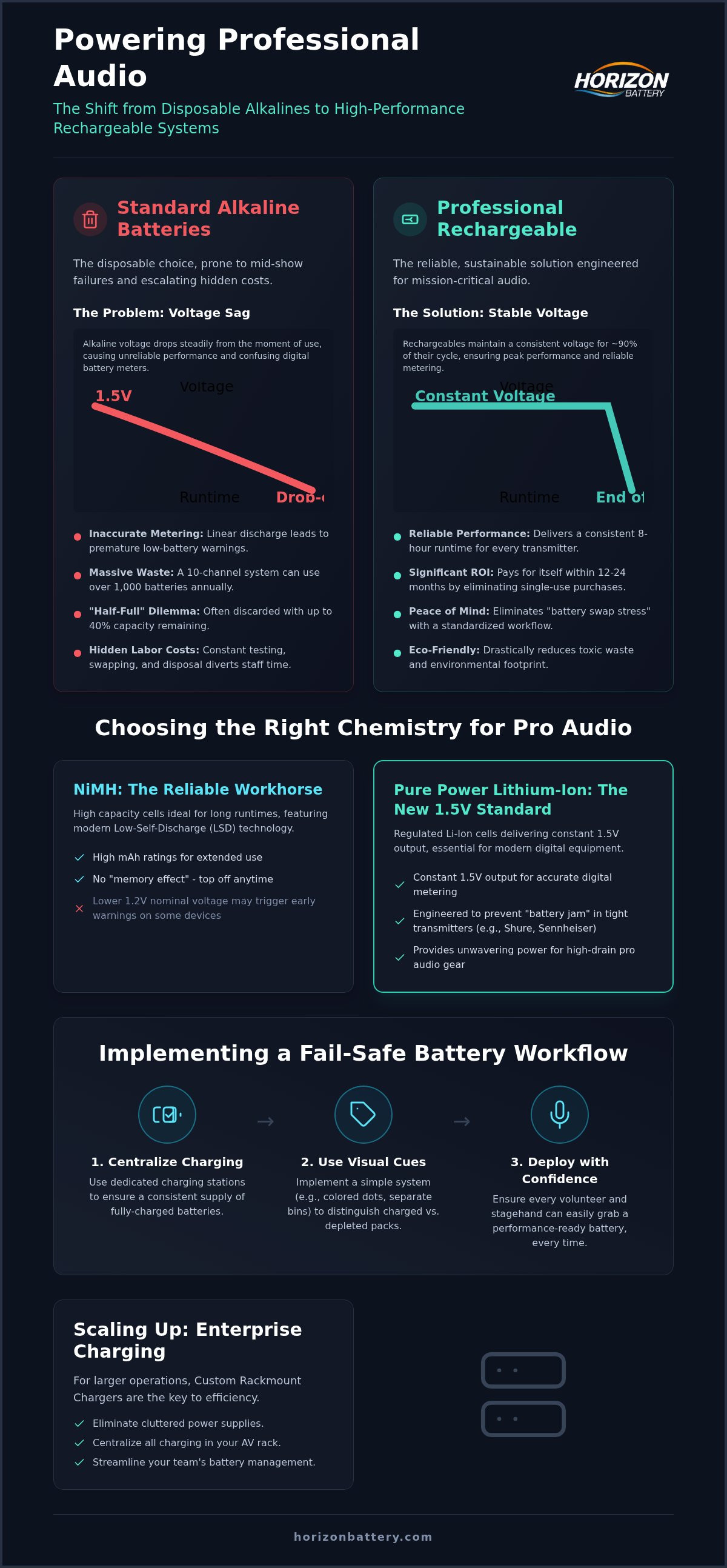
Relying on the 1.5V label of a standard alkaline battery is a gamble that often leads to mid-show failures. While that voltage is accurate when the battery is fresh, it begins to drop the moment you power on your transmitter. In professional environments, this decline forces technicians into a cycle of waste. Large venues often end up with containers full of batteries that still have 40% capacity but are deemed too risky for the next performance. This "half-full" dilemma creates a massive environmental footprint and ignores the underlying efficiency of a dedicated wireless microphone battery and charger kit.
The Hidden Cost of Single-Use Batteries
A typical 10-channel wireless system used for three weekly events can easily consume over 1,000 AA batteries per year. The financial cost is only part of the equation. You must also account for the labor hours spent by staff or volunteers constantly testing, swapping, and disposing of cells. Because single-use batteries are often discarded "just in case" after only a few hours of use, the actual cost per hour of operation is significantly higher than the shelf price suggests. Additionally, managing the logistical headache of toxic waste disposal adds another layer of complexity to your production workflow.
Switching to rechargeable batteries for business provides a clear path to reclaiming these lost hours and expenses. Most professional organizations find that the initial investment in high-capacity cells and charging hardware pays for itself within 12 to 24 months. Beyond the ROI, the shift reduces "battery swap stress" for your team. Instead of rummaging through boxes of loose alkalines, they can rely on a standardized, centralized system that ensures every mic is ready for a full eight-hour shift.
Voltage Curves: Alkaline Sag vs. Rechargeable Stability
The primary technical reason alkalines fail in high-drain audio gear is their linear discharge curve. They lose power steadily from the start, which confuses digital battery meters and leads to premature low-battery warnings. In contrast, modern rechargeable battery technologies, such as the Pure Power Series, are engineered to provide a flat discharge curve. They maintain peak voltage for roughly 90% of their cycle, ensuring the transmitter performs consistently until the cell is nearly empty. Voltage sag refers to the temporary drop in voltage that occurs when a transmitter draws a burst of power, which can lead to reduced RF range or audible dropouts. By utilizing a professional wireless microphone battery and charger kit, you eliminate this instability and gain the peace of mind that comes with constant, reliable power.
Choosing the Right Chemistry: NiMH vs. Lithium-Ion for Pro Audio
Selecting the right chemistry for your wireless microphone battery and charger kit requires looking beyond simple price points. While Nickel-Metal Hydride (NiMH) has been the industry standard for decades, regulated Lithium-Ion cells are rapidly changing the expectations for 1.5V equipment. The choice usually comes down to whether you prioritize raw milliamp-hour (mAh) capacity or a constant, regulated voltage output.
NiMH: The Reliable Workhorse
Modern NiMH cells utilize low-self-discharge (LSD) technology. This hybrid engineering ensures batteries stay charged even if they sit in a drawer for weeks between events. Ansmann high capacity batteries are a prime example of this technology, offering high mAh ratings that translate to long runtimes for handheld transmitters and in-ear monitors (IEMs). The "memory effect" that plagued older Nickel-Cadmium cells is largely a myth with modern NiMH chemistry. You can top them off without worrying about losing capacity. However, NiMH cells are heavier and have a lower nominal voltage of 1.2V. This can occasionally trigger early low-battery warnings on sensitive digital systems that expect a full 1.5V from an alkaline cell.
Pure Power Lithium-Ion: The New Standard for 1.5V Gear
The Pure Power Series represents a significant leap forward by integrating a tiny voltage regulator into each cell. This allows the battery to maintain a constant 1.5V output until it is completely exhausted. This behavior is ideal for mission-critical gear that requires a steady voltage to maintain signal strength and accurate battery telemetry. Beyond electrical performance, Lithium-Ion cells are significantly lighter than NiMH. This reduces the physical load on talent during long theatrical performances or multi-hour keynote speeches. Charging speeds also favor this chemistry; Li-ion cells often reach full capacity in less than half the time of their NiMH counterparts.
Heat management is another critical factor. Wireless transmitters generate internal heat during operation, and high-quality cells are designed to dissipate this energy without performance degradation. Whether you choose the high-capacity endurance of NiMH or the regulated precision of the Pure Power Series, matching the chemistry to your specific hardware ensures peak reliability. If you are unsure which chemistry fits your current inventory, consulting with a technical specialist can help you avoid costly compatibility errors. Both chemistries have their place, but the decision should always be based on the specific power draw and voltage sensitivity of your wireless receivers and transmitters.
Physical Dimensions and the 'Tight Fit' Problem in Professional Gear
One of the most frustrating obstacles in professional audio is the "battery jam." You invest in a high-quality wireless microphone battery and charger kit, only to realize the cells are too thick to slide into your bodypack. This occurs because many rechargeable AA batteries are manufactured slightly larger than the international standard for alkaline cells. While a fraction of a millimeter seems negligible, it is enough to get a battery permanently stuck inside an expensive transmitter. Forcing a tight battery can lead to cracked housings or bent terminal contacts, turning a minor inconvenience into a costly repair.
Identifying Tight Battery Compartments
Professional gear from manufacturers like Sennheiser (specifically the G3 and G4 series), Shure, and AKG often features battery slots with extremely narrow tolerances. These compartments are designed to hold batteries securely to prevent power interruptions during high-energy movement, but this leaves little room for the extra girth of generic high-capacity rechargeables. To avoid damaging your equipment, you should measure your battery slots or test with a single cell before committing to a bulk purchase. High-capacity AA batteries for professional audio must adhere to strict physical specs to ensure they don't compromise the integrity of the transmitter's internal contacts. Systems like the Shure QLX-D and Axient Digital are particularly sensitive to these engineering tolerances.
Slimline vs. Standard High-Capacity Cells
There is often a direct trade-off between energy density and physical cell thickness. Standard high-capacity cells achieve their 2800+ mAh ratings by packing more active material into the casing, which can cause the battery to swell slightly during the manufacturing process. The Ansmann 2850 mAh Slimline series addresses this specifically by maintaining a thinner profile without sacrificing significant runtime. It has become an industry favorite because it slides freely into the most restrictive packs without the need for tools to pry it back out.
A simple way to verify compatibility is the "drop test." If you hold the transmitter upside down and the battery does not slide out under its own weight, the cell is too tight for that specific device. You should never have to force a battery into place. By choosing a wireless microphone battery and charger kit that prioritizes physical dimensions alongside electrical performance, you protect your hardware investment while ensuring reliable power for every performance. This attention to detail separates professional-grade power solutions from consumer-grade alternatives that can fail in the field.
Implementing a Fail-Safe Battery Management Workflow
A high-performance wireless microphone battery and charger kit is only as reliable as the system used to manage it. In professional environments, human error is often the primary cause of audio dropouts. Implementing a "Green/Red" system provides an immediate visual cue for volunteers and stagehands. Green bins or labels signify batteries that are fully charged and ready for deployment; red bins are for depleted cells waiting for the charger. This simple protocol eliminates the guessing game that often leads to half-dead batteries being placed back into a transmitter.
Standardizing your inventory is equally critical. Mixing different brands, capacities, or battery ages within the same device leads to uneven discharge. This can cause one cell to fail while the other still shows a charge, leading to unexpected shutdowns. You should treat your batteries as matched pairs or sets. If you are using the Pure Power Series, keep those cells together throughout their entire lifecycle to ensure consistent performance across all channels.
Step-by-Step: The Show Day Routine
Your routine should begin with pre-show testing using a true-load battery tester. A simple voltmeter often provides a "false positive" by showing high voltage without a load, whereas a load tester simulates the actual draw of a transmitter. Establish a dedicated "dirty" station for batteries removed after a performance and a "clean" station for fresh ones. While your goal is 100% rechargeable reliability, it's a best practice to keep a small, sealed emergency kit of alkalines for absolute contingencies, such as a localized power failure that prevents charging.
Asset Management for Large Facilities
Managing dozens of cells across multiple rooms requires a methodical approach to asset tracking. Use date codes or batch numbers to identify when batteries entered service. This allows you to rotate your stock effectively, ensuring even wear across your entire inventory. Most professional rechargeable cells should be retired from mission-critical use after a specific number of cycles or a set time period, such as 18 to 24 months. These retired cells don't need to be discarded immediately; they are often perfect for non-critical gear like office wall clocks or remote controls.
Proper organization prevents physical damage and electrical shorts. Utilizing dedicated Battery Storage cases ensures that terminals do not touch, which can lead to heat buildup or accidental discharge. To maintain a professional standard in your facility, browse our professional charging solutions to find the infrastructure that fits your specific channel count. Creating a one-page standard operating procedure (SOP) for your tech booth ensures that every team member, regardless of their experience level, follows these same fail-safe steps.
Scaling Up: Enterprise Charging and Rackmount Infrastructure
Managing a single wireless microphone battery and charger kit is straightforward, but the complexity increases exponentially as you scale to 16, 32, or 40+ channels. In many sound booths, this growth leads to a chaotic mess of "wall warts" and plastic consumer chargers daisy-chained across power strips. This disorganized approach is more than just an eyesore; it introduces multiple points of failure and makes it nearly impossible to verify the charge status of your entire inventory at a glance. Professional environments require a centralized power hub to maintain order and ensure every transmitter is ready for the stage.
Why Professional Venues Need Rackmount Charging
Transitioning to a centralized charging station solves the logistical nightmare of high-channel counts. Industrial-grade hardware outlasts consumer plastic units because it is built to withstand the heat and continuous use of a professional production schedule. Unlike proprietary networked systems that often lock you into one specific brand of expensive transmitter, universal rackmount chargers provide the flexibility to manage any high-quality AA or AAA cell in your inventory. This ensures every battery receives an identical, optimized charge cycle, which significantly extends the overall lifespan of your power assets. For those in the European market looking to complement their infrastructure with premium audio output, the ability to hifi luidsprekers kopen from trusted specialists allows for a complete, high-fidelity system upgrade.
When you move beyond basic desktop units, you need a solution engineered for the specific environment of an AV rack. Our enterprise battery charging solutions prioritize thermal safety and precision. High-density charging generates heat, so Custom Rackmount Chargers are designed with proper ventilation and internal engineering to protect the chemistry of your batteries. Essential features include individual channel monitoring and "delta-V" cut-off technology, which detects the exact moment a battery is full to prevent overcharging and performance degradation.
Centralizing your power management into a single rack space streamlines the entire workflow for your technical staff. Instead of hunting for loose chargers or untangling cables, your team has a dedicated station where they can rotate stock with military precision. This level of organization is the final step in moving from a reactive "hope it works" mindset to a proactive, professional standard of reliability. If you are ready to eliminate the clutter and secure your production workflow, explore our Custom Rackmount Charging solutions for your facility to find the right fit for your channel count.
Securing Your Production for the Future
Transitioning to a professional wireless microphone battery and charger kit is more than an environmental choice; it's a strategic move for audio reliability. By choosing cells engineered for tight-fit professional battery compartments and implementing a fail-safe workflow, you eliminate the "battery jam" and mid-show dropouts that plague unmanaged systems. Whether you prioritize the constant voltage of the Pure Power Series or the high-capacity endurance of NiMH, the right infrastructure ensures your team stays focused on the performance rather than the power levels.
Since 1998, Horizon Battery has been trusted by major US houses of worship and theaters to provide industrial-grade solutions. Our Custom Rackmount Chargers are made in the USA and designed specifically for the rigors of the AV rack. You can finally move away from the chaos of loose chargers and unverified cells to a system that delivers a measurable return on investment. Upgrade your wireless system with Horizon’s Professional Battery Bundles today and gain the confidence that comes with seasoned expertise. Your next show deserves the security of a power system that is built to last.
Frequently Asked Questions
Will 1.2V NiMH batteries work in my 1.5V wireless microphone?
Yes, they work, but they may trigger early low-battery warnings on your receiver. High-capacity NiMH cells are reliable workhorses, but their lower nominal voltage of 1.2V can be problematic for sensitive digital systems. For these mission-critical applications, the Pure Power Series 1.5V Lithium-ion cells are a better fit. These regulated cells provide the constant voltage your equipment expects from a fresh alkaline battery, ensuring more accurate telemetry readings during your performance.
How many hours of runtime can I expect from a 2850 mAh AA battery?
You can generally expect 7 to 10 hours of continuous operation from a 2850 mAh cell. This range varies based on the transmitter's power settings and whether the system is analog or digital. Using a professional wireless microphone battery and charger kit ensures your cells are conditioned for maximum runtime. It is always best to test your specific gear under load to establish a reliable baseline for your technical staff and volunteers.
Why do some rechargeable batteries get stuck in Sennheiser battery packs?
Some rechargeable batteries are slightly thicker than standard alkaline cells due to the extra material required for high-capacity ratings. Professional gear from Sennheiser and Shure has extremely tight tolerances to keep batteries secure during movement. If a cell is even a fraction of a millimeter too wide, it can get stuck. We recommend using "Slimline" batteries engineered specifically for these tight compartments to avoid damaging your expensive transmitter housings or bending the internal contacts.
Is it better to use Lithium-ion or NiMH for church wireless mics?
For most church environments, 1.5V Lithium-ion batteries like the Pure Power Series are the preferred choice. They offer a flat discharge curve that keeps battery meters accurate throughout the entire service. NiMH is a great secondary option for non-critical gear, but Lithium-ion's lighter weight and faster charging cycles make it the modern standard. This choice reduces the stress on volunteers who need to know exactly how much runtime is left in every microphone.
How often should I replace my professional rechargeable batteries?
Professional rechargeable batteries should typically be replaced every 18 to 24 months in facilities with regular weekly use. While these cells are durable, their internal chemistry eventually degrades, leading to shorter runtimes. You should monitor your inventory for any cells that fail to reach their rated capacity during a charge cycle. Retiring aging batteries before they fail mid-performance is a key part of maintaining a fail-safe audio environment for your venue.
Can I use a standard charger for Pure Power Series Lithium batteries?
You cannot use a standard NiMH charger for Pure Power Series Lithium-ion batteries. These regulated cells require a specific charging profile to protect their internal circuitry and ensure a full charge. A standard charger won't recognize the Lithium-ion chemistry correctly, which could lead to overheating or permanent cell damage. It is essential to use a compatible wireless microphone battery and charger kit that is specifically rated for 1.5V regulated Lithium-ion technology to maintain safety.
What is the best way to store rechargeable batteries between weekly services?
The best practice is to remove cells from the transmitters and place them in dedicated Battery Storage cases. Storing them in a cool, dry place prevents terminal corrosion and accidental discharge. You should avoid loose storage in bags or bins where terminals can touch, as this creates a short-circuit risk. Keeping your stock separated in labeled cases ensures your team always knows which batteries are fully charged and ready for the next service day.
How do I know if my wireless mic is compatible with high-capacity rechargeables?
Most modern systems are compatible, but you should verify the physical dimensions of the battery compartment first. If your transmitter is known for having a tight fit, such as certain Sennheiser or Shure models, look for "Slimline" rechargeable options. Additionally, check if your receiver's battery telemetry is calibrated for 1.2V NiMH or 1.5V Lithium. Testing a single pair of high-capacity cells in your gear is the most reliable way to confirm electrical and physical compatibility.