

Did you know that a single professional-grade rechargeable battery can replace hundreds of disposables while reducing your environmental impact by 28 times? For organizations managing high-drain equipment like wireless microphones, the logistical burden of alkaline waste is a constant headache. If you're tired of the endless cycle of bulk purchases and the fear of a critical failure mid-performance, switching to rechargeable batteries for business is no longer just a green initiative; it's a financial necessity. As of January 1, 2026, a complex patchwork of state-level regulations has made battery disposal more difficult, turning single-use waste into a significant compliance liability.
We understand that reliability is your primary concern when moving away from the perceived safety of single-use cells. This guide provides a clear roadmap to transition your organization to professional-grade systems, such as our Pure Power Series, which are designed to slash operational costs and eliminate technical downtime. We'll show you how to establish a standardized charging infrastructure using custom rackmount chargers and calculate an ROI timeline that often sees payback within eight months. You'll gain the expertise needed to ensure your high-stakes devices always have dependable power through a structured, methodical approach to energy management.
Key Takeaways
- Learn why transitioning from recurring bulk alkaline purchases to a centralized infrastructure model is the most effective way to stabilize your operational budget.
- Identify the critical differences between NiMH and 1.5V Lithium-ion cells to maintain signal clarity and range for professional wireless systems.
- Discover how switching to rechargeable batteries for business can be streamlined by implementing centralized rackmount charging hubs and dedicated storage systems.
- Follow a structured facility-wide audit process to match specific high-drain devices with the appropriate high-capacity power solutions.
- Establish a standardized power workflow that eliminates the logistical headache of managing thousands of spent cells while ensuring peak performance for every event.
The Business Case for Rechargeable Systems in 2026
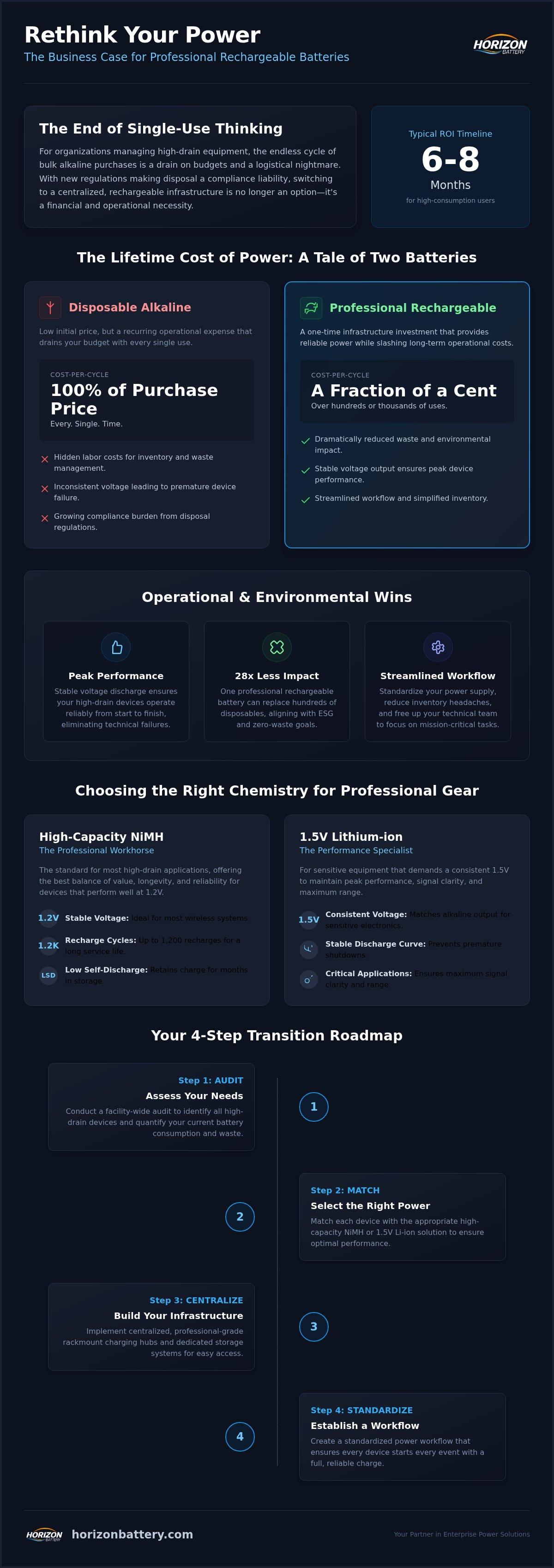
The financial landscape of 2026 has shifted the perspective on battery procurement from a minor consumable to a strategic infrastructure investment. For organizations operating at scale, the sheer volume of bulk alkaline purchases represents a significant drain on cash flow. Beyond the purchase price, the logistical burden of managing thousands of spent cells adds hidden labor costs that many facilities fail to account for in their annual budgets. Switching to rechargeable batteries for business is often driven by a need to control these recurring costs while ensuring high-performance standards.
Alkaline vs. Professional Rechargeable Cost Comparison
The most accurate way to evaluate this transition is through the cost-per-cycle metric. This calculation divides the total cost of a battery and its charging hardware by the number of times it can be recharged. While an alkaline cell has a low entry price, its cost-per-cycle is 100% of its purchase price every single time. In contrast, professional-grade rechargeable battery technology, such as our Pure Power Series, allows for hundreds of uses. This effectively drives the cost per use down to a fraction of a cent over the life of the cell.
High-drain devices like wireless microphones and flash units accelerate the ROI timeline. These devices often deplete standard alkalines in a matter of hours, requiring constant replacement. By switching to rechargeable batteries for business, high-consumption users typically see the initial investment pay for itself within 6 to 8 months. This timeline accounts for the cost of professional battery storage and high-capacity AA rechargeable batteries. It also eliminates the recurring expenses of shipping and specialized waste disposal fees that are becoming more common under new environmental regulations.
Operational Efficiency and Waste Reduction
Operational reliability is often the deciding factor for technical directors and facility managers. Standardizing on a few high-performance cells reduces the inventory management headache. Staff no longer need to spend hours checking expiration dates on bulk packs or managing the disposal of hazardous waste. This streamlined workflow allows technical teams to focus on their primary responsibilities rather than inventory logistics.
Environmental, Social, and Governance (ESG) goals also benefit from this shift. A single rechargeable battery can replace hundreds of disposables, significantly reducing the volume of waste sent to landfills. This aligns with modern "Prevention First" models and helps organizations achieve zero-waste certifications. Additionally, professional systems provide more consistent voltage than mass-produced alkaline batches. By utilizing custom rackmount chargers, teams ensure that every device starts its shift with a full, reliable charge. This reduces the risk of technical failure during mission-critical events, providing a level of security that disposable alternatives cannot match.
Evaluating Performance: NiMH vs. Lithium-Ion for Professional Gear
When switching to rechargeable batteries for business, the technical distinction between Nickel-Metal Hydride (NiMH) and Lithium-ion determines your equipment's reliability. Choosing the wrong chemistry leads to premature device shutdowns or reduced signal range. Professional gear requires a specific discharge curve. While consumer alkalines lose voltage linearly as they drain, professional rechargeable cells maintain a stable plateau. This stability ensures that high-drain devices like wireless microphones perform consistently from the first minute to the last.
High-Capacity NiMH: The Workhorse for High-Drain Devices
High-capacity NiMH cells are the standard choice for most professional applications. These batteries utilize Low-Self-Discharge (LSD) technology. This means they retain their charge even when sitting in a storage drawer for months. For devices that pull significant current but operate well at 1.2V, NiMH offers the best value. Modern cells can handle up to 1,200 recharge cycles, making them a durable long-term investment. You can find more technical specifications in our Ansmann High Capacity Batteries: 2026 Professional Guide.
Many organizations prefer NiMH for its robustness in varied temperatures. It's a reliable chemistry that staff already understand. However, check your device's battery compartment before bulk purchasing. Professional NiMH cells are often slightly larger than standard alkalines. Ensuring a "slimline" fit is essential for specialized gear with tight tolerances. This prevents batteries from becoming stuck in beltpacks or handheld units during a fast-paced event.
Pure Power Series: Constant Voltage for Mission-Critical AV
Mission-critical audio and video equipment often requires a constant 1.5V output to maintain peak performance. Standard NiMH cells occasionally trigger "low battery" warnings prematurely because they operate at 1.2V. Our Pure Power Series Lithium-ion cells solve this by using an internal circuit to provide a steady 1.5V until the cell is exhausted. This prevents "voltage sag," which can cause wireless microphone dropouts or reduced transmission range. It provides the same experience as a fresh alkaline but with the cost benefits of rechargeability.
Switching to rechargeable batteries for business using the 1.5V Lithium-ion chemistry is ideal for digital wireless systems. These systems are sensitive to voltage fluctuations. By maintaining a flat discharge curve, the Pure Power Series ensures your equipment remains fully functional until the very end of the charge cycle. For a deeper look at this technology, read the Pure Power Series: The Professional Guide to Lithium-Ion AA Batteries. To ensure your team is equipped for any scenario, consider integrating these cells into our professional battery bundles designed for high-stakes environments.
Building a Professional Charging Infrastructure
For a professional organization, the transition is only successful when the charging infrastructure matches the quality of the cells. Relying on small, consumer-grade desktop chargers creates a logistical bottleneck that can paralyze a technical team during busy shifts. Switching to rechargeable batteries for business requires a centralized 'charging hub' approach. This shift in mindset ensures that batteries are handled safely and are always ready for immediate deployment in high-pressure environments.
The backbone of a reliable system is microprocessor-controlled charging. These advanced chargers monitor each individual cell's voltage, internal resistance, and temperature throughout the cycle. They prevent overcharging, which is the primary cause of heat-related damage and premature battery failure. By utilizing these smart systems, you maximize the lifespan of your high-capacity AA rechargeable batteries. Multi-channel chargers are also essential. When your facility manages dozens of wireless beltpacks, high-capacity charging stations allow staff to refresh the entire inventory simultaneously. This eliminates the risk of someone grabbing a partially charged cell because they were waiting for an open slot.
Integrating Custom Rackmount Chargers
Broadcasters, theaters, and large houses of worship often find that desktop space is a luxury they don't have. Moving charging hardware into the equipment rack solves this problem while improving organization. Custom rackmount chargers provide a high-density solution that fits into standard 19-inch racks. They keep power cables organized and place status indicators right where the technical crew can see them. This professional setup protects the hardware from accidental spills or being knocked over. For a deeper look at specific hardware configurations, consult our Enterprise Battery Charging Solutions: The 2026 Professional Buying Guide.
Storage and Asset Management Logistics
Effective asset management prevents the common mistake of mixing charged and depleted cells. We recommend a clear 'Charged' versus 'Depleted' labeling system using dedicated battery storage cases. These cases protect the terminals from short circuits and mechanical damage during transport. Implementing a methodical rotation system is also vital for long-term cell health. By drawing from the oldest charged stock first, you ensure even wear across your entire battery fleet. This prevents specific cells from being overused while others sit idle. A well-organized storage system is a critical component when switching to rechargeable batteries for business, transforming a collection of loose parts into a dependable energy ecosystem.
Implementation Roadmap: Transitioning Your Organization
Transitioning a large facility away from disposables requires more than just a purchase order. It demands a structured change in how your team handles energy. A successful rollout ensures that every technical staff member feels confident in the new equipment. Switching to rechargeable batteries for business is a multi-step process that begins with a clear understanding of your current power needs and ends with a sustainable, long-term protocol.
Conducting the Battery Audit
The first step involves a facility-wide audit of every battery-operated device. You must distinguish between mission-critical gear, such as wireless microphone transmitters and emergency communication units, and convenience devices like wall clocks or remote controls. Mission-critical devices typically require the high-capacity AA rechargeable batteries or the constant voltage of the Pure Power Series discussed earlier. Convenience devices often remain better suited for standard alkaline use due to their low drain levels and long standby times.
Once you identify your critical devices, calculate your total inventory needs. We recommend following a strict inventory ratio to ensure you never run out of power during back-to-back events. For every active battery slot in your facility, you should maintain a total inventory of three cells. This "3-to-1" rule provides one cell in the device, one fully charged cell in storage, and one cell currently in the charging cycle. This buffer allows for unexpected extensions in performance times and ensures that staff always have a fresh set ready to go.
Staff Training and Protocol Success
Technical teams often experience "rechargeable anxiety" during the initial phase of switching to rechargeable batteries for business. They worry that a cell might fail during a high-stakes performance. To overcome this, provide staff with performance data from your initial testing and implement simple health-check procedures. Using chargers with built-in capacity testing allows staff to verify cell health before a major event. This objective data builds trust in the system more effectively than verbal reassurances.
Clear signage and a standardized "swap and charge" protocol are essential for compliance. Design your charging station layout for maximum accessibility, choosing between desktop stations for office environments or custom rackmount chargers for technical booths. Establish a clear decommissioning schedule based on the expected cycle life of your cells. When a battery no longer holds its rated capacity during a test, it must be removed from the fleet immediately. This methodical approach ensures your organization maintains a reliable, professional-grade energy ecosystem. To begin your facility's transition with the right hardware, explore our professional charger and battery bundles today.
Horizon Battery: Your Partner in Enterprise Power
Horizon Battery has served as a specialized distributor of mobile energy solutions since 1998. We understand that for production houses, churches, and schools, a battery failure isn't just an inconvenience. It's a technical disaster. Our role is to act as a knowledgeable guide, helping your organization navigate the complexities of switching to rechargeable batteries for business. By providing professional-grade hardware and high-capacity cells, we ensure your team can focus on the performance rather than the power source.
Custom Engineered Charging Solutions
Reliability starts with the charging electronics. Our custom rackmount chargers are engineered to support the unique requirements of the Pure Power Series. Unlike generic chargers, these systems are designed for the rigors of constant professional use. They provide the precise microprocessor control necessary to maintain cell health and maximize longevity. This specialized focus is why Horizon remains the primary source for rackmount hardware in theaters and broadcast studios across the US and Canada. We prioritize safety and steady performance, ensuring that every cell in your battery storage system is ready for immediate deployment.
Get Started with a Professional Battery Bundle
Simplifying the transition is at the heart of our service. We offer pre-configured charger / battery bundles that take the guesswork out of procurement. These kits combine our high-capacity AA rechargeable batteries with the hardware needed to manage them effectively. Whether you're managing a few wireless microphones in a school auditorium or a massive fleet of beltpacks for a multi-campus church, we provide tailored energy solutions. We don't just ship products; we help you build a reliable power ecosystem.
Our specialists offer expert guidance to help you choose between NiMH and Lithium-ion chemistries based on your specific device requirements. We move beyond simple product sales to help you design a complete facility infrastructure. This includes everything from initial audits to establishing long-term decommissioning schedules. If you're ready to eliminate the logistical headache of disposables and secure your organization's power future, contact our specialists today. We'll help you design a customized power infrastructure that meets your specific operational needs and provides long-term peace of mind.
Securing Your Organization's Power Future
Transitioning to a professional energy ecosystem is a strategic move that pays dividends in both operational efficiency and fiscal stability. By switching to rechargeable batteries for business, you eliminate the recurring costs of single-use cells and the logistical burden of hazardous waste disposal. Success depends on matching the right chemistry, like our specialized Pure Power Series, to your high-drain devices while supporting them with custom rackmount hardware designed for longevity. This structured approach ensures that your technical infrastructure remains reliable and cost-effective for years to come.
Since 1998, Horizon Battery has acted as a trusted partner for organizations that can't afford technical downtime. We provide the expert guidance and engineered solutions required to make your facility's transition seamless. You can now move forward with the confidence that your wireless microphones and mission-critical gear will have reliable, constant voltage for every event. It's time to stop managing waste and start managing performance with a system built for professional demands.
Take the first step toward a more sustainable and cost-effective power strategy for your team today. Shop Professional Charger and Battery Bundles to equip your facility with industry-leading technology and specialized support.
Frequently Asked Questions
Is it really cheaper to use rechargeable batteries for a large business?
Yes, the long-term savings are substantial. While the upfront investment in chargers and cells is higher, the cost-per-cycle is significantly lower than buying single-use alkalines. High-consumption organizations often see a full return on investment within 6 to 8 months. By switching to rechargeable batteries for business, you also avoid the rising costs associated with specialized battery disposal and the logistical labor of managing bulk disposable inventory.
Which is better for wireless microphones: NiMH or Lithium-ion?
The choice depends on your specific equipment. High-capacity NiMH is a reliable workhorse for standard devices that operate well at 1.2V. However, for mission-critical wireless systems that require constant voltage, Lithium-ion cells like the Pure Power Series are superior. These provide a steady 1.5V output, preventing the voltage sag that can lead to signal dropouts or premature low-battery warnings on professional beltpacks and handheld transmitters.
How many charge cycles can I expect from professional-grade batteries?
Professional-grade NiMH batteries typically deliver between 500 and 1,200 charge cycles depending on usage and charging conditions. Lithium-ion cells in the Pure Power Series offer a long service life, though the exact cycle count can vary based on the depth of discharge. Using microprocessor-controlled chargers helps maximize this lifespan by preventing heat damage. Regularly testing your fleet ensures you maintain a high standard of performance throughout the life of the cells.
Do I need a special charger for the Pure Power Series Lithium-ion cells?
Yes, you must use chargers specifically designed for 1.5V Lithium-ion chemistry. Standard NiMH chargers operate with different voltage termination points and won't correctly or safely charge Lithium-ion cells. Our custom rackmount chargers are engineered to handle these specific requirements, ensuring the internal circuitry of the Pure Power Series remains protected. This specialized hardware is essential for maintaining the safety and longevity of your professional battery investment.
Can I mix different brands or types of batteries in the same charging rack?
You should never mix different chemistries, such as NiMH and Lithium-ion, in the same charging bay unless the charger specifically supports multi-chemistry sensing. Even when using the same chemistry, mixing brands or ages can lead to inconsistent performance. We recommend standardizing your inventory to a single high-performance line. This simplifies your swap and charge protocol and ensures that every device in your facility receives a uniform level of power.
What happens if a rechargeable battery fails during a live event?
Live failures are best prevented through a strict 3-to-1 inventory rule and pre-event health checks. If a failure occurs, your staff should follow a standardized emergency swap protocol using fully charged spares from your battery storage. Switching to rechargeable batteries for business significantly reduces failure rates compared to unpredictable alkaline batches. This is because professional cells provide a flat discharge curve, giving you more consistent and predictable runtimes during high-stakes performances.
How do I know when it is time to replace my rechargeable battery fleet?
You should replace your cells when they no longer hold at least 80% of their original rated capacity. Most professional chargers include a test or refresh mode that measures actual milliamp-hour capacity. If a battery consistently fails to meet performance benchmarks during these tests, it should be decommissioned immediately. Establishing a regular testing schedule, perhaps quarterly, ensures that your fleet remains reliable and free of underperforming units.
Are there specific storage requirements for bulk rechargeable batteries?
Proper storage is critical for maintaining cell health and safety. Batteries should be kept in dedicated battery storage cases to prevent terminals from touching and causing short circuits. Store them in a cool, dry environment, as extreme temperatures can accelerate self-discharge and degrade the internal chemistry. For long-term storage, NiMH batteries should be charged to approximately 40% to 50% capacity to prevent the cells from falling into a deep discharge state.