
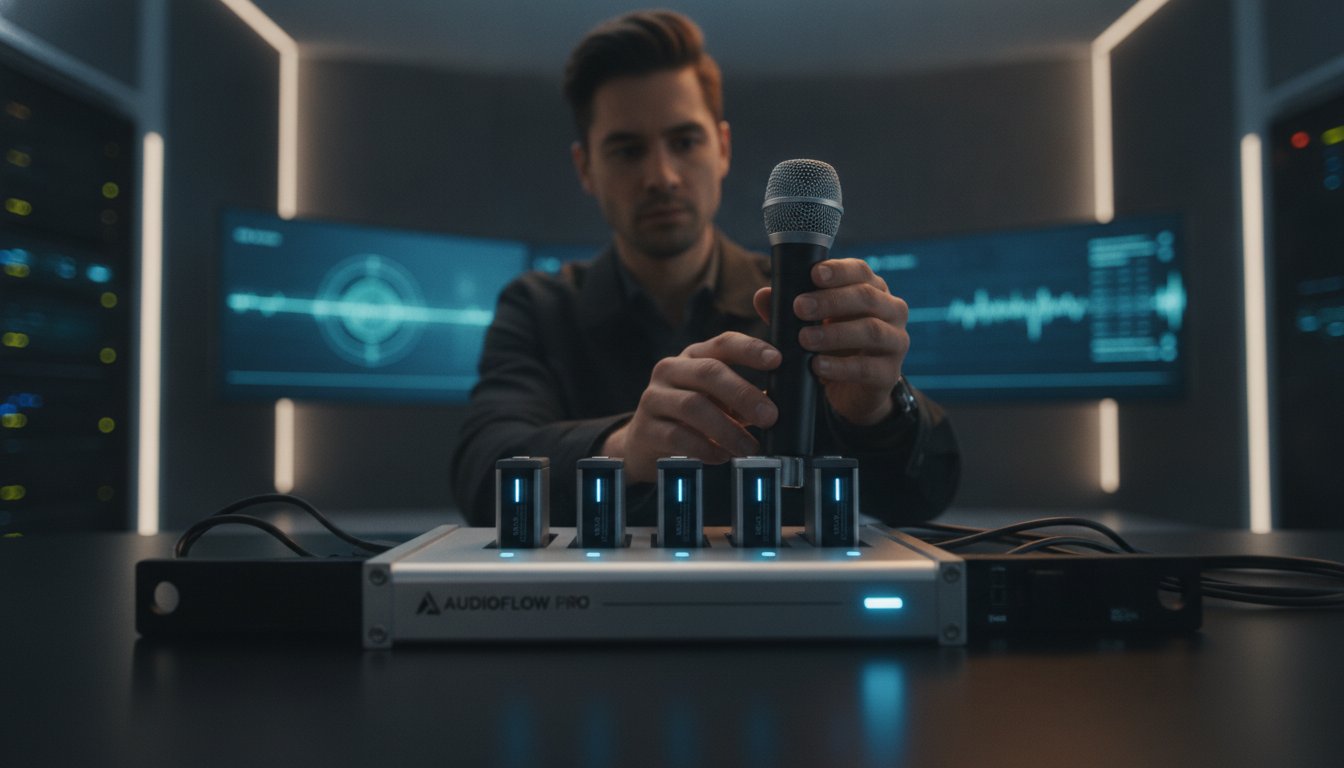
What if the batteries you think are saving your organization money are actually the single largest hidden drain on your 2026 operations budget? You've likely experienced the frustration of a wireless microphone dropping out during a critical event or the logistical headache of managing thousands of disposable cells. It's a costly, unreliable cycle that creates unnecessary labor and equipment risk. Understanding your professional lithium-ion ROI is the first step toward breaking that cycle and securing your facility's power needs.
At Horizon Battery, we've helped enterprise clients navigate these transitions since 1998. We know the true value of a power system isn't found on a price tag. This guide provides a clear framework for calculating the total cost of ownership for high-stakes environments. You'll learn how to maximize performance through technologies like our Pure Power Series, which offers constant 1.5V output to eliminate voltage-related failures. We'll also examine how custom rackmount chargers can streamline inventory and reduce labor costs. By the end of this article, you'll have a roadmap to reliable, cost-effective mobile power for all your high-drain devices.
Key Takeaways
- Learn how to calculate professional lithium-ion ROI by shifting focus from initial unit price to long-term performance and gear protection.
- Understand why the Pure Power Series 1.5V constant voltage is critical for preventing wireless microphone dropouts and premature low-battery warnings.
- Identify the hidden labor costs associated with managing disposable batteries and how standardized workflows can reclaim technical man-hours.
- Discover how custom rackmount chargers centralize power management and extend the operational life of your enterprise battery inventory.
- Develop a phased rollout strategy for large facilities using high-capacity bundles to ensure a seamless transition to professional rechargeable power.
Defining the Total Cost of Ownership (TCO) for Professional Batteries
Calculating the true value of a power system requires looking past the invoice for a single box of batteries. In high-stakes environments like broadcast studios or large houses of worship, the unit price of an alkaline cell is a deceptive metric. A meaningful analysis of professional lithium-ion ROI considers the entire lifecycle of the power source. By 2026, enterprise standards have shifted toward viewing mobile power as a strategic asset rather than a consumable expense. This transition is driven by three primary pillars: extended cycle life, significant labor reduction, and the protection of expensive wireless hardware.
Hidden costs often lurk in traditional procurement cycles. These include the administrative burden of frequent ordering, the physical storage space required for thousands of units, and the logistical complexity of managing waste streams. When an organization treats batteries as a capital investment, these inefficiencies disappear. A professional Lithium-ion battery is designed to maintain high energy density and performance across hundreds of uses, making the initial purchase price only a small fraction of the long-term value proposition.
The 'Disposables Trap' in Professional Environments
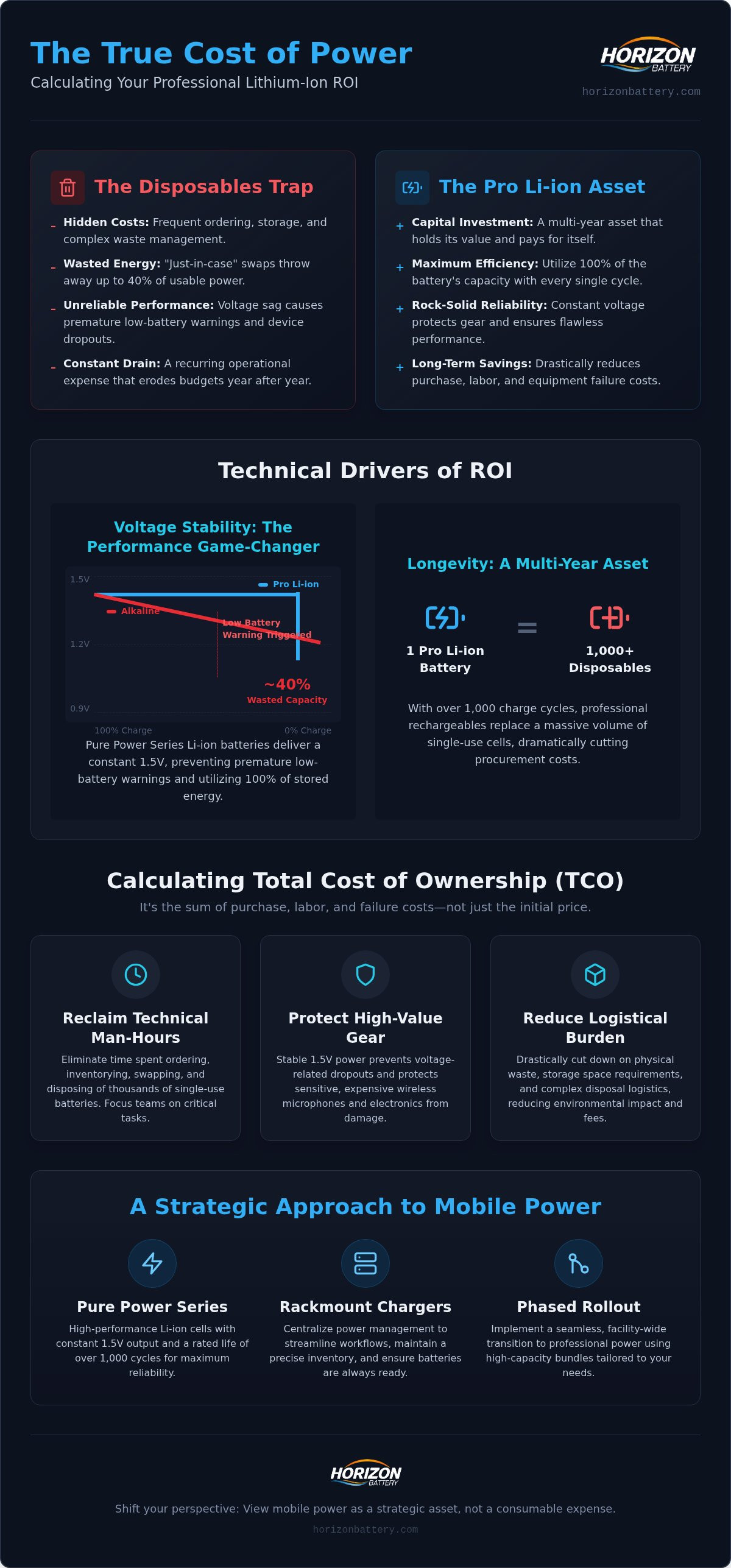
Consider a facility operating 50 wireless microphones. If those mics run for several hours daily, the annual spend on alkaline batteries becomes a staggering operational expense. Beyond the purchase price, there's the cost of "just-in-case" swaps. Technicians often pull half-used batteries before a live event to prevent failure, effectively throwing away paid-for energy. Additionally, many regions now impose environmental impact fees or strict disposal logistics. These factors turn "cheap" disposables into a constant financial and operational drain that erodes your professional lithium-ion ROI before you've even started the show.
Lithium-ion as a Multi-Year Capital Asset
Modern rechargeable cells are built for longevity, often supporting 1,000 or more charge cycles before seeing significant capacity loss. This durability allows departments to budget for power requirements over several years rather than months. Systems like the Pure Power Series provide the reliability needed for this long-term approach. By centralizing charging with custom rackmount chargers, facilities can maintain a precise inventory without the clutter of loose cells. Total cost of ownership is the sum of purchase, labor, and failure costs. This calculation proves that the higher initial investment in professional-grade rechargeable systems pays for itself through sheer durability and operational efficiency.
Technical Drivers of ROI: Voltage Stability and Cycle Life
Technical performance is the primary engine behind professional lithium-ion ROI. In high-drain environments, the behavior of the power cell under load determines the efficiency of the entire operation. Unlike standard alkaline or NiMH cells, the Pure Power Series maintains a constant 1.5V output from the moment it's turned on until the charge is depleted. Most traditional batteries suffer from "voltage sag." As their energy level drops, their voltage output decreases. This often triggers "low battery" warnings on professional equipment when the cell still has 30% or 40% of its capacity remaining. This premature failure forces technicians to swap batteries far more often than necessary, wasting both time and usable energy.
Thermal management is another critical factor that protects your long-term investment. High-performance professional electronics generate significant heat during extended use. If a battery cannot manage this thermal load, the internal chemistry degrades at an accelerated rate. Professional lithium-ion systems incorporate specialized internal circuitry to regulate temperature and prevent overheating. This protection ensures that the cells reach their full rated cycle life rather than failing early due to heat stress. While consumer-grade rechargeables might lose significant capacity after a year, these professional assets are engineered to remain operational well into the future. By balancing cycle life with calendar life, organizations can ensure their power inventory remains reliable through 2030.
Protecting High-Value Gear from Voltage Instability
Sensitive professional electronics, particularly wireless microphones and field recorders, require a steady power profile to maintain signal integrity. Fluctuating voltage doesn't just lead to dropouts; it can also increase the noise floor and degrade the quality of the captured audio. In some instances, the inconsistent power delivery from inferior cells can even cause long-term damage to delicate internal circuits. When you compare the Pure Power Series to NiMH alternatives, the technical advantage is clear. NiMH batteries typically start at 1.2V and drop almost immediately. Professional lithium-ion stays at a rock-solid 1.5V, providing the exact electrical environment these devices were designed to inhabit.
Cycle Efficiency and Energy Density
Maximizing the runtime per charge is essential for reducing the daily workload of your technical staff. The physics of 2026 lithium-ion chemistry provides much higher energy density than the standards of just a few years ago. This means you get more watt-hours in the same physical footprint, allowing for longer continuous runtimes without interruptions. For a deeper technical breakdown of these specifications, you can read our Pure Power Series: The Professional Guide to Lithium-Ion AA Batteries. To see how these technical advantages scale across an entire facility, you might consider evaluating our high-capacity Charger / Battery Bundles for a complete power solution.
Labor Savings: The Often Overlooked ROI Component
While technical specifications like voltage and energy density are vital, the human element often represents the largest portion of an enterprise budget. Managing a fleet of wireless devices requires constant attention. When an organization relies on disposable cells, technical staff spend hundreds of collective hours every year on battery testing, sorting, and replacement. Every minute a lead technician spends digging through a bin of loose alkaline batteries is a minute lost to more critical production tasks. A strategic shift toward professional lithium-ion ROI recognizes that reclaiming this time is just as valuable as the energy itself.
Standardized workflows transform the equipment room from a chaotic storage area into an efficient hub. Moving from thousands of loose cells to organized, high-capacity systems simplifies the entire logistics chain. This change significantly reduces the risk of human error. In high-pressure environments, a technician might accidentally grab a partially used disposable battery, leading to a mid-show failure. With a professional rechargeable system, the status of every cell is clear and predictable. This clarity eliminates the guesswork that often leads to costly technical mistakes.
Streamlining Facility Workflows
The most successful production teams utilize a "Grab-and-Go" methodology. By using Custom Rackmount Chargers, facilities can centralize their power management. Technicians simply pull fresh batteries from the rack and return depleted ones at the end of the shift. This workflow removes the "battery bin" mess entirely. Standardizing on Ansmann for wireless microphone kits ensures that every kit has a consistent, reliable power profile. It's a methodical approach that allows teams to focus on the performance rather than the power source.
Training and Retention Benefits
Professional tools foster a professional culture. AV crews often experience high levels of frustration when equipment fails due to avoidable power issues. Providing reliable hardware like the Pure Power Series signals to your team that their time and the quality of their work are valued. This investment improves morale and can even assist in staff retention by reducing the stress of live production. When calculating your labor ROI, consider the savings per 100 technicians. Reducing battery-related troubleshooting by even 15 minutes per shift adds up to thousands of reclaimed man-hours over a fiscal year.
Infrastructure ROI: The Role of Custom Rackmount Chargers
High-performance batteries require high-performance infrastructure to reach their full potential. Using consumer-grade chargers with professional cells is a common mistake that destroys your professional lithium-ion ROI. These retail chargers often lack the sophisticated circuitry needed to manage the complex charging profiles of modern lithium chemistry. They can cause heat buildup or overcharging, which physically degrades the battery's internal structure over time. In contrast, Custom Rackmount Chargers are engineered to maximize both cell health and operational speed. This industrial approach ensures your investment lasts for its full rated lifespan.
Centralizing your power needs provides an at-a-glance view of your entire inventory. Instead of technicians searching through drawers for loose cells, they can see the status of hundreds of batteries simultaneously. This visual management is essential for large facilities where equipment downtime isn't an option. Intelligent charging systems monitor the internal resistance of each cell. This ensures that every battery in the rack is performing at peak efficiency before it ever leaves the room. It's a methodical way to guarantee that your gear always has the pure power it requires.
Centralized vs. Decentralized Charging
Scattered "wall-wart" chargers and a web of tangled cables create a significant hidden cost for enterprise facilities. They take up valuable surface space and are prone to being accidentally unplugged or lost during busy shifts. Integrating charging directly into existing AV racks saves physical space and ensures power is always where it's needed. This professional setup eliminates the clutter that leads to equipment damage and lost man-hours. For a detailed look at hardware options, consult our Enterprise Battery Charging Solutions: The 2026 Professional Buying Guide.
Advanced Asset Monitoring
Professional systems allow you to identify underperforming cells before they reach the field. This proactive monitoring prevents the technical failures and signal dropouts that can ruin a live production. Data-driven replacement cycles mean you don't have to guess when to refresh your inventory; the hardware provides the necessary metrics. Industrial-grade charging protection also reduces fire risks by monitoring for thermal runaway and electrical faults. This level of safety is a core component of professional lithium-ion ROI for any large-scale organization. To upgrade your facility's infrastructure, explore our Custom Rackmount Chargers today.
Strategic Implementation: Switching to Ansmann Professional
Transitioning an entire facility to a rechargeable ecosystem requires a methodical approach to ensure a seamless shift in operations. For large organizations like schools, churches, or media houses, a phased rollout is often the most effective strategy. Instead of replacing every battery at once, start with high-priority departments where voltage stability is most critical, such as lead wireless microphone kits or field recording teams. This allows your staff to adapt to new workflows while you begin to see the immediate impact on your professional lithium-ion ROI.
To maximize your investment, follow this 5-step framework for 2026 implementation:
- Audit: Quantify your current annual spend on disposables and the technical man-hours lost to battery management.
- Prioritize: Identify high-drain devices that frequently trigger low-battery warnings or experience signal dropouts.
- Standardize: Select uniform Charger / Battery Bundles to eliminate inventory confusion.
- Integrate: Install custom rackmount hardware in central technical hubs for organized, at-a-glance charging.
- Monitor: Track cycle usage and performance data to establish a predictable refresh schedule every few years.
Selecting the Right Battery/Charger Bundles
Success depends on matching battery capacity to the specific drain profile of your gear. While the Pure Power Series is the gold standard for constant 1.5V requirements, certain high-drain applications may still benefit from the Ansmann 2850 mAh NiMH series. These high-capacity NiMH cells offer a reliable alternative for devices that don't require the specific voltage regulation of lithium-ion. For a deeper look at making the transition, consult our Switching to Rechargeable Batteries: 2026 Business Guide. Choosing the right chemistry for each application ensures you aren't over-specifying your needs while still maintaining peak performance.
The Horizon Battery Advantage
Since 1998, Horizon Battery has acted as a veteran distributor and knowledgeable guide for the US and Canadian markets. We don't just ship products; we provide expert consultation to help you design Custom Rackmount Chargers that fit your facility's unique footprint. This partnership approach helps organizations reach their break-even point more quickly, typically within an 18-month window. By combining the Pure Power Series with industrial-grade hardware, you secure a professional lithium-ion ROI that protects your budget and your performance standards for years to come.
Securing Your Enterprise Power Strategy for 2026
Transitioning to a professional power ecosystem is more than a simple equipment upgrade; it's a strategic move toward operational stability. By shifting focus from the initial purchase price to a comprehensive professional lithium-ion ROI, your organization can eliminate the unpredictability of disposable cells. The combination of Pure Power Series constant voltage technology and custom engineered rackmount solutions ensures that your high-drain devices perform without interruption. You'll reclaim valuable technical man-hours and protect your sensitive electronics from the risks associated with voltage sag and battery failure.
Since 1998, Horizon Battery has served as a reliable partner for professional AV and production teams across the US and Canada. We understand the specific requirements of high-stakes environments and provide the industrial-grade hardware needed to sustain them. Don't let outdated power habits drain your 2026 budget. It's time to professionalize your inventory and secure the performance of your facility. Calculate your facility's ROI with Horizon Battery today and take the first step toward a more efficient, reliable mobile power future.
Frequently Asked Questions
What is the typical break-even point when switching to professional lithium-ion?
Most enterprise facilities reach a break-even point within approximately 18 months of implementation. This calculation includes the immediate reduction in recurring alkaline purchase costs and the significant reclamation of technical labor hours. While the upfront investment for professional-grade systems is higher, the durability of the cells ensures they pay for themselves long before they reach their end-of-life. Measuring your professional lithium-ion ROI helps justify this shift in procurement strategy.
How does the Pure Power Series maintain 1.5V throughout the cycle?
These batteries utilize an internal buck-converter circuit to regulate energy output. This electronic component takes the raw lithium cell voltage and steps it down to a rock-solid 1.5V. It remains at this precise level until the cell is fully discharged. This prevents the voltage sag typical of NiMH or alkaline cells; ensuring your professional electronics never receive under-powered signals or trigger premature low-battery warnings during a production.
Are lithium-ion AA batteries safe for long-term storage in professional facilities?
Yes, professional lithium-ion cells have a very low self-discharge rate compared to other chemistries. They can be stored for several months without losing significant capacity or performance. It's best to store them at a partial charge in a cool, dry environment for maximum longevity. This stability makes them ideal for facilities that maintain emergency backup kits or seasonal equipment that isn't used in a constant daily rotation.
Can I use standard NiMH chargers for Pure Power Series lithium-ion batteries?
You cannot use standard NiMH chargers for these cells because the charging profiles are fundamentally different. Lithium-ion batteries require precise voltage regulation and specific termination logic to ensure safety and longevity. Using the wrong charger will likely damage the internal circuitry of the battery and void your warranty. To secure your professional lithium-ion ROI, we recommend using our integrated Charger / Battery Bundles or custom rackmount solutions.
What are the labor savings associated with rackmount charging systems?
Labor savings come from centralized inventory and simplified technical workflows. Staff no longer spend time sorting through bins or testing thousands of individual cells before an event. A rackmount system allows for at-a-glance status checks, reducing the time spent on battery management by several hours per week in large facilities. This efficiency allows your crew to focus on high-value production tasks instead of managing a mess of disposables.
How do professional lithium-ion batteries perform in high-drain wireless microphones?
High-drain wireless mics require consistent voltage to maintain signal integrity and transmission range. The Pure Power Series eliminates the "low battery" warnings that often occur prematurely with alkaline cells. Because the voltage doesn't drop as the battery depletes, the microphone operates at peak efficiency for the entire duration of the charge. This provides reliable audio for long events without the fear of a sudden signal dropout or noise floor increase.
Is there a specific ROI difference between Ansmann NiMH and Pure Power Li-ion?
The ROI difference depends on the specific device requirements. Ansmann NiMH batteries, like the 2850 mAh series, are cost-effective for devices that handle 1.2V well and require high capacity. However, for voltage-sensitive wireless audio, the Pure Power Li-ion provides a better return by preventing mid-show failures and equipment downtime. Both options offer significant savings over disposables when you match the battery chemistry to the right professional application.
Do lithium-ion batteries lose capacity if left on a charger?
Modern professional chargers feature intelligent termination and trickle-charge protection. They stop the main charging current once the cell reaches 100% to prevent overcharging and heat buildup. While it's generally good practice to remove batteries once they're charged, leaving them in a professional rackmount system won't cause the rapid capacity loss seen in older consumer technologies. Our systems are designed for constant enterprise readiness and long-term cell health.