
Professional battery maintenance is a high-stakes asset management strategy, not just a simple charging habit. If you manage large-scale fleets for live events or broadcast, you've likely felt the sting of a wireless mic failing mid-performance or the frustration of replacing expensive cells every year. It's a common struggle to keep up with the shifting landscape of lithium ion battery maintenance while distinguishing between the needs of 1.5V Li-ion and traditional NiMH. With raw materials now accounting for over 70% of battery costs in 2026, every cycle you lose is a direct hit to your operational budget.
We understand that reliability is the only metric that truly matters when the curtain goes up. This guide provides the technical protocols required to double the service life of your professional lithium-ion battery assets and maximize your ROI. We will examine the latest 2026 IATA shipping regulations regarding state-of-charge limits, the impact of stringent safety tag requirements, and the specific storage workflows for the Pure Power Series. You'll gain a repeatable maintenance protocol that ensures 100% reliability for your wireless gear and eliminates the confusion surrounding modern high-capacity power solutions.
Key Takeaways
- Implement the 20-80% charging rule to mitigate chemical stress and significantly extend the operational cycle life of your battery fleet.
- Establish a professional lithium ion battery maintenance protocol using the Visual-Voltage-Vetting (VVV) routine to ensure total reliability for wireless audio gear.
- Optimize your facility's power infrastructure with custom rackmount chargers that provide superior thermal management and organized asset tracking.
- Learn why the Pure Power Series serves as the industrial standard for constant 1.5V output in high-stakes professional environments.
- Transition your workflow from reactive charging to proactive asset management by designating a dedicated Battery Lead within your technical team.
The Science of Lithium-Ion Degradation in Professional Gear
In 2026, the chemical lifespan of lithium-ion cells is defined by the gradual decay of the electrolyte and the physical expansion of the anode. With raw materials now accounting for over 70% of total battery costs, effective lithium ion battery maintenance has become a critical financial strategy rather than a simple chore. While many consumer guides suggest a fixed range of 300 to 500 cycles, professional production teams know that cycle life is a moving target. Understanding how lithium-ion batteries work reveals that high-drain devices, such as digital wireless transmitters, pull current at rates that accelerate chemical exhaustion significantly faster than standard consumer electronics.
Internal resistance is the primary indicator of professional battery failure. As cells age, the path for electrons becomes obstructed by microscopic build-up within the chemistry. This resistance generates excess heat during use, leading to voltage drops that cause equipment to shut down prematurely. In a professional environment, a battery with high internal resistance is a liability, even if a basic meter shows a full charge. Reliable performance requires monitoring these changes before they impact a live production.
The Impact of Depth of Discharge (DoD) on Service Life
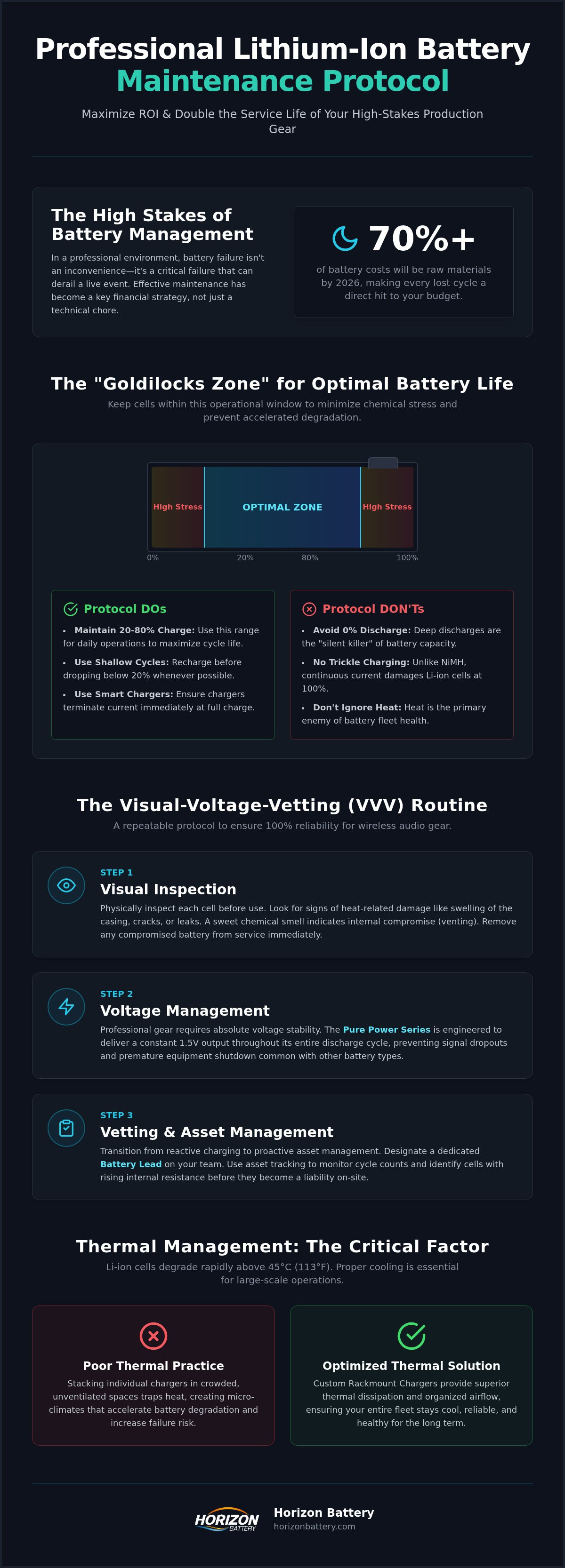
Discharging a cell to 0% is the silent killer of capacity. Lithium chemistry is most stable when ions are distributed evenly between the anode and cathode. Shallow cycles, where the battery is recharged before dropping below 20%, can significantly extend the total number of usable cycles. Depth of Discharge in a professional wireless mic context refers to the percentage of total capacity consumed during a single performance or production shift. Keeping this percentage low ensures the chemical structure remains intact for years rather than months.
Heat: The Primary Enemy of Professional Battery Fleets
Thermal thresholds are critical for long-term health. Most lithium-ion cells begin to degrade rapidly once they exceed 45°C (113°F). Crowded AV racks often create micro-climates where stagnant, warm air traps heat around charging units. This is why organized cooling and airflow are essential for large-scale operations. Utilizing Custom Rackmount Chargers allows for better thermal dissipation compared to stacking individual chargers in a confined, unventilated space.
Watch for signs of heat-related damage during your daily routine. Swelling of the battery casing or a sweet chemical smell, known as venting, indicates that the cell's internal safety mechanisms have been compromised. Consistent lithium ion battery maintenance includes tactile inspections to catch these issues before they damage your hardware or cause a total failure during a live event.
The "Goldilocks Zone": Optimal Charging and Storage Protocols
Achieving peak performance from a professional fleet requires moving beyond basic charging habits. Effective lithium ion battery maintenance relies on keeping cells within a specific operational window known as the "Goldilocks Zone." Following academic-backed battery care tips, production teams should aim to keep charge levels between 20% and 80% for daily use. Operating in this range minimizes the mechanical stress on the cell's internal structure; this prevents the accelerated degradation caused by the extreme expansion and contraction seen at 0% or 100% states of charge.
Avoid the temptation of "trickle charging" your lithium-ion assets. Unlike older NiMH technology, lithium-ion chemistry does not tolerate a continuous low-current top-off once it reaches capacity. Forcing current into a full cell can lead to metallic lithium plating on the anode. This reduces capacity and increases the risk of internal shorts. Use smart charging systems that terminate the current immediately upon reaching a full state to protect your investment. It's a simple change that prevents long-term chemical damage.
Voltage Management for Pure Power Series Cells
Professional audio gear requires absolute voltage stability to prevent signal dropouts. The Pure Power Series is engineered to deliver a constant 1.5V output throughout the entire discharge cycle. This differs from standard lithium cells that may vary in voltage as they drain. Because of this specialized internal regulation, standard NiMH chargers are incompatible with these cells. Using the wrong hardware can bypass safety circuits and damage the internal buck converter. Always verify charge status using a dedicated tester designed for 1.5V Li-ion cells before high-stakes events to ensure your wireless mics remain fully powered through the final curtain call.
Climate-Controlled Storage for Enterprise Inventories
Preparing for a seasonal hiatus or long-term inactivity requires a different approach than daily production. The ideal dormancy state for lithium-ion cells is a 40% to 50% charge stored at a constant 15°C (59°F). Storing batteries at 100% charge in a warm environment accelerates chemical breakdown, while storing them at 0% can lead to a "deep discharge" state from which the cell may never recover. Consistent lithium ion battery maintenance during these periods is vital for protecting your fleet's ROI.
Implement a First-In, First-Out (FIFO) system for your Ansmann high capacity batteries to ensure no single unit sits idle for too long. For facilities managing hundreds of cells, specialized Battery Storage solutions provide the organized environment needed to prevent terminal oxidation and maintain inventory health.
Industrial-Scale Maintenance: Managing Rackmount Charging Systems
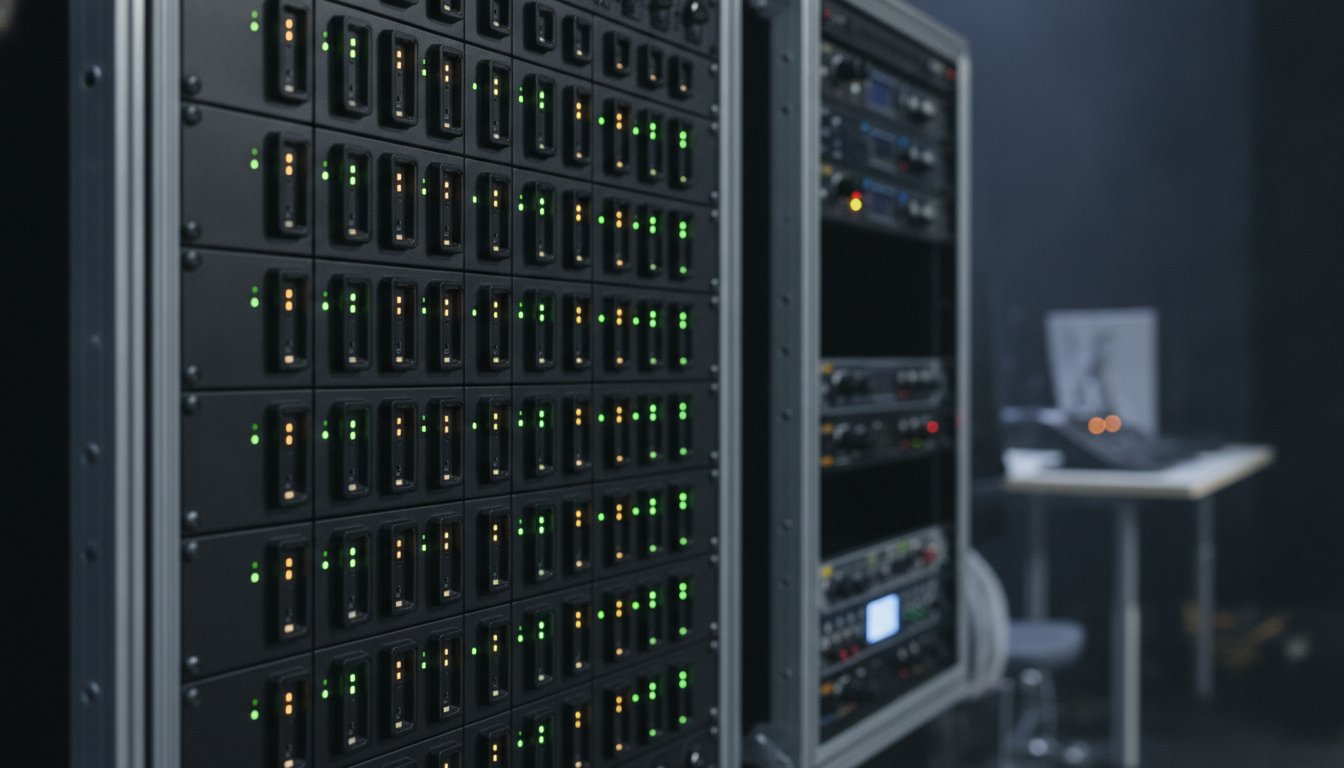
Managing a handful of batteries is simple; managing a fleet of fifty or more requires a shift in infrastructure. When production teams move away from a chaotic collection of individual chargers toward centralized power hubs, they eliminate the primary source of operational failure: disorganized handling. Professional lithium ion battery maintenance at scale relies on Custom Rackmount Chargers to provide a stable, cooled environment for high-capacity cells. These systems are designed to integrate directly into existing AV racks, ensuring that charging assets are as organized as the wireless receivers they power.
Airflow is the most critical factor in a high-density charging environment. Standard charging racks can quickly become heat traps if cables aren't managed and fans aren't positioned correctly. By adopting enterprise battery charging solutions, facilities can ensure that each cell receives consistent current without the risk of thermal runaway. Proper cable management isn't just about aesthetics; it's about preventing "hot spots" that can lead to the chemical degradation discussed earlier. A methodical layout ensures that every cell in the rack stays within the safe thermal thresholds required for longevity.
Benefits of Centralized Rackmount Charging
Centralized systems significantly reduce the physical wear on battery terminals. In a loose charging environment, batteries are often dropped or inserted at awkward angles, which can damage the contact points over time. Rackmount units provide a standardized insertion path that protects the mechanical integrity of the cell. These systems also allow for better visual monitoring. A technician can identify a "bad cell" or a charging error across dozens of channels at a single glance, rather than hunting through individual LED indicators scattered across a room. This organization prevents the common mistake of mismatched equipment or lost cells during the strike of a live event.
Maintenance for the Charger Hardware Itself
The hardware requires its own protocol to remain effective. Dust and oxidation on charger contacts create high-resistance connections that can trick smart chargers into ending a cycle too early. Clean these contacts monthly with a non-conductive electronic cleaner to ensure accurate voltage sensing. Modern smart systems also benefit from periodic firmware updates. These updates often include refined cycle algorithms that better manage the unique discharge curves of high-capacity lithium cells. A daily inspection checklist should include checking fan operation, verifying cable seating, and inspecting for any signs of terminal discoloration. This proactive approach keeps your lithium ion battery maintenance strategy running as smoothly as the events you support.
A Step-by-Step Maintenance Protocol for Production Teams
Assigning a "Battery Lead" within your technical crew transforms lithium ion battery maintenance from a sporadic chore into a rigorous technical protocol. This individual takes ownership of the fleet's health, ensuring that every cell is ready for high-stakes deployment. Accountability at this level prevents the common "last man out" syndrome where chargers are left unmonitored or empty cells are accidentally mixed with fresh inventory. When one person manages the power assets, reliability becomes a measurable metric rather than a hopeful guess.
The core of this protocol is the "Visual-Voltage-Vetting" (VVV) daily routine. Technicians first perform a visual check for casing cracks, terminal corrosion, or any unusual residue. Next, they verify the voltage level using a dedicated 1.5V lithium-ion tester to ensure the internal regulator is functioning. Finally, they vet the cell by confirming it belongs to the active rotation group for that day’s performance. This three-step process catches the majority of potential failures before they reach the stage.
To ensure even wear across the entire fleet, implement a strict rotation strategy. Group your batteries into numbered sets (e.g., Set A, Set B, Set C) and cycle through them sequentially. This prevents a scenario where a few "favorite" batteries are depleted daily while others sit idle and lose capacity through chemical stagnation. When a cell consistently fails to reach its target voltage or shows a 20% drop in expected runtime, it must be decommissioned from professional use immediately to maintain the integrity of your wireless systems.
Tracking Cycle Counts and Performance Metrics
Establishing a digital or physical log for each battery set is essential for fleet longevity. Use a simple labeling system, such as a small alphanumeric code, to track the purchase date and estimated usage. Periodically perform a "Stress Test" by running critical wireless gear for a full four-hour window and measuring the remaining voltage to identify hidden capacity loss. To calculate the ROI of your battery fleet, divide the total procurement cost by the number of successful performance cycles achieved before the cell hits its decommissioning threshold.
Handling and Transportation Safety for Crews
Safety during transit is a legal requirement that demands crew training. As of January 1, 2026, IATA regulations mandate that lithium-ion batteries shipped by air, including those packed with equipment, must not exceed a 30% state of charge. Ensure your crew is prepared for these limits when traveling between venues. For ground transport, utilize specialized Battery Storage cases to prevent short circuits caused by loose cells contacting metal tools in technician bags. If a technician discovers a "swollen" cell, they should isolate it in a fire-proof container and follow hazardous material disposal guidelines immediately.
Scaling Your Power Infrastructure with Horizon Battery
Scaling a professional operation requires more than just a large inventory; it requires a specialized ecosystem. Since 1998, Horizon Battery has served as a veteran distributor for high-profile clients who cannot afford power failures. The Pure Power Series serves as the bedrock of a robust lithium ion battery maintenance strategy by providing a constant 1.5V output. This stability is essential for professional audio and wireless mic applications where voltage fluctuations lead to signal degradation. By standardizing your fleet with these high-capacity cells, you ensure that every piece of equipment in your facility performs predictably from the first rehearsal to the final curtain call.
Effective infrastructure management often fails due to fragmented supply chains. When you consolidate your procurement for batteries, charger/battery bundles, and specialized battery storage, you eliminate technical bottlenecks. Horizon Battery provides the industrial authority needed to align your hardware with your operational goals. Our custom rackmount chargers are engineered to integrate seamlessly into your existing AV racks, providing the thermal management and organization required for large-scale fleets. This centralized approach simplifies the daily tasks of your technical crew and protects your long-term ROI.
Future-Proofing Your Facility for 2026 and Beyond
Professional facilities are increasingly adopting a hybrid power strategy to balance cost and performance. This involves utilizing high-capacity NiMH for general-purpose gear while reserving the Pure Power Series for mission-critical wireless systems. We offer consultation services for facility-wide power audits to help you navigate these complex transitions. Our experts ensure that your legacy gear remains compatible with modern 1.5V lithium chemistry, preventing the hardware damage often caused by unregulated consumer cells. Staying ahead of regulatory changes, such as the 2026 IATA shipping mandates, is part of the steady reliability we provide to our partners.
Next Steps: Upgrading Your Maintenance Setup
Start your upgrade by assessing your current "failure rate." If your team is frequently replacing cells or experiencing mid-event dropouts, your current lithium ion battery maintenance protocol is likely insufficient. Transitioning from consumer-grade chargers to industrial rackmount systems is the most effective way to improve fleet health and accountability. These systems provide the precision charging algorithms needed to maximize the lifespan of professional lithium-ion assets. Contact Horizon Battery today to discuss custom-engineered power solutions tailored to your facility's specific rack space and operational requirements.
Securing Your Technical Future with Professional Power Standards
Mastering lithium ion battery maintenance is about more than just preserving individual cells; it's about ensuring the total reliability of your production environment. By adopting a structured protocol that includes the 20-80% charging rule and the Visual-Voltage-Vetting routine, you protect your fleet from the high costs of premature degradation. These technical habits, combined with centralized rackmount infrastructure, transform power management from a daily headache into a predictable asset strategy that supports your entire technical crew.
Horizon Battery has been an industry leader since 1998, providing the specialized expertise required for high-stakes AV integration. Our constant 1.5V output technology and specialized custom-engineered charging racks ensure that your wireless gear remains stable through every performance. Upgrade your facility with professional Pure Power Series and Custom Rackmount Chargers from Horizon Battery. Start treating your batteries as mission-critical assets today. With the right hardware and a repeatable maintenance protocol, you'll see immediate improvements in both gear reliability and long-term ROI across your entire inventory.
Frequently Asked Questions
Do lithium-ion batteries really have no "memory effect" like older NiCd cells?
No, lithium-ion batteries don't have a memory effect. Unlike older Nickel Cadmium (NiCd) cells that required full discharge cycles to maintain capacity, lithium-ion chemistry thrives on partial discharges. Frequent shallow cycles are actually beneficial for long-term health. Resetting the battery isn't necessary and can cause significant chemical stress. Focus your lithium ion battery maintenance on keeping the state of charge between 20% and 80% for the most reliable results.
How often should I test the capacity of my professional battery fleet?
You should test the capacity of your professional fleet every three to six months. This frequency ensures that you identify cells with high internal resistance before they fail during a live event. Utilize a "Stress Test" by running your most power-hungry wireless transmitters for a full four-hour window while monitoring voltage stability. Regular vetting allows you to pull aging cells from critical rotations and maintain a high standard of reliability.
Is it safe to leave lithium-ion batteries in a rackmount charger overnight?
It is safe to leave batteries in a professional rackmount charger overnight if the hardware includes smart termination features. Our Custom Rackmount Chargers are engineered with automated cutoff circuits that stop the current once the cell reaches 100% capacity. This prevents the "trickle charging" damage common in consumer-grade units. Always ensure the charging rack has adequate airflow to prevent heat build-up while the facility is unattended during off-hours.
What is the ideal temperature range for storing high-capacity Li-ion AA batteries?
The ideal temperature range for storing high-capacity Li-ion AA batteries is between 15°C and 20°C (59°F to 68°F). Storing cells in environments above 30°C (86°F) significantly accelerates chemical degradation and capacity loss. For long-term inactivity, ensure the batteries are kept in a climate-controlled area with low humidity to prevent terminal oxidation. Proper thermal management is a cornerstone of professional lithium ion battery maintenance for large enterprise inventories.
Can I use a standard NiMH charger for Pure Power Series 1.5V lithium batteries?
No, you can't use a standard NiMH charger for Pure Power Series 1.5V lithium batteries. These cells contain internal voltage regulation circuitry that requires specific charging algorithms and voltage thresholds. Don't use an incompatible NiMH charger, as it can bypass safety mechanisms or fail to charge the cell completely. To protect your investment and ensure equipment safety, always use the dedicated chargers provided in our Charger / Battery Bundles designed specifically for this chemistry.
What are the signs that a lithium-ion battery has reached its end of life?
Visible swelling, excessive heat during charging, and rapid voltage drops under load are primary signs of end of life. If a battery feels hot to the touch while powering a wireless mic, its internal resistance has likely reached a dangerous level. You may also notice that the cell takes significantly longer to reach a full charge or fails to hold its voltage overnight. When these symptoms appear, decommission the cell from professional use immediately.
How do I properly dispose of professional lithium-ion batteries at a national level?
Professional lithium-ion batteries should be disposed of through certified national electronics recycling programs. Many states, including California as of 2026, have implemented specific recycling fees to fund the safe collection of professional-grade batteries. Never discard these cells in standard trash bins, as they pose a fire risk in waste management facilities. Contact a specialized hazardous waste carrier to handle the bulk disposal of your decommissioned production fleet and ensure environmental compliance.
Does fast charging significantly shorten the lifespan of professional cells?
Fast charging can shorten the lifespan of professional cells by generating excessive internal heat. While rapid chargers are convenient for quick turnarounds, the high current flow puts additional stress on the electrolyte and electrodes. For daily production cycles, a standard charging rate is preferred to minimize thermal wear. If you must use fast charging, ensure your Custom Rackmount Chargers are positioned in a well-ventilated area to dissipate heat as quickly as possible.