

The true cost of using disposable alkaline batteries in a professional environment isn't found on the receipt, but in the repeated technical failures and logistical clutter they create. Most production managers agree that managing hundreds of single-use cells is a sustainability nightmare that leads to critical voltage sag. Implementing robust enterprise battery charging solutions is the only way to avoid the frustration of messy wall warts and the premature death of expensive wireless mics due to inconsistent power delivery.
This guide provides a professional roadmap for transitioning from disposable waste to high-performance, rack-integrated systems that scale with your organization. You'll learn how to implement the Pure Power Series for constant voltage needs and utilize custom rackmount chargers to eliminate equipment room clutter. We will also examine how high-capacity Ansmann bundles provide a reliable foundation for your critical wireless gear while significantly improving your organizational sustainability metrics and reducing long-term operational overhead.
Key Takeaways
- Understand why enterprise battery charging solutions require an infrastructure-first mindset to eliminate the recurring costs and technical failures associated with disposable alkaline cells.
- Learn how custom rackmount chargers streamline operations by integrating high-density, multi-channel power systems directly into your existing 19-inch AV or IT racks.
- Discover why the Pure Power Series is the preferred choice for professional audio gear that demands constant 1.5V voltage for peak performance.
- Master the logistics of battery asset management by implementing "First-In, First-Out" rotation and proper storage to extend cell life and prevent damage.
- Identify the benefits of standardized charger and battery bundles to ensure consistent performance across large-scale facilities and multi-department fleets.
Beyond the Wall Wart: Why Organizations Need Industrial Rechargeable Battery Solutions
For many facilities, battery management remains an afterthought until a high-profile technical failure occurs. Relying on bulk-purchased alkalines and consumer-grade chargers creates a cycle of waste and technical instability. Professional environments require a shift toward enterprise battery charging solutions that prioritize reliability over convenience. This transition isn't just about changing chemistry; it's about building a predictable power infrastructure for your most critical gear.
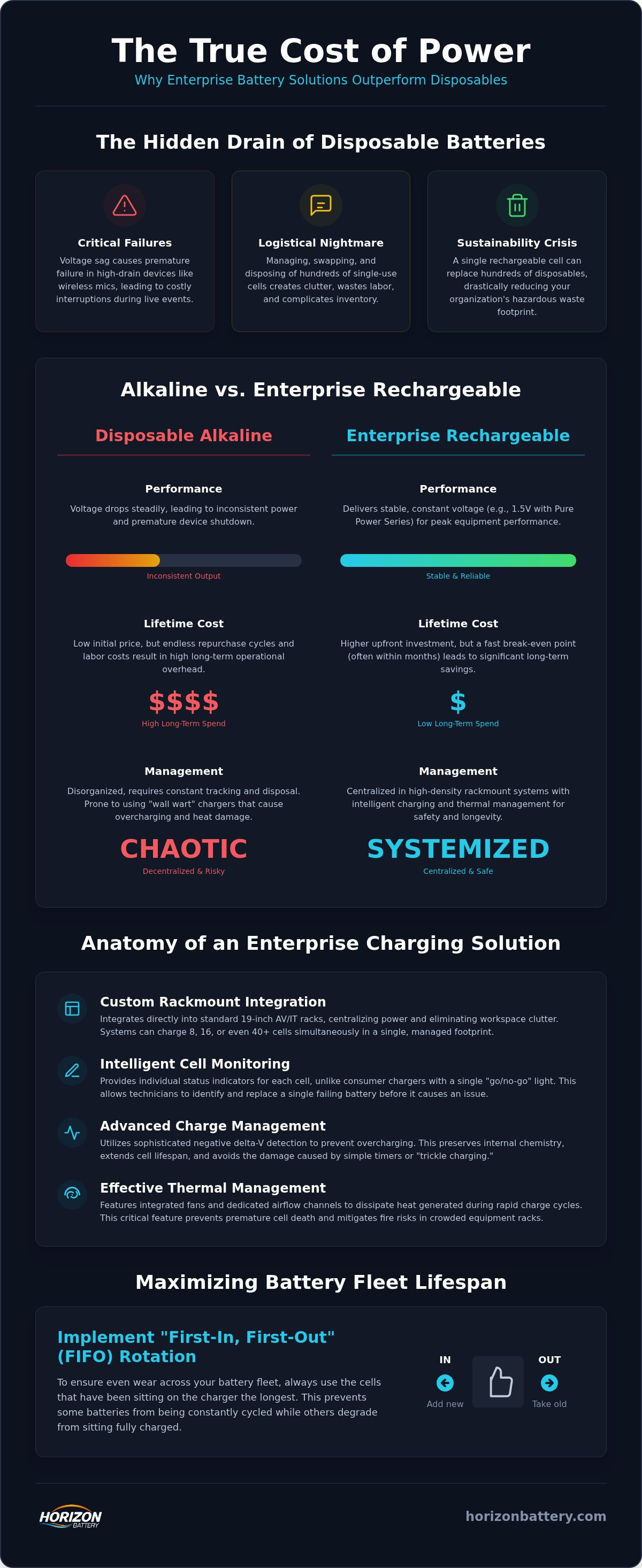
The hidden operational costs of disposable batteries extend far beyond the purchase price. Facilities managing dozens of wireless channels find that the labor required to swap, track, and dispose of alkaline cells often outweighs the cost of the batteries themselves. When you factor in the risk of voltage sag during a live event, the argument for a centralized, industrial-grade strategy becomes undeniable.
The Failure of Consumer Chargers in Professional Settings
Consumer chargers are designed for occasional home use, not the rigors of daily professional cycles. Many of these units rely on simple timers or "trickle charging" without sophisticated negative delta-V detection. This lack of precision often leads to overcharging, which generates excess heat and significantly shortens the lifespan of high-capacity cells. In a crowded gear closet or an unventilated equipment rack, these chargers become dangerous heat traps.
Voltage instability from cheap power hubs also presents a silent threat. Inconsistent current flow can lead to micro-corrosion on battery contacts, causing intermittent power drops in wireless microphones and handheld devices. Moving to professional enterprise battery charging solutions ensures that each cell receives a clean, managed charge that preserves the internal chemistry and maintains contact integrity.
Environmental and Economic ROI of Enterprise Rechargeables
Switching to a rechargeable battery fleet offers a clear financial turning point for large organizations. While the initial investment in Ansmann high capacity batteries is higher than a case of disposables, the break-even point typically occurs within a few months of heavy use. Standardizing your battery SKUs simplifies procurement and inventory management, ensuring that every department uses the same high-performance cells.
Beyond the ledger, the environmental impact is substantial. A single high-capacity rechargeable cell can replace hundreds of alkalines over its service life. This drastically reduces the hazardous waste footprint of your organization. By implementing a standardized charging infrastructure, you align your technical requirements with modern sustainability goals without compromising on the power needed for professional applications.
Engineering for Scale: The Role of Custom Rackmount Chargers
When scaling power infrastructure, the primary challenge shifts from simple energy delivery to high-density management. Standard consumer chargers often clutter workspaces and create heat-related safety hazards. Custom Rackmount Chargers provide a professional alternative, integrating directly into 19-inch AV/IT racks to centralize power for wireless microphone fleets and handheld tools. These systems are a cornerstone of effective enterprise battery charging solutions, offering the ability to charge 8, 16, or even 40+ cells simultaneously within a single managed footprint.
Intelligent monitoring is what separates industrial systems from bulk chargers. Instead of a single "go/no-go" light for a whole tray, enterprise systems provide individual cell status indicators. This allows technicians to identify a single failing cell before it reaches a device, ensuring that every battery pulled from the rack is at peak capacity. This granular visibility is essential for maintaining the reliability of high-profile productions and critical communication networks.
Anatomy of an Enterprise Charging Rack
Effective thermal management is the most critical feature of a rack-integrated system. High-drain charging generates significant heat; without proper ventilation, this heat leads to premature cell death and potential fire risks. Professional racks include integrated fans and airflow channels to keep temperatures stable during rapid charge cycles. This design also improves space efficiency by replacing a messy "octopus" of individual power adapters with a unified, high-density drawer. Organizations looking to streamline their gear rooms often find that standardizing their hardware significantly reduces maintenance time and equipment clutter.
Sequential vs. Parallel Charging in Large Facilities
Choosing between sequential and parallel charging depends on your facility's specific turnaround needs. Parallel charging delivers current to all cells at once, which is ideal for rapid rotations between events. However, in older facilities or mobile setups with limited power overhead, sequential charging hubs protect the local grid by staggering the draw. Custom Rackmount Chargers allow you to match the channel count and charging logic to your specific fleet size while ensuring full UL compliance. This compliance is a non-negotiable safety standard for permanent facility installations, providing peace of mind that your enterprise battery charging solutions meet rigorous electrical safety codes.
NiMH vs. Lithium-Ion: Choosing the Right Chemistry for Your Fleet
Selecting the right chemistry is the most critical decision when building enterprise battery charging solutions. It isn't just about which cell lasts the longest; it's about how the battery behaves under load. Professional audio gear and high-drain handhelds often have strict voltage requirements. While consumer batteries might suffice for a remote control, professional wireless systems need a predictable discharge curve to maintain signal integrity throughout a long production day.
Organizations must weigh cycle life against capacity and self-discharge rates. For devices that sit in a drawer for weeks, low self-discharge is vital. For daily use, cycle life and cost-per-charge take precedence. Understanding these trade-offs ensures your facility remains powered without unexpected downtime or sudden equipment failure during a live event.
Pure Power Series: The Lithium-Ion Standard
The Pure Power Series represents a significant shift in how professional fleets are powered. Unlike standard Lithium cells that output 3.7V, these specialized AA batteries use an internal buck converter to maintain a constant 1.5V output. This voltage stays locked until the cell is nearly exhausted, preventing the premature "low battery" warnings that often plague NiMH users. These cells are also significantly lighter than NiMH, reducing fatigue for performers using belt-packs or handheld wireless mics. It's important to use specific charging hardware designed for 1.5V Lithium-ion chemistry to ensure safety and cell longevity.
Ansmann NiMH: The Reliable Workhorse for High-Drain Gear
High-capacity NiMH batteries remain the industry standard for many legacy systems and large-scale deployments. As an authorized distributor of Ansmann professional products, we've seen these cells perform reliably in schools, churches, and theaters for decades. Modern intelligent chargers have largely eliminated the memory effect myth, allowing these cells to be topped off without losing capacity. For organizations outfitting hundreds of devices, NiMH offers a cost-efficient path to standardization. They provide the rugged durability needed for high-drain applications where absolute voltage consistency is less critical than raw runtime and budget-conscious procurement. Matching these with the right enterprise battery charging solutions ensures they provide years of dependable service.
Implementation Guide: Managing Your Battery Assets
Successful implementation of enterprise battery charging solutions depends on rigorous asset management. Organizations that treat batteries as disposable consumables often suffer from "dead on arrival" gear during critical moments. To prevent this, professional facilities adopt a First-In, First-Out (FIFO) rotation. This ensures that every cell in your fleet receives equal wear, preventing a scenario where a small subset of your inventory is over-cycled while the rest degrades from self-discharge. Training your staff on these protocols is just as important as the hardware itself.
Tracking cycle counts is another pillar of professional management. By monitoring how many times a cell has been through a full discharge and recharge, technicians can predict end-of-life before a failure occurs on stage. Modern intelligent systems often assist with this, but a manual log or software-based tracking system adds an extra layer of security. When you treat your power cells as high-value assets rather than commodities, your operational reliability increases significantly.
Organization and Storage Strategies
Implementing dedicated Battery Storage systems is non-negotiable for safety and efficiency. Loose batteries tossed into a gear drawer can easily short circuit against metal objects or other cells, creating a significant fire hazard. We recommend using color-coded storage cases to distinguish between charged and depleted cells at a glance. For example, green cases for ready-to-use cells and red cases for those needing a charge cycle. Environmental controls also play a role; maintaining a cool, dry storage area prevents premature chemical degradation and ensures long-term cell health.
Developing a Maintenance Schedule
A proactive maintenance schedule extends the life of your investment and guarantees performance. Quarterly capacity testing is the only way to identify "weak link" cells within a bundle. If one cell in a group of four is underperforming, it can drag down the runtime of the entire device. Technicians should also regularly clean contact points on both chargers and devices using isopropyl alcohol to ensure maximum conductivity. You'll know it's time to retire a cell when it shows signs of physical degradation, such as bulging or leaking, or when it consistently fails to reach 80% of its original rated capacity. For organizations needing to standardize their inventory and management, our Charger / Battery Bundles provide a complete foundation for professional power management.
Horizon Battery: Your Partner in Enterprise Power Since 1998
Since 1998, Horizon Battery has established itself as a primary source for high-performance power infrastructure. Organizations trust us because we don't just supply individual components; we deliver integrated enterprise battery charging solutions tailored to professional demands. Serving the United States and Canada for over 25 years has given us a unique perspective on the evolving needs of AV departments, theaters, and large-scale corporate facilities. Our steady reliability and industrial professionalism ensure that your critical gear never fails due to subpar power management.
Choosing a veteran partner means gaining access to established expertise. We act as a knowledgeable guide, helping you move away from the inefficiency of disposable waste toward a sustainable, high-performance model. Our commitment to quality is reflected in our status as an authorized distributor for professional-grade cells that industry insiders rely on daily. We understand that your reputation depends on the reliability of your wireless microphones and handheld devices, which is why we prioritize performance above all else.
Custom Engineering for Unique Facility Needs
Every facility presents a different set of logistical challenges. We offer a wide range of Custom Rackmount Chargers to meet these specific needs, ranging from 8-channel portable kits for mobile production to 40-channel permanent rack drawers for large venues. This level of customization allows you to optimize your workspace and eliminate the clutter of consumer-grade charging setups. Whether you're sourcing specialized high-capacity AA batteries for niche electronics or outfitting a new broadcast studio, we provide the industrial-grade hardware required for the job. Our "Horizon promise" is simple: we provide the steady reliability you need to focus on your production rather than your power levels.
Streamlining Your Procurement
Managing the procurement process for a large institution requires order and clarity. Our Charger / Battery Bundles are designed to simplify this task by providing everything needed to standardize a fleet in a single package. These bundles ensure that your chargers and cells are perfectly matched for chemistry and voltage requirements from the start. You'll have direct access to our extensive inventory of the Pure Power Series and professional Ansmann products, facilitating large-scale institutional rollouts without the headache of sourcing from multiple vendors. Bulk purchasing through a seasoned distributor doesn't just reduce costs; it guarantees a consistent standard of performance across your entire organization.
Consult with a Horizon specialist on your enterprise charging needs to build a scalable power infrastructure today.
Modernizing Your Professional Power Infrastructure
Transitioning from the hidden costs of disposable batteries to a centralized charging strategy is a critical upgrade for any large-scale facility. By integrating high-density rackmount hardware and selecting the appropriate chemistry for your specific gear, you eliminate the technical instability that plagues consumer-grade setups. Implementing enterprise battery charging solutions doesn't just improve your sustainability metrics; it provides the steady reliability required for high-stakes productions and daily operations. Proper asset management, including rotation and environmental controls, ensures that your investment continues to perform at its peak for years to come.
Horizon Battery has been a trusted partner for professional facilities since 1998. As an authorized distributor for the Pure Power Series and Ansmann professional products, we specialize in custom-engineered rackmount hardware that fits your unique channel count and workflow requirements. We're here to help you build a scalable power foundation that supports your organization's growth and technical excellence. Our team provides the industrial expertise needed to navigate complex power requirements with confidence and precision.
Explore Custom Rackmount Charging Solutions to standardize your fleet today. We look forward to helping you achieve a more efficient and reliable power environment.
Frequently Asked Questions
What is the difference between consumer and enterprise battery chargers?
Enterprise chargers prioritize high-density management and individual cell monitoring to ensure fleet reliability. Consumer units often utilize simple timers or bulk charging indicators that can lead to overcharging or "cell drift" across your inventory. Professional systems include sophisticated thermal management and negative delta-V detection to protect high-capacity cells. These enterprise battery charging solutions are engineered for the rigors of daily industrial use rather than occasional home applications.
Can I mount any battery charger into a standard 19-inch AV rack?
No, standard consumer chargers lack the mounting hardware and thermal management required for rack integration. Attempting to shelf-mount multiple consumer chargers creates dangerous heat traps and significant cable management issues. True rackmount systems are engineered with 19-inch faceplates and internal cooling fans to maintain safe operating temperatures. These units facilitate a professional workflow by centralizing power within your existing IT or AV infrastructure while meeting UL safety standards.
How many times can professional rechargeable batteries be cycled?
High-quality professional NiMH cells can typically be cycled between 500 and 1,000 times depending on the depth of discharge and charging speed. Lithium-ion variants, such as the Pure Power Series, offer similar longevity while maintaining consistent voltage throughout each cycle. To achieve maximum cycle life, it's essential to use intelligent chargers that prevent overheating and overcharging. These factors are the primary causes of premature cell failure in large-scale professional fleets.
Why do some wireless microphones perform poorly with standard rechargeable batteries?
Many professional wireless microphones require a constant 1.5V to maintain signal stability and range. Standard NiMH batteries output 1.2V, which can trigger premature "low battery" warnings or cause signal dropouts even when the cell is mostly full. Using 1.5V Lithium-ion cells solves this issue by providing a flat discharge curve. This ensures your audio gear remains reliable until the battery is completely exhausted, preventing unexpected technical failures during live events.
Is it safe to leave enterprise batteries on a charger 24/7?
Yes, provided you are using an intelligent system equipped with automatic shut-off or maintenance modes. Enterprise-grade chargers detect when a cell reaches full capacity and either terminate the current or switch to a low-frequency pulse charge. This prevents the damaging heat buildup associated with consumer trickle chargers. For long-term storage of several months, we recommend removing the cells and placing them in a cool, dry location to preserve the internal chemistry.
What are the benefits of sequential charging for large battery fleets?
Sequential charging reduces the peak current draw on your facility's electrical circuit by charging groups of batteries in stages. This is particularly useful in mobile setups or older buildings where power overhead is limited. While parallel charging is faster for immediate needs, sequential hubs protect the local grid and reduce overall heat generation. Many enterprise battery charging solutions offer selectable modes to balance turnaround speed with site-specific electrical safety requirements.
How do I calculate the ROI of switching from alkaline to rechargeable batteries?
To calculate ROI, compare the total cost of ownership over a 12-month period. Include the initial purchase price of rechargeable cells and rackmount hardware against the recurring cost of bulk alkalines and the labor hours spent on constant battery swaps. Most professional organizations find that the system pays for itself within six to nine months. Beyond the financial ledger, you must also factor in the reduced hazardous waste footprint and improved technical reliability.
Are Lithium-Ion AA batteries compatible with all professional gear?
Most modern professional gear is compatible with 1.5V Lithium-ion AA cells, but you should verify the voltage requirements of your specific devices. While these cells provide excellent 1.5V stability, some legacy equipment designed strictly for 1.2V NiMH might report incorrect battery telemetry. It's critical to use a charger specifically designed for 1.5V Lithium chemistry. Using a standard NiMH charger can damage the internal buck converters that allow these cells to maintain their constant voltage.