
A sudden wireless microphone dropout during a live event is more than a technical glitch; it's a failure of the power infrastructure supporting your production. You've likely dealt with the logistical headache of managing hundreds of loose AA batteries and the persistent fear that a budget charger might fail when the stakes are highest. In this 2026 professional comparison of the EBL battery charger vs Pure Power series, you'll learn how to transition from reactive troubleshooting to a standardized energy strategy that prioritizes reliability.
We'll explore the critical performance gaps between hobbyist tools and the Pure Power series, which is engineered specifically for churches, media houses, and AV integrators. This guide covers everything from constant 1.5V output technology to the long-term cost benefits of integrated rackmount charging solutions. By the end, you'll have the data needed to eliminate technical failures and reduce the overhead of high-volume battery management. We'll show you how professional-grade equipment protects your performance and your bottom line.
Key Takeaways
- Understand why the constant 1.5V output of the Pure Power series eliminates the "low battery" warnings and signal dropouts common with standard NiMH cells.
- Compare the logistical efficiency of custom rackmount chargers against loose desktop units for managing high-volume battery needs in professional facilities.
- Analyze the total cost of ownership in the EBL battery charger vs Pure Power debate, factoring in labor savings and reduced equipment failure during live events.
- Learn how to implement standardized battery storage systems that streamline tech prep and prevent the loss of mission-critical power assets.
- Identify the specific technical indicators that signal when your organization has outgrown consumer-grade charging and requires a professional infrastructure upgrade.
Consumer vs. Professional: The Core Philosophy of EBL and Pure Power
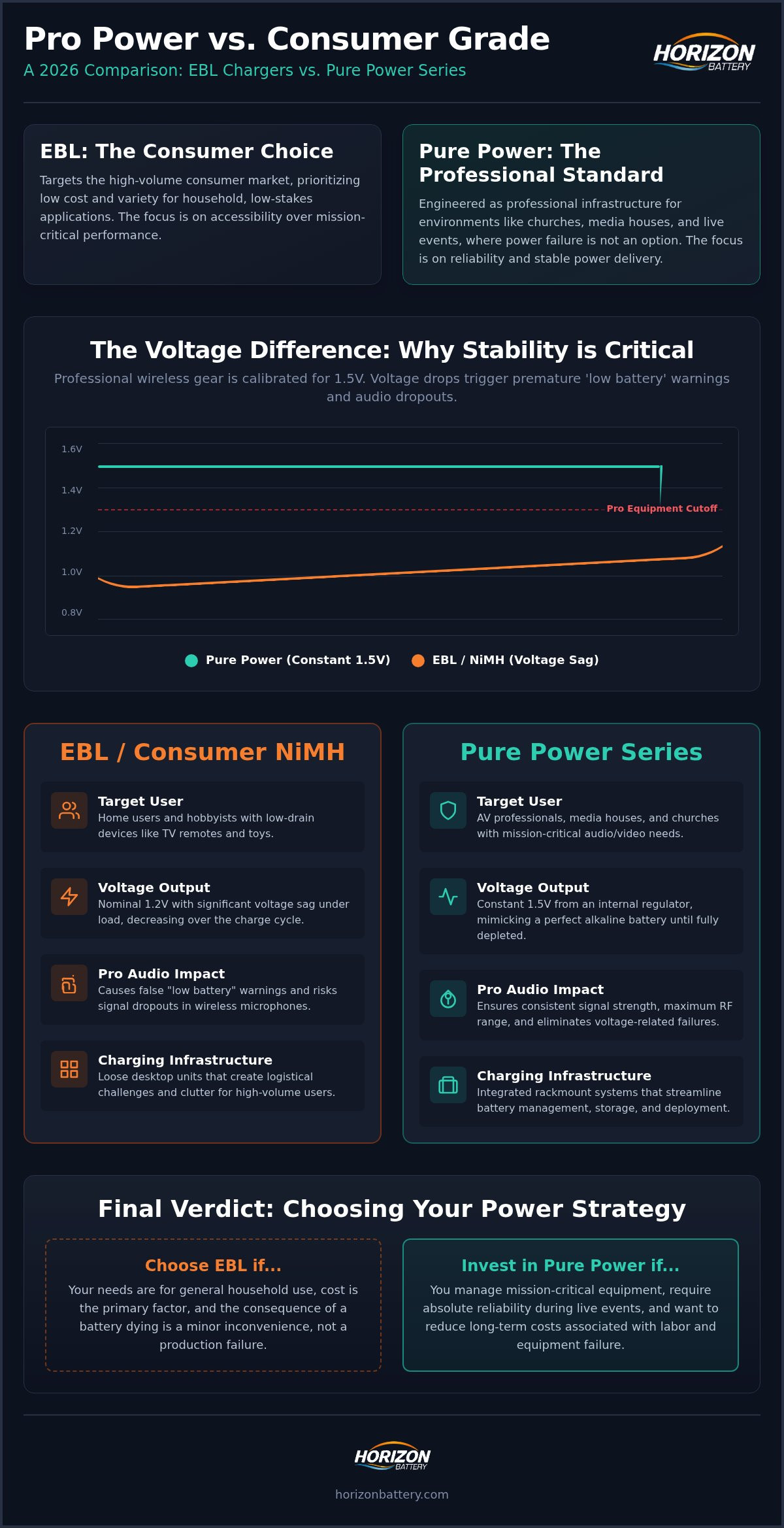
The energy landscape of 2026 has matured. Users no longer simply buy "rechargeables"; they invest in power systems. Choosing between an EBL battery charger vs Pure Power isn't about which brand is "better" in a vacuum. It's about matching the tool to the specific environment. EBL targets the high-volume consumer market where price and variety are the primary drivers. Conversely, the Pure Power series acts as professional infrastructure for mission-critical applications where a power failure means a cancelled broadcast or a failed church service. The stakes are different, and the hardware reflects that reality.
Consumer chargers often prioritize the lowest possible manufacturing cost per slot. This often leads to compromises in thermal management and circuit sophistication. In a home setting, a hot battery is a minor annoyance. In a professional rack, excessive heat shortens the lifespan of your inventory and increases failure rates. Professional systems focus on "stable power" rather than just "high capacity." While a remote control can run on declining voltage, a wireless microphone requires a steady hand to maintain signal integrity and prevent audio dropouts.
EBL: The Versatile Consumer Choice
EBL has built a reputation on accessibility. Their catalog is vast, spanning everything from AAA and AA to 9V and specialized C or D cells. These products provide an excellent value proposition for low-stakes, low-drain household applications. Most of these consumer systems rely on Nickel-metal hydride (NiMH) batteries. While effective for hobbyists, NiMH cells often struggle with voltage sag. As the charge drops, the voltage falls below the threshold required by professional equipment. This leads to premature "low battery" indicators even when energy remains in the cell. For a household, it's a minor inconvenience; for a live event, it's a liability.
Pure Power Series: The Professional Standard
The Pure Power series shifts the focus from raw capacity to industrial reliability. It's engineered to provide a constant 1.5V output, which mimics the performance of a high-end alkaline battery. This is critical for professional audio and wireless microphone systems that depend on specific voltage levels to maintain signal strength. For organizations managing dozens of transmitters, the move to enterprise battery charging solutions is a matter of operational security. Implementing a dedicated system for Battery Storage ensures that your inventory stays organized, cool, and ready for immediate deployment. This standardized approach is what separates a professional facility from a hobbyist setup.
Technical Performance: Constant 1.5V Output vs. NiMH Voltage Sag
The core technical differentiator in the EBL battery charger vs Pure Power debate lies in the discharge curve. Most consumer rechargeable systems, including those from EBL, utilize Nickel-metal hydride (NiMH) chemistry. These cells provide a nominal voltage of 1.2V. While this suffices for a household TV remote, professional wireless transmitters are calibrated for the 1.5V output of standard alkaline batteries. When a 1.2V NiMH cell is inserted, the device often perceives it as already partially depleted. This triggers premature "low battery" indicators, even if the cell has hours of runtime remaining.
In contrast, the Pure Power Series utilizes advanced Lithium-Ion chemistry with an internal voltage regulator. This allows the cell to maintain a constant 1.5V output from the moment it is turned on until the internal energy is fully exhausted. This flat plateau of power ensures that RF signal strength remains consistent and audio clarity isn't compromised by voltage sag. In professional RF environments, maintaining this voltage is the only way to guarantee the full operating range of your equipment.
Why 1.5V Stability Matters for Wireless Mics
Transmitter dropouts often occur because the internal circuitry cannot maintain a stable carrier wave when voltage dips. By using the Pure Power Series, technicians eliminate the "safety" alkaline backups typically kept on hand for emergencies. These cells protect sensitive AV circuitry from the erratic power delivery associated with consumer NiMH alternatives. It's a shift toward reliability that allows production teams to focus on the performance rather than the battery meter. Standardizing your facility starts with choosing the right infrastructure; you can explore professional-grade lithium power to see how these specs translate to your specific gear.
Cycle Life and Degradation
Consumer brands often advertise 1,000 or more recharge cycles. However, real-world performance in high-heat production environments tells a different story. Heat is the primary enemy of battery longevity. Professional cells include internal protection circuits that prevent over-discharge and manage thermal buildup during the charging process. This specialized engineering ensures long-term capacity retention, even when used daily in demanding environments like media houses or large churches. While EBL serves the hobbyist well, the Pure Power series is designed to withstand the rigorous duty cycles of professional integration.
Charging Infrastructure: Desktop Units vs. Rackmount Systems
When comparing the EBL battery charger vs Pure Power systems, the physical form factor often dictates the efficiency of your workflow. Managing a handful of batteries for a home office is a simple task. However, when you oversee 40 or more cells in a church, school, or media house, the limitations of consumer hardware become a daily obstacle. Desktop units often lead to disorganized storage and a mess of tangled power cables. Professional facilities require a centralized, methodical approach to ensure every wireless transmitter is ready for the next event without delay.
Thermal management serves as a critical safety and performance differentiator. Consumer desktop chargers frequently lack active cooling or sufficient spacing between battery slots. This causes significant heat buildup during rapid charging cycles. Over time, excessive heat degrades battery chemistry and reduces overall capacity. Integrated enterprise battery charging solutions are engineered specifically for continuous, high-volume use. These professional systems prioritize airflow and thermal dissipation, protecting your inventory and ensuring the long-term safety of your equipment rack.
Custom Rackmount Chargers: The Pro Advantage
Professional environments demand equipment that integrates into existing workflows. Custom rackmount chargers fit directly into standard AV racks or mobile flight cases. This centralized power management reduces the physical footprint and eliminates the need for a dozen separate wall outlets. These systems utilize industrial-grade charging contacts designed for thousands of cycles. Unlike the thin metal springs found in consumer units, these contacts maintain high tension and conductivity over years of heavy use. This level of durability is essential for high-repetition environments where batteries are swapped multiple times every day.
EBL Desktop Chargers: Best for Individual Kits
EBL produces a wide range of portable desktop chargers that are effective for small, independent field kits. Their USB-powered options provide necessary flexibility for creators who need to charge on the go. While these units are convenient for a single videographer or a small podcast setup, they present challenges in large-scale production. The mechanical components aren't built for the rigors of industrial duty cycles. Frequent loading and unloading can eventually lead to contact fatigue or housing failure. For permanent facility installations, these consumer units often become the weak link in the production chain.
The True Cost of Ownership: Reliability and Long-Term ROI
Focusing solely on the initial purchase price of an EBL battery charger vs Pure Power system often leads to a distorted view of actual expenses. Consumer-grade batteries and chargers are undeniably cheaper at checkout. However, professional facilities must account for operational costs, which include labor, replacement frequency, and the financial impact of technical failures. A single wireless microphone dropout during a high-profile corporate presentation or a televised service can cause reputational damage that far outweighs the savings of a budget battery. Reliability is an insurance policy for your production's integrity.
Labor efficiency represents a significant portion of your long-term return on investment. Tech teams often waste hours every week testing loose cells or troubleshooting "low battery" warnings caused by voltage sag. Implementing a standardized system for Battery Storage and charging reduces this prep time. When every cell is accounted for in a professional rack, your staff spends less time on logistics and more time on the technical aspects of the performance. This streamlined workflow turns energy management from a daily chore into a predictable background process.
Analyzing the ROI for Business and Schools
For large organizations, the transition to professional power is a strategic infrastructure investment. When switching to rechargeable batteries for business, the break-even point typically occurs within the first 12 to 18 months. This calculation includes the elimination of recurring alkaline purchases and the reduction of hazardous waste disposal fees. Pure Power cells are designed for a 3 to 5 year service life in high-use environments. While consumer cells may require replacement every few months under heavy duty cycles, professional lithium-ion infrastructure maintains its capacity and performance for hundreds of additional cycles.
Maintenance and Asset Management
Managing a fleet of batteries requires more than just a place to plug them in. Professional systems allow for better tracking of cell health and age. Pure Power systems simplify inventory management by providing consistent performance across every unit in your rack. This consistency is rarely found in consumer marketplaces where manufacturing tolerances can vary between batches. Dealing with a dedicated professional distributor also ensures you have access to expert support and industrial warranties. If you're ready to move beyond the limitations of consumer hardware, you can view our professional charging bundles to see how integrated solutions protect your bottom line.
Final Verdict: Choosing the Right Power Solution for Your Application
Deciding between an EBL battery charger vs Pure Power system requires a realistic assessment of your operational needs. The 2026 technology standards have clarified the boundary between consumer convenience and professional infrastructure. EBL remains a viable option for general household use where the cost of a device powering down is negligible. However, for organizations where audio clarity and signal stability are non-negotiable, the Pure Power series provides the necessary technical headroom to ensure consistent performance.
Transitioning from a consumer setup to a professional infrastructure involves more than just swapping cells. It requires a shift toward centralized management and standardized charging protocols. If you currently face issues like "low battery" indicators on freshly charged NiMH cells or struggle with disorganized desktop chargers, your facility has outgrown consumer-grade hardware. Moving to a rack-integrated system eliminates these variables and creates a predictable energy environment for your technical team.
Choose EBL Battery Chargers If...
- You're powering low-drain household devices such as television remotes, wall clocks, or basic flashlights.
- You have a small, non-critical hobbyist application where a sudden loss of power won't disrupt an event or recording.
- Budget is your only primary constraint and you're a non-professional user who doesn't require industrial durability or constant voltage.
Choose Pure Power Series If...
Professional environments require a higher standard of reliability. You should choose the Pure Power series if you manage wireless microphones, in-ear monitors (IEMs), or other critical AV gear that demands a constant 1.5V output. This series is the correct choice for facilities that require a rack-integrated charging solution to maintain order and thermal safety across a large inventory. You can upgrade your facility with Pure Power Series today to secure your production's power needs.
The final recommendation for 2026 is clear. Use consumer tools for consumer tasks. For everything else, rely on professional-grade energy solutions that offer the durability, voltage stability, and centralized organization required by modern production standards. While the EBL battery charger vs Pure Power comparison often starts with price, it ends with performance and reliability. Standardizing your power supply is one of the simplest ways to improve the overall reliability of your technical services.
Secure Your Production with Professional Power Infrastructure
The decision between an EBL battery charger vs Pure Power infrastructure ultimately depends on the cost of failure in your specific environment. While consumer hardware serves the needs of hobbyists, professional facilities require the constant 1.5V output and industrial thermal management found only in specialized series. By standardizing your charging systems, you eliminate the technical variables that lead to wireless dropouts and logistical bottlenecks. This transition shifts your focus from troubleshooting power issues to delivering a flawless performance.
Horizon Battery has served as a reliable professional battery supplier since 1998. Every product in our inventory is engineered for the high-stakes pro audio industry and mission-critical applications. We offer efficient national shipping across the US and Canada to support media houses, churches, and enterprise facilities. Investing in professional power infrastructure today protects your sensitive AV gear and your professional reputation for years to come.
Shop the Pure Power Series and Professional Rackmount Chargers to streamline your energy management and guarantee your next event's performance.
Frequently Asked Questions
Can I charge Pure Power Lithium-Ion batteries in an EBL NiMH charger?
No, you shouldn't use a standard NiMH charger for Pure Power cells. Pure Power batteries utilize advanced lithium-ion chemistry that requires a specific charging protocol. Most EBL units are designed for Nickel-metal hydride (NiMH) chemistry, which operates at different voltage levels. Using an incompatible charger can lead to incomplete charges or permanent cell damage. It's best to use the dedicated hardware included in our professional charger and battery bundles to ensure safety and longevity.
Why do my wireless microphones show 'low battery' quickly with NiMH cells?
This issue is caused by the nominal voltage of NiMH cells. Standard rechargeable batteries operate at 1.2V, while professional wireless transmitters are designed for 1.5V alkaline power. When comparing an EBL battery charger vs Pure Power, the latter uses regulated lithium technology to maintain a steady 1.5V output. This prevents your gear from triggering a "low battery" warning prematurely. It ensures your signal stays strong until the cell is actually depleted.
What is the difference between constant 1.5V and 1.2V rechargeable batteries?
The difference lies in the discharge curve. A 1.2V NiMH battery loses voltage gradually, which can cause sensitive AV equipment to malfunction or lose range. Constant 1.5V batteries use an internal circuit to hold the voltage at a steady level throughout the entire discharge cycle. This mimics the performance of high-end alkaline cells. It provides the consistent power required by professional audio systems to maintain clear signals and prevent unexpected dropouts during live events.
Are rackmount chargers compatible with standard 19-inch AV racks?
Yes, these units are engineered for seamless integration. Custom rackmount chargers are built to fit standard 19-inch AV racks and mobile flight cases. This design helps organizations manage high-volume battery needs without the clutter of multiple desktop units. It provides a centralized power hub that improves airflow and thermal management. For churches and media houses, this infrastructure is a significant upgrade over loose consumer chargers that often fail under heavy industrial use.
How many charge cycles can I expect from the Pure Power Series?
You can expect hundreds of high-performance cycles from this series. While some consumer brands make inflated claims about cycle life, our lithium-ion cells focus on real-world durability in high-heat production environments. Internal protection circuits prevent the cell from over-discharging, which significantly extends its usable life. This industrial engineering ensures that your investment provides a reliable return over a three to five year period, even when the batteries are used daily.
Is it worth switching from alkaline to Pure Power for a small church?
Transitioning to a professional system is highly beneficial for small organizations. While the upfront cost is higher than buying alkalines, the break-even point typically occurs within 18 months. You'll stop throwing away partially used batteries and reduce your environmental footprint. More importantly, the constant 1.5V output provides peace of mind. It eliminates the technical failures that often plague live services when using budget consumer-grade rechargeable batteries or declining alkaline cells.
Do Pure Power batteries require special storage conditions?
These batteries perform best when kept in a controlled environment. You should store them in a cool, dry location to maintain their chemical stability. Using dedicated battery storage solutions is the most effective way to prevent cells from touching and short-circuiting. Proper organization also simplifies inventory tracking for your technical team. Maintaining these conditions ensures that your Pure Power cells are ready for immediate use whenever a high-stakes production begins.
What is the best way to manage a large inventory of rechargeable batteries?
The most efficient method involves centralizing your energy infrastructure. You should utilize custom rackmount chargers and professional battery storage systems to keep your fleet organized. This approach reduces the labor time spent on tech prep and troubleshooting. By standardizing your equipment, you ensure that every technician in the facility follows the same protocol. This methodical management style extends the life of your inventory and guarantees that your wireless gear is always powered reliably.