
Why does your wireless receiver show a full battery bar right before the audio cuts out entirely? Professional audio technicians know the frustration of voltage sag and the unpredictable dropouts that happen during live events. Managing hundreds of charging cycles across a large team is difficult enough without worrying if your high-capacity AA batteries for professional audio will fail at the worst possible moment. We've served the industry since 1998 and understand that reliability isn't just a preference; it's a requirement for your production.
This article explains the technical differences between traditional NiMH and the advanced Pure Power Series to help you optimize your gear performance. We'll analyze the 300-cycle lifespan of Ansmann NiMH cells against the constant 1.5V output and 500-cycle durability of the Pure Power Series to provide a clear procurement framework for 2026. You'll learn how to navigate charger compatibility and implement a battery management system that reduces technical failures while improving your total ROI. By the end, you'll have the technical insight needed to choose the right power source for your specific wireless applications.
Key Takeaways
- Understand the fundamental engineering differences between NiMH and Lithium-ion chemistries to ensure your gear receives the most reliable power source.
- Discover how the Pure Power Series maintains a constant 1.5V output to prevent frequency drift and sudden audio dropouts in wireless microphones.
- Compare the technical specifications of high-capacity AA batteries for professional audio, including weight differences and recharge cycle longevity.
- Identify why standardizing on specific battery series is becoming the preferred strategy for churches, theaters, and touring professionals.
- Learn how to implement enterprise-level management using custom rackmount chargers and bundled kits to improve long-term ROI.
The Engineering Behind Ansmann Battery Technology in 2026
Ansmann battery technology represents the pinnacle of German-engineered mobile power solutions. For over two decades, these cells have provided the foundational energy for high-stakes audio production. Choosing Ansmann high capacity batteries means investing in a chemistry designed specifically for high-drain environments. Horizon Battery has served as a specialized distributor since 1998, ensuring production teams have access to enterprise-level solutions that consumer-market rechargeables simply can't match. Professional-grade cells are built with lower internal resistance, allowing them to deliver consistent power even under the heavy current draw of modern wireless transmitters.
The Legacy of Ansmann High-Capacity NiMH
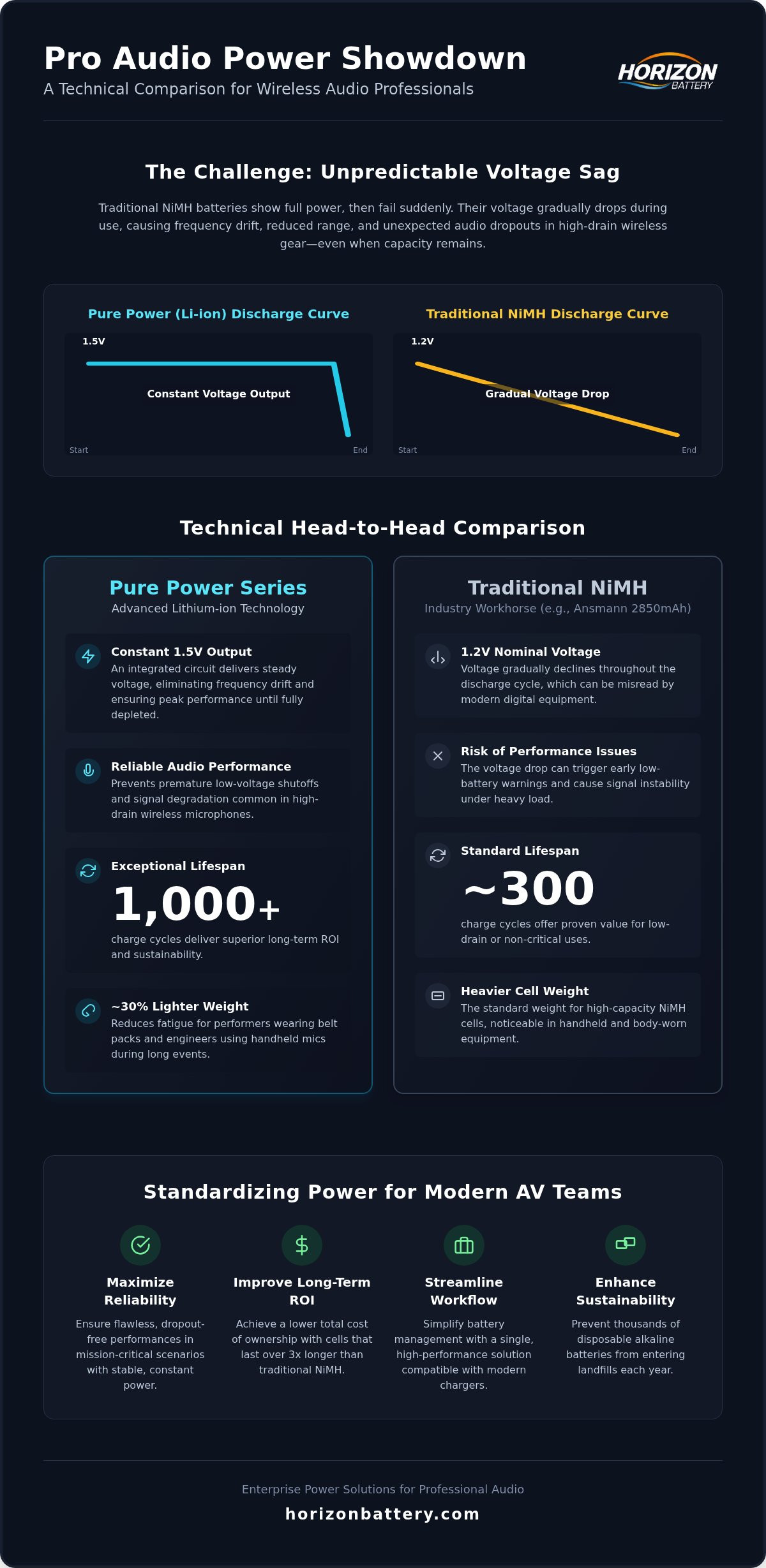
The 2850 mAh Slimline cell became the industry standard for pro audio due to its high energy density and precise physical dimensions that fit even the tightest battery compartments. These Nickel-metal hydride (NiMH) batteries operate at a 1.2V nominal voltage. While this is sufficient for many transmitters, the voltage discharge curve is gradual. As the cell loses charge, the voltage drops steadily. In some legacy wireless gear, this leads to early low-battery warnings even when significant capacity remains. Despite this, the NiMH line remains a workhorse for teams managing hundreds of units where cost-per-cycle is the primary metric. It's a reliable, proven technology that continues to offer excellent value for non-critical or low-drain applications.
The Rise of Lithium-Ion Innovation
Modern digital electronics demand more than just raw capacity; they require voltage stability. The industry is shifting toward lithium-ion technology to solve the voltage sag issue inherent in older chemistries. Ansmann engineering addressed this by integrating a sophisticated circuit that regulates output. This innovation ensures that high-capacity AA batteries for professional audio maintain a constant voltage throughout the entire discharge cycle. The Pure Power Series represents this modern successor. It eliminates the premature low voltage shut-offs that plague standard rechargeables in high-stakes environments. By providing a steady 1.5V, these cells ensure that wireless microphones maintain their full operating range until the moment the battery is depleted. This prevents the frequency drift and signal degradation that often occur when voltage begins to dip during a long performance.
Professional cells outperform consumer alternatives because they are built to handle the rapid discharge rates of modern RF equipment. While a consumer battery might work for a television remote, it will likely fail under the stress of a four-hour theater performance or a live broadcast. Horizon Battery provides the expertise to help you transition between these two powerful technologies based on your specific equipment needs and budget requirements.
Pure Power Series: Why Constant 1.5V Output Matters for Audio Gear
The Pure Power Series stands apart by utilizing an integrated circuit to maintain a steady 1.5V output throughout the entire discharge cycle. This is a critical departure from traditional NiMH cells that drop to 1.2V almost immediately. For technicians using high-capacity AA batteries for professional audio, this constant voltage is the primary defense against frequency drift. Wireless microphones rely on stable power to maintain their Phase-Locked Loop stability. When voltage sags, the transmitter's signal can become unstable, leading to decreased range or audible interference.
Beyond electrical performance, the Pure Power Series offers a significant weight advantage. Lithium-ion cells are approximately 30% lighter than high-capacity NiMH equivalents. This weight reduction is immediately noticeable during long shifts for performers wearing belt packs or engineers handling handheld microphones. Adopting a rechargeable lithium system also provides substantial sustainability benefits. A single facility can prevent thousands of alkaline batteries from entering landfills each year by standardizing their power workflow.
Integrated Charging Intelligence
Every Pure Power cell contains an internal PCB (Printed Circuit Board) that manages the charging process and prevents overheating. This nanoscale engineering for battery power allows these cells to achieve over 1,500 charge cycles. This is five times the lifespan of many standard NiMH options. To ensure compatibility with existing hardware, the intelligence on the PCB mimics a gradual voltage curve at the very end of the capacity. It allows your equipment's battery meter to provide a short but accurate warning before the cell shuts down, rather than cutting out without notice. If you're ready to upgrade your facility's workflow, you can explore the full Pure Power Series lineup to find the right fit for your gear.
Performance in Extreme Conditions
Professional audio often moves outdoors, where temperature fluctuations can cripple standard batteries. The Pure Power Series maintains its capacity in cold weather far better than alkaline or NiMH chemistries, which often see a significant drop in performance near freezing. Additionally, these cells feature an extremely low self-discharge rate. Backup gear stored for several months will remain ready for immediate use. 1.5V Lithium-ion technology serves as the bridge between alkaline reliability and rechargeable economy.
Technical Head-to-Head: Pure Power Li-ion vs. High-Capacity NiMH
Choosing between these two chemistries requires a clear understanding of your hardware's electrical tolerances. While both options represent top-tier engineering, they solve different operational problems. Pure Power cells provide a regulated 1.5V output, whereas Nickel-Metal Hydride (NiMH) cells offer a 1.2V nominal voltage. This distinction is the most significant factor when selecting high-capacity AA batteries for professional audio. If your equipment was designed specifically for the 1.5V curve of alkaline cells, the regulated lithium output ensures peak performance without the voltage drop typical of older rechargeables.
Li-ion technology also excels in long-term storage scenarios. These cells retain their charge for months, making them the superior choice for emergency backup gear that needs to be ready at a moment's notice. Conversely, NiMH cells have a higher self-discharge rate and often require a "top-off" charge if they've been sitting for more than a few weeks. The physical weight also plays a role in the decision. A rack of handheld mics outfitted with lithium cells is noticeably lighter than one using NiMH, reducing fatigue for performers during long sets.
Infrastructure is the final piece of the comparison. Pure Power cells require dedicated lithium-compatible chargers to manage their internal PCBs safely. NiMH cells remain compatible with the standard charging hardware most facilities already own. Horizon Battery has helped production teams navigate these transitions since 1998, ensuring the charging infrastructure matches the chosen cell chemistry.
Solving Voltage Sag and Equipment Reliability
Voltage "sag" occurs when a battery's output drops under the heavy current load of a wireless transmitter. This drop often triggers premature shutdowns or signal dropouts, even if the battery still has energy left. The Pure Power Series eliminates this issue by holding a flat 1.5V line until the very end of the cycle. While lithium is the modern standard for digital RF, the Ansmann NiMH 2850 mAh cells still lead in raw capacity for specific analog applications. In older devices where 1.2V is the intended operating voltage, the higher mAh rating of NiMH can provide longer runtimes than lithium-ion alternatives.
Total Cost of Ownership (ROI) Analysis
Large venues must look beyond the initial purchase price. While lithium cells represent a higher upfront investment, their 1,500-cycle lifespan drastically lowers the cost-per-use compared to NiMH. When switching to rechargeable batteries for business, the ROI becomes clear after the first year of operation. Cheap consumer batteries carry hidden costs, such as leakage risks and inconsistent discharge rates that can damage expensive gear. By standardizing on professional Ansmann technology, teams reduce the labor costs associated with frequent battery swaps and equipment maintenance.
Choosing the Right Cell: Guidance for AV Teams
AV teams must evaluate the specific power requirements of every device in their inventory to ensure peak performance. Wireless microphone transmitters are high-drain devices that require immediate, stable current. Conversely, items like wall clocks, remote controls, or simple LED indicators are low-drain and don't benefit from high-performance lithium chemistry. Standardizing your workflow involves matching the right cell to the right application. Horizon Battery has acted as a knowledgeable guide since 1998, helping facilities navigate these technical choices with precision.
Churches and theaters are increasingly standardizing on the Pure Power Series for their primary wireless channels. The constant 1.5V output eliminates the "low battery" anxiety that often occurs mid-service or mid-performance. However, NiMH remains a viable option for legacy equipment designed specifically for 1.2V curves or for budget-conscious bulk deployments where hundreds of cells are needed for non-critical tasks. Physical dimensions also matter. The Ansmann NiMH Slimline series is engineered to fit tight battery compartments that might struggle with the slightly larger tolerances of some lithium-ion casings.
Digital Wireless Mic Optimization
The Pure Power Series is our top recommendation for 2026 production kits. Schools and educational theaters often face technical hurdles due to inconsistent battery management across large teams. By moving to a 1.5V lithium standard, these institutions have reported a significant reduction in audio dropouts and transmitter sync failures. While some lithium cells can be difficult to fit into older transmitter packs, the Pure Power Series maintains standard AA form factors. If you're managing a high-stakes environment, choosing high-capacity AA batteries for professional audio that deliver consistent voltage is the most effective way to safeguard your signal.
General Facility Maintenance
Not every device in a theater requires the premium performance of lithium-ion. NiMH cells are excellent for general maintenance tasks, such as powering flashlights, door sensors, and backstage intercom units. Managing a mixed inventory requires a methodical approach to prevent cross-contamination between charger types. Implementing a professional Battery Storage system ensures that your team can distinguish between chemistries at a glance. Clear labeling and dedicated bins prevent a NiMH cell from ending up in a lithium-only rackmount charger, which could damage the hardware.
If you need help auditing your facility's power needs, you can consult with our technical experts to build a customized procurement plan that balances performance with your annual budget.
Implementing Enterprise Power Solutions with Horizon Battery
Large-scale productions cannot rely on consumer-grade tabletop chargers scattered across a venue. Centralized management is the only way to ensure that your high-capacity AA batteries for professional audio are ready for every performance. Since 1998, Horizon Battery has specialized in high-density power distribution, providing the hardware needed to manage hundreds of cells simultaneously. Transitioning your facility starts with a comprehensive audit of your current gear. By identifying which transmitters require the 1.5V stability of the Pure Power Series and which can utilize high-capacity NiMH, you can create an upgrade path that maximizes both performance and budget.
A methodical transition prevents the technical failures associated with mixed chemistries and incompatible charging hardware. We recommend a phased approach where critical wireless channels are upgraded to the Pure Power Series first, followed by general-purpose electronics. This allows your team to adjust their workflow and monitoring habits without overwhelming the production staff. Horizon Battery acts as a seasoned guide throughout this process, ensuring that your procurement strategy matches the technical demands of your 2026 equipment roster.
Custom Rackmount Infrastructure
Centralizing your power needs into standard AV racks improves operational efficiency and asset tracking. Our enterprise battery charging solutions allow technicians to monitor charge status from a single, organized location. These custom rackmount chargers eliminate the clutter of individual power strips and wall-warts that often plague backstage areas. They provide a professional, industrial look while ensuring that every battery is accounted for at the end of a shift. Proper management through these centralized systems helps identify weak cells before they fail during a live event, protecting your signal integrity and reducing the labor costs of last-minute swaps.
Scaling with Bundled Kits
Outfitting a full production team is most efficient when using standardized bundled kits. These kits leverage our 25+ years of experience in mobile energy solutions to provide the exact ratio of cells and chargers your team needs for a specific venue size or tour. Large organizations trust Horizon Battery because we provide ongoing technical support for Ansmann technology, ensuring your investment remains protected through hundreds of charge cycles. Horizon Battery is the primary source for professional mobile energy in the United States, acting as a veteran distributor that understands the unique pressures of the U.S. production markets.
Standardizing Your Professional Power Strategy
Selecting the right power source is a strategic decision that directly impacts the reliability of your signal. Whether you prioritize the 1,500-cycle life of the Pure Power Series or the proven capacity of traditional NiMH cells, standardizing your inventory is the first step toward reducing technical failures. High-capacity AA batteries for professional audio have evolved to meet the rigorous demands of modern digital RF environments. Ensuring your team has the correct chemistry for each specific device is essential for maintaining a flawless production.
Horizon Battery has served as an industry leader since 1998; we help pro audio technicians across the United States and Canada implement specialized custom rackmount charging solutions. Moving toward centralized management and bundled kits provides the long-term ROI needed for large-scale facilities and touring productions. It's time to eliminate the uncertainty of voltage sag and focus on the performance of your gear. View our Pure Power Series and Ansmann Battery Bundles to find the expert solution for your production needs. We look forward to helping you power your next event with confidence.
Frequently Asked Questions
Can I charge Pure Power Series batteries in my existing NiMH charger?
No, you shouldn't use an NiMH charger for the Pure Power Series. These lithium-ion cells require a dedicated charger designed specifically for their regulated 1.5V chemistry and internal circuit boards. Using a standard NiMH charger can damage the internal PCB or lead to incomplete charging cycles. We recommend using our specialized charger and battery bundles to ensure your equipment remains safe and your cells reach their full 1,500-cycle potential.
How long do Ansmann 2850 mAh NiMH batteries last compared to Pure Power Li-ion?
Ansmann 2850 mAh NiMH batteries typically provide up to 300 full capacity cycles. While this is excellent for many applications, the Pure Power Series represents a significant leap in longevity with over 1,500 rated cycles. When choosing high-capacity AA batteries for professional audio, the lithium-ion option offers a much lower cost-per-use over several years. This makes it the preferred choice for facilities managing large inventories of wireless equipment that see daily use.
What is the real-world benefit of 1.5V constant voltage for wireless mics?
Constant 1.5V output ensures that your wireless microphones maintain their full operating range and signal stability throughout the entire discharge. Traditional batteries drop to 1.2V quickly; this often triggers premature low-battery warnings on modern digital transmitters. By holding a flat 1.5V line, the Pure Power Series prevents the frequency drift and audio dropouts that occur during voltage sag. Your gear performs exactly as if it's running on fresh alkaline batteries until the cell is empty.
Are Ansmann Pure Power batteries safe for long-term storage in professional gear?
Pure Power batteries are exceptionally safe for storage due to their low self-discharge rate. Unlike NiMH cells that can lose significant charge in just a few weeks, these lithium-ion batteries remain ready for use even after months on the shelf. We still recommend removing them from gear during extended off-seasons to prevent parasitic drain from the device itself. Storing them in a dedicated battery storage system helps keep your inventory organized and physically protected from damage.
Why are Lithium-ion AA batteries lighter than traditional NiMH batteries?
Lithium-ion cells are approximately 30% lighter than NiMH batteries because lithium is a much lighter element than the metals used in older chemistries. This weight reduction is a practical advantage for performers wearing belt packs or engineers handling handheld microphones for several hours. Reducing the physical load on your equipment helps prevent fatigue and makes the gear more comfortable to use during long production shifts. It's a small change that makes a noticeable difference for your talent.
Does Horizon Battery offer bulk discounts for large organizations and churches?
Horizon Battery has focused on the needs of large organizations and churches since 1998. We provide specialized bundled kits and enterprise power solutions that are designed specifically for high-volume users. While we don't publish individual price tiers, our procurement framework is built to help production teams achieve the best possible ROI. We encourage large facilities to contact us directly to discuss outfitting their entire inventory with standardized charging hardware and high-capacity AA batteries for professional audio.
What happens if a Pure Power battery is fully discharged?
If a Pure Power battery is fully depleted, the internal PCB will automatically shut off the output to protect the lithium cell from deep-discharge damage. This prevents the battery from reaching a state where it can no longer be recharged. You should place the battery on a compatible charger as soon as possible after it cuts out. Promptly recharging ensures the internal electronics stay healthy and ready for your next production or live event without any loss in capacity.
How do I know when it is time to replace my professional rechargeable batteries?
It's time to replace your cells when you notice a significant drop in runtime or if they no longer hold a charge between events. Professional smart chargers can often measure internal resistance; a high reading usually indicates the chemistry is nearing the end of its functional life. If your batteries can't reliably power a transmitter through a standard four-hour shift, they should be retired from your primary inventory and replaced with fresh cells to avoid mid-show failures.