
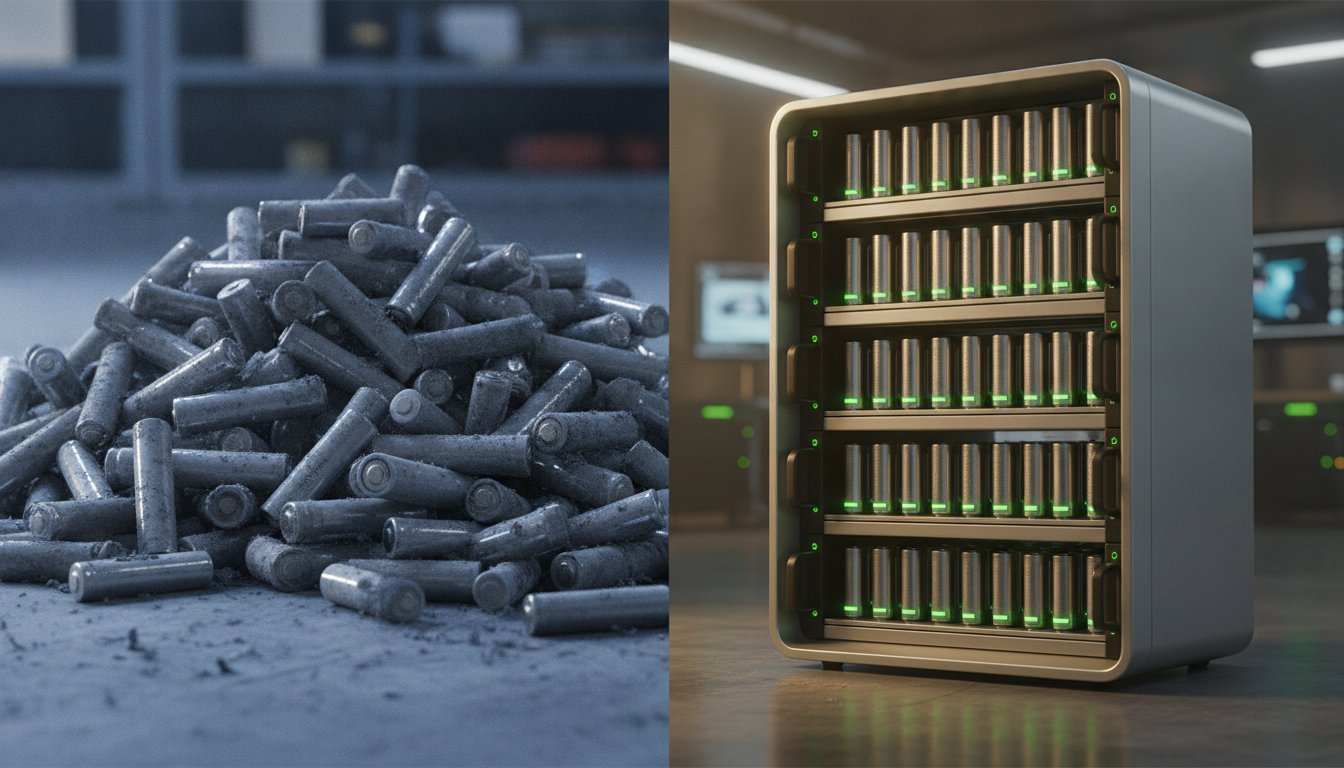
What if the "cheap" batteries your organization buys by the pallet are actually the most expensive line item in your production budget? Most production managers accept the constant cycle of buying and discarding alkaline cells as a necessary cost of doing business. However, when you factor in the labor of inventory management and the risk of equipment failure mid-event due to voltage sag, the hidden costs of disposables become impossible to ignore. Choosing between alkaline vs rechargeable for professional use is no longer just a sustainability goal; it's a strategic shift toward a more reliable power infrastructure.
We understand the pressure of maintaining a zero-failure standard for wireless gear while managing strict budgetary constraints. This 2026 guide provides a clear roadmap for transitioning from a disposable expense model to a high-capacity rechargeable system that maximizes your ROI. You'll learn how to navigate the latest IATA shipping regulations regarding state-of-charge limits, compare the performance of Pure Power Series lithium-ion versus high-capacity NiMH cells, and implement a charging ecosystem that simplifies your daily operations.
Key Takeaways
- Understand the physics of voltage sag and why it causes mission-critical equipment to fail long before an alkaline battery is truly depleted.
- Identify the 100-cycle threshold where high-capacity rechargeable systems begin to deliver a superior return on investment compared to bulk disposables.
- Compare the technical advantages of alkaline vs rechargeable for professional use to ensure your wireless gear maintains a consistent, reliable power signal.
- Learn how to match specific battery chemistries to your equipment, including why the Pure Power Series is becoming the standard for modern wireless transmitters.
- Simplify your facility's logistics by implementing a professional power infrastructure that utilizes custom rackmount chargers and organized battery storage.
The Professional Power Dilemma: Why Disposables are a Liability
For decades, the standard operating procedure for AV departments and medical facilities was simple: buy alkaline batteries by the thousand and swap them out before every shift. While this approach seems convenient, it ignores the inherent physical limitations of primary cells. In a professional environment, a battery is not just a consumable; it is a component of a larger mission-critical system. When assessing alkaline vs rechargeable for professional use, the decision must account for the high-value equipment these cells power. Alkaline batteries are prone to leaking potassium hydroxide, a caustic agent that can permanently corrode the internal circuitry of a $3,000 wireless transmitter or a sensitive medical monitor.
The administrative burden of disposables is equally taxing. Managing the logistics of ordering, storing, and eventually disposing of thousands of depleted cells creates a significant "hidden" labor cost. Professional organizations must define their "Duty Cycle"—the specific window of time a device must operate at peak performance—and alkalines often fail to meet this requirement. Unlike household devices, professional gear demands a consistent voltage that many consumer-grade disposables cannot maintain under heavy loads.
The True Cost of Battery Failure
The financial impact of a power failure is rarely limited to the cost of the battery itself. If a wireless microphone fails during a live broadcast or a corporate keynote, the resulting "dead air" carries a heavy reputational cost. Alkaline batteries are particularly susceptible to this because of their sloping discharge curve. As the battery depletes, the voltage drops steadily, often causing equipment to behave unpredictably or lose signal range long before the cell is actually empty. Advancements in rechargeable battery technologies have fundamentally changed this risk assessment. Modern systems provide a flat discharge curve, ensuring the device receives full power until the very end of the cycle. Standardizing on a professional rechargeable platform eliminates the "guesswork" of testing half-used alkalines, which is a common logistical nightmare in large facilities.
Sustainability as an Operational Requirement
In 2026, sustainability is no longer a secondary concern; it's a mandatory operational requirement for most enterprise-level organizations. Meeting corporate "Green" mandates requires a drastic reduction in hazardous waste. A single high-capacity NiMH or Lithium-ion cell can replace hundreds of disposables over its operational lifespan, significantly lowering the carbon footprint of production teams. Beyond the environmental benefits, the transition simplifies inventory management. Instead of tracking pallets of disappearing disposables, managers can maintain a fixed asset of cells. This shift is why so many organizations are switching to rechargeable batteries to streamline their 2026 supply chains. By moving to a rechargeable infrastructure, you're not just being environmentally conscious; you're choosing a more stable and predictable power standard for your professional gear.
The Physics of Performance: Alkaline vs. NiMH vs. Li-ion
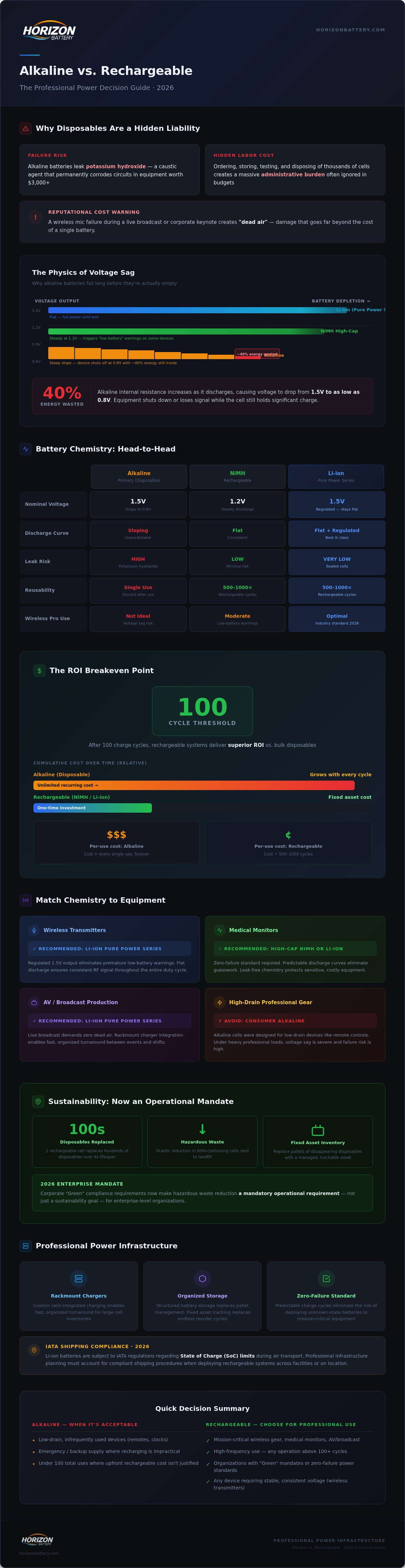
Understanding the internal physics of alkaline vs rechargeable for professional use requires a look at how different chemistries behave under a consistent electrical load. Most consumer-grade alkaline batteries are designed for low-drain devices like remote controls. When placed in high-drain professional gear, they suffer from "voltage sag." This occurs because the internal resistance of an alkaline cell increases as it discharges, causing the voltage to drop rapidly from 1.5V to as low as 0.8V. Consequently, your equipment may shut down or lose signal integrity while the battery still contains over 40% of its theoretical energy. Professional rechargeable chemistries are engineered specifically to mitigate this drop-off.
Voltage Stability and Signal Integrity
For production professionals, the "1.2V problem" has historically been a barrier to adopting NiMH rechargeables. While standard NiMH cells provide a steady discharge, their lower starting voltage often triggers premature "low battery" warnings on sensitive wireless transmitters. The Pure Power Series has revolutionized this space by utilizing Lithium-ion technology with an internal voltage regulator. This allows the cell to maintain a constant 1.5V output until the moment it is exhausted, providing a level of reliability that matches or exceeds primary cells. Maintaining this steady voltage is a core component of effective wireless mic battery management, ensuring that the transmitter's RF output remains stable throughout the entire duty cycle. Industry leaders often reference a professional audio battery guide to help technicians understand how these voltage curves impact signal-to-noise ratios in high-stakes environments.
Capacity vs. Discharge Rate
Capacity alone does not determine run time; the discharge rate is equally critical. High-capacity workhorses like the Ansmann 2850 mAh NiMH cells are designed to handle the heavy current draw of digital wireless systems and motorized camera gear. These cells feature low self-discharge (LSD) technology, which allows them to retain up to 85% of their charge after a year in storage. Energy density refers to the total amount of electrical energy a battery can store per unit of volume. In the context of AA batteries, higher energy density means longer run times without increasing the physical footprint of the battery pack. If you are managing a fleet of high-drain devices, you might consider upgrading to the Pure Power Series to stabilize your signal chain and reduce downtime.
Temperature resilience also varies significantly across these chemistries. Alkaline batteries often fail in cold outdoor environments because the chemical reaction slows down, increasing internal resistance. High-capacity NiMH and Lithium-ion cells maintain their performance in extreme temperatures, making them the preferred choice for outdoor broadcast and field recording. By matching the specific chemistry to your operational environment, you ensure that your gear performs as expected, regardless of the conditions.
Calculating the Real ROI: Enterprise Costs and Logistics
Financial decisions regarding alkaline vs rechargeable for professional use often stall at the initial purchase price. A single professional-grade rechargeable cell costs significantly more than a bulk-pack alkaline. However, this comparison is misleading because it treats a long-term asset as a consumable. In a high-drain environment, the 100-cycle threshold represents the point where rechargeable systems typically pay for themselves. Beyond this mark, every subsequent use represents a direct reduction in your operating expenses. For a facility managing 50 or more wireless devices, these savings scale rapidly into thousands of dollars over the first year of implementation.
Labor costs are the most frequently overlooked variable in the battery equation. The time technicians spend unboxing alkalines, testing half-used cells, and managing the logistics of hazardous waste disposal adds up to hundreds of man-hours annually. Switching to a rechargeable infrastructure replaces this chaotic cycle with a streamlined workflow. Instead of constant testing, teams rely on a rotation of "Ready-to-Go" cells. Treating batteries as managed assets rather than disposable junk allows for better long-term budget forecasting and eliminates the "panic buy" scenarios that often occur when disposable stock runs low.
The Cost-Per-Use Breakdown
A direct comparison reveals the stark contrast in value. Ten high-capacity rechargeable cells can easily replace 1,000 alkaline batteries over their operational lifespan. While the upfront investment includes cells and enterprise battery charging solutions, the cost-per-hour of operation drops to a fraction of a cent. This transition shifts the battery budget from a variable, recurring expense to a controlled, fixed cost. Detailed financial modeling in our Professional Lithium-ion ROI: The 2026 Enterprise Guide demonstrates how enterprise clients can achieve a full return on investment in less than six months.
Operational Efficiency and Logistics
Logistical simplicity is another major driver for enterprise adoption. Reducing the frequency of battery orders lowers shipping expenses and minimizes the administrative burden on procurement departments. Standardizing with battery bundles ensures that every department uses the same high-performance cells, which simplifies inventory across the entire organization. This methodical approach ensures that production teams are never hunting for fresh power. With a dedicated charging station, the status of every cell is visible at a glance, allowing for a more organized and professional environment.
Application Guide: Matching Battery Chemistry to Your Gear
Choosing between alkaline vs rechargeable for professional use is rarely a one-size-fits-all decision. A modern production facility or corporate campus utilizes a wide variety of devices, each with unique power requirements and "drain profiles." While a disposable battery might be acceptable for a wall clock or a simple television remote, it is a liability when placed in a high-stakes wireless signal chain. Matching the specific battery chemistry to the device's duty cycle ensures that your gear performs at its peak while minimizing the risk of unexpected failure.
Pro Audio and Wireless Systems
Wireless microphones and In-Ear Monitors (IEMs) are particularly sensitive to voltage fluctuations. These devices require a steady 1.5V to maintain maximum RF output and provide accurate telemetry data to the receiver. When the voltage drops, the "low battery" indicator may trigger prematurely, or the signal range may decrease. The Pure Power Series (Lithium-ion) has become the new standard for these applications. Because these cells utilize an internal regulator to maintain a constant 1.5V, they eliminate the "low battery anxiety" often associated with traditional 1.2V NiMH cells. For touring teams and live performance crews, standardizing on a regulated lithium platform ensures that every transmitter performs identically from the first minute to the last.
For field recording and video gear, high-capacity NiMH cells like the Ansmann 2850 mAh Slimline are often the preferred choice. These cells offer the extended runtimes necessary for long production days. The "Slimline" factor is essential for professional audio because many battery compartments in older transmitters or portable recorders are built with very tight tolerances. Standard high-capacity batteries can sometimes be slightly oversized, causing them to get stuck. The Slimline design ensures a perfect fit while still delivering industry-leading capacity.
Facility Management and Education
In educational settings or large corporate offices, the focus shifts toward managing power for classroom technology and wireless peripherals. Standardizing on a single power platform for wireless keyboards, mice, and interactive boards simplifies inventory across multiple departments. Hybrid NiMH batteries are ideal for these low-to-medium drain devices because they have extremely low self-discharge rates. They can remain in emergency lighting or backup equipment for months without losing their charge. Implementing a centralized "charge-and-swap" station allows staff to exchange depleted cells for fresh ones instantly, creating a methodical workflow that keeps the facility running smoothly. To streamline your organization's power requirements, browse our professional AA Rechargeable Batteries - High Capacity and bundle options.
Standardizing with Horizon Battery: Professional Infrastructure
Transitioning an entire organization from a disposable model to a rechargeable one requires more than just purchasing new cells; it demands a commitment to a professional power infrastructure. While the technical debate over alkaline vs rechargeable for professional use often focuses on chemistry, the real-world success of that transition depends on the charging and storage ecosystem. Horizon Battery provides this complete ecosystem, moving beyond individual "wall wart" chargers to integrated, enterprise-grade solutions that fit into professional workflows. Moving to a standardized platform ensures that every department, from AV to facility management, operates under the same high-performance guidelines.
Custom Charging Hardware
In high-density environments like theaters, large houses of worship, or corporate campuses, a disorganized collection of consumer chargers is a logistical liability. Custom Rackmount Chargers allow you to integrate battery management directly into your existing AV racks, saving space and centralizing power. These units are specifically engineered with advanced thermal management and safety protocols to handle dozens of high-capacity cells simultaneously without overheating. By monitoring individual charge cycles, these systems ensure that your Pure Power Series cells maintain peak performance over hundreds of uses. This methodical approach to charging protects your investment and ensures that every battery in the rotation is ready for mission-critical tasks.
Getting Started with Horizon
Operating since 1998, Horizon Battery has served as a veteran expert for organizations looking to stabilize their signal chains. We specialize in providing scalable solutions that grow with your organizational needs. You might start with targeted Charger / Battery Bundles for a single production team or implement a multi-facility deployment across an entire campus. Standardizing on the Pure Power Series allows your staff to rely on a consistent 1.5V output, which eliminates the unpredictability of mixed battery inventories and "consumer-grade" disposables. This level of standardization is why enterprise clients increasingly choose Horizon as their primary source for specialized power.
Effective battery management also requires organized storage. Dedicated Battery Storage systems prevent the accidental mixing of charged and depleted cells, a common point of failure in high-pressure environments. Our team can help you design a "charge-and-swap" workflow that prioritizes order and clarity for your technicians. If you're ready to move away from the hidden costs of disposables and modernize your facility's power standards, contact Horizon Battery for a professional energy audit. We can help you determine the most efficient path to maximize your ROI and ensure your wireless gear never fails when it matters most.
Future-Proofing Your Organization’s Power Standards
Moving from a disposable battery model to a professional rechargeable infrastructure is a strategic shift that improves reliability and budget control. By evaluating alkaline vs rechargeable for professional use, you can eliminate the risks of voltage sag and caustic leakage that threaten high-value AV and medical equipment. Standardizing your facility with high-capacity cells ensures your team always has access to dependable power when it matters most.
Horizon Battery has specialized in pro-grade mobile energy since 1998. We provide custom rackmount charging solutions engineered for performance, which is why we are the trusted standard for leading media houses and churches. It's time to stop managing an endless inventory of waste and start treating your power as a high-performance asset. Upgrade your organization to professional power with Horizon Battery's Pure Power Series and build a workflow that is both sustainable and secure. Your production team will appreciate the reliability.
Frequently Asked Questions
Is it better to use alkaline or rechargeable batteries for wireless microphones?
Rechargeable batteries are the superior choice for wireless microphones in professional settings. High-drain transmitters cause standard alkaline cells to experience voltage sag, leading to signal dropouts even when the battery is half full. By contrast, the Pure Power Series maintains a constant 1.5V output until the cell is depleted. This stability ensures consistent RF performance and accurate telemetry for production teams who can't afford mid-event failures.
Do rechargeable batteries really have lower voltage than alkalines?
Standard NiMH rechargeable batteries typically operate at 1.2V, while alkalines start at 1.5V. However, alkalines drop their voltage immediately under load. Modern professional solutions like the Pure Power Series utilize internal voltage regulation to provide a steady 1.5V. This technology eliminates the "low battery" warnings often triggered by 1.2V NiMH cells, making the debate of alkaline vs rechargeable for professional use much simpler for AV technicians.
How many times can I actually recharge a professional NiMH battery?
High-quality professional NiMH batteries, such as the Ansmann 2850 mAh series, are generally rated for 500 to 1,000 charge cycles. The actual longevity depends on the quality of your charging hardware and how deeply the cells are discharged. Using custom rackmount chargers with proper thermal management helps maximize this lifespan. Replacing 1,000 disposables with a single rechargeable cell provides a massive return on investment for any high-volume facility.
What is the best rechargeable battery for high-drain professional devices?
The best choice depends on your specific equipment requirements. For wireless microphones and IEMs that require a steady 1.5V, the Pure Power Series Lithium-ion cells are the industry standard. If you need maximum capacity for field recording or motorized gear, the Ansmann 2850 mAh NiMH batteries are excellent workhorses. Both options provide the reliability needed for mission-critical applications where consumer-grade batteries often fail to perform under heavy electrical loads.
Are Lithium-ion rechargeable AA batteries safe for all professional gear?
Regulated Lithium-ion AA batteries are safe for professional gear when they include internal protection circuitry. Horizon Battery's Pure Power Series is designed to mimic the 1.5V output of an alkaline cell while providing the high energy density of lithium. It's crucial to use batteries that have passed UN 38.3 safety testing to ensure they won't overheat. Always verify that your specific device can handle the constant high output of professional lithium cells.
How much money can a church or school save by switching to rechargeables?
Organizations like churches and schools often save thousands of dollars in annual operating expenses by eliminating the recurring cost of bulk disposables. When you factor in the labor costs of swapping, testing, and disposing of thousands of cells, the savings become even more significant. Most professional facilities reach their break-even point within six months. This transition shifts the battery budget from a variable, unpredictable expense to a controlled, fixed infrastructure cost.
Why do my rechargeable batteries seem to die faster in storage?
This phenomenon is known as self-discharge, where batteries lose energy while sitting idle. Older NiMH chemistries were prone to this, but modern Low Self-Discharge (LSD) batteries retain up to 85% of their charge after a year in storage. Lithium-ion cells also have very low self-discharge rates compared to traditional rechargeable options. Using dedicated battery storage systems helps technicians track which cells are fresh, ensuring your gear is always ready for immediate deployment.
Can I mix different brands of rechargeable batteries in the same device?
You should never mix different brands, capacities, or chemistries in the same professional device. Mixing cells leads to uneven discharge rates, which can cause the weaker battery to over-discharge or leak. This practice compromises the reliability of your equipment and can permanently damage sensitive electronics. For the best results, use matched sets from a single manufacturer and replace the entire set at the same time to maintain a balanced power load.