
Reliable wireless audio is fundamentally a product of management infrastructure rather than simple battery capacity. Achieving professional wireless mic battery management means moving past the high-stakes pressure where a single uncharged cell can derail a production. It's frustrating to manage the rising costs of disposable batteries or the confusion of disorganized charging stations. We understand that in a mission-critical environment, "good enough" power is a liability you can't afford.
This article provides a comprehensive logistical framework for 2026 to help you master high-capacity rechargeable systems and ensure zero failures during your shows. We'll cover the voltage stability of the Pure Power Series, establish a precise rotation and retirement schedule for your cells, and demonstrate how custom rackmount chargers streamline large-scale facility workflows. By the end of this guide, you'll have a clear roadmap to transition from reactive troubleshooting to a proactive, industrial-grade power strategy that secures a significant long-term ROI on your battery spend.
Key Takeaways
- Eliminate the logistical nightmare of disposable battery waste by adopting a professional framework designed for high-capacity rechargeable systems.
- Understand why the Pure Power Series 1.5V constant voltage is a mission-critical requirement for modern digital wireless stability.
- Streamline large-scale facility operations using custom rackmount charging hardware that prioritizes organization and thermal safety.
- Master a standardized wireless mic battery management routine that includes pre-show verification and real-time telemetry tracking.
- Secure a significant long-term ROI by implementing a clear rotation and retirement schedule for your high-capacity cells.
The Hidden Risks of Poor Wireless Mic Battery Management
Alkaline batteries are often viewed as a reliable default for live sound. In 2026, this is a dangerous misconception for professional AV technicians. While "fresh out of the box" alkalines seem convenient, they act as a false security blanket that hides underlying technical vulnerabilities. Relying on disposables creates a logistical nightmare involving massive waste and inconsistent performance levels that don't meet modern production standards.
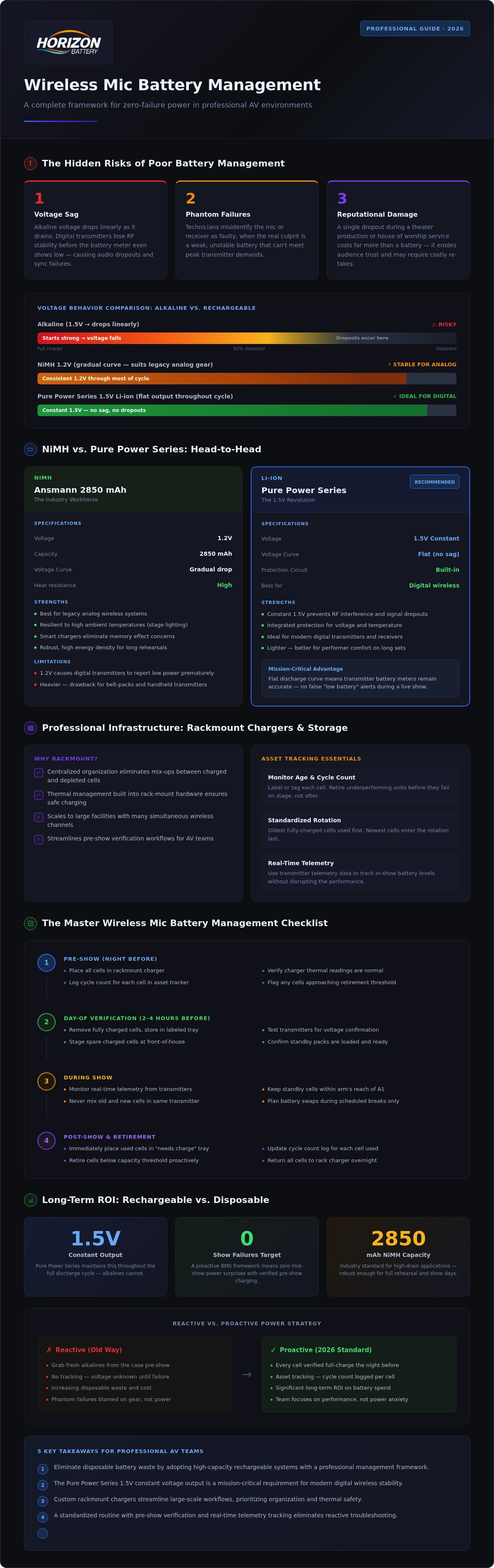
Voltage sag is the primary culprit behind unexpected audio issues. As an alkaline cell drains, its voltage drops linearly. Modern digital transmitters require stable power to maintain a clean signal. When voltage dips below a certain threshold, the radio frequency (RF) signal becomes unstable. This leads to dropouts and sync issues even if the battery meter on the transmitter shows a half-full charge. To solve this, leading organizations are switching to rechargeable batteries for business to ensure a consistent power floor for every performance.
The Real Cost of Technical Failures
A single audio dropout during a critical moment in a theater production or a house of worship service carries a heavy price. Beyond the immediate technical disruption, the reputational damage is significant. In professional environments, the "per-show" cost of a failure isn't just the price of a battery; it's the loss of audience trust and the potential for costly re-runs or lost recordings. Disorganized wireless mic battery management often results in "phantom" failures. These occur when a technician incorrectly identifies a microphone or receiver as faulty, when the actual issue was a weak, unstable power source that couldn't handle the transmitter's peak demands.
Moving from Reactive to Proactive Power
A proactive battery management system (BMS) replaces guesswork with a structured logistical framework. Instead of reacting to low-battery warnings mid-show, AV teams must implement standardized charging cycles. This ensures every microphone starts the event with a verified, high-capacity charge. Asset tracking is essential when using high-capacity AA rechargeable batteries. By monitoring the age and cycle count of each cell, you can retire underperforming units before they cause a failure on stage. This methodical approach transforms wireless mic battery management from a source of anxiety into a reliable, invisible part of your technical infrastructure. It allows your team to focus on the performance rather than the power levels.
NiMH vs. Lithium-Ion: Choosing Your Wireless Mic Engine
Selecting the correct energy chemistry is the foundation of a successful wireless mic battery management strategy. In 2026, the choice usually settles between high-capacity Nickel Metal Hydride (NiMH) and the newer 1.5V Lithium-ion standards. Each chemistry offers distinct advantages based on your specific hardware and environmental conditions.
Ansmann High-Capacity NiMH: The Workhorse
For years, the Ansmann 2850 mAh NiMH cell has been the industry standard for high-drain applications. When examining Ansmann 2850 mAh vs Pure Power Series performance, NiMH remains a formidable choice for older analog wireless systems. These systems often handle the gradual 1.2V discharge curve of NiMH better than modern digital counterparts. Additionally, modern smart chargers have effectively eliminated the "memory effect" myth, allowing these cells to be topped off without losing capacity over time. They are robust, reliable, and provide a high energy density that suits long rehearsal days.
Environmental factors like stage lighting heat can also impact performance. NiMH batteries tend to be more resilient to high ambient temperatures than some older lithium designs, but they are significantly heavier. This extra weight can be a drawback for performers using belt-packs or handheld transmitters during long sets. If your facility relies on legacy analog gear, keeping a stock of high-capacity AA rechargeable batteries is often the most practical route.
Pure Power Series: The 1.5V Lithium Revolution
The shift toward digital wireless has changed the requirements for wireless mic battery management. Traditional NiMH cells provide 1.2V, which can cause digital transmitters to report low power prematurely or drop signal. The Pure Power Series solves this by providing a constant 1.5V output throughout the entire discharge cycle. These cells feature integrated protection circuits to manage voltage and temperature, ensuring safety in professional environments. Constant voltage prevents RF interference by ensuring the transmitter’s internal power regulator doesn't create noise while attempting to compensate for a dipping voltage floor.
Lithium cells are also roughly 30% lighter than their NiMH counterparts, reducing fatigue for talent. For mission-critical digital systems, you can explore the Pure Power Series to ensure maximum signal integrity. This constant voltage technology represents the current peak of professional audio power solutions in 2026.
Professional Infrastructure: Rackmount Chargers and Storage
Effective wireless mic battery management extends beyond the cells themselves. It requires a dedicated physical infrastructure. Many smaller venues rely on consumer-grade "plug-in" chargers, but these create a disorganized environment prone to failure. Professional AV racks in 2026 require integrated solutions that eliminate the clutter of "wall warts" and prevent accidental power disconnects during critical charging windows.
Custom Rackmount Chargers for AV Racks
Integrating multi-channel charging directly into your equipment rack ensures that power is always where it's needed. Custom Rackmount Chargers provide a centralized hub for mobile production kits and permanent installations alike. Unlike consumer units, these systems offer clear LED indicators or LCD telemetry. This allows technicians to verify charge status at a glance across 16 or more channels. This immediate visibility is vital for quick stage turnovers where every second counts and a single uncharged mic can stall a production.
Engineering for thermal management is a critical distinction in professional hardware. Charging dozens of high-capacity batteries simultaneously generates significant heat. Without proper airflow and heat dissipation, battery life cycles can shorten or cells can vent. Professional rack solutions are designed to handle this thermal load. This ensures that your investment in the Pure Power Series or Ansmann cells remains protected during rapid charge cycles in tight rack spaces.
Battery Asset Management and Storage
Organization is the final pillar of a reliable power system. Implementing a "First-In, First-Out" (FIFO) rotation prevents specific cells from being overused while others sit idle. Using color-coded Battery Storage cases helps teams distinguish between fully charged units, those awaiting a cycle, and cells reaching their retirement date. This simple visual cue reduces the risk of a technician reaching for an uncharged battery during a high-pressure event. It's a low-tech solution that provides high-level security for wireless mic battery management.
Standardizing on specific Charger / Battery Bundles ensures consistent duty cycles across your entire inventory. When every transmitter behaves the same way, troubleshooting becomes a logical process rather than a guessing game. Protective storage cases also prevent short circuits during transport, which is a common hazard in mobile production environments. Investing in a complete infrastructure ensures your power strategy is as professional as the audio it supports.
The Master Wireless Mic Battery Management Checklist
A successful technical outcome relies on a repeatable process. While high-quality hardware provides the engine, a master checklist serves as the operator's manual for wireless mic battery management. This framework ensures that every cell in your inventory is accounted for, verified, and ready for the stage without exception.
Daily Operational Tasks
Precision begins with a visual inspection. Technicians should examine the battery contacts on both the cells and the transmitters before every soundcheck. Even microscopic amounts of skin oil or dust can increase resistance, leading to inconsistent power delivery. Always confirm a "Ready" status on your rackmount chargers before assigning gear to talent. This simple step prevents the nightmare of accidentally deploying a partially charged unit.
Labeling is another critical daily habit. Use small, durable stickers to mark batteries with "Batch Dates." This allows your team to track the age of each cell at a glance. During the show, utilize the real-time telemetry on your receivers to monitor voltage levels. Keep a set of "hot-swap" spares in a dedicated storage case for immediate access. Once the show concludes, rotate used cells back into the charging cycle immediately to maintain a consistent First-In, First-Out flow.
Long-Term Maintenance and Retirement
Not all cells age at the same rate. Monthly capacity testing is necessary to identify "lazy" units. These are cells that appear fully charged but suffer from rapid voltage drop under a load. Professional smart chargers can run a discharge and charge cycle to measure the actual milliamp-hour capacity remaining. A standard industry practice is to set a retirement threshold at 80% of the original capacity. Once a cell dips below this mark, it's no longer suitable for mission-critical applications.
Reviewing your professional lithium-ion ROI on an annual basis helps you decide when to scale your system or refresh your inventory. This data-driven approach ensures you aren't overspending on disposables or holding onto degraded rechargeable cells for too long. For those looking to standardize their facility, you can view our high-capacity battery bundles to find a solution that fits your specific channel count.
Safe disposal is the final step. Industrial batteries should never be thrown in the trash. Establish a clear protocol for collecting retired cells in a designated bin before taking them to a certified recycling center. This completes the cycle of responsible, professional power management while protecting the environment from hazardous waste.
Standardizing Your Power with Horizon Battery
Since 1998, Horizon Battery has acted as a veteran guide for professionals navigating complex energy requirements. We provide more than just cells; we deliver the logistical infrastructure discussed throughout this guide. Professional venues trust us because we understand that mission-critical events leave no room for error. By standardizing your wireless mic battery management with our Pure Power Series, you ensure that every transmitter in your fleet operates with consistent, industrial-grade reliability. This level of specialized knowledge is what separates a standard distributor from a true technical partner.
For new facilities, our Charger / Battery Bundles offer a turnkey solution that eliminates the guesswork of matching chemistries with specific hardware. These kits are curated to provide the exact balance of capacity and charging speed required for high-intensity production schedules. If your installation has unique spatial constraints or non-standard power needs, our custom engineering services can adapt rackmount charging hardware to fit your specific AV rack configuration. This ensures that your power hub is as organized and efficient as the rest of your signal chain.
Scaling from 4 to 40 Channels
Growth shouldn't compromise your power standards. Our modular charging solutions are designed to scale alongside your wireless inventory as your production needs expand. Whether you're managing a single four-channel mobile kit or an enterprise-level 40-channel system across multiple campus buildings, we help you maintain total consistency. This uniformity is vital for large facilities where technicians may move between different rooms or venues. Contacting Horizon for bulk enterprise outfitting allows you to establish a single, high-performance power protocol. This simplifies training for your technical staff and ensures that every microphone performs identically, regardless of its location on campus.
The Future of Professional Mobile Energy
As the wireless spectrum becomes increasingly crowded and digital systems more demanding, the need for stable power is non-negotiable. Horizon Battery remains committed to high-performance, sustainable energy solutions that reduce environmental impact without sacrificing stage reliability. By moving away from disposable waste, your organization stays ahead of both technical and ecological trends. It's time to transition to a system that pays for itself through longevity, performance, and the peace of mind that comes with a zero-failure record. Explore Professional Wireless Mic Battery Solutions today to secure your production's future and master your wireless mic battery management strategy for 2026 and beyond.
Securing Your Production Continuity
Mastering wireless mic battery management requires a shift from reactive troubleshooting to a proactive logistical framework. By prioritizing the 1.5V constant voltage of the Pure Power Series and implementing a strict rotation schedule, you eliminate the technical vulnerabilities that lead to audio dropouts. Reliable power is no longer a variable; it's a professional foundation built on high-capacity hardware and methodical oversight that protects your reputation.
Since 1998, Horizon Battery has been a trusted partner for major US theaters and houses of worship. We provide the only 1.5V Lithium solution specifically engineered for the demands of professional audio, supported by custom rackmount chargers designed for 24/7 industrial use. These systems ensure your team spends less time managing cells and more time focusing on the quality of the performance. Upgrade Your AV Rack with Custom Charging Solutions and ensure your next show is powered with industrial-grade precision. You have the tools to achieve zero battery failures; now it's time to put them into practice.
Frequently Asked Questions
Is it better to use NiMH or Lithium-ion batteries for wireless microphones?
Lithium-ion is generally superior for modern digital systems, while NiMH remains a workhorse for legacy analog gear. Digital transmitters benefit from the constant voltage of the Pure Power Series, whereas analog systems can handle the linear discharge of high-capacity NiMH. Choosing the right chemistry is a core part of wireless mic battery management because it dictates signal stability and transmitter runtime throughout a professional production environment.
Can I use a standard AA charger for Pure Power Series lithium batteries?
No, you must use a charger specifically designed for 1.5V lithium-ion cells. Standard NiMH chargers use different termination methods and voltage profiles that are incompatible with the integrated circuitry of the Pure Power Series. Using the wrong hardware can result in incomplete charges or damage to the cells. We recommend using dedicated Charger / Battery Bundles to ensure all components in your power infrastructure are electrically matched for reliability.
How often should I replace my rechargeable batteries for professional use?
Professional batteries should be retired once they drop below 80% of their original rated capacity. For most high-intensity AV environments, this retirement threshold is reached every 12 to 18 months, depending on the frequency of use. Tracking the age and performance of your cells ensures that wireless mic battery management remains proactive. Regular capacity testing prevents degraded cells from causing unexpected failures during live events or mission-critical recordings.
Why do my wireless mics show a low battery signal even with fresh rechargeables?
This usually occurs because standard NiMH rechargeables operate at 1.2V, which is lower than the 1.5V expected by many transmitter battery meters. The transmitter interprets the lower voltage as a nearly depleted alkaline battery. To resolve this, switch to the Pure Power Series; it's a solution that provides a constant 1.5V output. This ensures your transmitter accurately reflects the power status and prevents premature low battery warnings during a performance.
How many charging cycles can I expect from Ansmann 2850 mAh batteries?
You can typically expect hundreds of reliable cycles from Ansmann 2850 mAh NiMH batteries when used with professional smart chargers. These high-capacity cells are engineered for high-drain applications, making them ideal for long rehearsal days. To maximize longevity, avoid deep discharges and ensure your charging hardware provides thermal protection. Consistent monitoring of these cycles is a vital part of maintaining a dependable inventory for large-scale facility operations.
What is the best way to store a large inventory of AA batteries between shows?
The best practice is to store AA batteries in dedicated, color-coded Battery Storage cases in a cool, dry environment. Avoid loose storage in drawers where terminals can touch; this can cause short circuits or parasitic drain. Organizing your inventory using a First-In, First-Out (FIFO) rotation ensures that all cells receive equal use. This prevents specific batches from sitting idle; it's a simple way to maintain long-term reliability.
Do custom rackmount chargers protect batteries from overcharging?
Yes, custom rackmount chargers are engineered with sophisticated microprocessors to prevent overcharging. These units monitor the individual voltage and temperature of each cell; they automatically switch to a maintenance or trickle charge once full capacity is reached. This protection is essential for 24/7 industrial use, as it prevents thermal stress and extends the overall life of your cells. It allows technicians to safely leave batteries in the rack until they are needed.
How does constant 1.5V output improve digital wireless microphone performance?
Constant 1.5V output ensures the transmitter's internal power regulator operates efficiently without creating electronic noise. In digital wireless systems, a steady voltage floor prevents RF interference and maintains signal integrity even as the battery nears depletion. Unlike NiMH cells that drop to 1.1V or lower, the Pure Power Series maintains its peak voltage until the cell is exhausted. This provides a predictable performance window that technical teams can rely on.