
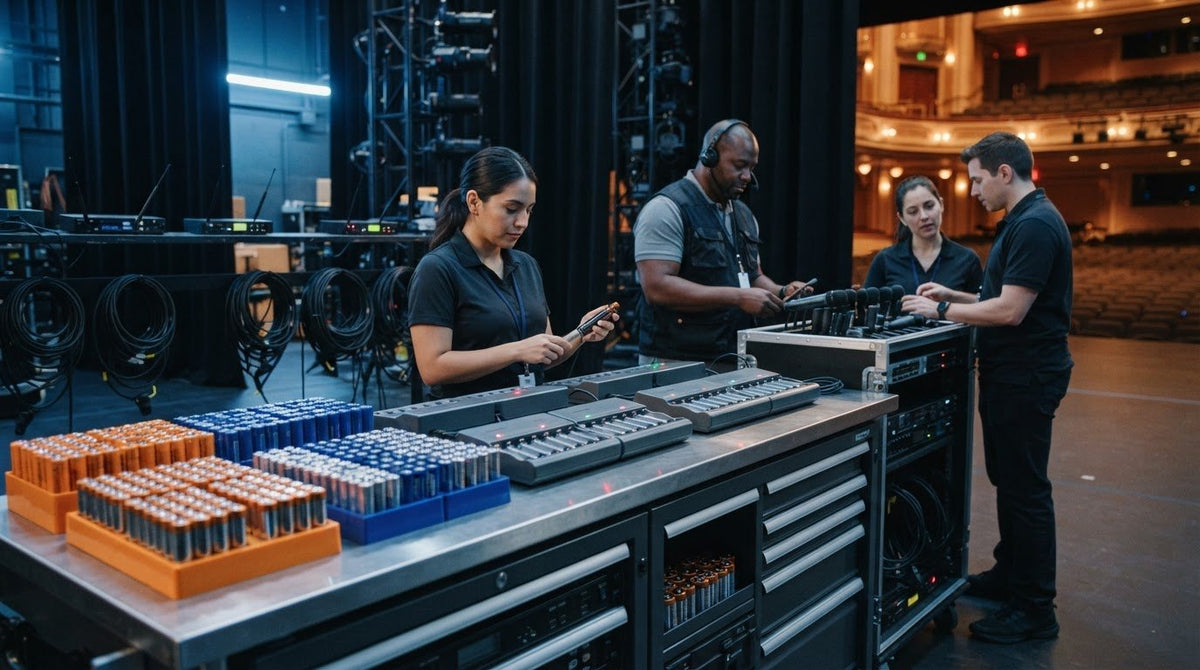
What if the biggest performance-day battery risk isn’t a dead cell, but a system no one can read at a glance? Rechargeable AA battery systems for performing arts centers work best when batteries, chargers, storage, and daily routines are planned together. Without a clear process, departments can lose track of what’s charged, and charging can become a bottleneck between performances.
It’s understandable to want to reduce disposable battery use without introducing new uncertainty. Start by matching batteries and chargers to venue equipment, then make readiness simple to check and repeat. This guide explains how to compare battery options, verify requirements against equipment manufacturers’ documentation, and choose charging and storage that fit your operation. It also covers practical steps for labeling, rotation, and readiness checks across departments. Horizon Battery offers high-capacity rechargeable AA batteries, charger and battery bundles, custom rackmount chargers, and dedicated battery storage to support a coordinated setup.
Key Takeaways
- Build readiness into the whole battery system, including compatible cells, charging, labeled inventory, storage, and a repeatable check before performances.
- Compare battery chemistry and voltage with each device’s manufacturer guidance, and don’t treat capacity ratings as a guarantee of operating time.
- Choose distributed or centralized charging based on equipment volume, production schedule, available space, and charging windows.
- Use a rollout plan to audit equipment, size inventory, assign charging responsibilities, and test the rotation process before opening night.
- Evaluate rechargeable AA battery systems for performing arts centers as a coordinated workflow, with batteries, chargers, and storage matched to venue needs.
What Makes a Rechargeable AA Battery System Work for a Performing Arts Center?
On performance day, the priorities are straightforward: equipment must operate dependably, batteries need to turn around between uses, and staff should be able to see what’s ready without guesswork. That takes more than a supply of rechargeable cells. A dependable process connects equipment requirements with compatible batteries, suitable chargers, clearly labeled inventory, assigned storage, and repeatable readiness checks.
A performing arts center battery system is a coordinated set of compatible AA cells, chargers, labeled inventory, storage, and routines that make battery readiness visible and repeatable.
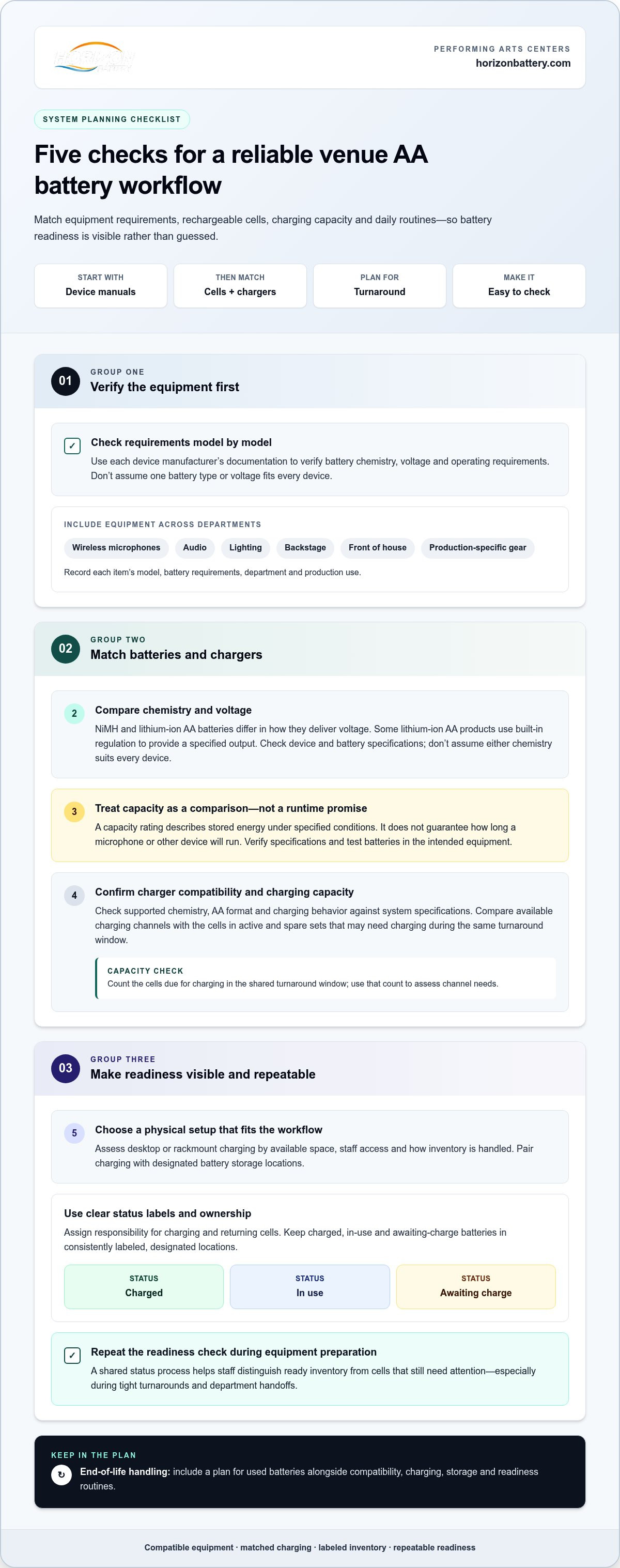
Don’t assume one battery type or voltage suits every device in the venue. Equipment manuals are the reference for chemistry, voltage, and operating requirements. Check requirements by device model before standardizing supplies or assigning batteries across departments.
Which performing arts devices commonly use AA batteries?
Start by inventorying wireless microphones and other AA-powered production equipment. Include devices used by audio, lighting, backstage, and front-of-house teams, along with equipment brought into service only for particular productions.
For each item, record its model, required battery type and voltage, department, and production use. Verify the requirements in the manufacturer’s documentation. This equipment-level record helps prevent venue-wide assumptions from creating compatibility problems. For background on one rechargeable chemistry, see this overview of Nickel-Metal Hydride (NiMH) batteries. Device manuals should still guide the choice for each application.
Why treat batteries, chargers, and storage as one system?
If no one owns charging or used cells are left in scattered locations, staff can’t quickly distinguish ready inventory from batteries awaiting attention. The problem becomes more apparent during a tight turnaround, when departments may draw from the same pool without a shared status process.
Assign responsibility for charging and returning cells. Use consistent labels and designated locations for charged, in-use, and awaiting-charge batteries. Choose chargers and storage that support the venue’s workflow, then make the readiness check part of routine equipment preparation. These controls make battery status easier to see and reduce uncertainty during handoffs.
For practical guidance on organizing inventory and assigning storage, read the professional battery storage and management system guide. It explains how to manage batteries, charging, and storage as connected parts of venue operations.
How to Choose Rechargeable AA Batteries and Chargers for Venue Equipment
Choose cells and chargers according to each device’s requirements, not a venue-wide preference. Compare battery chemistry, voltage, capacity, charger support, and the manufacturer’s instructions together. A battery’s capacity rating describes stored energy under specified conditions; it doesn’t guarantee how long a particular microphone or other device will run. Operating time depends on the equipment and how it’s used, so verify specifications and test batteries in the intended devices.
When should a venue compare NiMH and lithium-ion AA options?
Compare chemistries when device documentation indicates that battery type or voltage could affect operation. NiMH and lithium-ion AA batteries differ in how they deliver voltage, and lithium-ion AA products may use built-in regulation to provide a specified output. Don’t assume either chemistry works for every device or delivers a particular runtime. Review device and battery specifications, then validate performance in venue use. For more on lithium-ion AA options, see the Pure Power Series lithium-ion AA guide.
What should a professional AA battery charger support?
Match charger chemistry and cell format to the batteries selected, then check its charging behavior and capacity against the system specifications. To estimate the number of charging channels needed, count the cells in active and spare sets that may need charging during the same turnaround window. For centralized equipment-room charging, assess whether a rackmount configuration suits the space, access, and workflow.
Use this comparison to organize the evaluation:
| Criteria | What to verify | Venue implication |
|---|---|---|
| Battery chemistry and voltage | Device manual and battery specifications | Determines whether a cell is appropriate for each equipment model. |
| Capacity rating | Units and conditions stated by the battery manufacturer | Helps compare cells, but doesn’t establish device runtime. |
| Charger compatibility | Supported chemistry, AA format, and charging behavior | Prevents mismatches and supports a consistent charging routine. |
| Charging capacity | Available channels compared with sets due for charging | Shows whether charging can keep pace with production turnaround. |
| Physical setup | Desktop or rackmount fit, access, and storage location | Helps align charging with how staff handle inventory. |
Include end-of-life handling in the plan. The EPA’s guidance on used household batteries offers information on managing used batteries. To compare rechargeable AA batteries, charger bundles, and storage options, visit Horizon Battery’s rechargeable AA system options.
Which AA Charging Setup Fits Your Performing Arts Center?
The right setup depends on how batteries move through a production day. A venue running rehearsals and performances on a tight turnaround has different charging demands from a department that uses AA-powered equipment only for occasional events. Start with the number of cells in circulation, the time between uses, where equipment is managed, and who oversees charging. Then compare those needs with the charger’s documented capacity and charging behavior.
When does distributed charging make sense?
Department-level desktop chargers can suit a smaller inventory or equipment managed independently by teams such as audio or backstage operations. Staff can charge near the equipment preparation area, which may simplify handoffs. The trade-off is oversight: inconsistent labels, unclear responsibility, and scattered charging locations can make readiness hard to see. Use one shared checklist to record cell returns, charging, and placement in the designated ready area.
Production cadence matters. For a short run with a predictable break between uses, map the charging window to the next call time and confirm that the available channels can handle the cells due back. For overlapping events or rapid turnovers, account for every department drawing from the battery pool at once. If the charging window is too short for the planned rotation, adjust inventory or centralize oversight instead of relying on an untested turnaround assumption.
When should a venue consider rackmount charging?
Centralized rackmount charging can bring batteries and charging tasks into one designated equipment-room location. This can make assignment and status tracking more consistent across departments, particularly when a venue manages a larger shared inventory. Before selecting a configuration, assess available rack space, staff access, required charging channels, and how cells will travel between the charging area and production workstations.
Custom rackmount chargers can suit a centralized operating plan when the configuration aligns with charger specifications and facility requirements. Consider the production calendar, too: a consolidated setup helps only if staff can access it when batteries need to be returned and prepared. The enterprise battery charging solutions buying guide offers further criteria for assessing centralized charging.
Use this practical distinction:
- Distributed desktop charging: Consider it when teams manage separate equipment and have suitable local charging space. Standardize labels, responsibility, and return procedures.
- Centralized charging: Consider it when shared inventory benefits from one charging location and clear oversight. Plan rack space, access, channels, and turnaround together.
The best rechargeable AA battery systems for performing arts centers follow the venue’s actual schedule, not an assumed average. Match the charging arrangement to equipment volume and available charging windows, then test the process during a representative production cycle. That reveals where handoffs, access, or capacity need attention before the workflow becomes routine.
How to Roll Out a Reliable Rechargeable AA Workflow Before Opening Night
Put the process into practice before a production depends on it. A controlled rollout lets departments identify equipment needs, check charging capacity, and find workflow gaps while there’s still time to adjust. Use these steps to establish a venue-specific routine:
- Audit equipment. List AA-powered devices by model, department, and production. Note how each is used and how often batteries are changed, using venue records where available.
- Verify compatibility. Check each device manufacturer’s guidance for battery type and voltage. Record approved battery and charger details alongside the equipment inventory.
- Size the inventory. Estimate how many cells are needed for simultaneous use, then account for spare sets, observed battery changes, turnaround time, and available charging windows.
- Assign charging. Name the role or department responsible for collecting used cells, charging them, and returning them to the ready area. Match these tasks to the production schedule.
- Test the workflow. Run a trial during a production-relevant rehearsal or event. Document device-specific performance and note whether charging, handoffs, and pre-show checks fit the schedule before expanding the program.
How should a venue size its working and spare inventory?
Base the estimate on your own operating pattern, not a universal cell count. Start with the number of AA-powered devices active at once, add devices used by simultaneous productions, and use venue records to estimate battery changes during each production cycle. Then consider how many cells can be charged between uses. If the schedule demands more ready cells than the charging window can supply, revise the spare inventory, charger capacity, or rotation plan, then test the revised approach.
How can staff keep battery status clear?
Set designated, consistently labeled locations for charged, in-use, and awaiting-charge cells. Assign responsibility for every handoff, including collection, charging, return to storage, and the pre-show readiness check. A simple sign-off log can show whether the next department has a ready set and whether used cells have entered the charging queue. For more organization practices, see the battery storage and management implementation guide.
Printable pre-show checklist
- Confirm required battery sets are in the charged location.
- Check equipment handoffs and record cells issued or returned.
- Confirm charging windows and assigned charging responsibility.
- Move returned cells to the awaiting-charge location.
- Review inventory and note device-specific performance after use.
A documented routine helps rechargeable AA battery systems for performing arts centers stay understandable across departments and production changes. Explore Horizon Battery’s rechargeable AA system options for batteries, chargers, and storage that can support your venue’s workflow.
Build Your Performing Arts Center Battery System with Horizon Battery
A dependable venue setup starts with the equipment, then connects battery selection, charger capacity, storage, and staff procedures into one operating plan. Confirm each device’s battery requirements, estimate how many cells must be ready during busy production periods, and map charging capacity to available turnaround windows. Clear storage locations and assigned handoffs complete the system.
Horizon Battery brings these components together through high-capacity rechargeable AA batteries, charger and battery bundles, battery storage, and custom rackmount chargers. The Pure Power Series is another option to consider as you develop a system around your venue’s equipment and workflow. Match the products you select to documented device requirements and battery and charger specifications.
Which Horizon Battery offerings fit a venue system?
Charger and battery bundles provide a coordinated starting point for venues selecting cells and charging equipment together. High-capacity rechargeable AA batteries can be considered for compatible devices, while battery storage supports an organized inventory process. For an equipment-room workflow, custom rackmount chargers offer a centralized charging option to assess alongside available rack space, staff access, and channel needs. Compare battery chemistry, voltage, charger support, capacity, and rackmount configuration with equipment and system specifications.
These are connected choices, not isolated purchases. A battery that suits one device may not suit another, and charger capacity must match the venue’s rotation plan. Keep device documentation and production schedules at the center of the selection process.
What information should a venue prepare for its next step?
Gather a practical summary of venue needs before evaluating system options. Include:
- Equipment models and manufacturer-stated battery requirements
- Simultaneous device counts across departments and productions
- Expected battery changes and available charging windows
- Equipment-room space, rack constraints, and access needs
- Current inventory labels, storage practices, and charging responsibilities
This information helps connect product specifications to real operating conditions, whether the venue is planning desktop charging, centralized charging, or a combination of both. Horizon Battery has operated since 1998 and offers rechargeable AA batteries, chargers, and storage options for coordinated workflows.
Explore Horizon Battery’s professional battery solutions to take the next step toward a system shaped around your equipment, charging schedule, and storage needs.
Set Your Venue Up for Reliable Battery Readiness
Dependable rechargeable AA battery systems for performing arts centers begin with verified device requirements, then bring batteries, charging capacity, and storage into one manageable workflow. Match battery chemistry and voltage to equipment documentation, and plan charger capacity around production schedules and available turnaround windows.
Clear labels, assigned handoffs, and a tested rotation routine help staff recognize which cells are ready, in use, or awaiting charge. These practical steps make battery status easier to track across departments and support a smoother transition between performances.
Horizon Battery offers high-capacity rechargeable AA batteries and charger bundles, custom rackmount chargers, and dedicated battery storage systems. Explore Horizon Battery’s rechargeable AA batteries and charging solutions to plan a system around your venue’s equipment and workflow.
With a compatible system and a repeatable process in place, your team can approach each performance with greater clarity and confidence.
Frequently Asked Questions
Can rechargeable AA batteries be used in wireless microphones?
Yes, rechargeable AA batteries can be used in wireless microphones if they meet the microphone manufacturer’s requirements. Check the manual for supported battery chemistry and voltage, then test the selected cells in the specific transmitter. Don’t assume batteries suitable for one microphone model will suit every model in the venue. Record device-specific operating results so staff can prepare appropriate batteries for rehearsals and performances.
How many rechargeable AA batteries should a performing arts center keep in rotation?
There’s no single quantity that fits every venue. Count the AA-powered devices used at the same time, account for simultaneous productions, and use venue records to estimate battery changes. Then include spare sets based on charging turnaround and the time available between uses. This gives you a working estimate for rechargeable AA battery systems for performing arts centers. Test the rotation against an actual production schedule and adjust as needed.
What is the difference between NiMH and lithium-ion rechargeable AA batteries?
NiMH and lithium-ion AA batteries use different chemistries and may deliver different voltage characteristics, so compatibility depends on the device. Some lithium-ion AA batteries regulate output, while NiMH cells have their own rated voltage. Compare battery specifications with the equipment manufacturer’s guidance rather than assuming one chemistry is universally better. Capacity ratings also don’t guarantee runtime; test suitable options in the intended devices and record results.
Can rechargeable AA batteries be charged in a rackmount system?
Yes, rechargeable AA batteries can be charged in a rackmount system when the selected charger supports the battery chemistry and cell format. A centralized setup may suit venues that manage shared inventory in an equipment room. Before choosing a configuration, compare charger capacity and charging behavior with the number of cells due for charging, available rack space, staff access, and the venue’s turnaround schedule.
How should a venue organize charged and uncharged AA batteries?
Use clearly labeled, designated locations for charged, in-use, and awaiting-charge batteries. Keep labels consistent across departments, and define who collects used cells, handles charging, returns ready cells to storage, and completes pre-show checks. Separate containers or compartments can make status easier to identify during handoffs. A shared log can record batteries issued and returned, note device-specific issues, and highlight inventory that needs attention.
What happens if a rechargeable AA battery is incompatible with a device?
An incompatible battery may cause a device to operate unreliably, show an unexpected battery indication, or fail to power on. The effect depends on the device and the mismatch, so don’t rely on trial during a performance. Check the equipment manual for supported chemistry and voltage, and stop using cells that produce unexpected results. Test compatible batteries in advance and document the results for the staff responsible for that equipment.
Is a rechargeable AA battery system practical for a small performing arts center?
Yes, a small venue can use a rechargeable system by starting with an inventory of its AA-powered equipment and matching battery and charger choices to documented device requirements. A department-level charger and a clearly labeled storage area may be sufficient for a compact inventory. Estimate spare cells from actual use and charging windows, then use a checklist to keep returns, charging, and pre-show readiness consistent.