
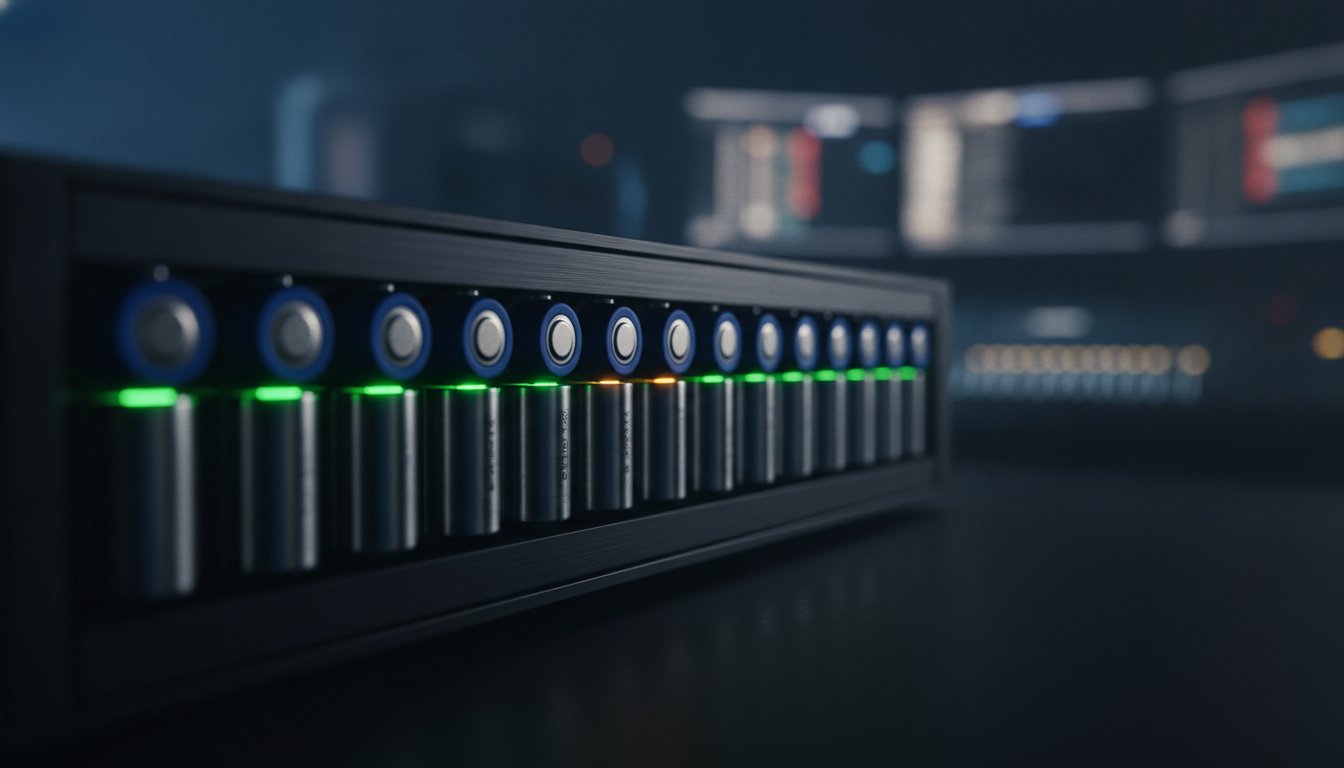
What Defines High Capacity AA Rechargeable Batteries for Professional Use?
For professionals managing fleets of wireless microphones, in-ear monitors (IEMs), and other high-drain electronics, the term "high capacity" signifies more than just a number on a label. It represents operational reliability. In the 2026 market, a high-capacity AA battery is not merely a power source; it's a critical component in a larger power management system. Understanding its true definition is the first step toward building a dependable workflow.
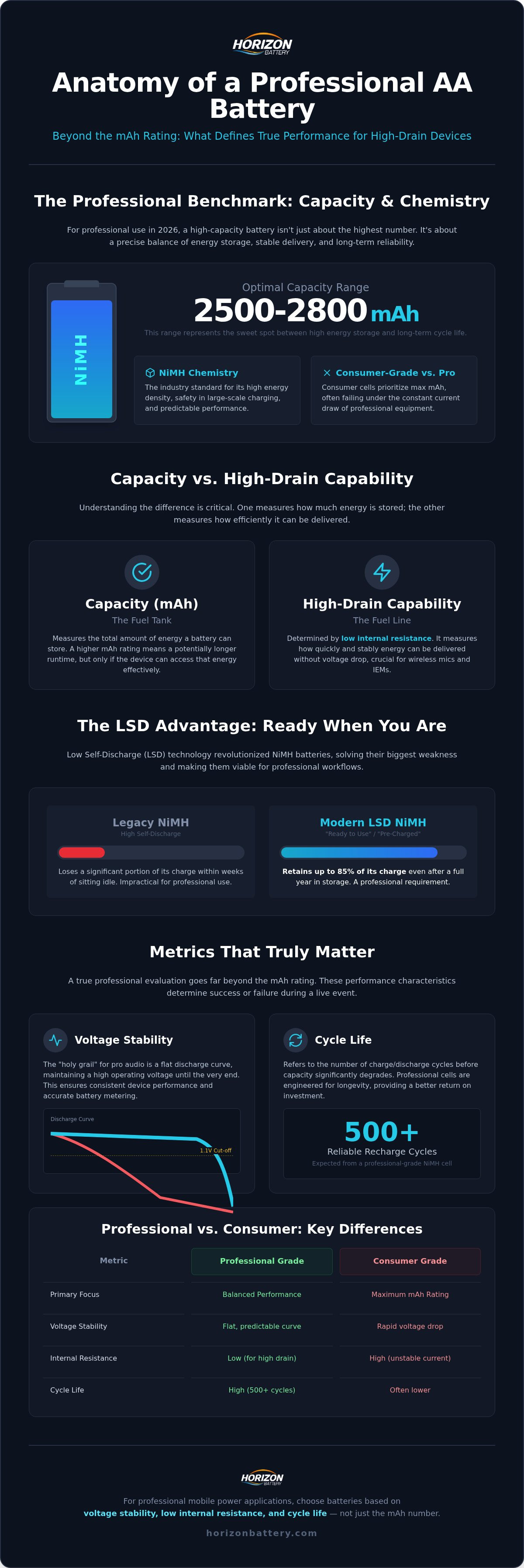
- Defining "High Capacity" in the 2026 Market: The benchmark for professional-grade high-capacity Nickel Metal Hydride (NiMH) AA batteries sits firmly between 2500mAh and 2800mAh. While some specialized brands may push this slightly higher to 2850mAh, this range represents the optimal balance of energy storage, stable voltage delivery, and long-term cycle life.
- The Role of NiMH Chemistry: NiMH has become the industrial standard for a reason. It offers a robust combination of high energy density, safety for large-scale charging, and a predictable discharge curve, making it ideal for the mission-critical demands of live production environments.
- Why Consumer-Grade Cells Fail: Many high-capacity AA batteries sold in retail stores are designed for consumer devices like toys or remote controls. These cells often prioritize maximum mAh over stable voltage output and low internal resistance, causing them to fail prematurely when subjected to the high, constant current draw of a professional wireless transmitter.
- The Trade-Off Between Capacity and Longevity: A critical concept in battery engineering is the inverse relationship between maximum capacity and total cycle life. The highest-rated mAh cells may offer slightly longer initial runtimes but often degrade faster, delivering fewer reliable recharges over their lifespan. A professional-grade cell is optimized for a balance of both.
The Evolution of NiMH Technology
Modern professional batteries are a significant leap forward from their predecessors. The most crucial innovation has been the development of Low Self-Discharge (LSD) technology. This advancement addresses the primary weakness of older NiMH cells, which could lose a substantial portion of their charge within weeks of sitting idle.
- From Standard NiMH to LSD Breakthroughs: Early NiMH batteries suffered from high self-discharge rates, making them impractical for professional use where a battery might be charged days before an event. LSD chemistry reformulates the internal components to minimize this passive energy loss.
- 2026 LSD Technology: Today’s leading LSD NiMH batteries can retain up to 85% of their charge even after a full year in storage. This means a fully charged battery pulled from a storage case is ready for immediate, reliable deployment without needing a last-minute top-off.
- "Pre-Charged" as a Professional Benchmark: If a battery is sold as "ready to use" or "pre-charged," it is a clear indicator that it utilizes LSD technology. This feature is no longer a consumer convenience but a professional requirement for efficient inventory management.
High Capacity vs. High Drain: Understanding the Difference
Capacity (mAh) and drain capability are two distinct, yet equally important, performance characteristics. A battery can have a high capacity but perform poorly in a high-drain device if it's not engineered correctly. For AV professionals, this distinction is paramount.
- Energy Storage vs. Current Delivery: Milliampere-hours (mAh) measure the total energy a battery can store, akin to the size of a fuel tank. High-drain capability, governed by low internal resistance, measures how quickly and efficiently that energy can be delivered—akin to the size of the fuel line.
- Identifying High-Drain Devices: Professional wireless microphones, IEM bodypacks, and portable field recorders are classic high-drain devices. They demand a strong, continuous flow of current to power transmitters and internal electronics. A battery with high internal resistance will struggle to meet this demand, causing its voltage to drop rapidly.
- The Importance of Low Internal Resistance: A low internal resistance allows a battery to deliver high current without significant voltage drop or heat generation. This is the key technical specification that separates a true professional-grade cell from a consumer-grade one, ensuring the device receives stable power from the first minute to the last.
Key Performance Metrics: Beyond the mAh Rating
The single biggest mistake in professional battery procurement is focusing solely on the mAh rating. While a useful metric, it fails to capture the performance characteristics that determine whether a battery will succeed or fail during a live event. True professional evaluation requires looking at the entire performance curve.
- Voltage Stability: For professional audio equipment, the "holy grail" is a flat discharge curve. This means the battery maintains a consistently high operating voltage throughout most of its discharge cycle before a rapid drop-off at the very end. This predictability is essential for accurate runtime monitoring.
- The "Cut-off Voltage" Trap: A 2800mAh battery is useless if the device it's powering shuts down when the battery still has 40% of its energy left. Most professional wireless gear has a cut-off voltage around 1.1V. A battery's performance must be measured by how long it stays above this critical threshold, not by its total energy storage.
- Cycle Life Expectations: Cycle life refers to the number of times a battery can be charged and discharged before its capacity degrades to an unusable level. A professional cell balances high capacity with a long cycle life (500+ cycles) to provide a better long-term return on investment.
- Internal Resistance: As a battery ages, its internal resistance increases. This leads to shorter runtimes, increased heat during charging and discharging, and a reduced ability to handle high-drain loads. Regular testing of internal resistance is a key practice in professional fleet management.
The Crucial 1.1V Threshold for Wireless Systems
The operating voltage of a battery under load is arguably the most critical metric for any wireless audio professional. Unlike a simple flashlight that just gets dimmer, a wireless transmitter will fail completely once the voltage drops below its required level, often with little warning.
- Why Transmitters Report "Low Battery" Prematurely: Many wireless systems measure battery life based on voltage. A consumer-grade battery's voltage can sag under load, triggering a "low battery" warning even when significant capacity remains. This creates a false sense of unreliability.
- Maintaining Higher Operating Voltage: Professional-grade cells like the Pure Power Series are engineered with low internal resistance to resist this voltage sag. They maintain a higher, more stable voltage under the constant load of a transmitter, ensuring the device's battery meter provides a more accurate and trustworthy reading.
- The relationship between voltage sag and signal dropouts is direct: as a battery's voltage falters under load, the transmitter's RF output power can become unstable, increasing the risk of signal interference and dropouts.
Temperature Resilience and Performance
Live production environments are rarely temperature-controlled. Batteries must perform reliably whether on a hot outdoor festival stage or in a cold event hall. A cell's chemical stability across a range of temperatures is a hallmark of professional design.
- Performance in Extreme Environments: NiMH chemistry is known for its robust performance in varying temperatures. However, extreme cold can temporarily reduce available capacity, while excessive heat can accelerate long-term degradation. Professional cells use purer materials to mitigate these effects.
- Heat and Chemical Degradation: Heat is the enemy of battery longevity. High-drain use and fast charging both generate internal heat. Professional batteries and their corresponding charging systems are designed to manage this heat, preserving the battery's chemical integrity and extending its service life.
- Safety Features: Look for built-in safety mechanisms like pressure relief vents. These are crucial, especially when charging dozens or hundreds of batteries simultaneously. They allow the cell to safely release any internal pressure buildup caused by overcharging or short-circuiting.
Evaluating Battery Chemistry: NiMH vs. Lithium vs. Alkaline
For any organization managing a large inventory of batteries, the choice of chemistry has significant financial, logistical, and environmental implications. While each type has its place, high-capacity NiMH has emerged as the clear standard for professional rechargeable fleets.
- Alkaline: Often seen as the "safe" disposable option, single-use alkalines are a poor fit for high-drain devices, offering short runtimes and unstable voltage. For large organizations, the recurring cost and environmental waste of disposing of thousands of cells per year make them an increasingly unsustainable choice.
- Rechargeable Lithium (1.5V): These batteries offer a perfectly flat 1.5V discharge curve, which is appealing. However, this is achieved with an internal buck converter that can, in some cases, introduce RF interference. Furthermore, their complex charging requirements and sudden death (no gradual power fade) make them challenging to manage in large-scale professional fleets. Some high-end models offer up to 3600mAh, but the system-level trade-offs remain.
- NiMH High Capacity: This chemistry provides the ideal balance for professional use. It delivers excellent performance in high-drain devices, offers a predictable discharge curve for monitoring, is inherently safer for high-density charging, and provides the best overall cost-per-hour, making it the industrial workhorse.
- Cost-Benefit Analysis: The initial investment in a NiMH battery and charger system is higher than a case of alkalines. However, considering a professional NiMH cell can replace over 1,000 single-use batteries, the system typically pays for itself in under 20 usage cycles.
The Environmental and Financial Impact of Disposable Batteries
The move toward rechargeable power is not just about performance; it's a strategic business decision. For production houses, houses of worship, and educational institutions, a rechargeable fleet drastically reduces both operational costs and environmental impact.
- Calculating "Cost Per Hour": A professional alkaline battery might cost $0.75 and last 4-5 hours in a wireless mic, costing roughly $0.15 per hour. A professional NiMH cell might cost $5 but deliver 16 hours of runtime over 1,000+ cycles, bringing the cost per hour down to a fraction of a cent.
- Waste Management: A venue using 50 wireless mics for three events a week could dispose of over 15,000 alkaline batteries annually. Switching to a rechargeable system reduces that physical waste to nearly zero, aligning with modern sustainability goals.
- The Industry-Wide Shift: Leading professional venues are rapidly adopting 100% rechargeable power policies. This change is driven by the undeniable long-term cost savings, improved reliability, and simplified logistics of a managed power system.
When to Choose Specialized NiMH over Lithium
While 1.5V rechargeable lithium batteries are a fascinating technology, professional system managers often choose high-capacity NiMH for several practical, mission-critical reasons, especially when managing large inventories.
- Avoiding RF Interference: The internal voltage-regulating circuits in some 1.5V lithium cells can emit radio frequency noise. While often minor, this presents an unacceptable risk of interference with sensitive wireless audio and video systems in a dense RF environment.
- Charging Safety at Scale: NiMH chemistry is more forgiving and generates less heat during the charging process. This makes it inherently safer and better suited for large, centralized rackmount charging stations where dozens of cells are charged in close proximity.
- Durability and Resilience: The simpler internal construction of NiMH cells makes them exceptionally robust. They are more resilient to the physical demands of stage use, including drops, vibrations, and constant handling by staff and volunteers.
Strategic Fleet Management: Charging and Storage at Scale
For professionals, "high capacity" is a liability without an equally high-capacity system for managing those batteries. Moving from a handful of devices to a fleet of dozens or hundreds requires a strategic shift from individual chargers to an integrated power management workflow.
- Centralized Charging: The era of "cable spaghetti" from 20 separate wall chargers is over. Professional operations now rely on centralized, custom rackmount chargers that provide a clean, organized, and efficient hub for power management.
- Electrical Infrastructure: Implementing large-scale charging systems often requires professional power distribution updates; Underline Energy Concepts specializes in the electrical upgrades needed to support modern, energy-efficient facility operations.
- The "Charge-Use-Rotate" Workflow: A standardized process is essential, especially with volunteer teams. A clear workflow ensures that fully charged batteries are always used first, and depleted batteries are immediately placed on the charger, preventing guesswork and mid-event failures.
- Testing and "Culling" Weak Cells: Not all batteries age equally. A professional workflow must include regular analysis and testing to identify and remove aging cells from the fleet. Culling these weak links before they can cause a failure on stage is a cornerstone of professional reliability.
- Storage Best Practices: Modern LSD NiMH batteries should be stored fully charged and ready for use. Proper storage in dedicated cases prevents accidental discharge, protects terminals, and makes inventory counts simple and fast.
The Case for Custom Rackmount Chargers
A rackmount charging system is the physical embodiment of a professional power strategy. It transforms battery management from a cluttered afterthought into a streamlined, integrated part of your technical infrastructure.
- Efficiency and Density: A single 2U rackmount unit can charge, analyze, and condition 16 to 64 AA batteries simultaneously, replacing a countertop full of individual chargers and power strips.
- Heat Management: Professional rack drawers often incorporate active cooling fans. This is not a luxury; it's a critical feature that dissipates the heat generated during charging, significantly extending the long-term service life of the entire battery fleet.
- Organization and Inventory Control: Integrated storage drawers and clearly labeled slots eliminate the risk of losing expensive batteries. This system ensures every cell is accounted for and its status is immediately clear.
Implementing a Battery Rotation Protocol
A simple but rigid rotation protocol ensures that all batteries in your fleet are used evenly, maximizing the lifespan of your investment and guaranteeing that the oldest cells are identified and replaced proactively.
- Step 1: Dating and Labeling Batches: When a new set of batteries is purchased, label them with the date of acquisition. This can be done with a simple marker or a color-coded system. Group them into distinct batches (e.g., "Red Batch," "Blue Batch").
- Step 2: Implementing a "First-In, First-Out" System: Always use the oldest batch of batteries first for any event. Once they are used and recharged, place them at the back of the rotation. This ensures even wear across your entire inventory.
- Step 3: Annual Capacity Testing: Once a year, use a smart charger with an analysis function to test the actual capacity of every cell in your oldest batches. Any battery that has fallen below 80% of its rated capacity should be culled and replaced.
Why Professionals Choose Horizon Battery for Mobile Power
Since 1998, Horizon Battery has operated as an industry insider, developing power solutions specifically for the rigorous demands of professional production environments. We understand that reliability is not optional. That's why we focus on engineering complete systems—not just selling batteries.
- A Legacy of Professional Service: For over two decades, we have been the trusted power partner for production companies, houses of worship, schools, and event venues that depend on flawless wireless performance.
- Pure Power Series: Our flagship line of high-capacity NiMH batteries is not a rebranded consumer product. It is engineered from the ground up to meet the specific high-drain, stable-voltage demands of professional wireless audio equipment.
- Integrated Solutions: We are one of the few providers that offers a complete ecosystem, bundling our Pure Power Series cells with custom-designed rackmount charging hardware and storage solutions for a truly streamlined workflow.
- Expert Support: Our team provides technical guidance to help organizations of any size transition from disposable batteries to a cost-effective, reliable, and sustainable rechargeable power system.
Pure Power Series: The Professional Benchmark
The Pure Power Series was developed to solve the specific problems faced by AV technicians in the field. Every aspect of its design is optimized for reliability when the show is on the line.
- Superior Voltage Retention: Engineered for the constant load of wireless transmitters, the Pure Power Series delivers a reliable 16+ hours of runtime in typical professional wireless microphones, maintaining a high operating voltage to prevent premature device shutdown.
- Exceptional Cycle Life: These high-capacity cells are optimized for an industry-leading 1500+ recharge cycles, offering an unparalleled long-term return on investment and drastically reducing operational costs.
- Bulk Availability: We maintain deep inventory to support large-scale facility transitions, ensuring your entire organization can upgrade to a single, standardized, and reliable battery platform.
While optimizing your technical gear is essential for a flawless production, many professionals also invest in their own physical recovery to stay sharp; for a next-generation approach to wellness and reducing inflammation, visit Pureffect.
Complete Power Systems: Chargers and Storage
A professional battery is only as good as the system that supports it. We provide the infrastructure to manage your power assets with efficiency and precision.
- Custom Rackmount Chargers: Explore our range of rackmount charging solutions designed to streamline your prep and breakdown workflows, ensuring your team is always ready for the next event.
- Professional Battery Storage: Protect your investment with our durable battery caddies and cases, designed to keep your fleet organized, secure, and ready for deployment.
Upgrade your facility to professional mobile power with Horizon Battery.