

Imagine it's five minutes before a major event begins and your lead technician is frantically digging through a desk drawer of loose AA cells, hoping to find enough power for the wireless mics. You've likely dealt with the frustration of tangled cables, overheating consumer chargers, and the constant uncertainty of inconsistent battery performance. This rackmount battery charger guide is designed to help you move past these common technical failure points. By centralizing your power management into a professional rack-integrated system, you can protect your gear and ensure reliable uptime for critical audio and IT systems.
We agree that professional production environments demand more than just a shelf full of plastic chargers. You need a solution that scales with your fleet while extending the lifespan of your cells through proper thermal management. In this guide, we'll walk you through the process of building a streamlined charging station, selecting high-capacity NiMH batteries like the Pure Power Series, and choosing the right custom rackmount hardware to fit your specific workflow.
Key Takeaways
- Learn how transitioning from consumer desktop units to integrated 19-inch rack hardware centralizes your workflow and eliminates technical clutter.
- Understand the importance of "Smart Charging" technology to prevent overcharging and maintain the integrity of your professional battery fleet.
- Compare sliding drawers and fixed-panel setups to optimize your spatial footprint and determine exactly how many rack units your gear requires.
- Use this rackmount battery charger guide to implement effective thermal management strategies that protect your cells from the damaging "Oven Effect" in enclosed cases.
- Discover how custom-engineered charging solutions and the Pure Power Series work together to provide reliable, high-density power for critical wireless systems.
What is a Rackmount Battery Charger and Why Do Pros Need One?
A rackmount battery charger is a specialized hardware unit designed to mount directly into standard 19-inch equipment racks. Unlike consumer-grade units that sit on a desk or shelf, these systems provide high-density charging for large battery fleets within a professional enclosure. While a basic battery charger might suffice for home use, professional environments like theaters, churches, and touring rigs require a more robust solution. This rackmount battery charger guide explores how moving toward industrial-grade integration improves workflow and equipment longevity.
The transition from loose desktop chargers to rack-integrated systems represents a shift toward industrial professionalism. Professionals in the AV and IT sectors often manage 16 to 64 AA batteries simultaneously. Managing this volume with consumer hardware leads to technical failure points. By centralizing power management, you gain better control over your inventory and ensure your gear is physically secured during both operation and transport.
The Problem with "Shelf-Based" Charging
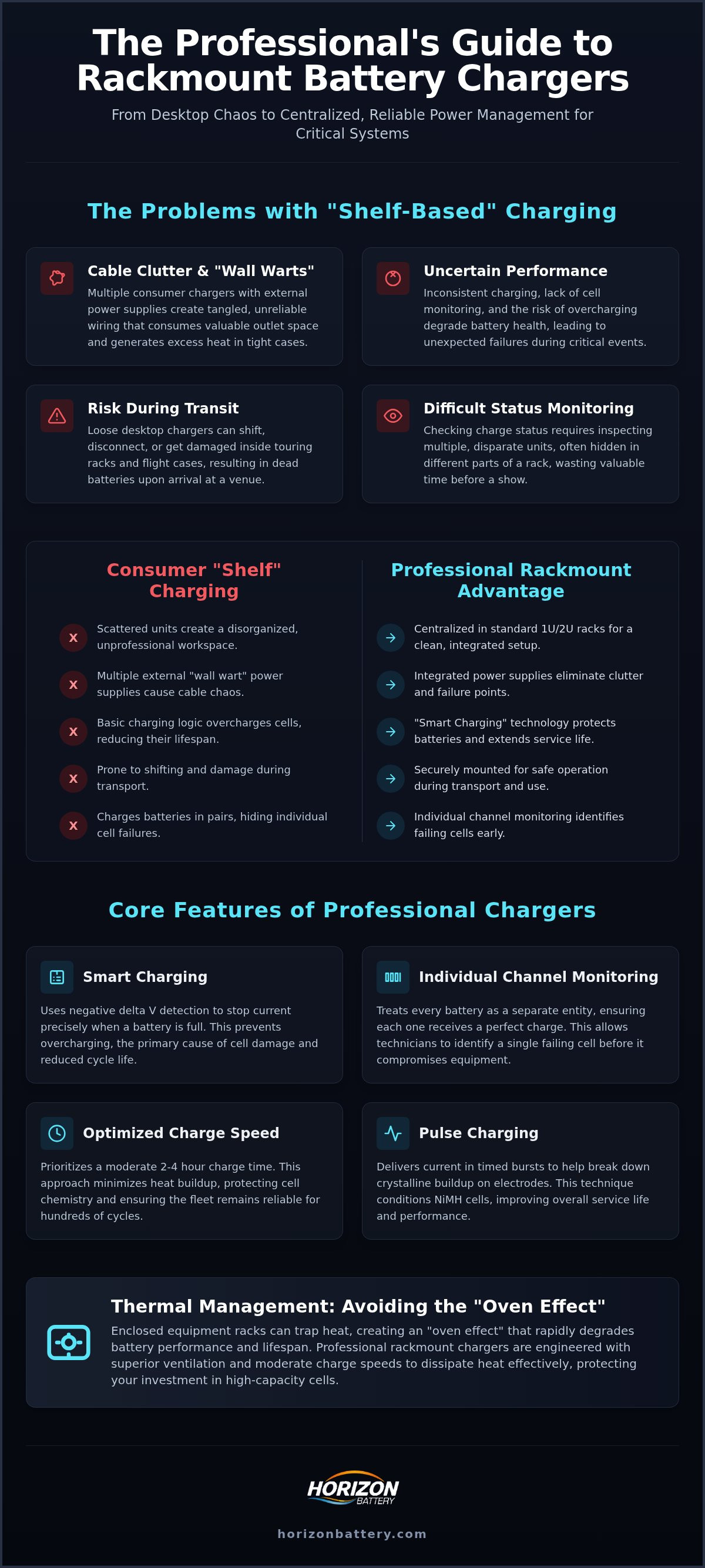
Relying on a collection of consumer chargers scattered across a shelf creates several operational risks. Cable management quickly becomes a nightmare inside production flight cases. Tangled power cords and multiple external power supplies, often called wall warts, consume valuable outlet space and create heat pockets. Loose chargers are also prone to shifting during transit. If a charger slides or disconnects while a touring rack is on the move, your team may arrive at a venue with dead batteries. Monitoring charge status is equally difficult when you have to check multiple disparate units across different locations in a rack.
The Professional Rackmount Advantage
Standardized 1U or 2U form factors allow these chargers to integrate seamlessly with your existing wireless receivers and power conditioners. This creates a clean, organized workspace that reflects a high level of technical discipline. One of the most practical benefits is the inclusion of front-facing status indicators. These lights allow technicians to perform rapid inventory checks at a glance, confirming that every cell is ready for the next performance. Professional units also feature integrated power supplies. This design choice eliminates the need for multiple wall warts, reducing the overall footprint and simplifying the internal wiring of your rack. In high-stakes environments like schools or houses of worship, this rackmount battery charger guide identifies these features as essential for maintaining 100% uptime for wireless mic systems.
Technical Specifications: Capacity, Chemistry, and Speed
Understanding the fundamentals of battery chemistry is the first step in selecting professional hardware. Most Pro AV systems rely on NiMH (Nickel-Metal Hydride) cells because they offer a stable discharge curve and high capacity. A professional rackmount system is designed to work in synergy with these cells, providing precise voltage regulation that consumer chargers simply can't match. This rackmount battery charger guide emphasizes that technical specifications aren't just about slot counts; they're about how the charger manages the chemical health of every individual cell.
Smart charging technology is a non-negotiable requirement for rack environments. Since batteries are often left in the rack for extended periods, the charger must use negative delta V detection to stop the current exactly when the battery reaches full capacity. This prevents overcharging, which is the primary cause of cell venting and reduced cycle life. While some consumer units offer "fast charging" in under an hour, professional rigs often prioritize a moderate charge speed of two to four hours. This approach minimizes heat buildup, ensuring your battery fleet remains reliable for hundreds of cycles.
Optimizing for High-Capacity AA Batteries
High-density environments require chargers that can handle high-capacity cells like the Pure Power Series without performance drops. Professional units utilize individual channel monitoring, which treats every battery as a separate entity rather than charging them in pairs. This allows you to identify a single failing cell before it compromises a wireless transmitter during a show. Pulse charging involves delivering current in short, timed bursts to help break down crystalline buildup on the electrodes and improve the overall service life of NiMH cells. If you're looking to upgrade your current setup, you can explore specialized charger and battery bundles designed for these high-capacity demands.
Power Input and Distribution
The physical design of the power supply matters in a rack. High-quality rackmount chargers often feature internal transformers to eliminate the clutter of external wall warts. This design allows for a cleaner integration with your existing Power Distribution Units (PDUs) and rackmount power strips. For international touring rigs, look for units with universal voltage input (100-240V). This ensures your charging station remains operational whether you're plugged into a 110V outlet in North America or a 230V system in Europe. A well-engineered power stage ensures that even when 48 slots are active, the current remains stable and safe.
Rackmount Configurations: Drawers vs. Custom Panels
Selecting the right physical layout for your charging station is just as important as the electronics inside. While the technical specs ensure your batteries stay healthy, the configuration determines how your team interacts with the gear during a high-pressure event. This rackmount battery charger guide breaks down the two primary styles of integration: sliding drawers and fixed custom panels. Each serves a specific purpose depending on whether you are managing a permanent installation or a mobile touring rig.
Space efficiency is measured in Rack Units (U), and every inch counts in a crowded flight case. A 1U or 2U footprint is standard for professional systems. This allows you to scale your battery fleet without sacrificing room for wireless receivers or network switches. The choice between a drawer and a panel often comes down to accessibility. Front-loading designs allow for quick swaps, while top-loading drawers might be preferred in setups where the rack is positioned at waist height.
Charging Drawers for Mobile Production
Sliding charging drawers are the preferred choice for mobile production teams and touring bands. These units utilize heavy-duty sliding mechanisms that allow technicians to access the charging bays even in cramped backstage areas. Because the drawer moves, cable management arms are essential. These articulated arms protect the power cables from fatigue and pinching during repeated use. For gear that spends time on the road, securing the batteries is a priority. High-quality drawers often include custom foam inserts or locking mechanisms to keep cells from rattling loose or falling out during transit in a road case.
Fixed Custom Rackmount Chargers
Fixed-panel designs offer the highest possible density for permanent installations like churches and school auditoriums. By utilizing a static front-facing panel, these units can fit 64 or more batteries in a single 2U space. This configuration is ideal for control rooms where rack depth is limited and moving parts are unnecessary. Fixed custom rackmount chargers also provide the benefit of permanent status displays. Because the panel is always visible, a technician can monitor the entire fleet at a glance without having to open a drawer. Eliminating the sliding mechanism also reduces potential mechanical failure points, ensuring the unit remains reliable for years of service. If you are designing a high-density station, you can find specialized custom rackmount chargers that maximize your available rack space while providing professional-grade durability.
Installation and Thermal Management
Heat is the primary factor that degrades rechargeable battery performance over time. When you charge 32 or 44 batteries simultaneously, the combined thermal output can be substantial. In this rackmount battery charger guide, we focus on the environmental factors that determine whether your battery fleet lasts for two years or six months. High-density charging generates localized heat that, if not managed, creates the "Oven Effect" within enclosed flight cases. This trapped heat accelerates the breakdown of the electrolyte inside the cells, leading to permanent capacity loss.
Most professional chargers use a combination of passive and active cooling. Passive cooling relies on internal heatsinks to dissipate heat, while active cooling uses integrated fans to force air through the chassis. If you're mounting your charger in a fully enclosed rack without much ventilation, active cooling is a requirement rather than an option. Proper spacing using 1U blanking panels between the charger and other gear also improves vertical airflow, preventing heat from soaking into the units above.
Strategic Placement in the Rack
The physical position of your charger within the rack frame significantly impacts thermal stability. Because heat naturally rises, it's a best practice to mount battery chargers in the lower half of the rack. This prevents the charger's thermal output from heating up sensitive equipment like wireless receivers or network switches located higher up. Maintaining at least 1U of clearance from RF-sensitive gear also helps minimize potential electromagnetic interference. Maintaining an ambient rack temperature between 20°C and 25°C (68°F to 77°F) is optimal for preserving the chemical integrity of high-capacity NiMH cells.
Ventilation Best Practices
Effective airflow requires both an intake and an exhaust. Perforated rack doors are the most efficient way to ensure cool air reaches the front of your charging bays. For racks that must remain closed during operation, using rear-mounted exhaust fans helps pull hot air away from the battery cells and out of the enclosure. You can also use simple digital thermometers to monitor internal rack temperatures during peak charging cycles. For those building out a new touring rig, selecting custom rackmount charging solutions with integrated thermal management ensures your power station remains cool under pressure. This organized approach to installation protects your investment and ensures your wireless systems remain ready for every performance.
Custom Rackmount Solutions from Horizon Battery
Horizon Battery specializes in solving the specific power challenges faced by Pro AV and IT professionals. Since 1998, we've provided custom-engineered rackmount charging hardware designed for high-density environments. This rackmount battery charger guide has detailed the technical and thermal requirements for professional systems, and our hardware is built to meet those exact standards. Whether you're managing a small church setup with a dozen wireless channels or a massive stadium tour requiring hundreds of batteries, our solutions scale to fit your specific channel count and rack space requirements.
Our US-based engineering team understands the rigors of the road and the precision required for permanent installations. We don't just sell components; we provide a comprehensive approach to power management that prioritizes equipment longevity. By partnering with a veteran provider, you gain access to decades of expertise in battery chemistry and hardware integration. This ensures your wireless systems remain reliable night after night, regardless of the venue size or technical complexity.
The Pure Power Ecosystem
Performance starts with the chemistry inside the cell. Our custom chargers are specifically tuned for the high-performance NiMH discharge curves found in our Pure Power Series batteries. This synergy ensures that every cell is charged to its optimal capacity without the risk of overcharging or thermal stress. We offer specialized charger and battery bundles as turn-key solutions, allowing your team to deploy a professional charging station immediately without worrying about compatibility issues between the charger and the cells.
Switching from single-use alkaline batteries to professional rechargeables significantly reduces long-term operational costs. While the initial investment in a rackmount system is higher than buying bulk disposables, the savings on consumables usually result in a full return on investment within the first year of heavy use. It's a more sustainable, reliable, and cost-effective way to manage large battery fleets in high-stakes environments.
Ready to Upgrade Your Power Management?
If you're unsure which configuration fits your needs, our team offers consultations for custom rack builds. We can assist with facility-wide power audits to determine the most efficient way to centralize your charging and inventory management. Integrating a Horizon Battery solution into your existing rack is a straightforward process that immediately improves your technical workflow and gear security. This rackmount battery charger guide serves as your starting point for building a more reliable power infrastructure. Don't let disorganized power management be the weak link in your professional production.
Streamlining Your Professional Power Workflow
Moving away from disorganized, shelf-based charging toward an integrated rack solution is essential for protecting your hardware and ensuring technical reliability. This rackmount battery charger guide has highlighted the critical importance of thermal management and chemistry-specific charging to prevent heat damage and extend the lifespan of your cells. By selecting hardware designed for high-density use, you eliminate common failure points and secure your inventory against the rigors of transport. You'll gain both a cleaner workspace and the confidence that your wireless systems are fully powered for every event.
Horizon Battery has served as an industry leader in mobile power since 1998, providing custom-engineered solutions for the most demanding Pro AV and IT environments. Our charging systems are meticulously optimized for the Pure Power Series high-capacity batteries to ensure consistent, reliable results. Whether you're outfitting a local church or a stadium tour, we have the expertise to help you build a professional power station that lasts. Explore Professional Rackmount Charging Solutions and take the first step toward a more efficient, failure-proof workflow today.
Frequently Asked Questions
Can I mount any battery charger into a rack using a shelf?
You can physically place a consumer charger on a rack shelf, but it's not recommended for professional environments. Consumer units lack the physical security, integrated power supplies, and thermal management found in dedicated rack hardware. Using this rackmount battery charger guide to select purpose-built equipment ensures your chargers don't shift during transport or create a cable management mess inside your flight case.
How many rack units (U) does a professional battery charger typically occupy?
Most professional battery chargers occupy 1U or 2U of rack space depending on their battery capacity. A 1U unit typically handles 12 to 22 cells, while high-density 2U configurations can manage 44 or more batteries. Choosing the right size depends on your total battery fleet and the available vertical space in your production rack or mobile touring rig.
Will a rackmount charger interfere with my wireless microphone frequencies?
Properly engineered rackmount chargers are designed to minimize electromagnetic interference (EMI) and shouldn't affect your wireless microphones. While any electronic device can emit some RF noise, professional units feature shielded internal components to protect sensitive wireless receivers. It's still a best practice to maintain at least 1U of spacing between your charging station and your primary antenna distribution system.
What is the benefit of a charging drawer over a fixed rack panel?
Charging drawers offer superior accessibility and battery security for mobile production rigs and touring bands. The sliding mechanism allows you to pull the unit out for easy loading in cramped backstage areas, and foam inserts keep batteries from rattling loose during transport. Fixed panels are better suited for permanent installations where space is at a premium and moving parts are unnecessary.
Do rackmount chargers require special power outlets or PDUs?
Most professional rackmount chargers use standard IEC power cables and are compatible with typical rackmount Power Distribution Units (PDUs). They don't usually require specialized high-voltage outlets. Since these units centralize power, they eliminate the need for multiple wall wart transformers, allowing you to use a single outlet on your power conditioner for the entire charging station.
How do I manage the heat generated by charging 32 batteries at once?
Managing heat requires a combination of active cooling and strategic rack placement. You should mount chargers lower in the rack since heat rises and use blanking panels to facilitate vertical airflow. Many professional units include internal fans, but you can also use perforated rack doors or rear exhaust fans to ensure ambient temperatures stay within a safe operating range.
Are these chargers compatible with both AA and AAA NiMH batteries?
Many professional rackmount chargers feature universal bays or interchangeable plates that accommodate both AA and AAA NiMH cells. It's important to verify the specific model tray configuration before purchase. Because NiMH chemistry is standard across both sizes, the internal smart-charging electronics can safely manage the voltage requirements for either battery type in a high-density environment.
Can I use high-capacity batteries like the Pure Power Series in any rack charger?
You can use high-capacity cells in most NiMH-compatible chargers, but they perform best in units specifically tuned for high-density discharge curves. This rackmount battery charger guide recommends using chargers that offer individual channel monitoring to ensure every high-capacity cell is fully topped off. Using a matched ecosystem ensures you get the maximum cycle life and runtime from your professional battery investment.