
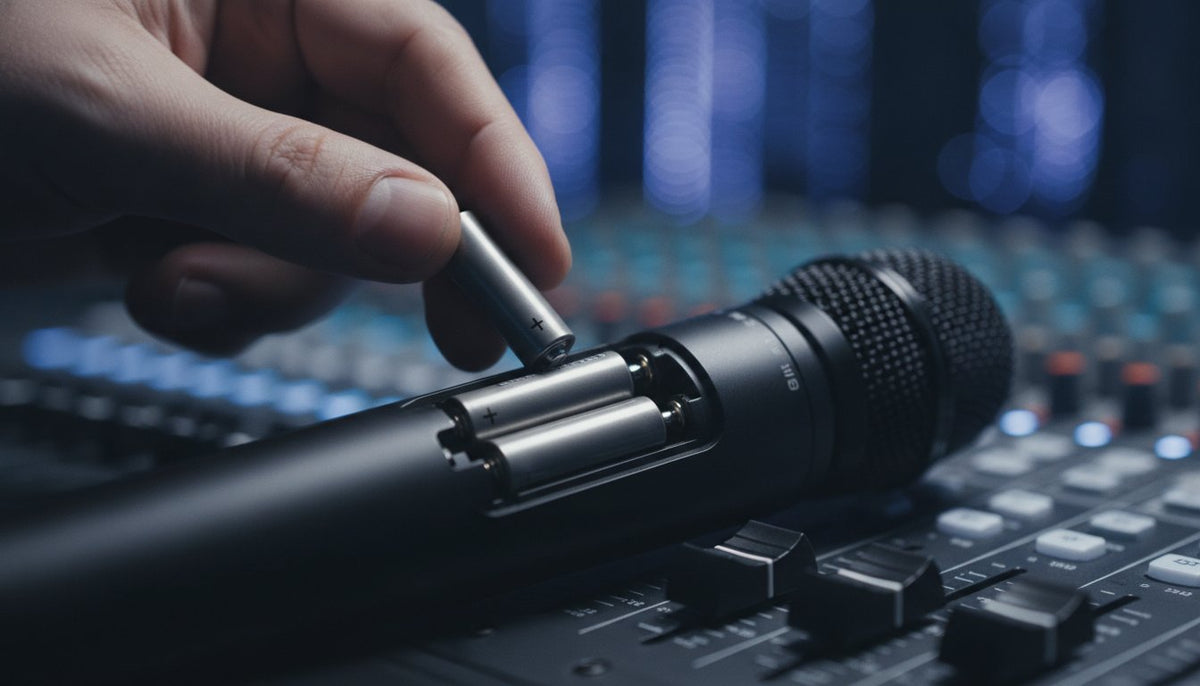
What if the most sophisticated wireless system in your rack is only as reliable as the battery powering it? For years, professional audio engineers have been forced to choose between the environmental guilt of disposing of thousands of alkaline cells and the technical instability of NiMH rechargeables. The Pure Power Series offers a definitive solution by providing a constant 1.5V output that traditional rechargeables simply cannot match. This regulated voltage ensures your gear performs exactly as intended from the first minute of the show to the last, effectively eliminating the voltage drop issues that trigger premature low-battery warnings.
You likely agree that managing a massive inventory of mismatched batteries is a logistical headache that often leads to unexpected dropouts and wasted budget. We promise to show you how the Pure Power Series eliminates inconsistent battery indicators and reduces your annual battery spend by 80% or more. This guide provides a detailed look at the internal management systems that protect your equipment and explains how to standardize your inventory with high-capacity lithium-ion cells designed for up to 1,500 recharge cycles.
Key Takeaways
- Learn why the Pure Power Series maintains a steady 1.5V output throughout its entire discharge cycle to prevent equipment failure.
- Understand the technical mechanics of voltage sag and how constant regulation ensures consistent wireless microphone range and audio clarity.
- Explore the engineering standards and internal shielding that protect professional audio gear from RF interference and safety risks.
- Calculate the long-term ROI of transitioning from disposable alkalines to high-capacity lithium-ion cells with over 1,000 recharge cycles.
- Discover how to scale your battery management with professional rackmount charging hardware designed for large-scale facility operations.
What is the Pure Power Series? Defining the 1.5V Standard
The Pure Power Series represents a fundamental shift in how professional facilities manage mobile energy. Unlike consumer-grade rechargeables, this is a professional 1.5V Lithium-ion rechargeable AA battery system designed for environments where failure is not an option. While some manufacturers use similar branding for uninterruptible power supplies or PC components, this series focuses specifically on the high-stakes requirements of wireless microphones, medical equipment, and high-drain production tools. Horizon Battery has served as the specialized distributor for these professional solutions since 1998, providing the technical expertise required to transition large-scale operations away from disposable cells.
The Evolution of Professional Mobile Energy
For decades, alkaline batteries were the industry standard because they provided a nominal 1.5V output. This specific voltage is critical for the internal circuitry of professional wireless transmitters and sensitive medical devices. When Nickel-Metal Hydride (NiMH) rechargeables arrived, they offered a sustainable alternative but carried a significant flaw: a lower nominal voltage of 1.2V. This discrepancy often leads to inconsistent signal range or premature low battery warnings on expensive gear. The Pure Power Series bridges this gap by utilizing an advanced Lithium-ion battery core coupled with internal regulation. This combination delivers the constant 1.5V performance of an alkaline with the long-term cost benefits of a rechargeable cell.
Key Technical Specifications of the Series
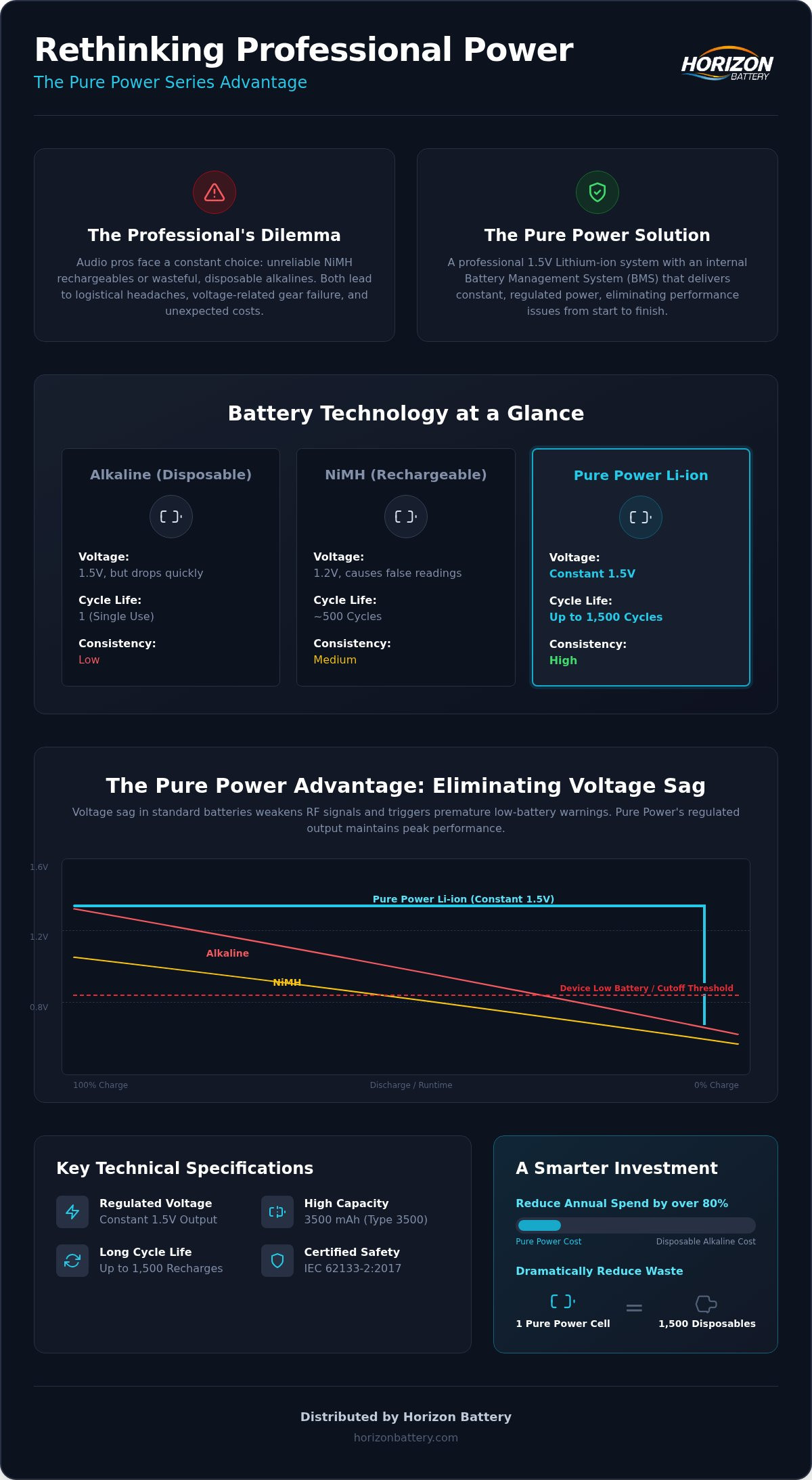
The engineering behind these cells centers on a sophisticated Battery Management System (BMS). This internal circuit steps down the native lithium voltage to a regulated 1.5V, maintaining that level until the cell is exhausted. This ensures your equipment receives full power throughout the entire discharge cycle. Performance is defined by several key metrics:
- Capacity: The Type 3500 model offers a nominal capacity of 3500 mAh, providing the high-capacity energy density needed for long performances or clinical shifts.
- Cycle Life: These cells are rated for up to 1,500 recharge cycles, which dramatically reduces the volume of hazardous waste generated by a facility.
- Safety: Integrated protection against overcharging and short circuits is standard; the cells are certified to IEC 62133-2:2017 standards.
- Temperature Stability: Reliable operation is maintained across a wide range, from -20°C to +60°C.
To maintain these performance levels, the system requires a dedicated charging module or a compatible charging cradle. Standard chargers can damage the internal regulation circuitry. This is why the series is managed as an integrated ecosystem of cells and specialized hardware, ensuring longevity and safety for the entire battery inventory.
Constant Voltage vs. Voltage Sag: The Pure Power Advantage
Voltage sag is the hidden enemy of professional wireless audio. As standard batteries discharge, their voltage output gradually declines. This phenomenon directly impacts the performance of wireless microphone transmitters and in-ear monitor packs. When voltage drops, the RF signal strength can weaken, leading to reduced range, increased noise floor, or audible distortion. While many consumer reviews focus on raw capacity, expert recommendations for rechargeable batteries in professional settings increasingly emphasize voltage stability over simple milliamp-hour (mAh) ratings.
The Pure Power Series addresses this by maintaining a flat discharge curve. Unlike an alkaline battery that starts at 1.5V and immediately begins to slide toward 0.9V, these cells provide a steady 1.5V from the moment the gear is turned on until the cell is fully exhausted. This consistency is vital for maintaining the integrity of digital wireless systems that require a specific voltage threshold to operate their internal processors reliably.
Lithium-ion vs. NiMH vs. Alkaline Comparison
Professional gear is usually calibrated for the 1.5V standard of alkaline batteries. Standard 1.2V NiMH batteries often cause equipment to display a "low battery" warning even when the cell still holds significant energy. This happens because the device interprets the 1.2V starting point as a near-depleted alkaline cell. High capacity in a NiMH cell doesn't translate to longer runtime if the device shuts down prematurely due to this voltage mismatch.
| Battery Type | Start Voltage | Mid-Cycle Voltage | End-Cycle Voltage |
|---|---|---|---|
| Pure Power (Li-ion) | 1.5V | 1.5V | 1.5V (Constant) |
| Alkaline | 1.5V | 1.2V | 0.9V |
| NiMH | 1.2V | 1.2V | 1.0V |
The integrated buck converter acts as a precision regulator, stepping down the native lithium cell voltage to a consistent 1.5V output. This ensures that the energy stored in the cell is actually accessible to 1.5V-sensitive equipment throughout the entire cycle.
Protecting Sensitive Professional Circuitry
Hardware "brownouts" occur when voltage dips low enough to cause digital circuits to malfunction or reset. In a live production or a critical healthcare environment, a momentary reset of a transmitter can result in several seconds of silence or data loss. For more technical details on deployment, consult our Pure Power Series: The Professional Guide to Lithium-Ion AA Batteries.
Maintaining stable power is equally critical for medical telemetry and patient monitoring. Inconsistent voltage leads to unreliable data transmission, which can complicate patient care in large facilities. If you're ready to upgrade your facility's energy infrastructure, consider browsing our high-capacity rechargeable solutions to find the right fit for your specific gear.
Addressing Professional Concerns: Safety and Interference
Skepticism often surrounds the use of regulated lithium cells in sensitive audio environments. It's a common concern among audio engineers that the internal electronics required to step down voltage might introduce electronic hum or RF interference. However, the Pure Power Series is engineered specifically to address these professional requirements. By utilizing advanced internal shielding and high-frequency regulation, these cells maintain a clean noise floor that meets the rigorous standards of modern broadcast and live sound.
RF Cleanliness and Audio Standards
To ensure RF cleanliness, the internal switching regulator in each cell operates at a frequency far beyond the audible range and the UHF/VHF bands used by wireless systems. This prevents the "switching noise" that can plague lower-quality consumer cells. Professional testing shows that the noise floor of the Pure Power Series is indistinguishable from traditional alkaline batteries. This makes them a reliable choice for high-sensitivity condenser microphones and digital transmitters where signal integrity is paramount. They don't suffer from the same signal degradation issues that appear when standard rechargeables begin to lose their charge.
Thermal management is another area where these lithium cells outperform traditional NiMH alternatives. NiMH batteries generate significant heat during high-drain use because of their higher internal resistance. In contrast, the lithium chemistry in this series remains remarkably cool even under heavy loads. This protects the delicate internal components of your gear and ensures the battery chemistry remains stable in fluctuating environments, from cold outdoor stages to hot broadcast studios.
Safety Certifications and Logistics
Reliability extends to the physical safety and transportability of the cells. Every battery in the series is certified in accordance with UN Transport Regulation 38.3. This certification is essential for touring professionals who must transport equipment via air freight. Additionally, the integrated Battery Management System (BMS) includes protection circuits that prevent damage from deep discharge or short circuits. For a deeper look at how this compares to other industry leaders, read our analysis on Ansmann Technology vs. Pure Power Series: The Professional Choice for 2026.
These cells are also certified to IEC 62133-2:2017 standards, ensuring they meet global safety requirements for portable electronics. This level of certification provides peace of mind for facility managers who are standardizing their battery inventory across multiple departments. By choosing a product with documented safety standards, you eliminate the risks associated with uncertified "white label" lithium cells that lack proper internal regulation. This structured approach to safety ensures that your power source is as professional as the equipment it drives.
ROI Analysis: The Economics of Enterprise Battery Transitions
Analyzing the total cost of ownership reveals that the largest expense in battery management isn't the unit price, but the recurring cost of replacements and the labor required to manage them. For an enterprise facility, the cycle of purchasing, storing, and disposing of thousands of alkaline cells creates a significant financial drain. The Pure Power Series addresses this by providing a high-capacity cell rated for up to 1,500 recharge cycles. This longevity transforms batteries from a consumable expense into a long-term capital asset, effectively eliminating the need for monthly procurement cycles and reducing the volume of hazardous waste sent to landfills annually.
Beyond the purchase price, "labor leakage" represents a hidden cost that many facility managers overlook. Staff hours spent testing partially used alkalines, sorting dead cells, and performing emergency battery swaps during events add up quickly. By standardizing on a reliable rechargeable system, organizations can streamline their workflows and redirect personnel to more critical technical tasks. The environmental impact is equally substantial, as a single set of rechargeable cells can replace thousands of disposable batteries over its operational life.
Case Study: Church and School AV Systems
A typical house of worship or educational facility operating a 20-microphone setup can go through hundreds of batteries in a single semester. Switching to the Pure Power Series allows these organizations to recoup their initial investment within the first year of operation by removing the need for bulk alkaline purchases. Standardizing on a single battery type also simplifies training for technical volunteers, as it removes the guesswork associated with inconsistent battery life indicators. For a deeper dive into the logistics of this transition, see our Switching to Rechargeable Batteries: 2026 Business Guide.
Long-Term Reliability and Asset Management
Relying on low-cost alkalines is often a lottery, as varying shelf lives and storage conditions can lead to inconsistent performance. Professional-grade lithium cells offer predictable runtimes that allow for precise event planning and clinical scheduling. Additionally, using rechargeables significantly reduces the risk of hardware damage caused by alkaline leakage and corrosion, which can destroy expensive wireless transmitters or medical telemetry packs. This protection of high-value assets is a core component of a sound fiscal strategy for any large facility.
Horizon Battery has supported large-scale deployments across the United States and Canada since 1998, acting as a knowledgeable guide for organizations looking to modernize their energy infrastructure. We understand that every facility has unique requirements, which is why we provide specialized support for enterprise-level transitions. If you're ready to stabilize your operating budget and improve equipment reliability, browse our AA rechargeable batteries and high-capacity bundles to find a solution that fits your facility's scale.
Implementing the Pure Power Series Infrastructure
Professional environments require a shift from consumer-grade habits to industrial infrastructure. Flimsy plastic chargers found in retail stores lack the durability and thermal management needed for continuous, high-volume use. Implementing the Pure Power Series involves more than just swapping cells; it requires a centralized management system that fits into your existing technical workflows. By integrating dedicated charging hardware into your equipment racks, you ensure that your power source is as reliable as the microphones and monitors they drive.
High-capacity lithium batteries need precise charging parameters to maintain their 1,500-cycle lifespan. Using unapproved hardware can compromise the internal regulation circuitry that maintains the constant 1.5V output. Centralizing your battery pool within your equipment racks ensures that cells are always where they need to be. This reduces the risk of lost inventory and eliminates the frantic search for fresh batteries during a production or clinical shift.
Rackmount Charging and Scalability
For large facilities, Custom Rackmount Chargers are the gold standard for organization and reliability. These units are available in 8, 16, or 32-bay configurations, allowing technicians to manage dozens of cells in a single rack unit. In dark backstage environments or busy medical wards, clear visual indicators are essential. These professional chargers provide at-a-glance status monitoring, so you never grab a depleted cell by mistake. For a comprehensive look at hardware options, consult our Enterprise Battery Charging Solutions: The 2026 Professional Buying Guide.
Selecting Your Series Bundle
Determining the right scale for your facility depends on your peak simultaneous usage. We often recommend a 2:1 or 3:1 ratio of batteries to charger bays. This ensures a fresh set is always ready while others are cycling through the charging process. Choosing pre-configured Charger / Battery Bundles is the most efficient way to standardize your inventory. These kits include the necessary Pure Power Series cells and the specialized charging modules required for safe, efficient operation.
Horizon Battery acts as a knowledgeable guide for enterprise-level transitions across the United States and Canada. Since 1998, we've helped facilities move away from the waste of alkalines toward high-performance rechargeable systems. If you're managing a complex deployment, our team provides professional consulting to help you select the exact hardware configuration for your gear. Proper Battery Storage and organization are the final steps in securing your investment and ensuring long-term operational success.
Standardizing Your Facility's Energy Future
Transitioning to a regulated lithium-ion system is about more than just convenience; it's about securing the technical reliability of your most critical equipment. By maintaining a constant 1.5V output throughout every cycle, the Pure Power Series removes the technical uncertainty that has long plagued professional audio and medical telemetry. Organizations can now move away from the environmental and financial waste of disposables while gaining superior performance and significant long-term savings.
Horizon Battery has served the professional audio and medical industries since 1998 with an exclusive focus on high-capacity professional energy solutions. We understand the logistical demands of large-scale facilities, which is why we offer custom rackmount chargers to centralize your power management and simplify your technical workflow. It's time to eliminate the risk of voltage sag and standardize your inventory with a system built for longevity. Upgrade your gear with the Pure Power Series at Horizon Battery and experience the new standard of professional stability. We're ready to act as your knowledgeable guide for a seamless energy transition.
Frequently Asked Questions
What makes the Pure Power Series different from standard rechargeable batteries?
The primary differentiator is the constant 1.5V regulated output provided by the Pure Power Series. Standard NiMH rechargeables only offer a nominal 1.2V; this often triggers "low battery" warnings on professional transmitters and medical monitors. These cells utilize an internal buck converter to step down the lithium chemistry's native voltage to a steady 1.5V. This ensures your equipment operates at peak performance throughout the entire discharge cycle without the signal dropouts common with traditional rechargeable technology.
Can I use a regular NiMH charger for Pure Power Series lithium-ion batteries?
No, you cannot use a standard NiMH or alkaline charger for these cells. The Pure Power Series requires a specialized charging module or cradle specifically designed to interface with its internal Battery Management System. Standard chargers don't provide the correct charging profile and could permanently damage the internal regulation circuitry. Using the proprietary hardware ensures your cells reach their full 1,500-cycle life while maintaining the high-capacity performance required for demanding professional applications.
Do Pure Power Series batteries provide a full 1.5V until they are empty?
Yes, these batteries maintain a regulated 1.5V output until the cell is completely exhausted. Unlike alkaline batteries that suffer from gradual voltage sag, these lithium cells use internal electronics to keep the power level flat. This prevents the range loss and audio distortion often caused by declining voltage in wireless microphones. Once the energy is depleted, the internal protection circuit safely shuts off the output to prevent damage from over-discharge, ensuring consistent reliability.
Are 1.5V lithium-ion batteries safe for high-end wireless microphones?
These batteries are specifically engineered for professional audio and high-end wireless systems. While some consumer-grade lithium cells can generate electromagnetic interference, the Pure Power Series features internal shielding and a switching frequency that sits outside the audible and RF spectrum. This ensures a clean noise floor for sensitive condenser microphones and digital transmitters. They've been a trusted choice for broadcast and live sound professionals who need stable energy without compromising signal integrity.
How many times can I recharge a Pure Power Series battery?
Each cell in this series is rated for up to 1,500 recharge cycles under normal operating conditions. This longevity significantly outperforms standard NiMH batteries and eliminates the need to purchase thousands of disposable alkalines over the life of the product. To achieve this maximum lifespan, it's essential to use the correct charging hardware and store the cells in a temperature-controlled environment. This high cycle count makes them an ideal investment for large-scale facilities.
Why does my battery indicator show 'full' for so long with these batteries?
Gear indicators typically measure voltage to estimate remaining life. Since these cells provide a constant 1.5V until they are nearly empty, your equipment will read "full" for the majority of the runtime. The voltage only drops once the internal management system prepares to shut the cell down for protection. We recommend timing your initial uses to understand the actual runtime in your specific gear, as the visual indicator won't show the gradual decline seen with alkalines.
Can the Pure Power Series be shipped by air for touring productions?
Yes, these batteries are fully certified for air transport in accordance with UN Transport Regulation 38.3. This certification is a critical requirement for touring professionals and production companies that frequently move equipment between locations via air freight. To ensure these sensitive technical assets are properly secured for flight, OEM Materials & Supplies provides specialized industrial packaging designed for the aerospace and transit sectors. The cells also meet IEC 62133-2:2017 safety standards, ensuring they are compliant with global regulations for portable energy. This makes them a reliable choice for international productions that require standardized, safe mobile power solutions.
Horizon Battery is the direct distributor for these products throughout the United States and Canada. We've specialized in high-capacity rechargeable solutions and professional mobile energy since 1998. You can purchase individual cells, charger bundles, or custom rackmount solutions directly through our national distribution network. Our team acts as a knowledgeable guide for facilities looking to transition their battery inventory, providing the technical expertise needed to support large-scale enterprise deployments across North America.