
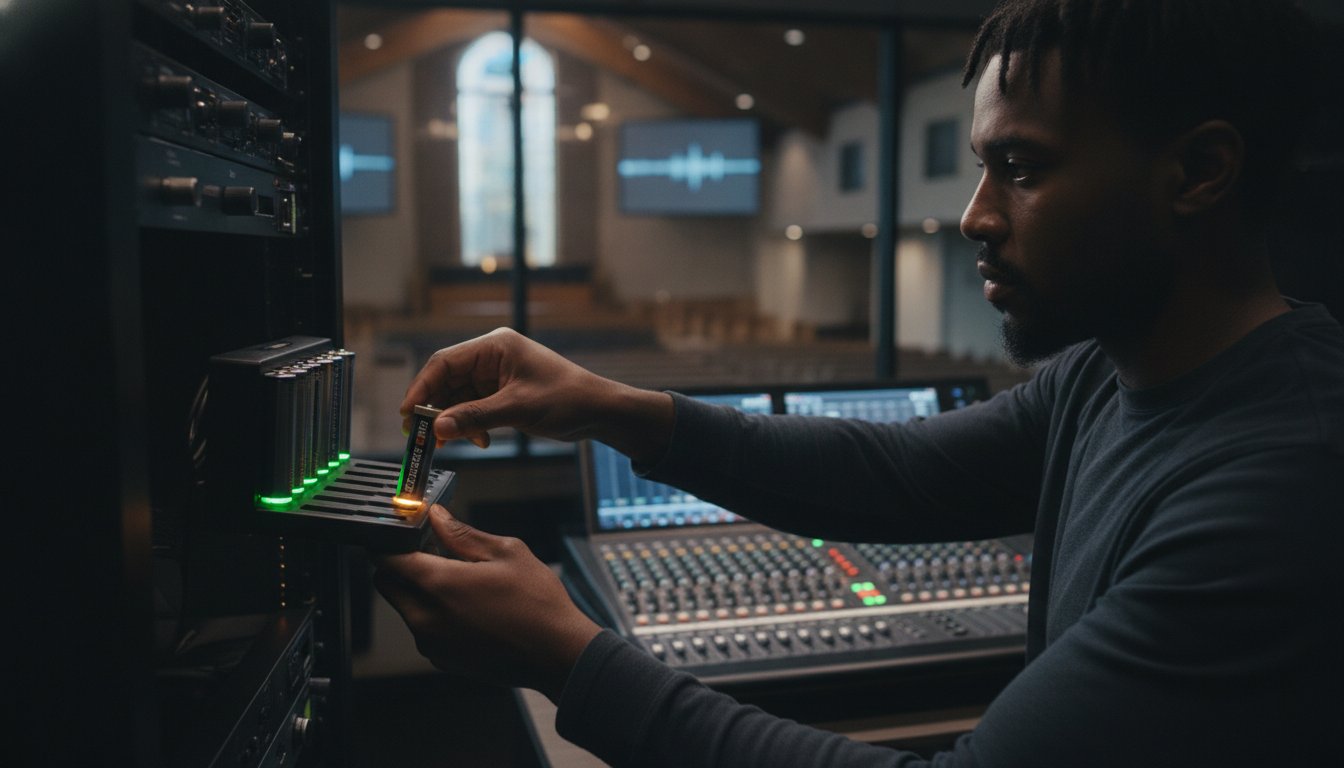
Your church's wireless audio is only as reliable as the cheapest battery in the supply closet. While grabbing a bulk pack of consumer rechargeables from a big-box store feels like a quick budget win, it often leads to the dreaded mid-sermon dropout. Choosing Ansmann for church AV ensures you don't fall into the trap of using consumer-grade gear for professional worship requirements. You shouldn't have to cross your fingers every time a speaker steps on stage, because reliable power is the foundation of a distraction-free service.
Standardizing on professional power systems allows your technical team to eliminate the anxiety of wireless failures while significantly slashing annual operating costs. This guide explains how professional cells provide predictable 8-plus hour runtimes and a sustainable, "set and forget" infrastructure for your facility. We will examine the technical advantages of high-capacity NiMH cells and show you how custom rackmount charging solutions can transform your workflow from a weekly headache into a streamlined, cost-effective operation. By moving away from disposable waste, your ministry can finally invest those savings back into its primary mission.
Key Takeaways
- Identify the technical causes of wireless dropouts and why consumer-grade batteries fail to maintain consistent voltage in professional audio gear.
- Discover the benefits of standardizing on Ansmann for church AV to ensure predictable runtimes and protect equipment with vented cell technology.
- Compare drawer-based and slot-based rackmount chargers to find the most efficient solution for managing high-density battery fleets.
- Implement a "Zero-Failure" workflow using a simple traffic light system and monthly refresh cycles to simplify battery management for volunteers.
- Reduce long-term operating costs and environmental waste by replacing disposable supply chains with professional rechargeable bundles.
The Wireless Failure Problem: Why Consumer Batteries Fail in Church AV
Many worship leaders rely on bulk alkaline packs, viewing them as a safe, low-cost option. This is a financial illusion. High-drain wireless systems consume power at a rate that quickly exhausts standard alkaline cells. Using Ansmann for church AV prevents the frequent, unpredictable failures that occur when consumer-grade power meets professional-grade audio demands. Relying on big-box store solutions isn't just a technical risk; it's a drain on your ministry's resources.
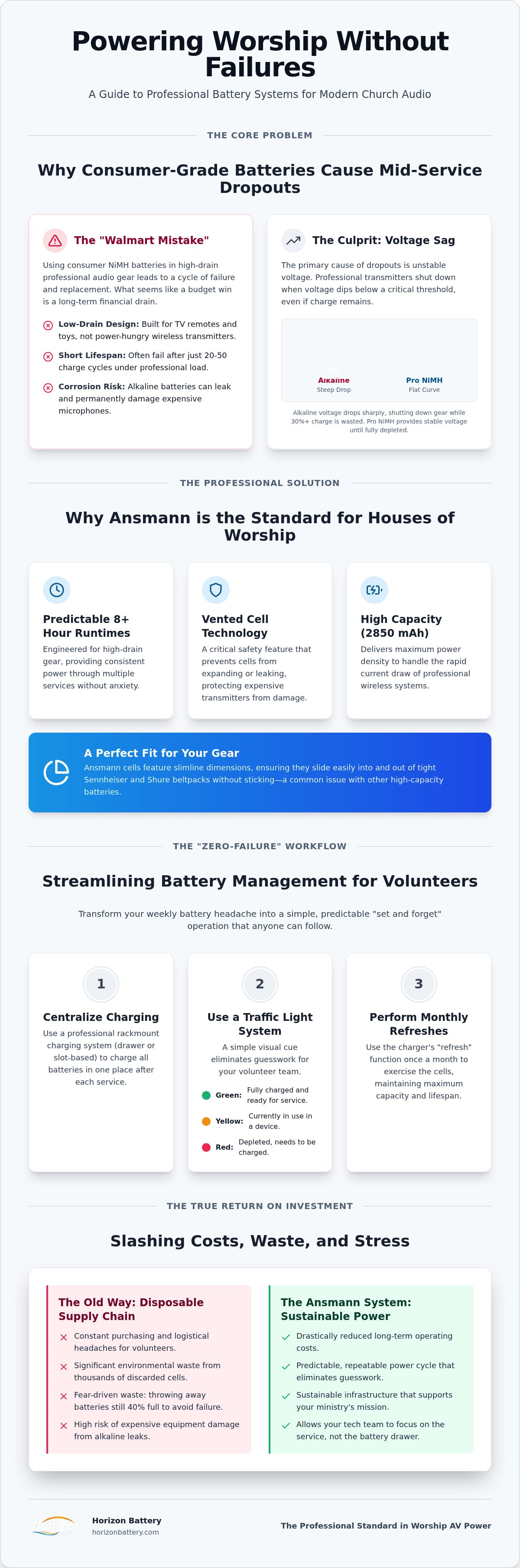
The "Walmart Mistake" happens when tech teams purchase consumer NiMH batteries designed for low-drain devices like remote controls or toys. These cells lack the internal chemistry needed to sustain the high-current demands of Sennheiser or Shure transmitters. Over time, these consumer units lose capacity rapidly, often failing after just 20 to 50 charge cycles. This leads to a cycle of constant replacement that erases any initial savings.
Understanding Voltage Stability in Worship Environments
Voltage sag is the primary culprit behind mid-service dropouts. Alkaline batteries begin at 1.5V, but their voltage drops on a steep, linear curve the moment they're put under load. Most professional transmitters require a specific voltage threshold to maintain a stable RF signal. When the voltage dips, the transmitter may shut down or mute even if the battery still holds a 30% charge. In contrast, modern rechargeable battery technology provides a flat discharge curve. Professional NiMH cells stay at a consistent 1.2V for nearly the entire runtime, ensuring the signal remains strong until the cell is truly empty.
We also see significant hardware damage from alkaline leakage. When these cells sit in a handheld microphone between Sundays, they can off-gas and leak corrosive chemicals. This often destroys the internal circuitry of an expensive microphone. It's a heavy price to pay for a disposable power source.
The Logistics of Disposable Battery Management
Managing thousands of loose batteries creates a logistical nightmare for volunteer teams. There's a hidden labor cost involved in constant purchasing, unboxing, and sorting. Without a standardized system, it's easy to mix dead and live cells, leading to a microphone failing five minutes into a sermon. This lack of organization creates unnecessary stress for your production crew.
Fear drives significant waste in large congregations. Because there's no way to accurately gauge remaining life in a used alkaline cell, many tech directors throw away batteries that are still 40% full. They simply can't risk a failure. Standardizing on Ansmann for church AV replaces this guesswork with a predictable, repeatable power cycle that saves both the budget and the environment. Moving to a professional system means your team can focus on the service, not the battery drawer.
Why Ansmann is the Professional Standard for Houses of Worship
Ansmann batteries are built with German engineering specifically tailored for high-drain applications. Unlike generic rechargeables, these cells are designed to handle the rapid current draw of professional wireless microphones and in-ear monitors. Using Ansmann for church AV provides a level of security that consumer brands simply cannot match. The internal construction features vented cell technology, which is a critical safety component. This venting prevents the cell from expanding or leaking if it overheats during a rapid charge cycle. It protects your expensive handheld transmitters from the physical damage often caused by low-quality alternatives.
One of the most significant advantages for tech directors is the slimline dimension of the cells. High-capacity batteries often have thicker walls that make them difficult to remove from tight Sennheiser or Shure beltpacks. Ansmann manages to pack high capacity into a standard-sized housing. This ensures they slide in and out of equipment without the need for tools or excessive force. When considering the best battery type for wireless microphones, physical fitment is just as vital as electrical performance. If your current batteries are sticking in your packs, it's time to upgrade your infrastructure with professional-grade power.
Ansmann 2850 mAh vs. Standard NiMH
The Ansmann 2850 mAh NiMH cell is the workhorse of the worship industry. While standard rechargeables might offer lower capacity or struggle with high-current draw, these cells maintain their integrity over hundreds of uses. Standardizing on Ansmann for church AV ensures your volunteers aren't struggling with equipment that won't power on during a rehearsal. You can expect between 500 and 1,000 charge cycles per cell, depending on usage patterns. This longevity is supported by the "Refresh" function found in professional chargers. This feature uses controlled discharge and recharge cycles to break down crystal formations within the cell, effectively reversing the memory effect that degrades older batteries. It keeps your fleet performing like new for years.
The Pure Power Series Alternative
Some modern wireless systems require a higher, more consistent voltage than traditional NiMH can provide. For these specific high-voltage needs, the Pure Power Series offers a professional Lithium-ion alternative. These 1.5V Lithium cells are ideal for digital wireless systems that are sensitive to the 1.2V nominal output of NiMH. Choosing between these options depends on your specific hardware. Lithium-ion provides a lighter weight and a perfectly flat 1.5V discharge curve, but they require dedicated chargers. Always ensure your charging hardware matches your chosen battery chemistry to avoid damaging your investment.
Comparing Ansmann Charging Systems for Church Racks
Efficiently managing a fleet of microphones requires more than just high-quality cells. It demands a centralized infrastructure that fits into your existing production workflow. Choosing Ansmann for church AV typically involves selecting between drawer-based and slot-based rackmount systems. Drawer systems keep the tech booth tidy by concealing batteries behind a 1U or 2U faceplate. Slot-based systems allow for immediate visual confirmation of charge status across the entire fleet. Both options eliminate the clutter of consumer wall-wart chargers and messy power strips that often plague smaller tech booths.
High-density fleets require specialized hardware to maintain cell health over time. Professional rack units can charge 16, 24, or even 44 batteries simultaneously in a single rack space. This density is a game-changer for large congregations running multiple wireless channels for vocalists, pastors, and instrumentalists. These systems are designed with advanced thermal management to prevent the heat buildup that often ruins batteries in enclosed spaces. Understanding the challenges in battery technology, such as heat-induced degradation, highlights why professional Custom Rackmount Chargers are a necessary investment for any serious AV setup.
Ansmann Rackmount Solutions for AA and 9V
The Ansmann Energy series rack units provide a versatile platform for mixed fleets. While AA batteries power most modern microphones, many churches still use 9V cells for older acoustic guitar preamps or specific beltpacks. A professional rack unit handles these different sizes in parallel. Crucially, these systems use individual cell monitoring. This means the charger treats every battery as a unique entity, stopping the charge exactly when that specific cell is full. This prevents the overcharging issues common in cheap chargers that monitor batteries in pairs, which often leads to one cell being undercharged while the other is cooked.
Fischer Amps vs. Ansmann: The Decision Framework
When comparing Fischer Amps to Ansmann, the decision often comes down to your specific volunteer-proof requirements. Fischer Amps systems are known for their rugged, tour-grade durability and high-density slot designs. They're excellent for fast Sunday morning rotations where speed is the priority. Ansmann systems often provide a more integrated approach for permanent installations within a single booth. Both brands offer the reliability needed for Ansmann for church AV setups, but Fischer Amps might be the better choice if your gear is frequently moved between different rooms or campuses. Consistency is key, so standardizing on one platform helps your volunteers master the workflow quickly and reduces the chance of operational errors during a live service.
Implementing a "Zero-Failure" Battery Workflow for Volunteers
Even the most advanced hardware requires a disciplined process to achieve total reliability. When you deploy Ansmann for church AV, you're providing your team with professional-grade tools, but the human element remains the final variable. A "Traffic Light" organization system is the most effective way to eliminate confusion in a busy tech booth. By using color-coded bins or designated rack areas, volunteers can instantly identify the status of every cell. Green indicates fully charged batteries ready for the stage, while red signals spent cells that require immediate processing. This visual shorthand prevents the common mistake of accidentally grabbing a partially depleted battery during a high-pressure transition.
Consistency is improved through proper labeling and pairing. Batteries should be kept in matched sets for the duration of their lifespan. Labeling a pair as "Set 1" or "Set 2" ensures that both cells experience identical discharge cycles. This prevents a scenario where a fresh battery is paired with a degraded one, which often leads to uneven voltage and premature transmitter shutdown. Training your volunteers to recognize the diagnostic LEDs on your Ansmann chargers is equally vital. A solid green light provides peace of mind, while a flashing red indicator warns of a faulty cell that should be pulled from rotation immediately.
The Sunday Morning Checklist
Establishing a standardized checklist ensures nothing is missed during the pre-service rush. Tech teams should verify all full-charge indicators at least 30 minutes before the first rehearsal begins. Proper insertion is also critical; volunteers must be taught to seat cells correctly without forcing them, which protects the battery contacts from long-term wear. Once the service concludes, a strict protocol for post-service collection ensures that no batteries are left inside transmitters to drain or leak over the week. Returning all cells to the charger immediately after the final benediction keeps the system ready for mid-week rehearsals.
Long-Term Asset Management
Professional batteries are assets that require periodic attention to maintain their ROI. Scheduling a monthly "Refresh" cycle is the gold standard for NiMH health. This automated process deep-discharges the cells before providing a full charge, which helps maintain capacity and extends the overall cycle life. For teams utilizing high-performance Lithium-ion options, maintaining a lithium ion battery maintenance log helps track the age and performance of these high-value assets. If a cell consistently triggers a fault light even after a refresh, it's time to retire it. To build your own reliable power infrastructure, browse our professional charger and battery bundles today.
Standardizing Your Worship Facility with Horizon Battery
Choosing a power partner is about more than just finding the lowest price; it's about securing the technical reliability of your entire AV infrastructure. Churches nationwide choose enterprise battery charging solutions from Horizon because we understand the high stakes of live production. Standardizing on Ansmann for church AV allows your facility to move from a reactive, crisis-driven model to a proactive, managed system. This transition typically pays for itself within a 24-month period by eliminating the recurring expense of thousands of disposable cells. Our team acts as a knowledgeable guide, helping you navigate the technical requirements of high-density charging while ensuring your investment remains protected for years to come.
Our specialized Charger / Battery Bundles are curated to meet the specific voltage and current requirements of professional wireless microphones. We don't just sell components; we provide a complete power strategy. This includes expert consultation to ensure your rack integration is clean, efficient, and volunteer-friendly. By standardizing your equipment, you create a repeatable workflow that reduces stress on your production crew and ensures every service remains distraction-free.
Selecting the Right Bundle for Your Congregation Size
Infrastructure needs vary based on the scale of your ministry. We recommend different configurations to ensure you have enough headroom for your specific channel count:
- Small Congregations (1-4 wireless channels): A compact desktop bundle provides a robust entry point without overcomplicating the booth workflow.
- Medium to Large Facilities (8-24 channels): Integrated 1U rackmount systems centralize all charging, allowing for rapid swaps during busy Sunday morning rotations.
- Mega-Churches and Multi-Campus: High-density infrastructure ensures that every location follows identical battery rotation protocols, making it easy for volunteers to serve at any campus.
The Horizon Battery Advantage
Horizon Battery provides direct access to Ansmann high capacity batteries, ensuring you receive genuine, fresh cells backed by professional support. Since 1998, we've focused on the unique needs of the pro-audio market, bridging the gap between industrial power requirements and the practical realities of non-profit operations. We understand that your budget needs to go further, which is why we emphasize the longevity and ROI of professional-grade equipment over consumer alternatives. Our procurement process is streamlined for churches, making it easy to transition away from inefficient consumer supply chains. When you partner with Horizon, you're investing in a legacy of reliability that protects your message every single week. We provide the steady, quiet confidence that your Ansmann for church AV system will perform exactly as expected when the first note is played.
Future-Proofing Your Worship Audio Infrastructure
Transitioning to a professional power system is an investment in the clarity of your message. By moving away from the unpredictability of consumer-grade alkaline cells, your tech team can focus on the service rather than the battery drawer. Standardizing on Ansmann for church AV provides the technical stability needed for distraction-free worship. It ensures that every microphone and monitor performs at its peak throughout the entire morning. This shift doesn't just reduce environmental waste; it creates a predictable, cost-effective workflow that pays for itself through long-term durability.
Horizon Battery has been a trusted partner for thousands of houses of worship since 1998. As an authorized Ansmann professional distributor, we offer exclusive custom rackmount charging solutions tailored to the unique demands of high-density production environments. Your ministry deserves a power system that is as reliable as the team behind the console. View Professional Ansmann Church AV Bundles at Horizon Battery to start your facility upgrade today.
Frequently Asked Questions
Why are Ansmann batteries better for wireless mics than standard rechargeables?
Ansmann cells are engineered with a high-current discharge curve that maintains stable voltage for the entire service. Standard rechargeables often suffer from voltage sag, causing transmitters to shut down prematurely. Choosing Ansmann for church AV ensures your microphones stay powered through long sermons and musical performances without the signal dropouts common in consumer brands. Their vented cell technology also prevents expansion, protecting your expensive audio hardware from physical damage.
Do Ansmann rackmount chargers work with other brands of NiMH batteries?
Yes, Ansmann professional chargers are compatible with any high-quality NiMH rechargeable battery. However, you'll achieve the best performance and longest lifespan by using Ansmann cells. These chargers use individual cell monitoring to prevent overcharging, which is essential for protecting your investment. While they work with other brands, the charging algorithms are specifically optimized for the internal chemistry of Ansmann professional cells to ensure maximum cycle life and reliability.
How many cycles can I expect from Ansmann 2850 mAh batteries in a church setting?
You can typically expect between 500 and 1,000 charge cycles from Ansmann 2850 mAh cells when managed correctly. In a typical church environment where batteries are used once or twice a week, this translates to several years of reliable service. To reach the upper end of this range, it's important to use professional chargers that include a refresh function. This prevents the capacity loss that occurs when batteries are partially discharged and recharged repeatedly.
Is it better to use NiMH or Lithium-ion batteries for church in-ear monitors?
NiMH is generally the standard for most beltpacks, but Lithium-ion is superior for digital systems that require a constant 1.5V output. In-ear monitors often have high current draw and are sensitive to voltage drops. If your IEM hardware supports it, Lithium-ion provides a lighter weight and a perfectly flat discharge curve. For most traditional analog systems, high-capacity NiMH remains the most cost-effective and reliable choice for weekly worship services.
How do I prevent my volunteers from accidentally throwing away rechargeable batteries?
Implementing a clear labeling and storage system is the most effective way to protect your inventory. Using Ansmann for church AV works best when you pair it with a "Traffic Light" bin system. Mark your rechargeable cells with a specific color of tape or permanent marker to distinguish them from disposables. Educating your team during orientation about the environmental and budgetary impact of these professional assets ensures they're handled with the necessary care.
Can I mount an Ansmann charger in a standard 19-inch AV rack?
Yes, Ansmann offers dedicated rackmount solutions designed specifically for 19-inch professional AV racks. These units typically occupy 1U or 2U of space and provide a clean, centralized charging station for your entire microphone fleet. Using rackmount chargers eliminates the clutter of individual power adapters and ensures your batteries are always where they belong. This professional integration is a hallmark of a well-organized tech booth and simplifies Sunday morning logistics.
What is the "Refresh" mode on Ansmann chargers and how often should I use it?
Refresh mode is an automated cycle that deep-discharges a battery before providing a fresh charge. This process breaks down the crystal formations that cause the "memory effect" and reduces a cell's capacity over time. You should run a refresh cycle approximately once a month for all NiMH batteries in your rotation. This simple maintenance step ensures your batteries maintain their full runtime and helps you identify cells that are nearing the end of their life.
Will Ansmann slimline batteries fit in my older Shure or Sennheiser wireless packs?
Ansmann slimline batteries are specifically designed to fit the tight compartments of professional Shure and Sennheiser wireless transmitters. Many high-capacity consumer batteries are slightly oversized, making them difficult to insert or remove from older beltpacks. Ansmann maintains standard dimensions even in their high-capacity 2850 mAh cells. This ensures they slide easily into your gear without causing mechanical stress on the battery door or internal contacts of your legacy wireless systems.