
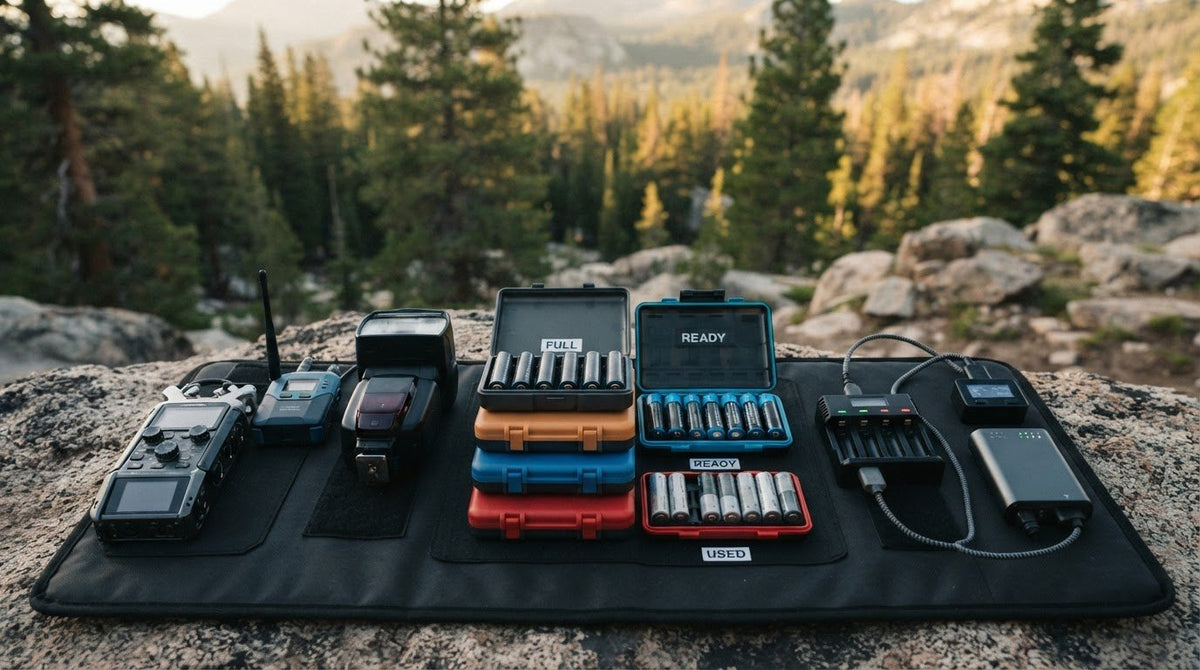
What if the AA cells with the highest capacity still aren’t right for your recorder or flash? Choosing high-capacity AA batteries for remote production gear isn’t only about runtime. A battery must also meet the device’s voltage and chemistry requirements, and an exhausted set at the wrong moment can interrupt a take or force an unplanned swap. Compatibility and a practical spare-cell plan matter just as much as capacity.
If you’ve been comparing battery ratings and wondering how many charged cells to pack, those are the right questions to ask. NiMH rechargeable AAs typically provide 1.2V, while alkaline batteries and some lithium-ion rechargeable AA options provide 1.5V. Your equipment’s requirements determine which chemistry is suitable. Runtime also varies by device and use, so a capacity rating alone can’t predict how long a battery will last on a shoot.
This guide explains how to match AA chemistry to production equipment, plan charged spares, and organize charging and rotation across multiple devices. It also covers how coordinated batteries, chargers, and storage can support a repeatable field workflow. Horizon Battery offers high-capacity rechargeable AA cells and charging options for professional setups.
Key Takeaways
- Match battery chemistry and voltage to each device’s requirements before prioritizing capacity.
- Use capacity ratings as a comparison point, not a promise of exact runtime in your equipment.
- Choose high-capacity AA batteries for remote production gear based on verified compatibility, charging needs, and how each device is used.
- Plan charged spares around your shoot schedule and access to charging, then track cell rotation to keep sets ready.
- Build a coordinated setup by pairing suitable rechargeable AA cells with compatible charging equipment and organized storage.
What Remote Production Gear Needs from High-Capacity AA Batteries
A remote shoot can put several devices to work for hours with no convenient place to recharge. If a battery runs low, the result may be a disrupted recording, an equipment swap, or a scramble through the kit for a charged set. Choosing high-capacity AA batteries for remote production gear starts with each device’s requirements, then turns to runtime planning and the charging workflow.
“High-capacity” describes rechargeable AA batteries promoted for storing more energy than lower-capacity options. It doesn’t promise a particular runtime or guarantee that a cell will suit every device. Chemistry affects characteristics such as nominal voltage and charging requirements. For an overview of AA battery chemistries, compare the basics with the specifications in your equipment documentation.
Which production devices commonly use AA batteries?
Depending on the model, wireless microphones, portable audio recorders, field monitors, and production accessories may use AA cells. Similar-looking gear can have different power requirements, so don’t assume a battery that fits one device is suitable for another. Check the manual and battery-compartment markings for the supported cell size, chemistry, and voltage. Use those requirements as the starting point for your kit.
Why field use changes the battery decision
Long shoot days and limited access to power make spare planning part of equipment preparation. A set that works for a short test may not cover a full day of recording or monitoring, especially when devices have different patterns of use. Estimate needs from your equipment and shooting schedule, and account for when and where you can recharge or exchange cells.
A battery’s capacity rating describes a specification under defined test conditions. It doesn’t tell you exactly how long that cell will run a particular microphone, recorder, or monitor. Results depend on the device and its operating demands. Compare specifications as a guide, then plan spares conservatively until you have experience with that battery-and-device combination.
Start with the equipment’s documented requirements. Confirm permitted chemistry, voltage, and size before comparing capacity or assembling a shared supply of charged spares. That order helps prevent a high-capacity cell from becoming an unsuitable field choice.
How Capacity, Chemistry, and Voltage Affect AA Battery Runtime
A capacity number can help narrow your options, but it can’t tell you how long a device will run in the field. When choosing high-capacity AA batteries for remote production gear, compare the rating alongside chemistry, voltage behavior, charging needs, and the equipment maker’s requirements.
What does AA battery capacity in mAh tell you?
Milliamp-hours (mAh) measure electric charge capacity under specified test conditions. Among compatible cells of the same chemistry, a higher mAh rating can indicate greater rated capacity. It isn’t a direct runtime figure: a recorder’s power demand may differ from a microphone’s, and actual results depend on the device and conditions of use.
Compare ratings carefully. Chemistry and test conditions affect what a number represents, so mAh values alone may not provide a like-for-like comparison across different battery types. Voltage also matters when considering energy. MIT’s guide to battery specifications explains terms such as capacity, voltage, and discharge rate that help put battery ratings in context. Don’t convert published capacity into exact operating hours unless the manufacturer provides a runtime figure for the specific device and use conditions.
NiMH or lithium-ion AA: what should production teams compare?
Start with the device maker’s stated chemistry and voltage requirements. NiMH rechargeable AA cells typically have a nominal voltage of 1.2V. Some lithium-ion AA options provide a regulated 1.5V output, but they aren’t universal substitutes for NiMH. The device’s permitted battery type and battery-compartment markings take priority over assumptions based on size or voltage alone.
For an approved option, compare rated capacity, output behavior, and charging method. NiMH cells require a compatible charger. Some lithium-ion AA designs use a different charging arrangement, so follow the battery manufacturer’s instructions. Keep cell types and charging workflows clearly identified in a shared kit to reduce mix-ups between devices and sets.
Actual runtime depends on the device, operating load, battery, and conditions. Use ratings to compare suitable cells, then refine your spare plan based on observed use rather than treating capacity as a runtime guarantee. For more chemistry context, read this professional lithium-ion AA guide. Horizon Battery’s high-capacity rechargeable AA batteries and charger-and-battery bundles support organized cell and charging workflows for production kits.
How to Compare High-Capacity AA Batteries for Your Production Kit
Compare cells in two stages: first rule out anything that doesn’t meet a device’s documented requirements, then weigh practical factors such as capacity, charger setup, and storage. This makes it easier to choose high-capacity AA batteries for remote production gear without treating one specification as a substitute for compatibility.
Which specifications deserve priority?
Start with physical AA size, voltage, and chemistry, then follow the device manufacturer’s battery guidance. Compare capacity ratings only among suitable cells, and consider the stated chemistry and test conditions alongside each rating. Battery University’s overview of key battery definitions can help clarify how specifications relate. After compatibility, consider whether the charger supports the cell type, how practical it is to keep enough charged spares, and how your team will store and identify them.
How should you match batteries to different devices?
Build a device-by-device matrix rather than assuming all AA-powered equipment has the same needs. Flag units with specific chemistry or voltage restrictions before choosing a shared battery and charger workflow. The table below is a comparison framework, not a compatibility guarantee. Use each device manual to complete it for your kit.
| Chemistry | Compatible devices | Capacity | Charging needs | Operational considerations |
|---|---|---|---|---|
| Rechargeable NiMH | Only equipment that permits NiMH cells | Compare documented mAh ratings for the specific cell | Use a charger designed for NiMH batteries | Track charged and used sets; keep spares organized |
| Rechargeable lithium-ion AA | Only equipment that permits that battery type and its voltage behavior | Compare the manufacturer’s stated capacity and measurement basis | Follow the battery maker’s specified charging method | Keep cells and charging instructions clearly identified for the team |
Don’t rank different chemistries by mAh alone or treat a capacity figure as an assumed runtime. If a specification isn’t published on a comparable basis, record it as unavailable rather than drawing a direct conclusion. For additional product-category context, see the Ansmann high-capacity battery guide.
Compatibility is a prerequisite; capacity helps refine the choice. Once each device’s permitted cells are clear, compare appropriate options and coordinate charging through a suitable AA battery and charger setup.
How to Plan Charged Spares and Battery Rotation for Remote Shoots
A reliable battery plan is built around the shoot, not a universal spare-cell count. Device mix, operating time, usage intensity, and access to charging all affect how many charged cells a team should bring. Use this process to turn your equipment history into a practical rotation plan for high-capacity AA batteries for remote production gear.
How many charged AA spares should a production team carry?
- Inventory the devices. Record each AA-powered unit, the number of cells it uses, and its documented battery requirements.
- Estimate use. Note expected operating periods, intensity of use, and any past battery changes for each device. Use production records when available.
- Allocate spares. Set aside charged cells by device or compatible group. Allow for longer or more demanding use, and reduce reliance on spares if charging or resupply will be accessible.
- Charge before departure. Use a charger suited to the exact battery chemistry and follow the battery and charger manufacturers’ instructions.
- Track rotation. Mark cells or sets as charged, in use, or depleted. After the shoot, record what was used and adjust the next plan based on actual experience.
A simple worksheet can keep estimates consistent without prescribing a fixed quantity:
- Device and cell requirement: record the unit and how many cells it takes.
- Expected use: note the shoot duration and likely operating intensity.
- Charging access: identify when charging is available during the session.
- Spare allocation: enter the charged sets assigned to that device.
- Actual use: log changes and remaining charged cells after the shoot.
Review the worksheet after each production day. A recorder used continuously may draw on the supply differently from an accessory used intermittently, so base allocations on each device’s real pattern rather than assuming a shared set will cover everything.
How can teams keep cells ready between sessions?
Use the same routine after every shoot: separate depleted cells from charged ones, charge them with chemistry-appropriate equipment, label their status, and return ready sets to designated storage. Keep different chemistries clearly identified, and follow manufacturer instructions for charging and storage. A consistent system helps every crew member identify which cells are ready to use.
For broader organization practices, see this guide to a professional battery storage and management system. Horizon Battery’s battery and charger options can be considered as part of a production workflow.
Choose a Horizon Battery Setup for Remote Production Gear
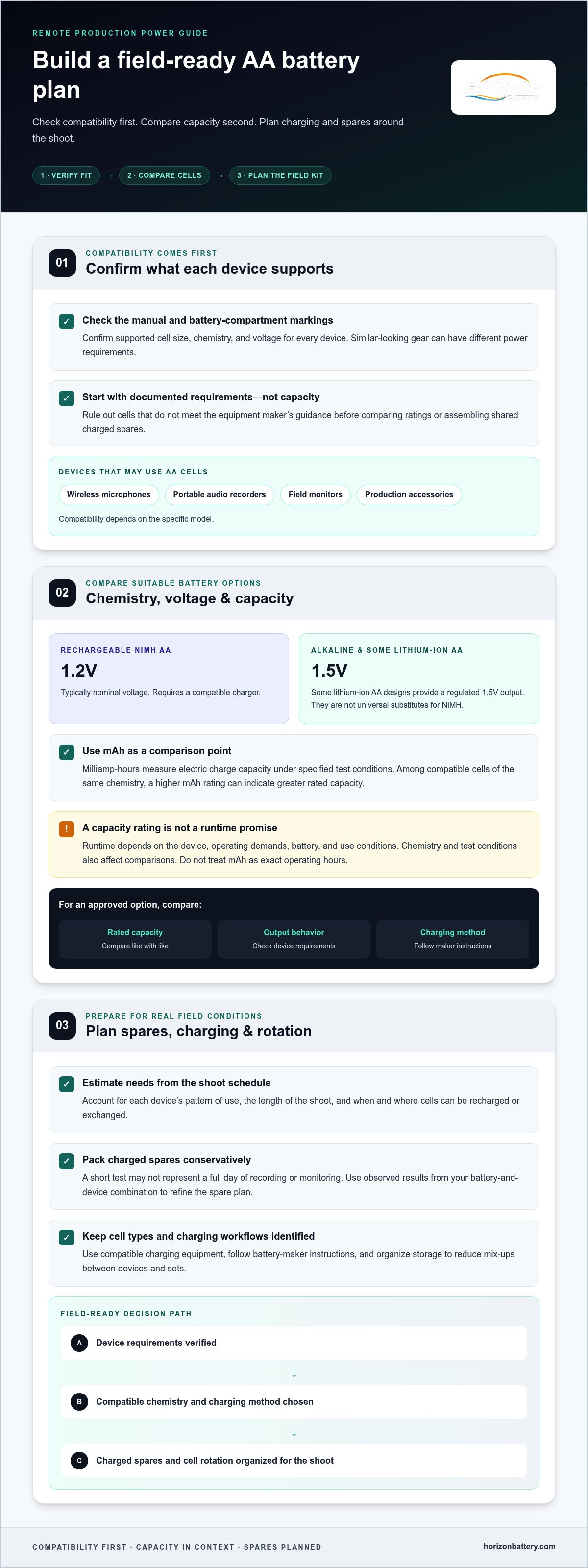
A production-ready battery setup follows a clear sequence: verify each device’s accepted battery size, chemistry, and voltage; compare cells that meet those requirements; then organize charging and charged spares around the shoot schedule. This keeps the decision grounded in equipment needs rather than capacity figures alone.
Horizon Battery offers high-capacity rechargeable AA batteries and charger/battery bundles, along with the Pure Power Series and custom rackmount chargers for professional setups. The right combination depends on your equipment and workflow. A bundle can bring cells and charging equipment together, but the battery and charger still need to suit the intended use. For larger charging arrangements, see the enterprise battery charging solutions guide.
Match the setup to the production workflow
- Several compatible devices, limited charging access: Select cells that meet each device’s documented requirements, then plan enough charged sets for expected use and practical swaps between charging opportunities.
- A small kit with regular access to power: A rechargeable AA battery and charger bundle may simplify purchasing and charging. Organize cells into labeled sets so the crew can identify ready and depleted batteries quickly.
- A larger, centralized charging setup: If the team manages many cells across repeated sessions, consider whether custom rackmount chargers and dedicated battery storage fit the equipment layout and rotation process.
These are workflow examples, not product-performance claims. Compare specifications for the specific cells and charging equipment, and follow the relevant manufacturer instructions. Don’t assume that one chemistry or charger works across every device in a production kit.
What to prepare before selecting a battery setup
Gather the information that makes the decision specific and repeatable:
- Device manuals and battery-compartment markings, including accepted cell size, chemistry, and voltage.
- Current specifications for the cells under consideration and the charger’s supported battery type.
- A device inventory, expected production schedule, and estimate of how intensively each unit will be used.
- Charging access during and between sessions, plus the team’s method for labeling and storing charged, in-use, and depleted cells.
Use those details to compare high-capacity AA batteries for remote production gear as part of a complete system, not as standalone cells. Horizon Battery offers rechargeable AA batteries and charging solutions for production workflows. Explore Horizon Battery’s rechargeable AA batteries and charging solutions.
Build a Battery Plan Your Crew Can Rely On
Choosing high-capacity AA batteries for remote production gear is a system decision. Start with each device’s documented requirements for size, chemistry, and voltage, then compare suitable cells without treating capacity as a promise of exact runtime. Plan charged spares around your equipment, the length of the shoot, and your access to charging.
A clear rotation routine helps keep charged, in-use, and depleted cells separate, while compatible chargers and organized storage support a consistent workflow. The setup should fit your gear and the way your team works in the field.
Horizon Battery offers high-capacity rechargeable AA batteries, charger bundles, the Pure Power Series, and custom rackmount chargers. Its product range supports different production charging and storage workflows.
Frequently Asked Questions
Are high-capacity rechargeable AA batteries suitable for wireless microphones?
They can be suitable if the microphone’s documentation permits the battery’s size, chemistry, and voltage. Wireless microphone systems vary, so don’t assume a rechargeable AA cell is compatible simply because it fits the compartment. Check the user manual and battery markings, then test an approved battery type in your normal workflow. Record actual use across sessions to help estimate charged spares for the equipment you operate.
How long do high-capacity AA rechargeable batteries last in production gear?
There isn’t one runtime that applies to every device or battery. Actual operating time depends on the equipment, its power demand, the battery’s chemistry and condition, and use conditions. A capacity rating can help compare compatible cells, but it isn’t a direct estimate of hours. For high-capacity AA batteries for remote production gear, use manufacturer runtime information when available and refine your plan with records from your own shoots.
Can I use lithium-ion AA batteries in any AA-powered device?
No. An AA form factor doesn’t guarantee that a lithium-ion cell is suitable for every AA-powered device. Lithium-ion AA designs can differ in voltage behavior and charging method from other rechargeable cells. Check the equipment manual for permitted chemistry and voltage, and follow the battery manufacturer’s instructions for charging. If a device specifies a particular battery type, treat that requirement as a compatibility limit, not a preference.
What does mAh mean on a rechargeable AA battery?
mAh means milliamp-hours, a measure of electric charge capacity under specified test conditions. It can help compare compatible batteries, especially when the chemistry and measurement basis are alike. A higher mAh rating doesn’t guarantee a particular runtime, since devices draw power differently and real operating conditions vary. Don’t convert the number directly into hours of recording or microphone use unless the equipment or battery maker provides a relevant runtime estimate.
How many spare AA batteries should I bring to a remote production?
Base the number on your device inventory, shoot duration, expected intensity of use, and access to charging or resupply. List each device and its cell requirement, estimate use from past sessions where possible, then assign charged spares accordingly. Keep a reserve for equipment that runs continuously or is critical to the shoot. Afterward, log what was used and adjust future allocations using your own production records.
Should a production team use one AA battery chemistry across all its gear?
Use one chemistry only if every device in the kit explicitly accepts it and the charging workflow suits those cells. A shared type can simplify labeling, charging, and spare management, but equipment requirements come first. Some devices may specify a chemistry or voltage that differs from the rest of the kit. Document each unit’s accepted batteries, keep incompatible cells clearly separated, and avoid mixing types within a device unless its manufacturer allows it.
How should rechargeable AA batteries be charged and stored between shoots?
Use a charger designed for the exact battery chemistry and follow both manufacturers’ charging and storage instructions. After each shoot, separate depleted cells from charged ones, label their status, and return ready sets to organized battery storage. Keep different chemistries identifiable to prevent mix-ups, and track which sets were used. For rechargeable AA batteries and charging solutions for your production kit, explore Horizon Battery’s options.