
What if the reason your wireless equipment fails at the most critical moment isn't a faulty cell, but a flawed management protocol? For production professionals and house of worship tech teams, the frustration of inconsistent runtimes is a costly disruption that drains both budgets and confidence. You likely already know that getting the most out of your rechargeable batteries requires more than just plugging them into a wall outlet; however, finding a repeatable workflow for a large fleet of high-capacity cells often feels like guesswork. When batteries die mid-performance or provide unpredictable power, the reliability of your entire technical setup is at risk.
This guide provides the professional protocols used by industry veterans to maximize the cycle life and performance of high-capacity NiMH cells. You will learn how to implement systematic charging, optimal storage techniques, and efficient rotation strategies using professional tools like the Pure Power Series and custom rackmount chargers. We will explore how a structured ecosystem of hardware and environment can transform your battery management from a source of anxiety into a predictable, cost-effective operation. By the end of this article, you will have a clear roadmap for achieving extended battery lifespans and ensuring your gear remains ready for every event.
Key Takeaways
- Understand the impact of Depth of Discharge (DoD) on cell health to maximize the total number of useful charge sequences.
- Implement scientific charging protocols, such as individual cell monitoring and negative delta V termination, for getting the most out of your rechargeable batteries.
- Mitigate self-discharge and capacity loss by managing environmental temperatures and maintaining the ideal state of charge during storage.
- Establish a professional "First-In, First-Out" (FIFO) rotation and labeling system to ensure predictable performance across your entire equipment fleet.
- Improve operational efficiency and eliminate technical clutter by integrating high-capacity cells with custom rackmount charging solutions.
Maximizing the Cycle Life of Professional NiMH Batteries
Cycle life represents the total number of useful charge and discharge sequences a cell can undergo before its capacity drops below a functional threshold. For production professionals, this metric is the cornerstone of getting the most out of your rechargeable batteries. While consumer-grade cells might boast high cycle counts on the packaging, those numbers often dwindle when subjected to the rigorous demands of wireless microphones and high-drain production gear. Understanding the difference between theoretical cycles and real-world performance is essential for reliable fleet management.
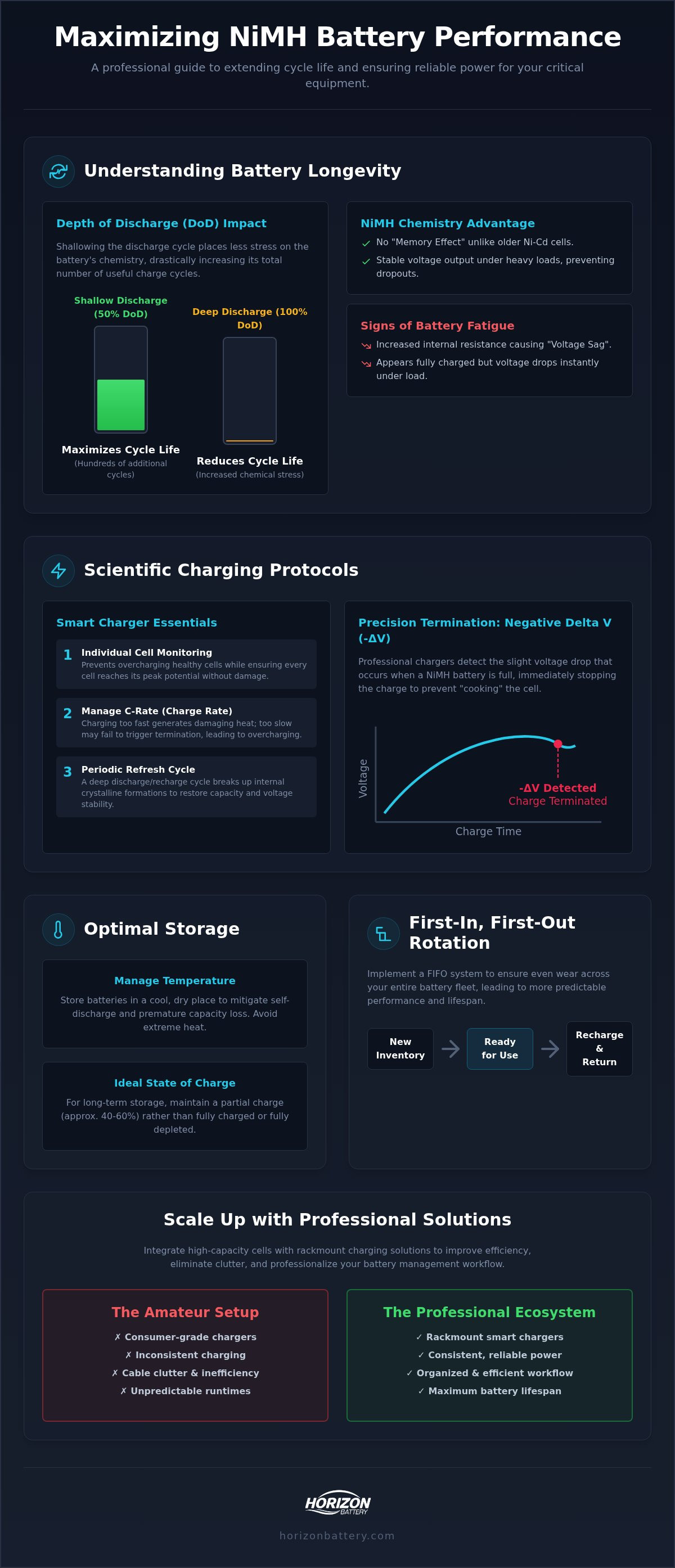
The Depth of Discharge (DoD) significantly influences this longevity. Discharging a battery to 100% of its capacity every time places more stress on the internal chemistry than shallower discharges. In professional settings, planning for a 50% to 80% DoD helps preserve cell health over the long term. It is also vital to distinguish between shelf life and cycle life. Shelf life refers to how long a battery remains viable while sitting in storage, whereas cycle life is about active service. A battery might have a five-year shelf life but only provide several hundred cycles if it's pushed to its chemical limits daily.
Understanding the NiMH Chemistry Advantage
Rechargeable battery technology has evolved, making Nickel-Metal Hydride (NiMH) the industry standard for mobile professional power. Unlike older Nickel-Cadmium cells, modern NiMH batteries don't suffer from the "memory effect" myth where partial discharges supposedly reduce total capacity. Their primary advantage lies in voltage stability. High-capacity cells, such as the Pure Power Series, are engineered to maintain a steady voltage under the heavy load of wireless systems. This prevents the sudden drop-offs that cause audio dropouts or equipment failure mid-performance.
Identifying the Signs of Battery Fatigue
Battery fatigue usually manifests as increased internal resistance. You'll often see this as "voltage sag," where a cell appears fully charged on a meter but the voltage drops instantly when it's placed into a high-drain device. This is a clear indicator that the cell's internal chemistry is degrading. Testing cells under actual operating loads, rather than using a simple voltage check, is the only way to accurately identify a battery nearing retirement. Recognizing these signs early ensures that inconsistent cells are removed from the fleet before they cause a failure during a critical event.
Implementing Scientific Charging Protocols for Maximum Capacity
Professional battery management requires more than just a power source. It demands a systematic approach to energy intake. Smart charging technology is non-negotiable for anyone serious about getting the most out of your rechargeable batteries. Unlike basic chargers that treat all cells as a single block, smart systems monitor each cell individually. This prevents overcharging healthy cells while attempting to fill a lagging one, ensuring every cell in your fleet reaches its peak potential without damage.
The primary mechanism for professional termination is the -ΔV (Negative Delta V) method. When a NiMH battery reaches full capacity, its voltage drops slightly. High-end chargers detect this specific signature and stop the main charge immediately. This precision prevents the chemical stress associated with "cooking" a battery. Managing the charge rate, or C-rate, is equally critical. Charging too fast generates excessive heat, while charging too slow may fail to trigger the -ΔV detection, leading to a dangerous overcharge condition.
Crystalline formations can sometimes develop within the cell chemistry, leading to reduced capacity over time. A periodic refresh cycle, which involves a deep discharge followed by a full recharge, helps break up these structures. It restores the active surface area of the electrodes and helps maintain voltage stability. Following battery care best practices ensures these technical protocols translate into real-world reliability for your production team.
The Dangers of Overcharging and Heat
Excess heat is the primary cause of premature failure in high-capacity AA rechargeable batteries. When a cell gets too hot, the internal pressure increases and the electrolyte can vent, leading to permanent capacity loss. Consumer wall-plug chargers often trap heat against the wall or within a small plastic enclosure. In contrast, professional equipment is designed for air circulation. Utilizing custom rackmount chargers allows for superior thermal dissipation, keeping cells within safe operating temperatures even during back-to-back charging cycles. Avoid the "trickle charge" trap; while a tiny maintenance current is fine for a few hours, leaving batteries on a charger for days can lead to plating and internal damage.
Establishing a Consistent Charging Schedule
Timing is everything in a professional environment. Ideally, you should complete your charging cycle as close to curtain time as possible to minimize the effects of natural self-discharge. Once an event ends, never leave your batteries depleted in a drawer. Storing a NiMH cell at 0% charge for weeks can lead to a state of deep discharge from which it may never recover. A top-off charge is a short, low-current charge applied immediately before an event to replenish any energy lost to self-discharge since the last full cycle.
Optimal Storage Conditions and Environmental Management
Storage is often an afterthought in the busy world of production, yet it remains a critical pillar of getting the most out of your rechargeable batteries. High-capacity cells are chemically sensitive to their surroundings. Temperature is the most significant external factor affecting this stability. When batteries are stored in hot environments, such as a touring van or a non-climate-controlled equipment room, internal chemical reactions accelerate. This leads to rapid self-discharge and, eventually, permanent capacity loss that no amount of charging can fix.
The ideal State of Charge (SoC) depends on your timeline. For mid-term storage where gear is used weekly, keeping cells at a higher charge is practical for immediate readiness. However, for long-term storage exceeding several months, a state of charge around 40% to 50% is the professional standard. This balance prevents the cell from falling into a deep discharge state while minimizing the chemical stress of a full charge. Humidity is another environmental variable that requires management. Excess moisture leads to oxidation on contact points. This increases electrical resistance and causes the voltage sag that disrupts wireless equipment performance. Keeping contacts clean and dry is as vital as the charge itself.
Cells that have been stored for extended periods may become "dormant." This doesn't mean they're dead; rather, the internal chemicals have stabilized in a way that resists rapid energy transfer. You can often recover these cells by performing two or three slow "break-in" cycles on a smart charger. This process wakes up the chemistry and restores the battery to its full operating capacity before it returns to active duty in your fleet.
The 'Cool and Dry' Standard
Professional storage requires a controlled temperature range between 50°F and 70°F. While some amateur guides suggest the refrigerator to slow self-discharge, this is a myth that introduces significant moisture risks. Condensation forms on the terminals and can even seep into the cell casing, leading to corrosion or internal short circuits. A dedicated equipment cabinet in a climate-controlled room is far superior. Always use specialized Battery Storage cases to organize your inventory. These containers prevent terminals from touching, which eliminates the risk of accidental discharge or thermal events during transport.
Managing Self-Discharge in High-Capacity Cells
High-performance cells like the Pure Power Series are engineered for the high-drain demands of wireless audio, but this design often results in a higher self-discharge rate. You should expect a typical loss of 1% to 5% of charge per day when stored at room temperature. This rate can double for every 18°F increase in temperature. Understanding this loss is essential for planning your "Ready-to-Use" inventory. While standard high-capacity NiMH cells provide the best runtime, keeping a small stock of Low Self-Discharge (LSD) varieties as emergency backups ensures you have functional power even if your primary rotation hasn't been charged in several weeks.
Professional Battery Rotation and Inventory Strategies
Managing a fleet of 100 or more cells requires a logistical strategy that goes beyond simple storage. The "First-In, First-Out" (FIFO) method is the professional standard for inventory management. This approach ensures that your oldest stock is used first, preventing any single batch from sitting dormant for too long. It's a fundamental part of getting the most out of your rechargeable batteries. By maintaining a steady rotation, you prevent chemical stagnation and ensure even wear across your entire fleet.
The Marriage of Cells: Keeping Sets Together
Voltage imbalance is a silent killer of equipment reliability. You should never mix new and old batteries in the same device, as the older cell will discharge faster and may even be "reverse charged" by the stronger cell. This leads to permanent damage and unpredictable runtimes. The solution is to maintain "married pairs" or sets. Use a permanent marker or small adhesive labels to group batteries into sets of two or four. These sets should live their entire service life together, from the first charge to final retirement. This ensures a balanced voltage discharge across all cells in a wireless transmitter, providing the most stable power curve possible.
Logging and Analytics for Large Organizations
For large facilities like churches or theaters, simple techniques for tracking performance can save thousands in replacement costs. Periodically conducting a bulk "cull" of the battery fleet ensures that weak links are identified before they fail on stage. The Capacity Test is the gold standard for fleet health, providing a precise measurement of how much energy a cell can hold under a specific load. Tracking these results in a simple spreadsheet allows you to spot trends and predict when a batch will need replacement. To streamline this process for large volumes of cells, many professionals integrate Custom Rackmount Chargers into their workflow to maintain order and data accuracy.
Scaling Performance with Professional-Grade Energy Solutions
Scaling a battery program requires moving beyond consumer-grade limitations. While the protocols discussed previously ensure longevity, the choice of hardware dictates the baseline of performance. Professional environments, such as live broadcast facilities and large houses of worship, cannot rely on standard retail cells designed for low-drain devices. Getting the most out of your rechargeable batteries at this level involves integrating specialized high-capacity cells and purpose-built charging infrastructure into the daily workflow. This transition ensures that the technical management of your fleet is supported by the physical capabilities of the hardware.
Transitioning from single-use alkaline batteries to a high-capacity NiMH system significantly reduces long-term overhead. A single professional cell can replace hundreds of alkalines over its service life; this eliminates the recurring cost and environmental impact of disposable power. While this shift requires a one-time investment in quality hardware, the operational savings and predictable runtimes provide a rapid return on investment for high-volume users. Specialized storage cases and organized charging stations further protect this investment, ensuring that cells are not lost or damaged during transport or storage. For those who apply this same standard of performance to their personal transport, you can check out Cooneys Bike Care for high-end electric bike solutions.
The Pure Power Series Advantage
The Pure Power Series is specifically engineered to meet the rigorous demands of high-drain wireless systems. Unlike consumer rechargeables that may struggle with voltage stability under load, these cells maintain a consistent output throughout the discharge cycle. This reliability is why professional audio departments trust them for high-stakes live events where a power failure is not an option. Production houses and churches report that using these specialized cells reduces the frequency of mid-show battery swaps, allowing technicians to focus on the performance rather than the power levels. These cells are designed for the high-intensity cycle life required in professional environments.
Streamlining with Rackmount Charging Drawers
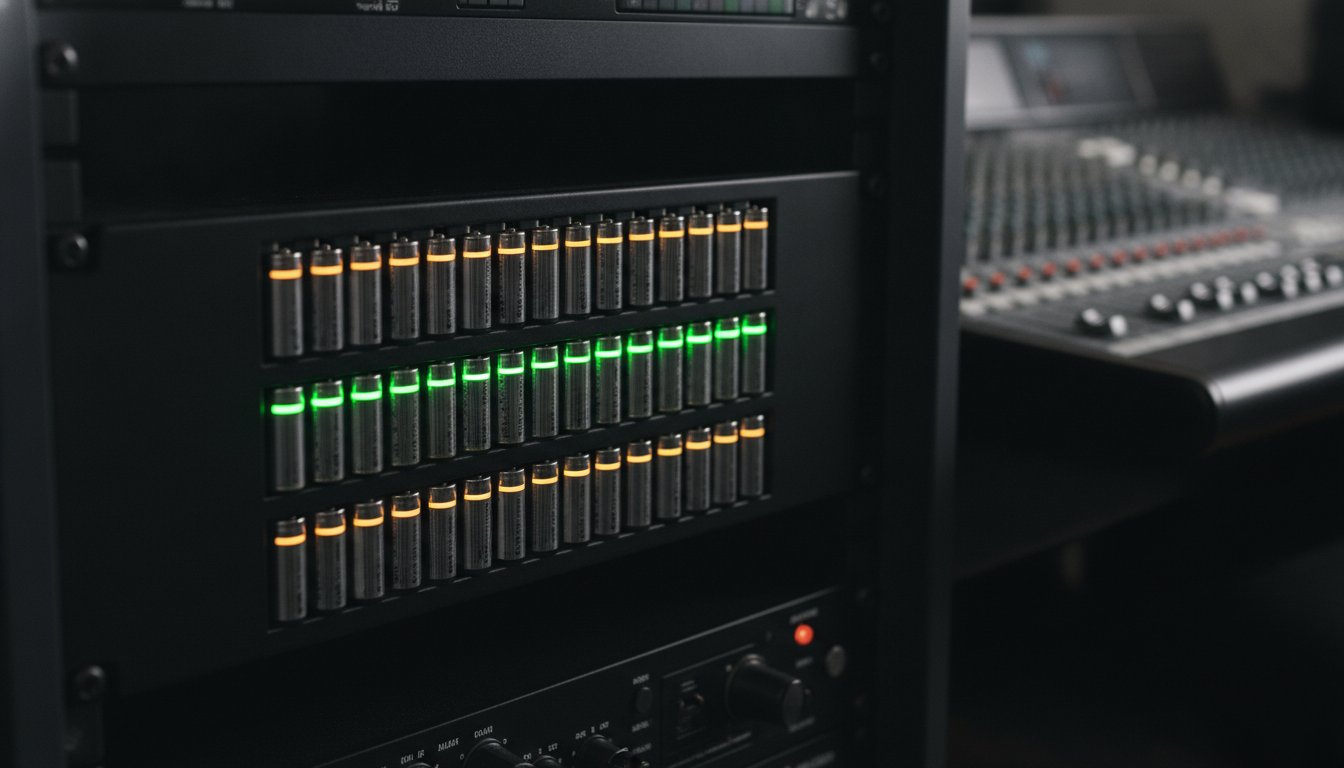
Managing dozens of individual wall-plug chargers creates a chaotic environment of tangled cables and unmonitored cells. Custom rackmount chargers solve this problem by centralizing power management into a single, organized location. These systems provide individual channel monitoring, allowing technicians to see the health and charge status of every battery at a glance. Explore our custom rackmount chargers to see how this hardware eliminates charger clutter and facilitates a more disciplined rotation. By integrating these drawers into a standard equipment rack, facilities can maintain a high-readiness state for their entire inventory while protecting their investment from the heat and physical stress common with consumer-grade chargers.
Standardizing Your Professional Power Workflow
Professional power management requires a transition from reactive maintenance to a systematic ecosystem of care. By implementing scientific charging protocols and a disciplined "First-In, First-Out" rotation, you ensure that every cell in your fleet performs with industrial-grade reliability. Predictable performance is about more than chemistry; it's about the specialized hardware and storage environments that protect your technical investment over hundreds of cycles.
Getting the most out of your rechargeable batteries is an ongoing process that reduces long-term overhead and eliminates the risk of mid-performance failures. Since 1998, churches and production companies have trusted our high-capacity cells specifically engineered for high-drain wireless systems. You can upgrade your facility with the Pure Power Series and Custom Rackmount Chargers at Horizon Battery to access custom-engineered rackmount solutions for streamlined operations. With these professional-grade tools and protocols in place, you can move forward with total confidence in your equipment's power supply.
Frequently Asked Questions
How many times can I actually recharge a professional AA battery?
Most professional AA NiMH batteries provide between 500 and 1,000 charge cycles under optimal conditions. Real-world performance in high-drain devices like wireless microphones often results in a lower practical cycle count. Factors such as depth of discharge and thermal management play a massive role in reaching these numbers. Consistently pushing a battery to its absolute limit will reduce the total number of useful sequences you can expect over its lifespan.
Is it better to charge batteries fast or slow for long-term health?
A moderate charge rate is generally the best approach for long-term cell health. Ultra-fast chargers generate excessive heat that can damage internal chemistry, while overnight slow chargers may fail to trigger the negative delta V termination. Smart chargers that utilize individual cell monitoring provide the ideal balance. This ensures the battery is filled efficiently without being subjected to the thermal stress that leads to premature capacity loss.
Do I need to fully drain my NiMH batteries before recharging them?
You don't need to fully drain modern NiMH batteries before every recharge. The memory effect associated with older technologies isn't a factor for the Pure Power Series or other professional-grade cells. In fact, shallow discharges are actually better for the chemistry. Periodically performing a full discharge and recharge cycle once every few months can help maintain capacity, but daily deep discharges will shorten the battery's overall cycle life.
What is the best temperature for storing high-capacity rechargeable batteries?
The ideal temperature range for professional battery storage is between 50°F and 70°F. Storing high-capacity cells in a cool, dry environment is essential for getting the most out of your rechargeable batteries by slowing down the natural self-discharge rate. Avoid extreme heat, such as in vehicles, and avoid the refrigerator. Moisture is a significant risk in cold storage and can lead to terminal corrosion or internal shorts.
How can I tell if a rechargeable battery is near the end of its life?
You can identify a failing battery by observing voltage sag during use. If a battery shows a full charge on your charger but drops significantly as soon as it's placed in a high-drain device, its internal resistance has likely increased. Using a capacity tester is the most accurate way to verify health. When a cell can no longer hold at least 80% of its original rated capacity, it's time for retirement.
Why do some batteries get hot during the charging process?
Batteries naturally generate some heat during the final stage of charging as the chemical reaction completes. However, excessive heat is usually a sign of an inefficient charger or a cell with high internal resistance. If a battery is too hot to touch comfortably, the charger is likely pushing too much current or failing to terminate the charge correctly. Professional rackmount systems manage this thermal energy much better than standard wall-plug units.
Can I mix different brands of rechargeable batteries in one device?
You shouldn't mix different brands, capacities, or ages of batteries in a single device. Each brand has a slightly different chemical composition and internal resistance, which leads to uneven discharge rates. This imbalance forces the stronger cell to work harder and can even cause the weaker cell to be reverse-charged. For the best results, always use matched sets from the same batch to ensure a stable voltage curve.
How long can I leave batteries in the charger after they are full?
It's best to remove batteries from the charger once the cycle is complete. While smart chargers switch to a low-current trickle charge to maintain capacity, leaving cells on a charger for days can lead to internal plating and reduced longevity. If you use a professional system, the monitoring lights will clearly indicate when the cycle is done. Removing them promptly ensures you are getting the most out of your rechargeable batteries by avoiding unnecessary stress.